Somebody types "how old is America" into Google — probably at 11 PM, probably while arguing with a friend, probably with a bag of chips in the other hand. Simple question. Should take five seconds. Except it doesn't, because the answer is 249 years, or 418 years, or maybe 15,000 years, depending on what you mean by "America" and what you mean by "old." That gap between the easy question and the complicated answer is where things get interesting. And in 2026, with the country hitting its 250th birthday, the timing matters more than usual.
249
Years Since Independence
418
Years Since Colonization
15,000+
Years of Native History
When Was America Actually Founded — And Why the Answer Depends on Who You Ask
Ask ten historians when America started and you'll get at least four different answers. That's not because historians are difficult people (though some are). It's because the question is genuinely slippery.
The date most Americans learned in school — July 4, 1776 — marks the Declaration of Independence. That's the birthday we celebrate, the one on the cake. If you want to see how that flag has evolved, exploring custom national flags gives you a sense of what different eras produced. But declaring independence and actually being independent are two different things. Britain didn't agree to let go until the Treaty of Paris in 1783. So were those seven years of Revolutionary War just... pre-America?
Then there's the Constitution, ratified on June 21, 1788. If you think of America as a system of government rather than a declaration of principles, that's your founding date. Before the Constitution, the country ran on the Articles of Confederation — a framework so weak that states were essentially running their own little countries with a shared post office.
Go back further. English settlers showed up in Jamestown in 1607, a full 169 years before anyone thought about declaring independence. Plymouth Colony followed in 1620. These weren't "America" yet, but they were the raw material.
And then there's the answer that makes the whole conversation feel a bit different: indigenous peoples have lived on this land for over 15,000 years. The Cahokia settlement near modern-day St. Louis had a larger population than London around 1100 AD. So when someone asks "how old is America," the honest response might be: older than you think, younger than the land deserves.
America Turns 250 in 2026 — What the Semiquincentennial Means
First, yes, there's an actual word for a 250th anniversary: semiquincentennial. Try saying that three times fast after your fourth of July hot dog.
On July 4, 2026, the United States turns 250 years old — counting from the Declaration of Independence, which is the starting line most people agree on even if historians argue about it. The America250 commission has been planning celebrations for years. The Freedom 250 White House Task Force is coordinating events. Philadelphia — ground zero for the whole founding — is putting together a time capsule. And organizers have promised what they're calling the largest pyrotechnics display in world history.
Here's what puts this birthday in perspective: the United States is a young country by almost any global standard. China traces its cultural history back roughly 4,000 years. Egypt's civilizational roots reach 5,000 years. The United Kingdom in its current unified form dates to 1707, making it only about 70 years older than the U.S. At 250, America is essentially a college graduate compared to civilizations that are retirement-age.
That youth matters. It shapes how Americans relate to their symbols — flags, anthems, monuments. Countries with thousands of years of history have layers of identity to fall back on. At 250, American identity still leans heavily on its founding documents, its origin story, and the physical symbols that represent those ideas. Expect 2026 to be the year when every front porch in the country gets a flag refresh — and picking the best outdoor American flag becomes a real decision.
The Timeline That Built a Nation — Key Milestones From Colony to Superpower
The distance from struggling colonies to global superpower took roughly 350 years if you start from Jamestown. That's fast by historical standards — absurdly fast, actually. Most empires take centuries just to figure out their borders. The flags that marked each milestone were shaped by available flag materials and printing methods of the era.
1607
1775
1775
Colonial Slow Burn
Jamestown nearly failed (the settlers ate shoe leather that first winter). Plymouth in 1620 barely survived either. For 150 years, British colonies grew along the coast — building, trading, and slowly getting annoyed at being taxed by a government 3,000 miles away.
1773
1783
1783
The Breakup
The Boston Tea Party in 1773 was the dramatic gesture. The actual Revolutionary War started in 1775 and dragged on for eight brutal years. Most people don't realize how close the whole thing came to failing — Washington's army spent the winter at Valley Forge literally freezing, and desertion was a constant problem.
1787
1803
1803
Building the Machine
The Constitution was written in 1787 — in secret, behind closed doors, during a hot Philadelphia summer with the windows shut so nobody could eavesdrop. Washington was inaugurated in 1789. The Louisiana Purchase in 1803 doubled the country's size overnight for about four cents per acre.
1861
1869
1869
Breaking and Rebuilding
The Civil War nearly ended the whole experiment. Then the Transcontinental Railroad in 1869 stitched the country back together physically in a way that politics alone couldn't.
1917
1969
1969
Global Stage
Two world wars, Hawaii becoming the 50th state in 1959, and a moon landing in 1969. In the span of a single human lifetime, the country went from regional power to putting footprints on another world.
How America Compares to Other Countries by Age
Country age comparisons are tricky because nobody agrees on the rules. Is it when the culture started? When the borders got drawn? When the current government took power?
Under the "current government" standard, the United States actually looks pretty old. The U.S. Constitution, ratified in 1788, is the oldest written national constitution still in active use. France is on its Fifth Republic — established in 1958. Germany reunified in 1990. Italy didn't exist as a unified country until 1861.
San Marino claims the title of oldest sovereign state, founded in AD 301. Ethiopia has maintained some form of sovereignty for over 2,000 years. Japan's imperial line stretches back centuries, though the modern constitutional government dates to post-WWII.
Key Distinction
The distinction that matters most: age of civilization versus age of state versus age of constitutional government. These are three completely different measurements.
China as a civilization is ancient — 4,000 years of continuous cultural identity. China as the People's Republic dates to 1949. That makes the U.S. government about 160 years older than China's current one.
So America is simultaneously one of the younger countries (by cultural history) and one of the older ones (by constitutional continuity). Both of those statements are true. Neither one is more correct than the other. The answer just depends on which yardstick you pick up. For organizations commemorating these milestones, a professional flag manufacturer can create historically accurate reproductions.
Why "How Old Is America" Is the Wrong Question — And What to Ask Instead
About 49,500 people search "how old is America" every month. That's a lot of late-night curiosity. But the question itself bundles together at least four separate things: a geographic territory, a political entity, a cultural identity, and a constitutional government. Each one gives you a different number.
Geographic Territory
The land mass has been here for billions of years. But that's obviously not what people mean.
Political Entity
If you mean "when did this specific nation-state start operating," then 1776 for the declaration or 1788 for the constitutional government.
Cultural Identity
That depends on whose culture you're counting. European colonists brought theirs starting in the 1500s. Indigenous civilizations had been building complex societies for millennia before that. The Clovis culture dates to roughly 13,500 BC. Cahokia — that massive settlement near St. Louis — peaked around 1100-1200 AD with an estimated 20,000 residents and sophisticated urban planning.
Norse explorers reached North America in the 10th century AD, about 500 years before Columbus. So even the "European discovery" narrative has a timing problem.
The better questions might be: What kind of country is a 250-year-old democracy? What does it mean to be this young and this powerful? How does a country with a relatively short history create such strong national symbols? Whether for event flags or historical displays, the answer partly lies in the flag itself.
Those questions don't have clean numerical answers. But they get closer to what people actually want to know when they Google "how old is America" at 11 PM with chips in hand.
Looking for historically accurate flag reproductions? From 13-star Betsy Ross flags to modern 50-star versions, contact our team for custom historical flag orders with expert design assistance.
How the Flag Tells America's Age Story — 27 Versions in 249 Years
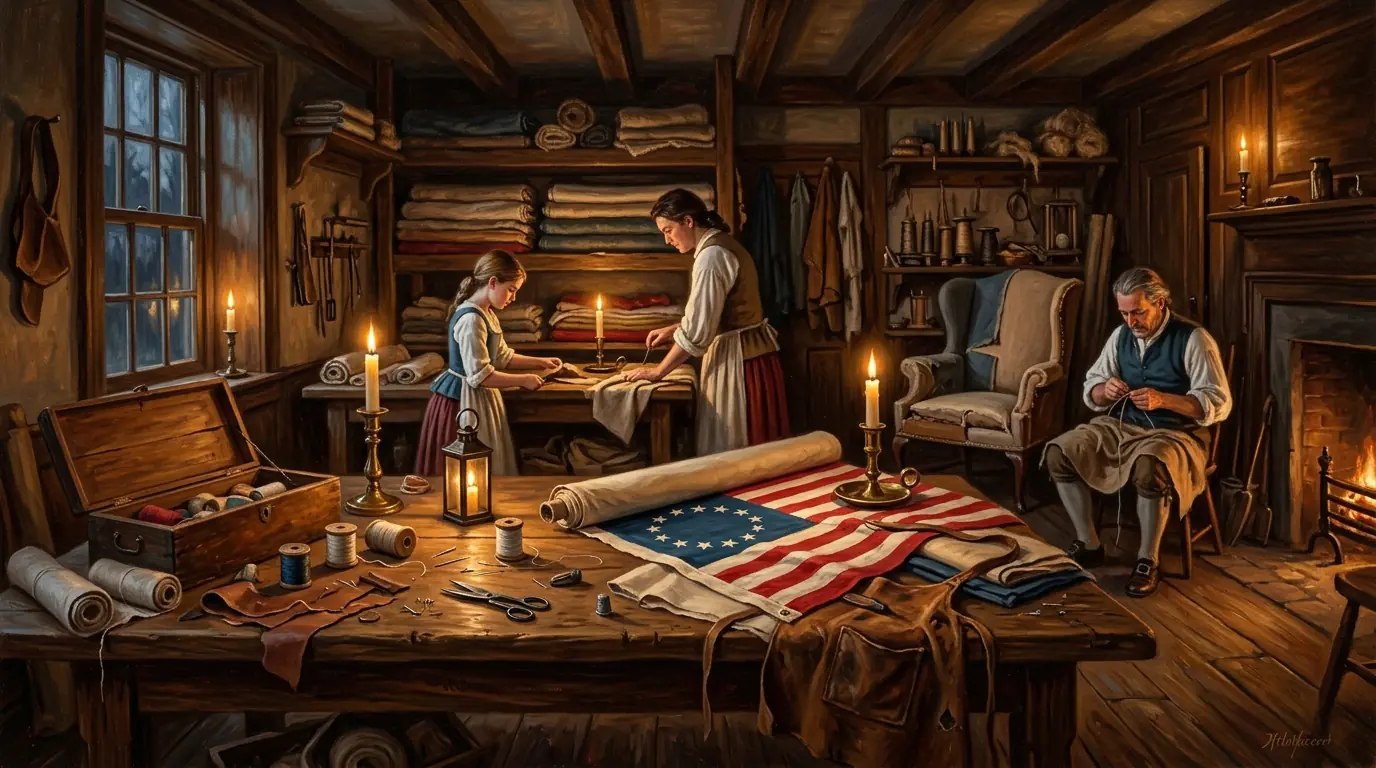
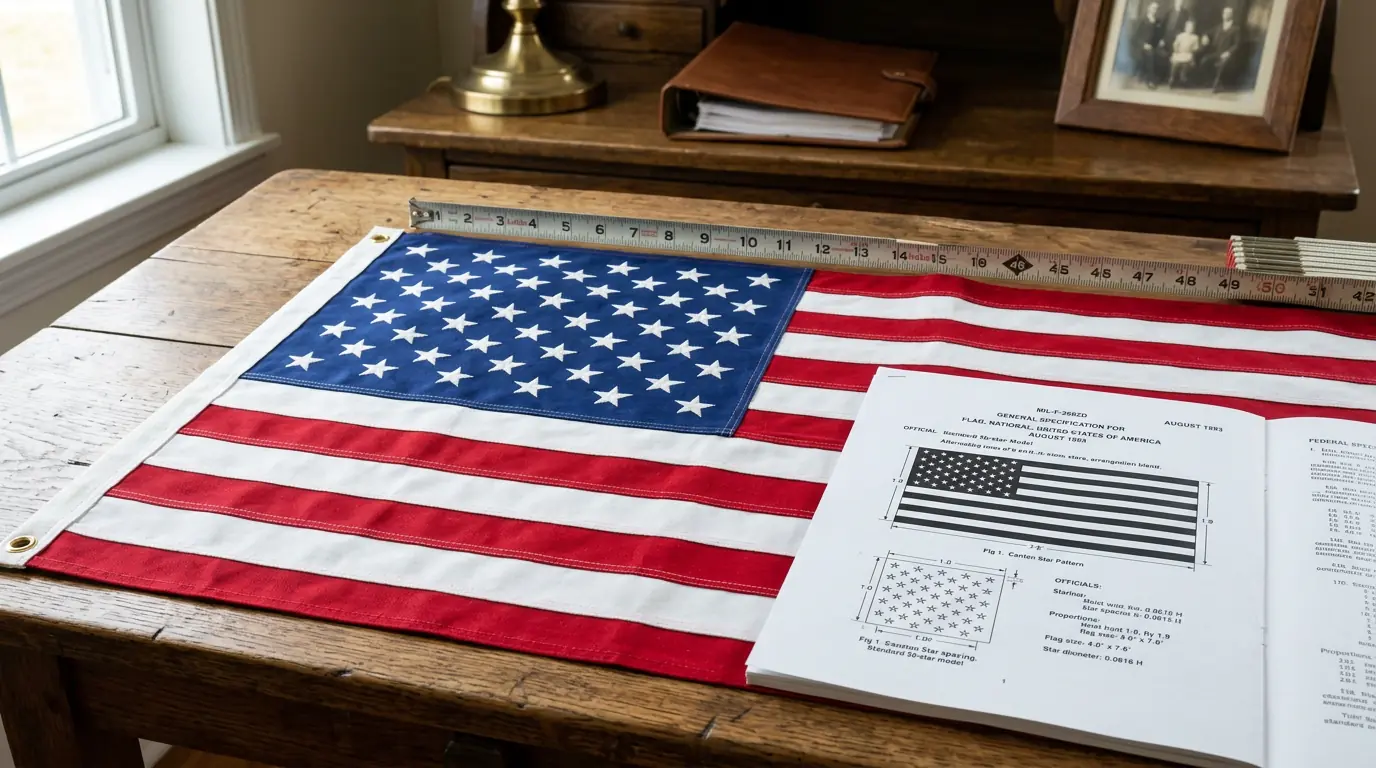
Here's a fact that surprises most people: there have been 27 official versions of the American flag since the first one was adopted on June 14, 1777. Twenty-seven. That's roughly one new flag every nine years across the country's history.
The first Flag Act established 13 stars and 13 stripes — one for each original colony. Simple enough. But as new states joined, the flag kept changing. For a while, they added both stars and stripes for each new state. By the time the flag had 15 stripes, it was starting to look cluttered. In 1818, Congress made the call to go back to 13 stripes permanently and only add stars going forward. Good design instinct. Understanding the ordering custom flags process today reveals how far production has come since those hand-sewn originals.
The current 50-star version has the best origin story of any flag in history. In 1958, a 17-year-old high school student named Robert G. Heft designed it as a class project. His teacher gave him a B-minus. Heft was annoyed, so the teacher made him a deal: get Congress to accept the design, and the grade goes up to an A. Heft mailed the flag to his congressman. It was selected from over 1,500 submitted designs and officially adopted on July 4, 1960. Today, getting a custom flag cost estimate is considerably easier than mailing one to Congress.
He got his A.
That flag — Heft's flag — has now been in service for over 65 years, making it the longest-serving version in American history. It's outlasted every other design by decades.
There's something fitting about the flag being a living record of the country's growth. Every star represents a moment when the map changed. The 27 versions are essentially 27 chapters of expansion, conflict, and compromise. You can read the country's age not just in years since 1776 but in the number of times its most recognizable symbol had to be updated.
With the 250th anniversary approaching in 2026, the flag becomes the visual centerpiece of the celebration — the one object that connects the founding story to every addition, every state, and every era since.
Conclusion
The Bottom Line
America is 249 years old in 2025, turning 250 on July 4, 2026 — if you're counting from the Declaration of Independence. It's 237 if you count from the Constitution. It's 418 if you start at Jamestown. And it's thousands of years old if you count the indigenous civilizations that were here first.
The real answer is that America's age depends on what story you want to tell. The founding documents story, the colonial story, the indigenous story — they're all legitimate, and they all give different numbers.
What's not debatable: the 250th anniversary is going to be significant. For a country that takes its symbols seriously — and few countries take their flag more seriously than the United States — 2026 is a year to mark. Whether you're flying a historical 13-star Betsy Ross flag, the current 50-star version, or a custom flag that represents your own piece of the American story, the semiquincentennial is the kind of milestone that calls for something on the flagpole — whether that means durable outdoor flags built to last or a custom commemorative design. You can always request a quote for your own 250th anniversary flag.
The kid who got a B-minus on his flag design would probably appreciate that.
Video Guide
Related Articles