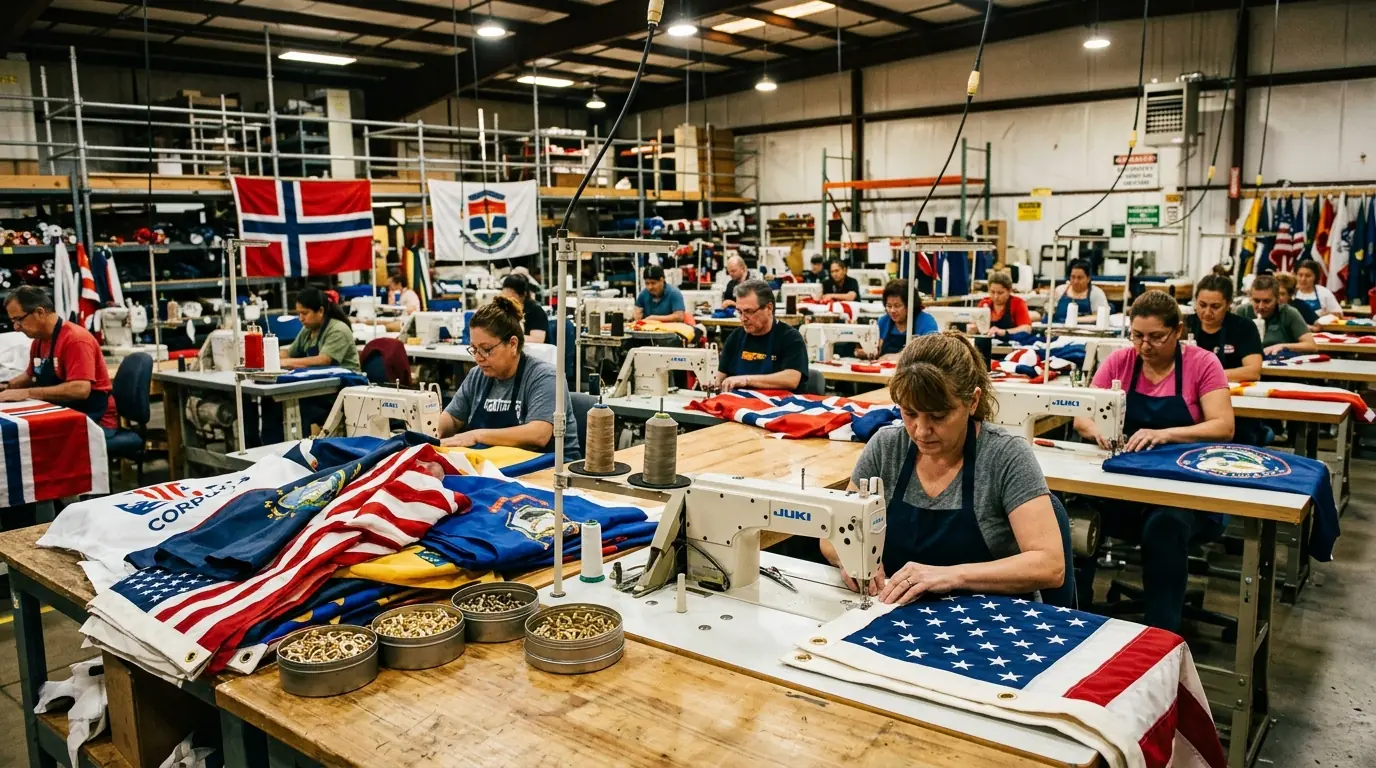
You ordered an American flag online. The listing said "Made in USA." The packaging had stars and stripes all over it. But when you pulled it out of the bag, the stitching looked thin, the colors seemed slightly off, and a loose thread was already hanging from the fly end. Something felt wrong — and you're not sure how to confirm whether what you bought was actually manufactured domestically or just marketed that way.
American flag manufacturing standards exist across several layers — federal procurement specs, industry certifications, trade law, and FTC labeling rules. The problem is that none of these systems talk to each other cleanly, and none of them were designed to protect a retail buyer standing in a store or scrolling through Amazon. Understanding which standards matter, what they actually require, and how to verify compliance is the difference between buying a flag that lasts and buying one that's a counterfeit wrapped in patriotic branding.
What Federal Specification DDD-F-416 Actually Mandates
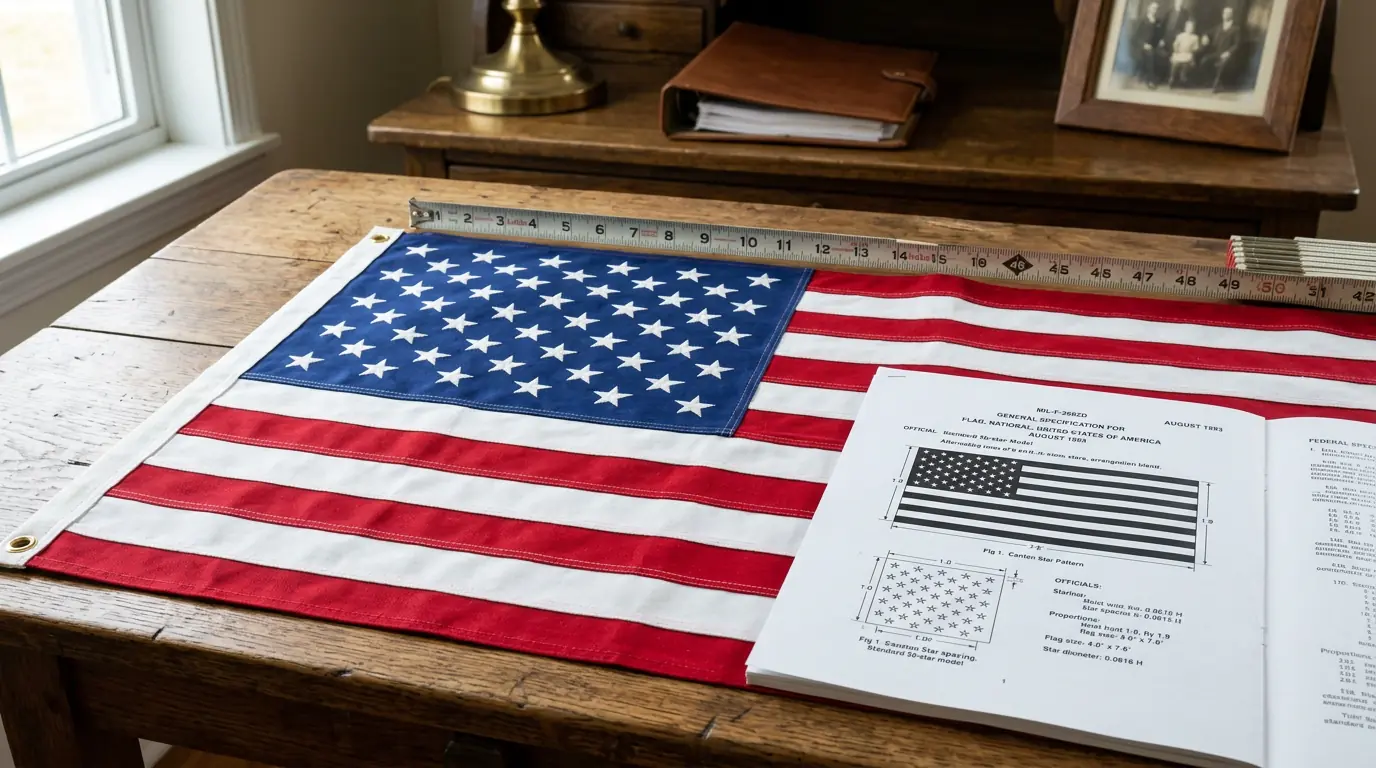
Most people searching for American flag manufacturing standards expect a single, clean rulebook. What exists instead is a federal procurement spec — DDD-F-416F, last revised in March 2005 — that was never written for consumers. It was written for government buyers placing bulk orders through GSA and DLA channels.
The spec covers what you'd expect: 13 stripes, 50 stars arranged in 9 alternating rows, proportions based on Executive Order 10834 from 1959. It also mandates Old Glory Red and Old Glory Blue color values, minimum 200-denier nylon for standard outdoor flags, and specific construction details for burial casket flags.
Key Distinction
DDD-F-416F is a procurement standard, not a retail certification. No one checks whether the flag you buy at a hardware store meets it. A manufacturer can claim "meets federal specifications" on their packaging without any third-party verification. The spec itself has no consumer enforcement mechanism — it only governs what the government accepts when it buys flags for federal use.
So if a brand says "meets federal spec" and prices their 3x5 flag at eight dollars, that claim is essentially unverifiable at the point of sale. The spec matters enormously for military and government procurement. For retail buyers, it's background knowledge — useful for understanding what a properly made flag should look like, but not something you can rely on as proof of quality.
FMAA Certification: The Consumer-Side Standard That Actually Matters
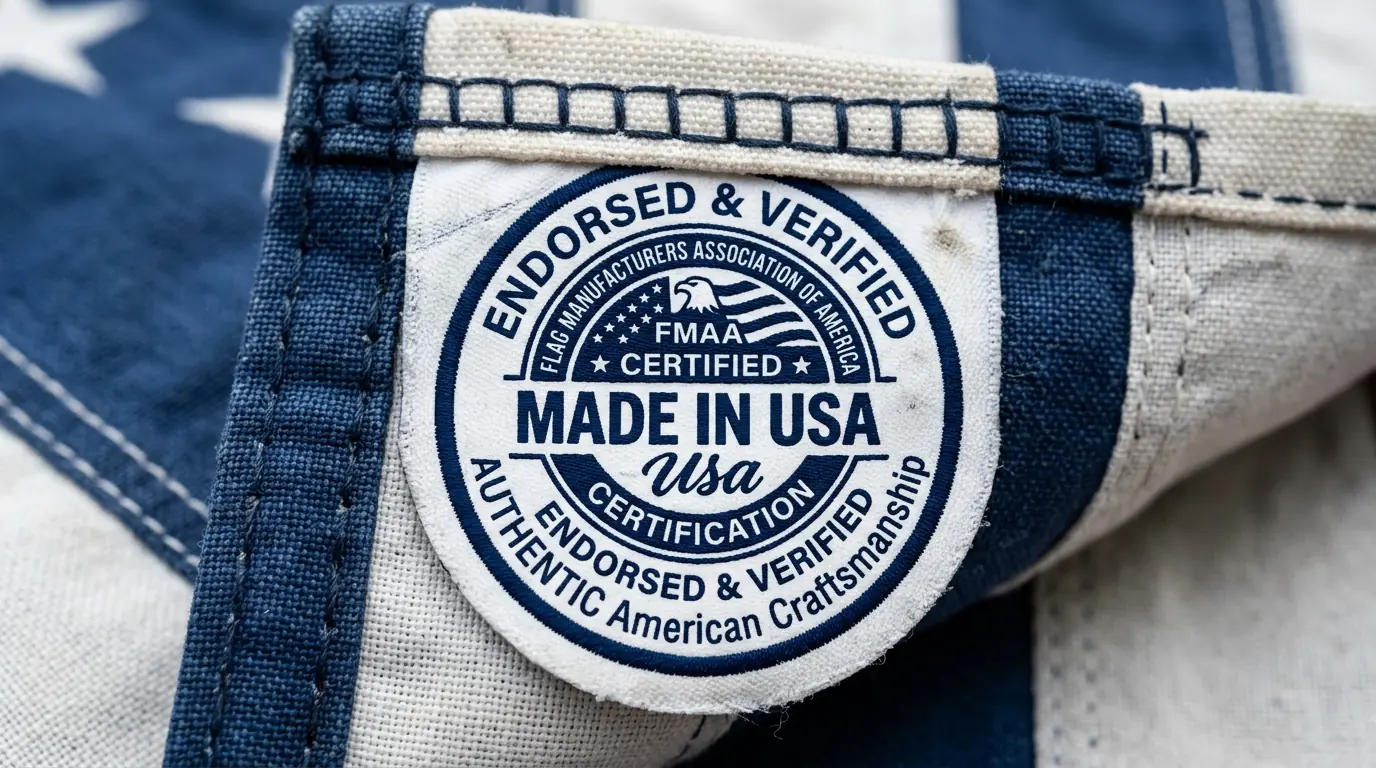
The Flag Manufacturers Association of America was founded in 2003 specifically because the federal spec wasn't solving the consumer problem. imported flags were flooding the market with "Made in USA" labels, and there was no retail-facing verification system.
FMAA's "Certified Made in the USA" program is the closest thing to a consumer trust mark in this industry. Around six manufacturers currently hold the certification — Annin Flagmakers, Valley Forge Flag, Eder Flag, and a few others. The certification seal on the flag's header or packaging means the manufacturer has been verified as producing domestically, with materials sourced and assembled in the United States.
That said, FMAA certification has limits worth understanding. The association is small and industry-funded. It is not a government body and has no regulatory enforcement power. Membership is voluntary, which means a legitimate domestic manufacturer who simply hasn't joined FMAA won't carry the seal. Absence of the seal doesn't automatically mean foreign-made — but its presence is a strong positive signal.
The more practical value of FMAA is its role in documenting counterfeits. The association has been tracking Chinese-manufactured flags sold as "Made in USA" on Amazon for years. One well-documented case involved flags with American-sounding brand names, US warehouse addresses, and "Made in USA" claims that turned out to be entirely manufactured overseas. FMAA worked with FTC to flag these sellers, but enforcement has been slow.
If you're buying for an organization, a school, or a government-adjacent purpose, asking specifically for an FMAA-certified flag cuts through most of the noise.
The Berry Amendment: Why Military-Grade Flags Clear a Higher Bar
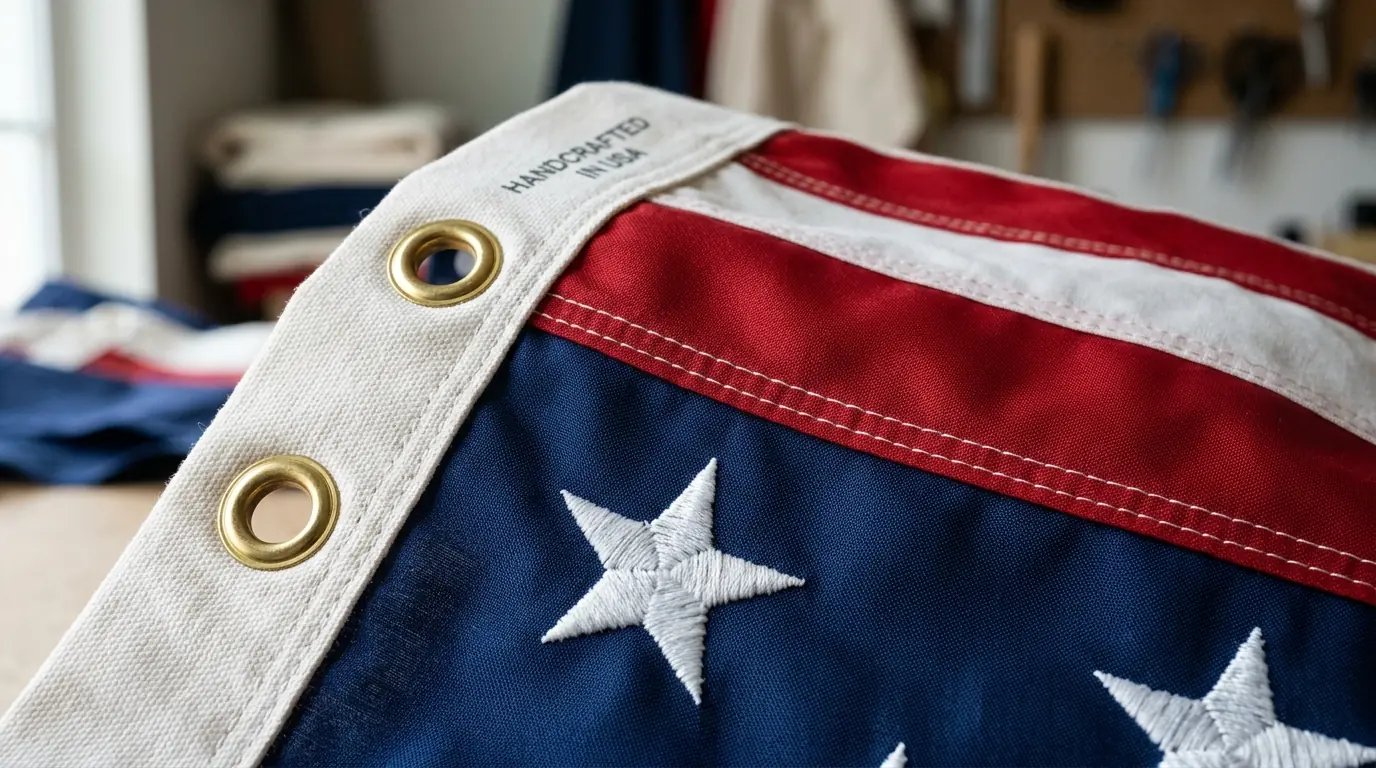
The Berry Amendment — codified at 10 USC §4862 — requires that textiles purchased by the Department of Defense be 100% domestically sourced and manufactured. This applies to flags bought for military use when the contract exceeds roughly $150,000, governed by DFARS clause 225.7002.
Berry Amendment Standard
This is a stricter standard than the general Buy American Act, which allows for some foreign content. Under Berry, even the thread, dye, and fabric must originate in the US. Not just assembled here — made here, from raw material forward.
For civilian buyers, the Berry Amendment isn't directly relevant. You can't walk into a store and demand a "Berry-compliant" flag unless you're working with a DoD supplier. But it serves as a useful benchmark. If a manufacturer supplies flags to the military, they've already cleared a supply chain audit that most retail flag sellers would never pass. Annin and Valley Forge both hold DoD contracts, which is one reason they tend to cost more than the generic brands you see on Amazon.
The Make American Flags in America Act, introduced in Congress, would extend Berry-like requirements to all flags purchased with federal funds. It hasn't passed yet, but the fact that it keeps getting reintroduced tells you something about the gap between military procurement standards and what the rest of the market tolerates.
Construction Quality Signals: How to Read a Flag's Physical Build
Forget the label for a moment. The physical construction of a flag tells you more about where and how it was made than most marketing claims.
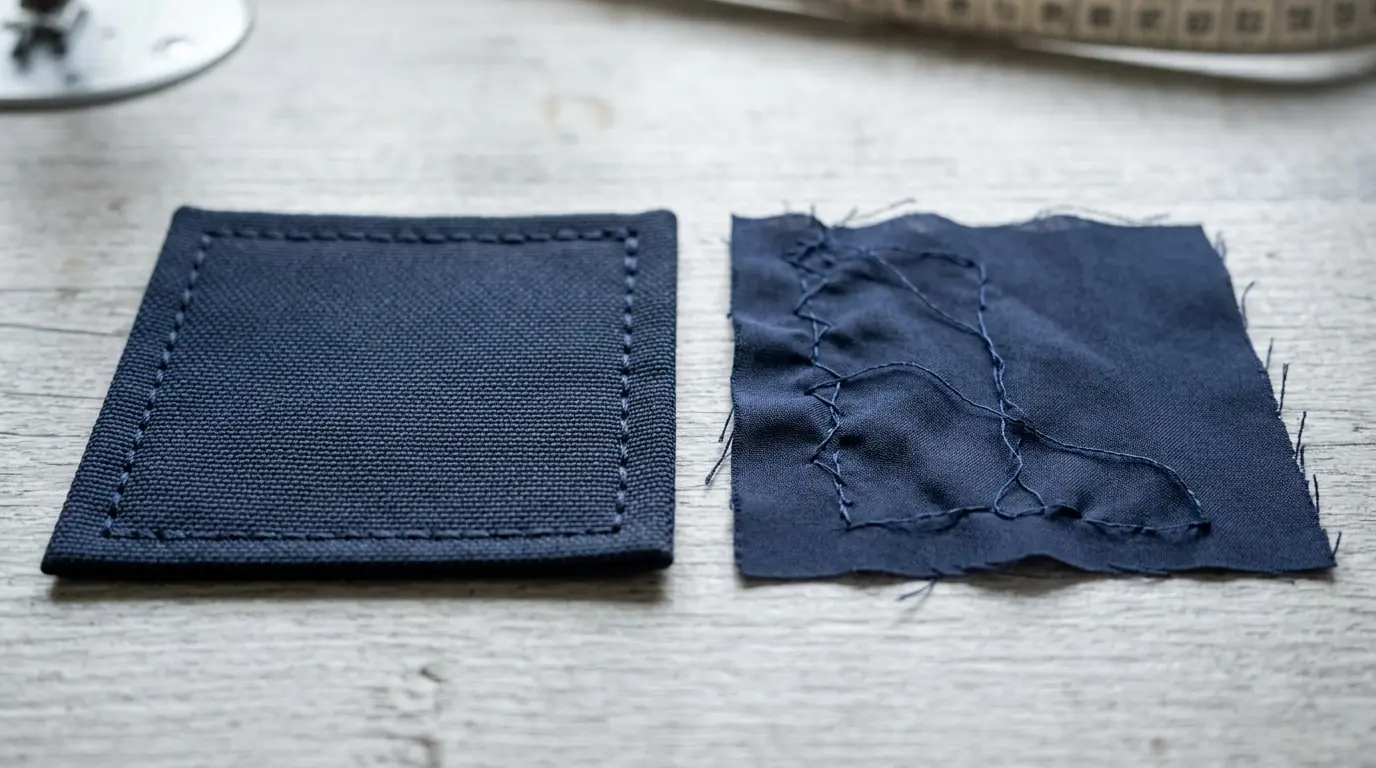
Start with the seams. Domestic manufacturers almost universally use lock-stitched flat-felled seams — the fabric edges are folded over and stitched through multiple layers. Cheaper imported flags typically use serged edges, which look finished but unravel faster under wind stress. A four-row lock stitch on the fly end (the side that takes the most beating) is standard on quality flags. If the fly hem is single-stitched or serged, the flag was built to a price point, not a durability standard.
Stars are another giveaway. Embroidered or appliqued stars on a sewn flag indicate a higher manufacturing investment. Printed stars on nylon aren't necessarily bad — plenty of legitimate US-made flags use dye sublimation — but the print quality matters. Fuzzy edges on star points, uneven white fields, or visible bleed-through on single-reverse flags suggest lower-quality production.
Material choice is straightforward. 200-denier nylon is the standard for outdoor residential flags. Heavier 210-denier polyester works better for high-wind commercial installations. The header — the reinforced strip where grommets attach — should be canvas duck or heavy synthetic, not thin nylon folded over. Grommets should be solid brass, typically #2 size, not plated steel that rusts after one season.
The proportions should follow the 1:1.9 ratio specified in federal standards. A 3x5 flag should measure close to 36 by 60 inches. Cheap imports sometimes cut corners on dimensions — literally — producing flags that are slightly undersized to save material. It's a small thing, but it's the kind of detail that separates a manufacturer following specs from one eyeballing it.
FTC Made in USA Labeling Rule: What the Law Actually Requires
The Federal Trade Commission finalized its Made in USA labeling rule in August 2021 under 16 CFR Part 323. The standard is "all or virtually all" — meaning the product must be substantially manufactured in the United States, with all significant processing and the majority of materials originating domestically.
This is a higher bar than most consumers realize. A flag sewn in South Carolina from Chinese nylon with Chinese thread doesn't qualify as "Made in USA" under FTC rules, even though final assembly happened domestically. The "all or virtually all" standard means the fabric, the stitching materials, the dyes, and the finishing all need to be US-sourced for an unqualified Made in USA claim.
Qualified claims — like "Assembled in USA from imported materials" — are legal and actually more honest than what many sellers use. The problem is that qualified claims don't sell as well, so sellers stretch their language. "Proudly American" or "American Quality" aren't regulated claims and mean nothing legally.
Enforcement was set to ramp up with potential civil penalties starting in July 2025. The FTC has the authority to fine companies making false Made in USA claims, but historically, enforcement in the flag market has been complaint-driven rather than proactive. FMAA and NIFDA (National Independent Flag Dealers Association) have submitted documentation of non-compliant sellers, particularly on Amazon and other online marketplaces, but the pace of action has been slow relative to the scale of the problem.
Key Takeaway
"Made in USA" on a flag is only as trustworthy as the seller behind it. Without FMAA certification or a known manufacturer name, the label itself proves very little.
Material and Durability Testing Standards
If you want to go deeper than visual inspection, the testing standards behind flag materials give you a framework for evaluating competing products — though few retail buyers will ever request test data directly.
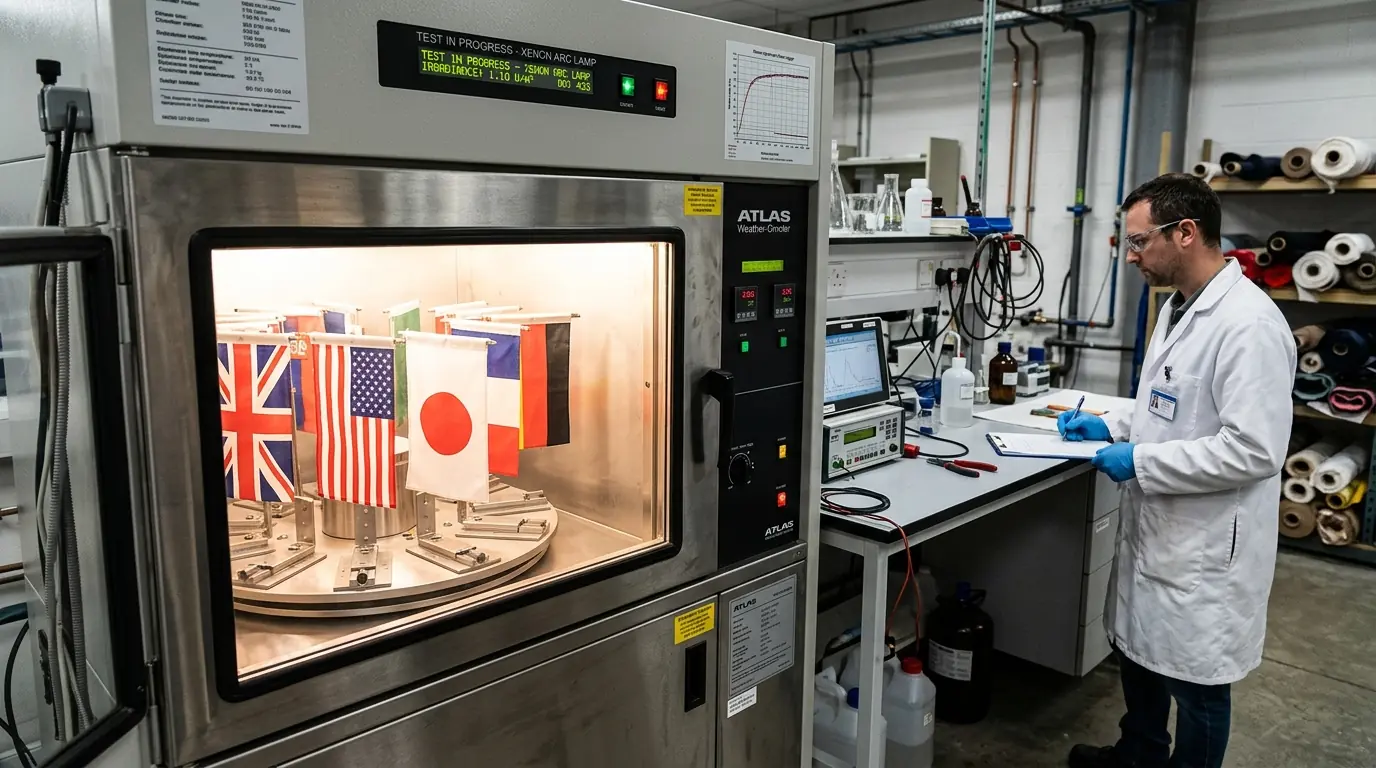
Colorfastness is tested under ISO 105-B01/B02 and AATCC 16.3, using a blue wool reference scale from 1 to 8. A rating of 4 or above is considered acceptable for outdoor flags. Solution-dyed nylon — where color is embedded during fiber production — generally outperforms surface-dyed fabric, which is printed or dipped after weaving. This distinction matters most in southern states or high-UV environments. A surface-dyed flag in Arizona might fade noticeably in a single summer. Solution-dyed nylon from the same manufacturer could last two to three seasons before showing significant color loss.
Break strength for flag-grade nylon runs around 175 pounds in the warp direction and 152 in the fill, per federal spec requirements. These numbers matter primarily for commercial and institutional flags that fly 24/7. For a residential flag that comes down in storms, break strength is less of a deciding factor than UV resistance and seam quality.
175 lbs
Warp Break Strength
152 lbs
Fill Break Strength
4+
Min. Colorfastness Rating
Grommets should meet NASM standards for corrosion resistance. Brass is the default for a reason — it doesn't corrode the way plated steel does when exposed to rain and humidity. The fabric weight for heavy-duty outdoor flags typically runs around 32 ounces per square yard for polyester. Nylon flags are lighter by design, which is why they fly better in light winds but don't hold up as well in sustained high-wind conditions.
None of this testing data appears on retail packaging. But if you're purchasing in bulk for an organization, asking the manufacturer for their test certifications — or at minimum, whether their nylon is solution-dyed — separates a real manufacturer from a reseller who couldn't answer that question if they tried.
Pro Tip: For bulk orders of 100+ flags with verified material certifications,
contact our team for factory-direct pricing and test documentation.
Spotting a Fake Made in USA Flag: A Practical Decision Framework
Price is your first and most reliable filter. A genuine domestically manufactured 3x5 nylon flag costs between $25 and $45 at retail, depending on construction quality and brand. If you're looking at a "Made in USA" flag for $8 to $12, the economics don't work. US-made nylon, domestic labor, brass grommets, and proper stitching have a floor cost that simply can't produce a finished flag at that price point.
Genuine Made in USA
$25 - $45
3x5 nylon flag, domestic materials, brass grommets, lock-stitched seams
Likely Imported
$8 - $12
Below production floor cost, serged edges, plated grommets, questionable origin
Several brands that dominate Amazon search results — Anley, G128, VSVO, VIPPER — are not domestic manufacturers. They ship from US warehouses, which is enough to confuse buyers who equate "Ships from USA" with "Made in USA." These are different claims with completely different meanings. A flag manufactured in China, shipped in bulk to a New Jersey warehouse, and Prime-delivered to your door is not a Made in USA product regardless of what the listing implies.
For verification, the FMAA maintains a list of certified manufacturers at fmaa-usa.com. If a brand isn't on that list, it doesn't necessarily mean the flag is imported — but it does mean the manufacturer hasn't submitted to independent domestic production verification. For most buyers, sticking with FMAA-certified brands is the simplest path.
Amazon Red Flags to Watch For
- Listings that emphasize "American-owned company" without saying where the flag is made
- Product photos that look identical across multiple brand names (suggesting white-label imports)
- Seller profiles with hundreds of unrelated products — flag sellers who also sell phone cases and yoga mats are resellers, not manufacturers
If you're buying for a VFW post, a municipal building, or a memorial, call the flag manufacturer directly. Annin, Valley Forge, and Eder all have customer service lines and can tell you exactly where a specific flag was made. That ten-minute phone call gives you more assurance than any amount of label-reading on a marketplace listing.
Your Next Move
If you've already bought a flag and you're questioning its origins, flip it over. Check the header for a manufacturer name — not a brand name, a manufacturer name. Look at the seam construction on the fly end. Feel the grommet weight. If the flag cost less than $20 for a 3x5 and the seller name doesn't match any FMAA-certified manufacturer, the odds are heavily against it being domestically made, regardless of what the label says.
If you haven't bought yet, the decision framework is simpler than the standards themselves suggest. Buy from Annin, Valley Forge, Eder, or another FMAA-certified manufacturer. Expect to pay $25 to $45 for a standard 3x5 outdoor flag. If someone tells you that's too much for a flag, remind them that the alternative is a Chinese import wrapped in American marketing — and there's nothing patriotic about that.
For institutional buyers — schools, VFW posts, municipal buildings — request Berry Amendment compliance documentation or FMAA certification directly from the supplier. Don't rely on marketplace listings. A five-minute call to the manufacturer's customer service line will tell you everything the label can't.