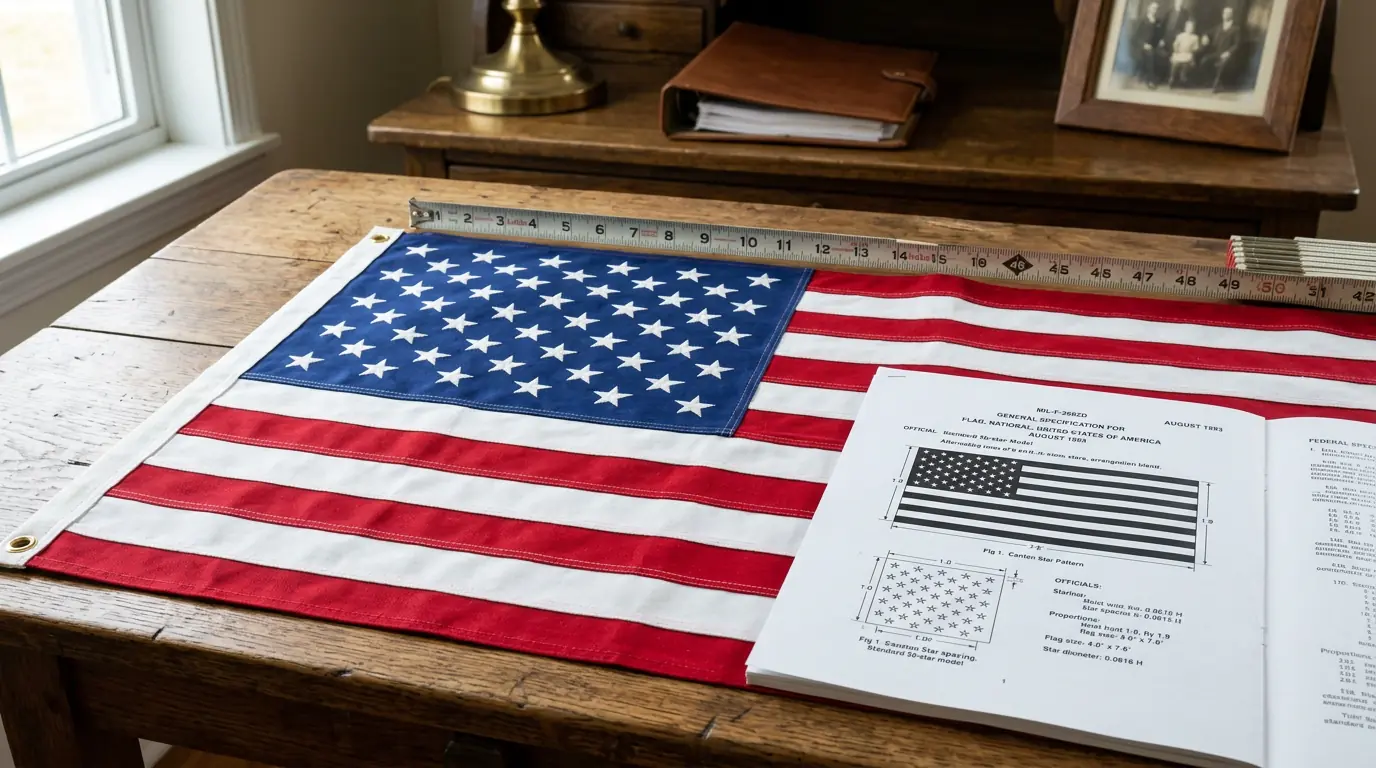
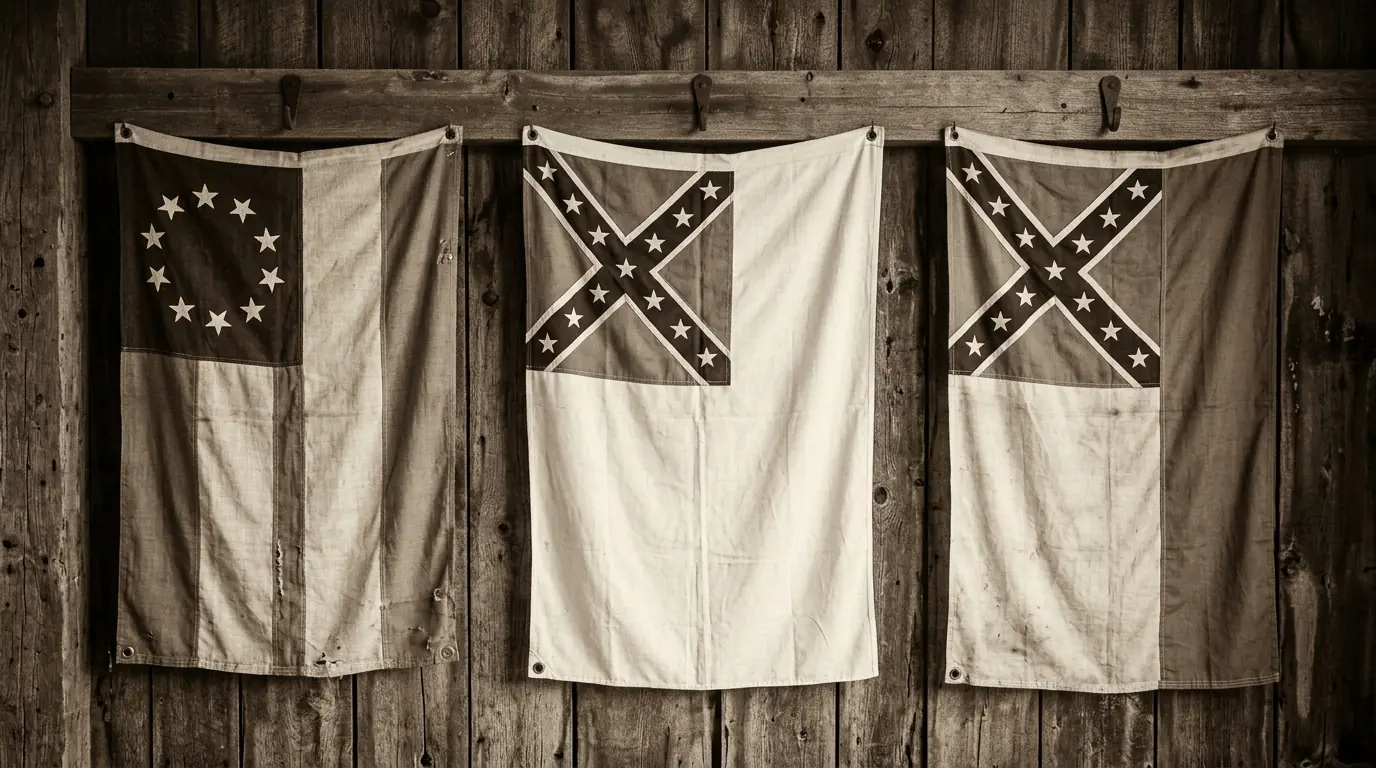
Most Americans learn the Betsy Ross flag story in grade school: George Washington walked into a Philadelphia shop, handed a seamstress a sketch, and she sewed the first American flag. It is a clean, simple origin story. It is also almost certainly not true — at least not the way we tell it. The real history behind who made the first American flag involves disputed claims, missing records, and a congressional delegate whose paper trail is stronger than anything the Ross family ever produced. The betsy ross flag remains one of the most recognized symbols in American history, but separating what we know from what we want to believe takes some honest reckoning with the evidence.
The Betsy Ross Legend — What Her Grandson Claimed in 1870
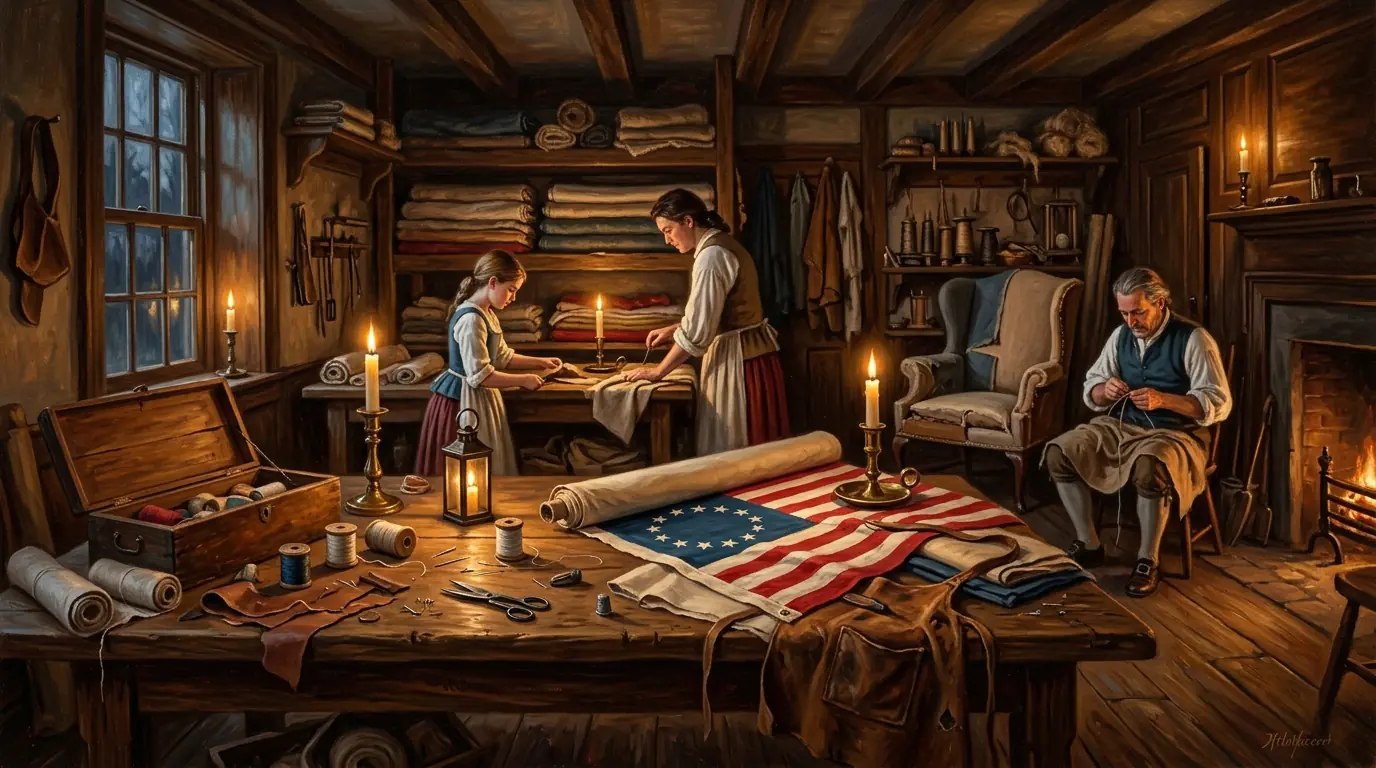
Ninety-three years after the alleged event, a man stood before the Historical Society of Pennsylvania and told a story that would reshape how Americans think about their flag. William J. Canby, Betsy Ross's grandson, presented his paper "The History of the Flag of the United States" in March 1870. The tale he told was vivid: George Washington, Colonel George Ross, and Robert Morris walked into Betsy's Philadelphia upholstery shop sometime around May or June 1776. Washington carried a sketch of a flag with six-pointed stars. Betsy suggested five-pointed ones instead and proved her point by folding a piece of paper and cutting a perfect star with one snip.
It is a great story. The problem is that Canby himself admitted he found no supporting documents — not in Philadelphia, not in Washington. The whole account rested on what his family had passed down by word of mouth across nearly a century.
The affidavits backing up the claim came after the 1870 presentation, not before it. Betsy's daughter Rachel Fletcher, granddaughter Sophia Wilson, and niece Margaret Donaldson Boggs all signed statements — but they were corroborating a story already made public, not surfacing new evidence.
The legend spread fast. George Henry Preble included it in his 1872 flag history book. Journals picked it up by 1873. Then Charles Weisgerber painted "Birth of Our Nation's Flag" in 1893 and displayed it at the Chicago World's Fair, and the image stuck. A grandmother in a rocking chair, sewing the first Stars and Stripes for General Washington — that painting did more for the Betsy Ross story than any document ever could. If you are considering custom national flags for heritage events, understanding what goes into a flag's origins adds real depth to the choice.
Key Timeline Gap
Here is the detail that should stop you cold: Congress did not even address a national flag until the Flag Resolution of June 14, 1777. That is a full year after Washington supposedly walked into Betsy's shop to commission one.
What Historians Actually Know — Evidence For and Against
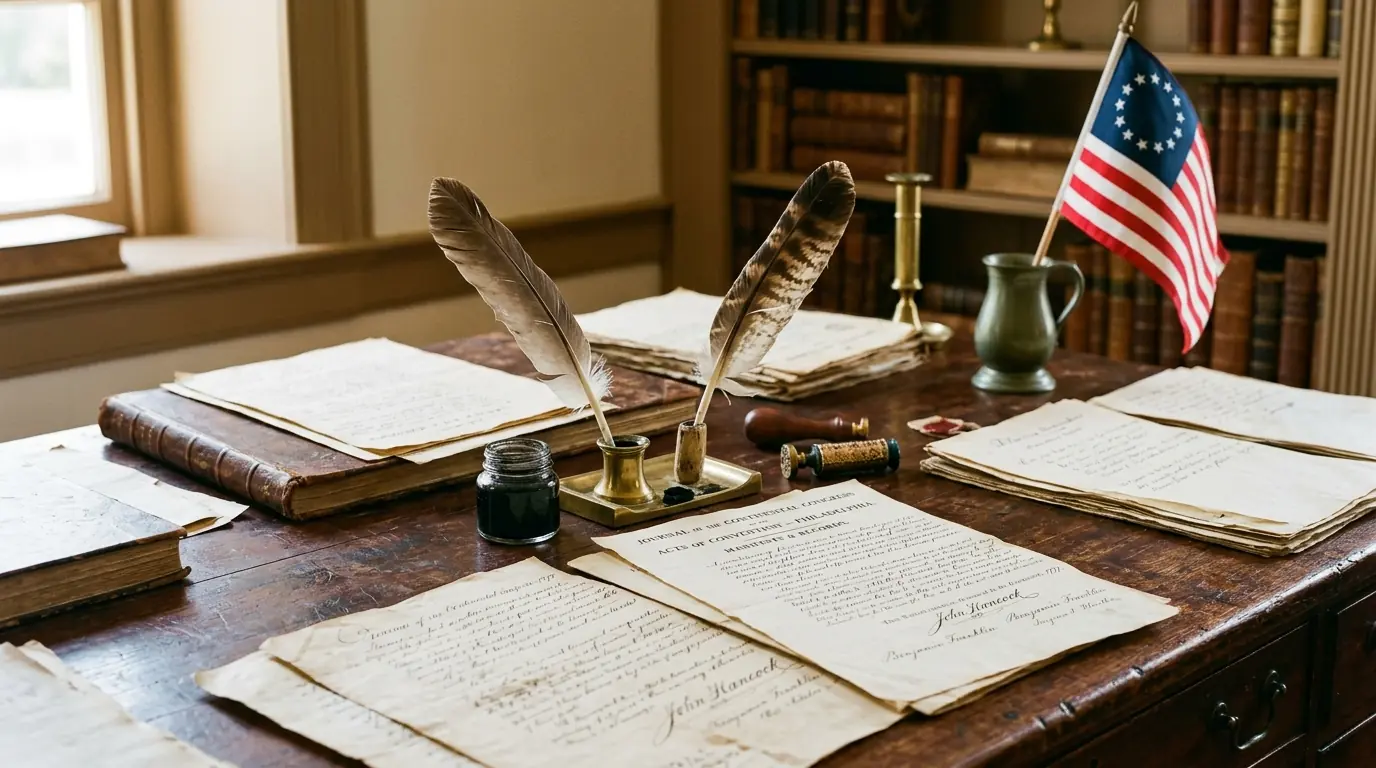
Strip away the legend and you are left with a short list of hard facts. No congressional record mentions a flag committee involving Washington, Morris, or George Ross visiting Betsy Ross in 1776. No diary, letter, or journal from any of those men references the visit. Archival searches — and there have been many — turn up nothing.
Critical Fact
One fact that often gets overlooked: George Washington was not a member of Congress in 1776. He was commanding the Continental Army. He could not have served on a congressional committee to commission a flag. This alone creates a structural problem for the traditional story that no amount of family testimony can fix.
The earliest known painting of a circular-star flag — the arrangement most people associate with Betsy Ross — is John Trumbull's 1792 work. But even Trumbull painted six-pointed stars, not five.
So did Betsy Ross make flags? Yes. That part is documented. Pennsylvania State Navy Board records from May 29, 1777 show a payment of fourteen pounds, twelve shillings, and two pence to "Elizabeth Ross" for "making ships colours." These were Pennsylvania naval flags, not the national flag, and the payment came after the Flag Resolution, not before it. An 1811 receipt shows she supplied over 50 garrison flags for the U.S. Arsenal on the Schuylkill River — confirming she ran a professional flag manufacturer operation for decades.
The honest summary looks like this: Betsy Ross was a real flag maker with a documented career. But the specific claim — that she designed the first American flag in a meeting with George Washington — has zero contemporary evidence supporting it. Historians separate these two facts cleanly, and you should too.
Francis Hopkinson — The Overlooked Designer Who Actually Has Receipts
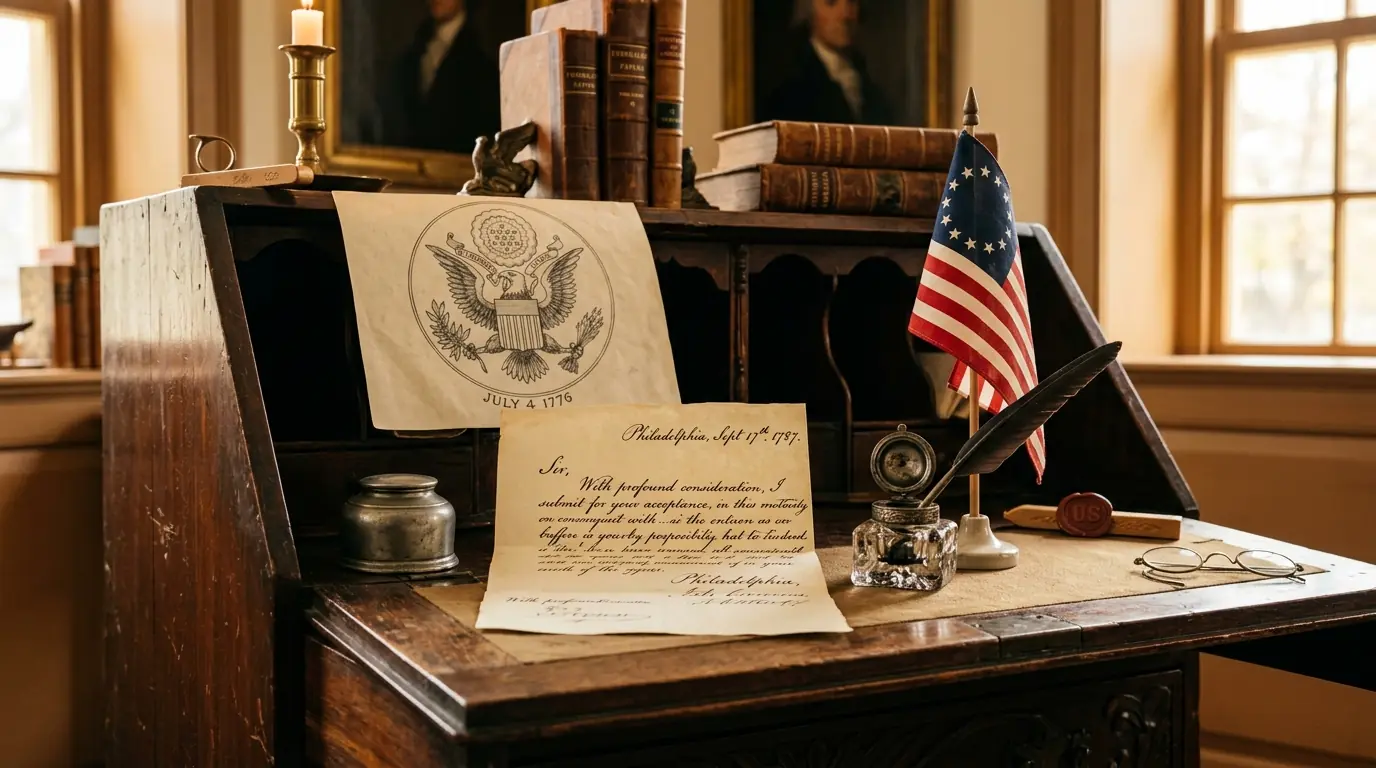
If the Betsy Ross story has no paper trail, Francis Hopkinson's claim has almost too much of one. Hopkinson was a New Jersey delegate to the Continental Congress, a signer of the Declaration of Independence, and — this matters — chairman of the Continental Navy Board starting in late 1776. That board handled naval flags directly.
On May 25, 1780, Hopkinson wrote to the Continental Board of Admiralty asking for payment. His letter itemized what he called his "Labours of Fancy" over the prior three years: the flag of the United States, the Great Seal, Continental currency designs, and seals for the Admiralty and Treasury boards. His requested fee? A quarter cask of public wine. The man designed the American flag and asked for a barrel of wine.
Hopkinson's "Labours of Fancy" included: the flag of the United States, the Great Seal, Continental currency designs, and seals for the Admiralty and Treasury boards. His fee request: one quarter cask of public wine.
Congress rejected the payment. But pay attention to why. The Board of Treasury said the work was a "collaborative effort" and that Hopkinson "was not the only person consulted." They also argued his salary as Treasurer of the Continental Loan Office already covered public service duties. What Congress did not do — and this is the critical point — is deny that he designed the flag. The rejection was about money, not authorship.
His sketches for the Great Seal and Admiralty Board Seal survive and show flag motifs: stripe patterns, star arrangements, including a version with six-pointed asterisks and seven white stripes with six red. The National Postal Museum credits him as the flag's designer. Understanding how the flag production process actually works makes Hopkinson's role as a designer — not a seamstress — even more distinct.
Compare the evidence: Hopkinson has official correspondence, congressional journal entries, and authenticated sketches. Ross has family oral tradition recorded 93 years after the fact. If you are making a judgment call based on documentation, there is no contest. The stronger claim belongs to Hopkinson by a wide margin.
Francis Hopkinson (Strong Evidence)
- Official 1780 letter to Board of Admiralty
- Congressional journal entries
- Authenticated sketches of flag motifs
- Chairman of Continental Navy Board
- National Postal Museum credits him
Betsy Ross (Weak Evidence)
- Family oral tradition only
- First recorded 93 years later (1870)
- No contemporary documents found
- Affidavits came after public presentation
- No congressional records of the visit
The 13-Star Design — What the First American Flag Actually Looked Like
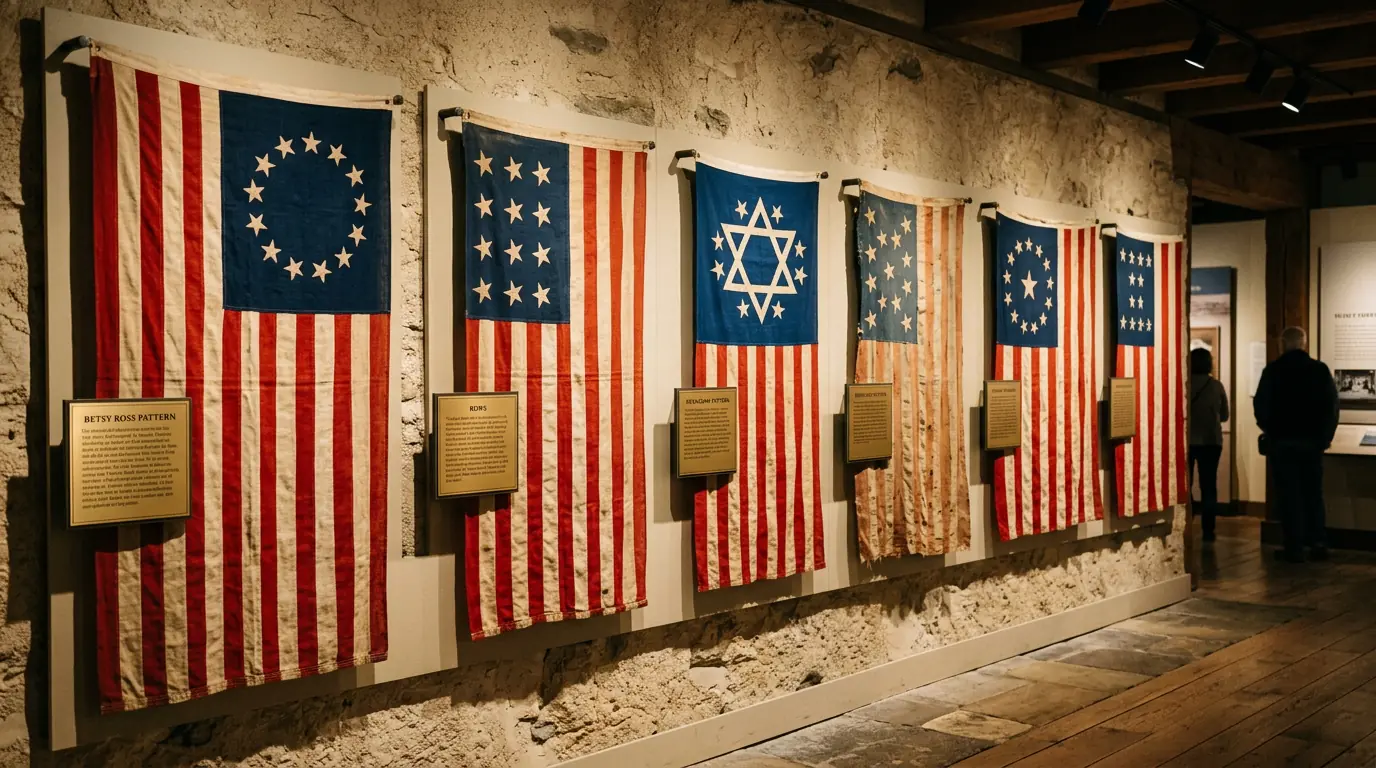
The Flag Resolution of June 14, 1777 — now observed as Flag Day — kept things vague on purpose. It said the flag should have "thirteen stripes, alternate red and white" and "thirteen stars, white in a blue field, representing a new constellation." That was it. No star arrangement specified. No diagram attached.
That vagueness produced real variety. At least six distinct star patterns showed up on actual flags during the period:
The circle or ring pattern — 13 stars in a loop, sometimes 12 around a center star — is what most people picture as the "Betsy Ross flag." But surviving 18th-century specimens using this pattern are rare. The rows pattern, either 3-2-3-2-3 or variations like 4-5-4, was far more common in practice. Continental Navy ships and privateers preferred rows because they read better at sea. There was also a hexagram version — 13 stars forming a six-pointed star shape — that appeared on the Great Seal in 1782. The choice of flag materials and printing methods in the 18th century also influenced which designs were practical to produce at scale.
The circular pattern we now call the "Betsy Ross flag" gained most of its popularity during the 1876 Centennial celebrations, not during the Revolution itself. That is worth sitting with. The most iconic image of the first American flag was not the most common version used during the actual war.
Charles Thomson, Secretary of the Continental Congress, defined the color meanings in 1782 when describing the Great Seal: white for purity and innocence, red for hardiness and valor, blue for vigilance, perseverance, and justice. These meanings came five years after the flag was adopted — another reminder that symbols often get their explanations after the fact, not before.
White
Purity & Innocence
Red
Hardiness & Valor
Blue
Vigilance & Justice
The original 13-star flag served from 1777 to 1795, when Vermont and Kentucky joined and pushed the count to 15 stars and 15 stripes. Congress fixed the stripe count back to 13 in 1818, adding only stars for new states going forward. If you want to display a flag outdoors correctly today, the same attention to detail that shaped the original flag still matters.
Looking for bulk historical flags? For orders over 100 pieces of 13-star Betsy Ross replicas,
contact our team for wholesale pricing and custom sizing options.
Why the Betsy Ross Flag Is Controversial Today
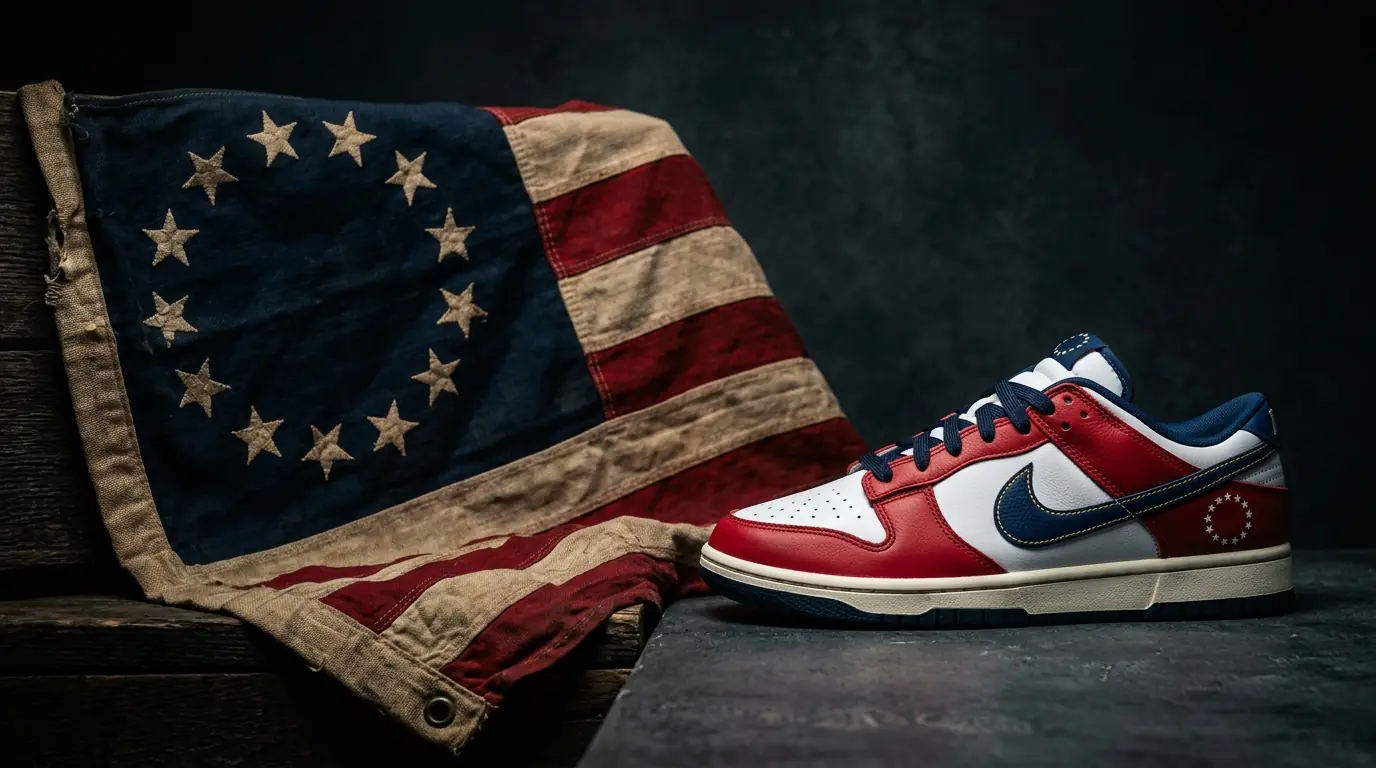
In 2019, Nike pulled an Air Max 1 sneaker featuring the Betsy Ross flag from shelves. Colin Kaepernick raised concerns that the flag evoked slavery-era America. Nike said it halted distribution to avoid "unintentionally offending" people. Arizona Governor Doug Ducey threatened to yank state incentives from a planned Nike facility over the decision.
The debate split along predictable lines. Critics pointed out the flag belonged to a period when Black Americans were enslaved. Defenders argued the 13-star flag predates the worst expansions of the slave trade and represents the Revolution, not the institution of slavery.
But there is a layer to this that most coverage missed. White supremacist groups had been co-opting the Betsy Ross flag years before the Nike incident. As early as 2016, a Michigan NAACP chapter flagged that these groups were using the 13-star design as a symbol of "original America" — code for a pre-diversity, pre-immigration United States. A school superintendent in Michigan apologized for flying it at a high school football game after this was brought up.
This is how symbols work in practice. A flag's meaning is not locked in at the moment of creation. It shifts based on who waves it and in what context. The Betsy Ross flag meant one thing at a 1788 Constitution parade, something different at an 1876 Centennial, and something different again when carried at a white nationalist rally. Even the best outdoor American flag carries this kind of symbolic weight depending on where and how you fly it.
Antique flag expert Jeff Bridgman makes a fair point: the 13-star pattern was used in varied arrangements for 135 years, and its history is far richer than any single political claim on it. That seems right. But pretending the controversy does not exist is not an option either. Understanding a flag means understanding how people actually use it — including uses that make you uncomfortable.
The 13-star Betsy Ross replica remains one of the most popular historical flag purchases for homes and events. The controversy has not dented demand in any measurable way. The right flag display system and mounting setup can make even a historical reproduction flag look properly dignified.
Betsy Ross the Person — Upholsterer, Businesswoman, Survivor
Whatever you think about the flag legend, the woman herself deserves more attention than she gets. Elizabeth Griscom was born January 1, 1752 — the eighth of seventeen children, about nine of whom survived childhood. Her father Samuel was a carpenter in Philadelphia.
She was raised Quaker, which makes what happened next matter more. In 1773, at 21, she eloped with John Ross, an Anglican, at Hugg's Tavern in Gloucester, New Jersey. The Quaker community disowned her for it. She chose the marriage knowing it would cost her that entire social network.
John Ross died in 1775 or 1776 while guarding munitions for the militia. They had no children. Betsy was in her early twenties, widowed, cut off from her religious community, and running an upholstery business on Arch Street alone. She kept going. She made uniforms, tents, blankets, cartridges, and flags for Continental forces. Any serious flag factory today operates with the same mix of craftsmanship and business durability that defined her shop.
Her second husband, Joseph Ashburn, was captured at sea and died in an English prison in 1782. She married John Claypoole in 1783; he died in 1817. Across three marriages, she had seven children, five of whom survived to adulthood.
She kept running the business until about age 76, retiring around 1827. She went blind in her final years and lived with her daughter Jane until her death on January 30, 1836, at 84.
1752
Born Elizabeth Griscom
8th of 17 children, Philadelphia
1773
Married John Ross, Disowned by Quakers
Eloped at 21, lost entire social network
1776+
Widowed, Built a Business Alone
Flags, uniforms, tents, blankets for Continental forces
1836
Died at Age 84
50+ years in business, legacy carried on until 1857
Here is what strikes me about Betsy Ross: the legend made her famous for a single afternoon — sitting in a chair, sewing a flag for George Washington. The real story is a woman who ran a business for over fifty years, survived three husbands, raised five children through a revolution and its aftermath, and built something durable enough that her daughters and granddaughters carried it on until 1857. That multigenerational operation lasted over 80 years. If you want to learn how to make a custom flag today, you are tapping into a craft tradition she helped define. The legend shrinks her. The facts are better.
Conclusion
The betsy ross flag history comes down to three things worth remembering. First, the Washington-visits-Betsy story has no contemporary documentation — it surfaced 93 years after the fact through family oral tradition. Second, Francis Hopkinson has the strongest documented claim to designing the flag, backed by congressional records and his own correspondence. Third, Betsy Ross was a real flag maker with a verified career spanning decades, even if the specific legend built around her does not hold up.
1
No contemporary documentation exists
The Washington-visits-Betsy story surfaced 93 years after the fact through family oral tradition
2
Hopkinson has the strongest claim
Backed by congressional records and his own authenticated correspondence
3
Betsy Ross was a real flag maker
Verified career spanning decades, even if the specific legend does not hold up
None of this diminishes the 13-star flag itself. It remains a powerful symbol of the founding era — one worth displaying with an accurate understanding of where it came from. Pair it with the right flag grommets and a proper flagpole and it looks exactly as commanding as it should.
Next steps:
Browse Our Collection
Browse our 13-star historical flag reproductions for heritage displays and patriotic events
Visit the Betsy Ross House
239 Arch Street, Philadelphia — draws over 300,000 visitors annually
Read the Primary Source
Francis Hopkinson's 1780 letter to the Board of Admiralty for the primary source behind the flag's design
Video Guide
Related Articles