Real-World Cautionary Case
An event coordinator in Riyadh once rejected a shipment of 200 Saudi flags because the sword faced the wrong direction. The manufacturer had mirror-printed a standard template, assuming bilateral symmetry. That mistake cost $14,000 and a three-week delay. The Saudi flag is one of the most protocol-sensitive national flags in the world, and getting it wrong carries real consequences — diplomatic, religious, and financial.
This guide covers the flag's meaning, its exact official specifications, the protocol rules that govern it, and what procurement teams need to know before placing an order.
The Shahada and the Sword — What Saudi Arabia's Flag Actually Says
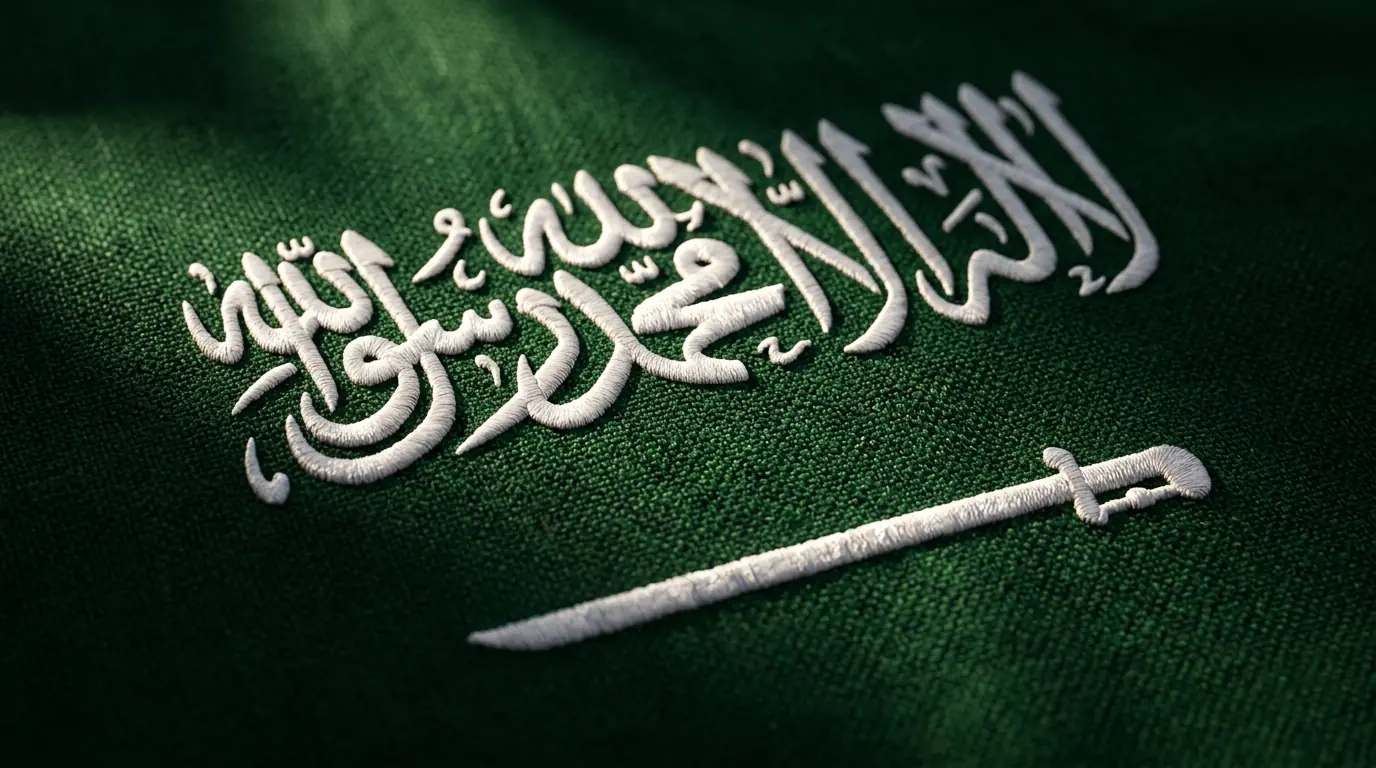
Most people see green fabric with white Arabic text and a sword. That description misses the point entirely.
The white script is the Shahada — Islam's declaration of faith: "There is no god but Allah, and Muhammad is the messenger of Allah." Written in Thuluth calligraphy, it is not a motto or a slogan. It is a profession of belief. That distinction shapes every rule about how this flag gets manufactured, displayed, and disposed of.
King Abdulaziz added the sword beneath the Shahada in 1921, during his campaign to unify the Arabian Peninsula. The sword represents justice and the willingness to defend faith — not aggression, despite what Western media sometimes implies. Its blade points left (toward the hoist), and its length spans roughly three-quarters of the Shahada's width.
Critical Manufacturing Requirement
Here is what catches manufacturers off guard: the Saudi flag must read correctly from both sides. Unlike nearly every other national flag, it requires identical obverse and reverse — meaning the text and sword must be legible whether you are looking at the front or the back. This demands either two separate fabric panels sewn together or specialized mirror-reverse printing. Single-layer screen printing, the standard method for most country flags, does not work.
The Shahada also makes the Saudi flag unique in global merchandise. You will not find it printed on T-shirts, beer koozies, or beach towels. Saudi law prohibits placing the flag — or any representation of it — on items that could be discarded, sat upon, or treated casually. The religious text is sacred. For flag manufacturers, this means the Saudi flag is a diplomatic and institutional product, not a consumer novelty item.
The military standard measures 150 x 100 cm with a 3:2 aspect ratio. But the Shahada-and-sword combination demands precision at any size. A poorly spaced calligraphy line or a disproportionate sword blade will get the flag rejected at customs or refused by the procuring embassy.
Official Color Specifications and Production Standards
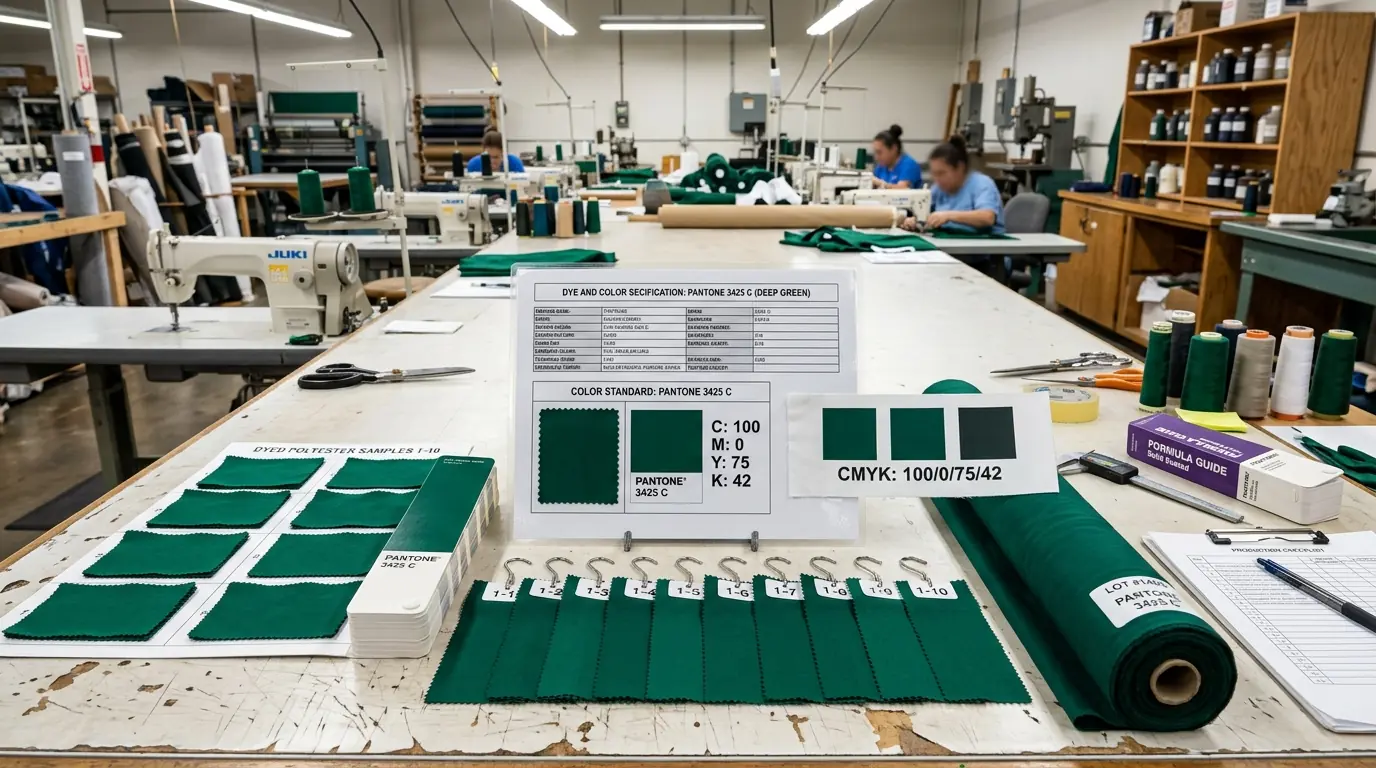
The green on the Saudi flag is not "just green." Production teams who guess the shade — or pull a hex code from a Google image search — end up with rejected orders.
The official primary green is Pantone 3425 C, a deep, saturated tone closer to forest green than the bright greens used by Nigeria or Brazil. The United Nations and National Olympic Committees sometimes reference Pantone 355, which runs slightly brighter. Both are technically acceptable, but embassy procurement officers almost always specify 3425 C. If your client does not specify, default to 3425 C.
For digital reproduction, the precise values are:
| System | Value |
|---|---|
| Pantone | 3425 C |
| CMYK | C89 M15 Y97 K56 |
| RGB | 0, 84, 48 |
| HEX | #005430 |
The white is pure — no ivory, no cream, no warm tint. On fabric, this means optical brightening agents in the polyester or a true-white nylon base.
The official aspect ratio is 3:2 (width to height), with the standard production size at 150 x 100 cm. This ratio differs from the 2:1 used by the UK or the 10:19 of the US flag. Confusing ratios is a common production error, especially in factories that batch-produce multiple country flags on the same line.
One detail that changed in 1973 and still trips up manufacturers: the sword. Before the Royal Decree of 1973, the sword had a curved blade and a nine-hole handle. The current specification requires a straight blade with a seven-hole handle. Factories working from outdated reference images — and there are many circulating online — produce flags that are technically incorrect. Always verify your artwork against post-1973 specifications.
The green must remain consistent across the entire flag surface. Dye sublimation on polyester handles this well. Screen printing on nylon requires careful ink formulation to avoid visible density variation, especially on large-format outdoor flags.
Why the Saudi Flag Never Flies at Half-Mast — And Other Protocol Rules
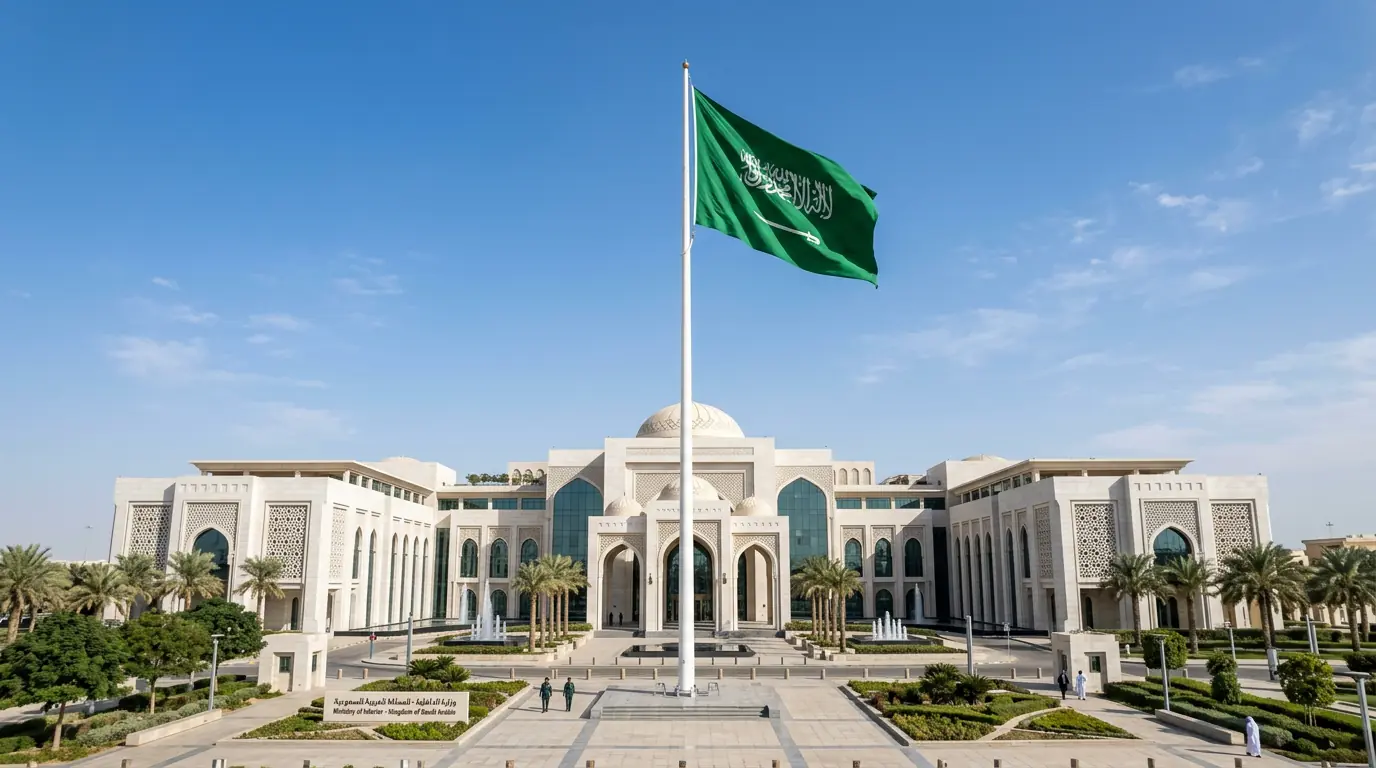
Saudi Arabia's flag protocol is stricter than almost any other nation's, and the reason is straightforward: the Shahada is on the flag. Lowering it would symbolically lower the word of God. That is not a cultural preference — it is a religious prohibition.
When other nations fly flags at half-mast during periods of mourning, Saudi Arabia does not participate. During the mourning period for King Abdullah in 2015, no Saudi flags were lowered. Diplomatic missions worldwide received explicit instructions to maintain full-mast display. Foreign embassies in Riyadh followed suit out of protocol reciprocity.
Saudi Flag Day: March 11
Established by royal decree. On this date, government buildings, schools, and public institutions display the flag with specific ceremonial guidelines.
Key protocol rules that affect manufacturers and event planners:
No Ground Contact
The flag must never touch the ground. Grommet placement and rope/halyard systems need to account for this.
No Modifications
No decorative modifications are permitted — no borders, no added text, no organizational logos superimposed.
Positioning Priority
When displayed alongside other national flags, the Saudi flag occupies either the center position or the rightmost position, and always at the highest point.
Vertical Orientation
Vertical hanging requires specific orientation: the Shahada must read correctly from right to left, with the sword pointing downward.
Respectful Retirement
Damaged or faded flags must be retired respectfully, not discarded in regular waste.
The 1973 Royal Decree codified these rules into law. For international event organizers, the practical implication is clear: you cannot treat the Saudi flag like a decorative element. It requires dedicated handling, correct positioning, and flags that meet exact specifications. A faded or incorrectly printed flag displayed at an international conference is not just a quality issue — it is a diplomatic incident.
From the First Saudi State to the Modern Kingdom — Flag Evolution Since 1744
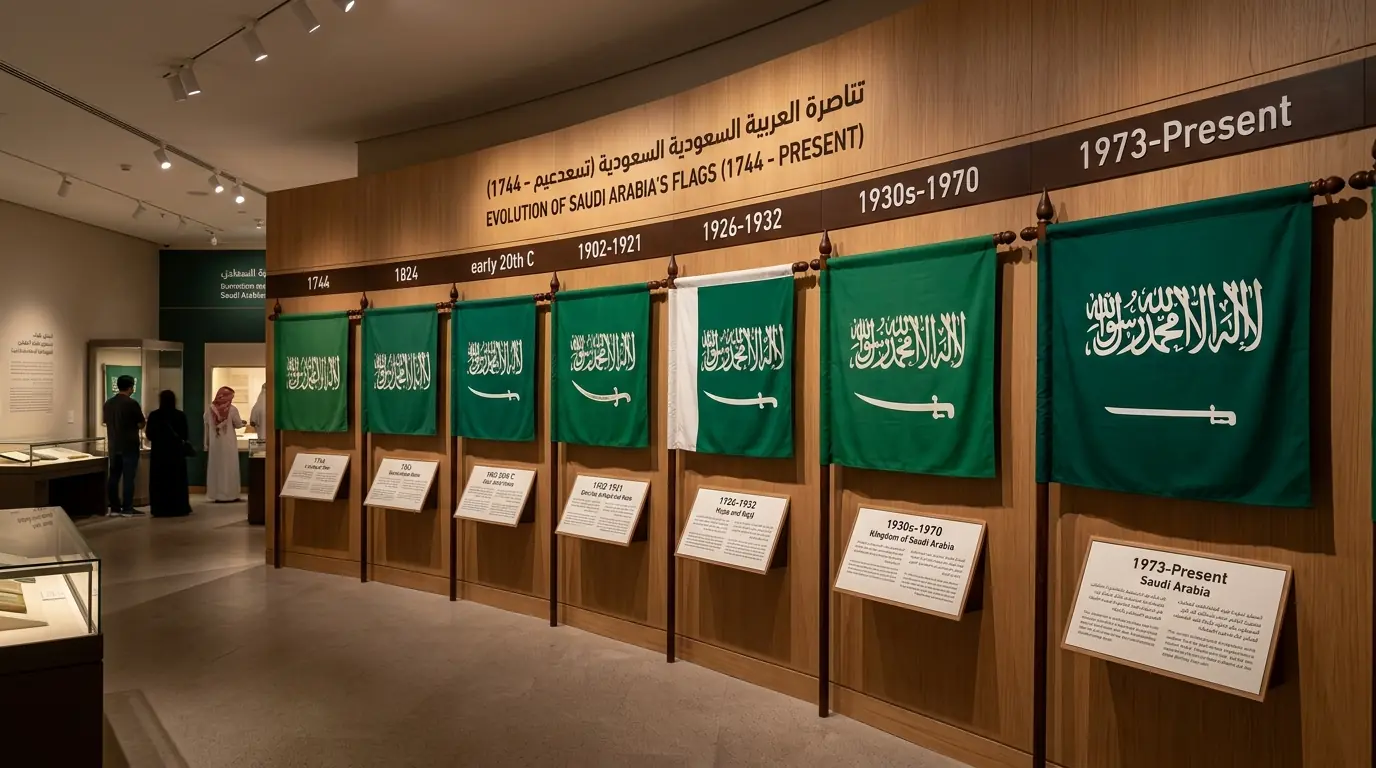
The Saudi flag did not arrive fully formed. It evolved across three Saudi states and multiple political upheavals, each iteration reflecting the priorities of whoever held power.
1744
1818
1818
The First Saudi State
The earliest version was plain green with the Shahada — no sword, no embellishments. Green represented Islam, and the Shahada declared allegiance. When the Ottoman-Egyptian forces destroyed the First Saudi State in 1818, the flag disappeared with it.
1902
1921
1921
Abdulaziz's Reconquest
When Abdulaziz ibn Saud captured Riyadh in 1902 and began reunifying the peninsula, he revived the green-and-Shahada design. For nearly two decades, no sword appeared. The flag functioned as a religious banner more than a national one — the state itself was still forming.
1921
The Sword Arrives
As Abdulaziz consolidated military control, he added a curved sword beneath the Shahada. This was not decorative. It signaled that faith would be defended by force. The sword gave the flag a political dimension it had lacked.
1932
1938
1938
The White Stripe Period
After the Kingdom of Saudi Arabia was formally declared in 1932, a wide white vertical stripe appeared on the hoist side. This design lasted only six years. Some historians suggest the stripe was intended to distinguish the national flag from other Islamic banners; others argue it was simply an aesthetic experiment that King Abdulaziz eventually discarded.
1938
1973
1973
Refinement
The white stripe was removed. The flag settled into the green-Shahada-sword format still used today, but with a curved blade and a nine-hole sword handle.
1973
Now
Now
Standardization
The Royal Decree of 1973 finalized every detail. The sword became straight-bladed with a seven-hole handle. Proportions were fixed at 3:2. Color specifications were standardized. This was not a redesign — it was a codification. The flag had been drifting between slightly different versions for decades; the decree ended that ambiguity.
Understanding this timeline matters for procurement. If a supplier shows you a "historical Saudi flag" with a curved sword or white stripe, those are obsolete designs. The only current legal version is the post-1973 standard.
How the Saudi Flag Compares to Other Islamic and Arab Nation Flags
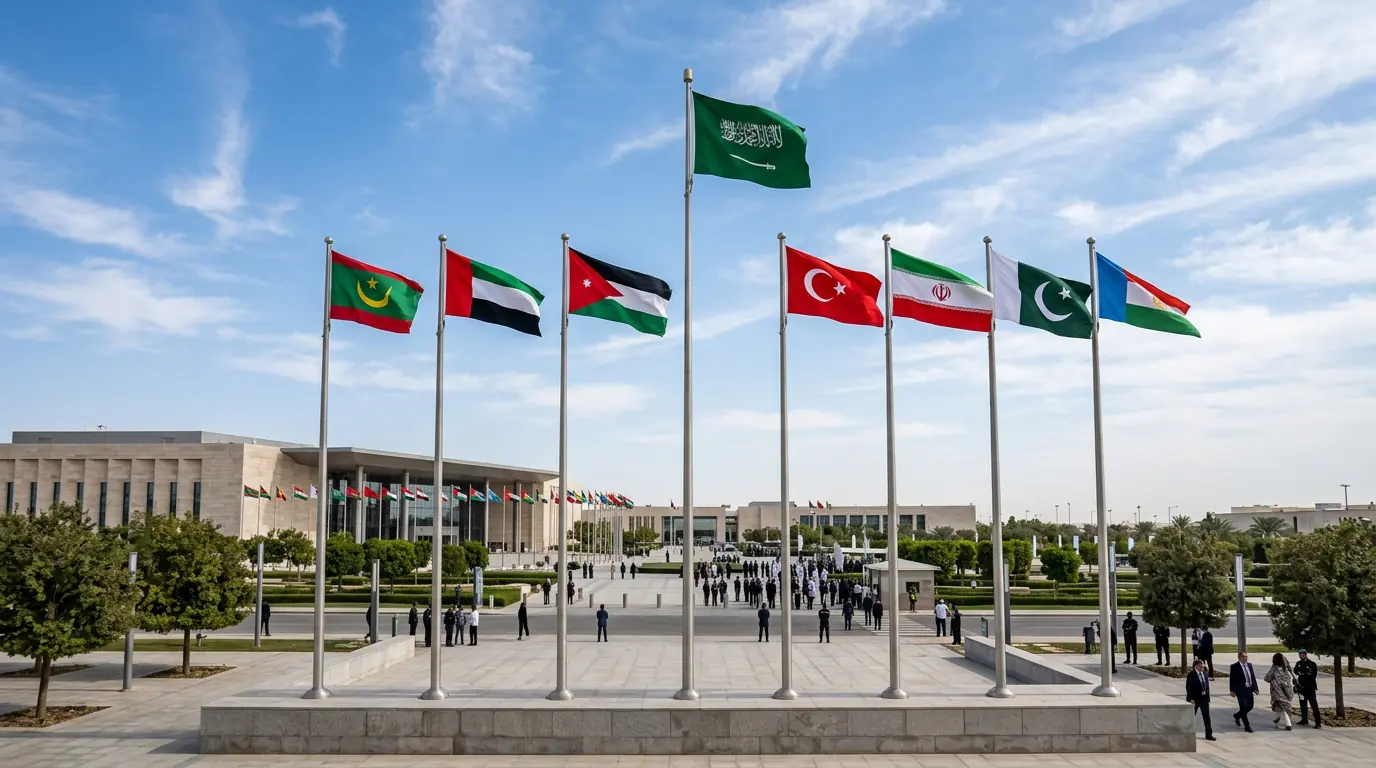
A common assumption groups the Saudi flag with other "Islamic flags" — green background, Arabic text, maybe a crescent. That grouping obscures how unusual Saudi Arabia's flag actually is.
The Shahada sets it apart. No other sovereign nation places the full Islamic declaration of faith as the central element of its national flag. Pakistan uses green with a white crescent and star — Islamic symbolism, but no scriptural text. Iran features a stylized emblem with the word "Allah" and the takbir repeated along its borders, but the central design is geometric, not calligraphic. Turkey and Tunisia use the crescent and star with no text at all.
Saudi Arabia also rejects the Pan-Arab color palette. Most Arab flags draw from red, white, black, and green — the colors associated with the Arab Revolt and various dynasties. The UAE, Jordan, Palestine, Kuwait, and Iraq all use some combination of these four. Saudi Arabia uses only green and white. It is making a deliberate statement: national identity rooted in Islam, not in pan-Arab political movements.
This comparison matters for flag manufacturers producing multiple national flags for international events. Saudi Arabia's flag demands a fundamentally different production process. While a UAE or Jordanian flag can be single-layer printed with standard color blocks, the Saudi flag needs dual-sided printing or sewn double panels to ensure the Shahada reads correctly from both sides.
30-50%
Higher Cost Per Unit
2-Panel
Dual-Sided Required
3:2
Aspect Ratio
That dual-sided requirement alone increases per-unit production cost by 30-50% compared to similarly sized flags with non-text designs.
Mauritania offers the closest parallel — green with gold calligraphy — but uses a crescent and star rather than the Shahada. Libya under Gaddafi (1977–2011) flew a plain green flag with no markings whatsoever, which was arguably the simplest national flag ever used. Neither approaches the Saudi flag's combination of religious text, symbolic weaponry, and strict bilateral legibility requirements.
Pro Tip: For bulk Saudi flag orders over 100 pieces for embassies or international events,
contact our production team for special diplomatic pricing and priority turnaround.
Procurement Specifications for Embassies, Events, and Custom Orders
If you are ordering Saudi flags for an embassy, international summit, or cultural event, the margin for error is effectively zero. Saudi diplomatic missions inspect delivered flags against official specifications, and non-compliant flags get returned.
The reference standard is published at saudiflag.sa (2023 guidelines). Any supplier claiming to produce official-spec Saudi flags should be working from this document, not from downloaded images or third-party references.
Key procurement requirements:
Certification matters. Flags imported into Saudi Arabia must meet SASO (Saudi Standards, Metrology and Quality Organization) requirements, and the SABER digital platform manages import compliance documentation. The Government Tenders and Procurement Law (GTPL) governs institutional purchases. Local content requirements mandate a minimum 30% for government contracts — relevant if you are bidding on a Saudi government tender rather than supplying to an international event.
Dual-sided printing is mandatory. The Shahada must read correctly from both sides. This is the single most common production failure. Standard flag printing uses single-layer dye sublimation, which produces a mirror image on the reverse. For Saudi flags, manufacturers must either use two panels sewn back-to-back with reinforced edges, or employ blockout printing technology that prevents ink bleed-through while allowing separate artwork on each side.
Material selection affects compliance. Outdoor Saudi flags need UV-resistant polyester or heavyweight nylon. The flag must fly freely — rigid or semi-rigid materials are not permitted. Quality hardware — brass grommets, reinforced headbands — prevents the flag from touching the ground, which violates protocol.
Vision 2030 sustainability standards now influence government procurement preferences. Suppliers using recycled polyester or water-based inks may receive scoring advantages in tender evaluations.
For organizations planning international events with multiple country flags, sourcing Saudi flags from a specialized manufacturer familiar with these dual-sided requirements avoids the most expensive mistake in flag procurement: a delivered order that cannot be used.
Conclusion
The Saudi flag carries more constraints than any other national flag in production. The Shahada makes it a religious object as much as a national symbol. Half-mast prohibitions, bilateral printing requirements, strict color specifications, and post-1973 design standards all narrow the acceptable margin to near zero.
For researchers and students, this guide covers the historical and symbolic foundations. For event planners and procurement officers, the specifications and protocol rules here should prevent the most common and costly errors.
If you need Saudi flags manufactured to official specifications — for embassy supply, diplomatic events, or international conferences — request a quote from our production team. We produce dual-sided, Pantone-matched Saudi flags with correct post-1973 sword design, proper Thuluth calligraphy, and compliant finishing hardware. Every flag is verified against the saudiflag.sa standard before shipping.