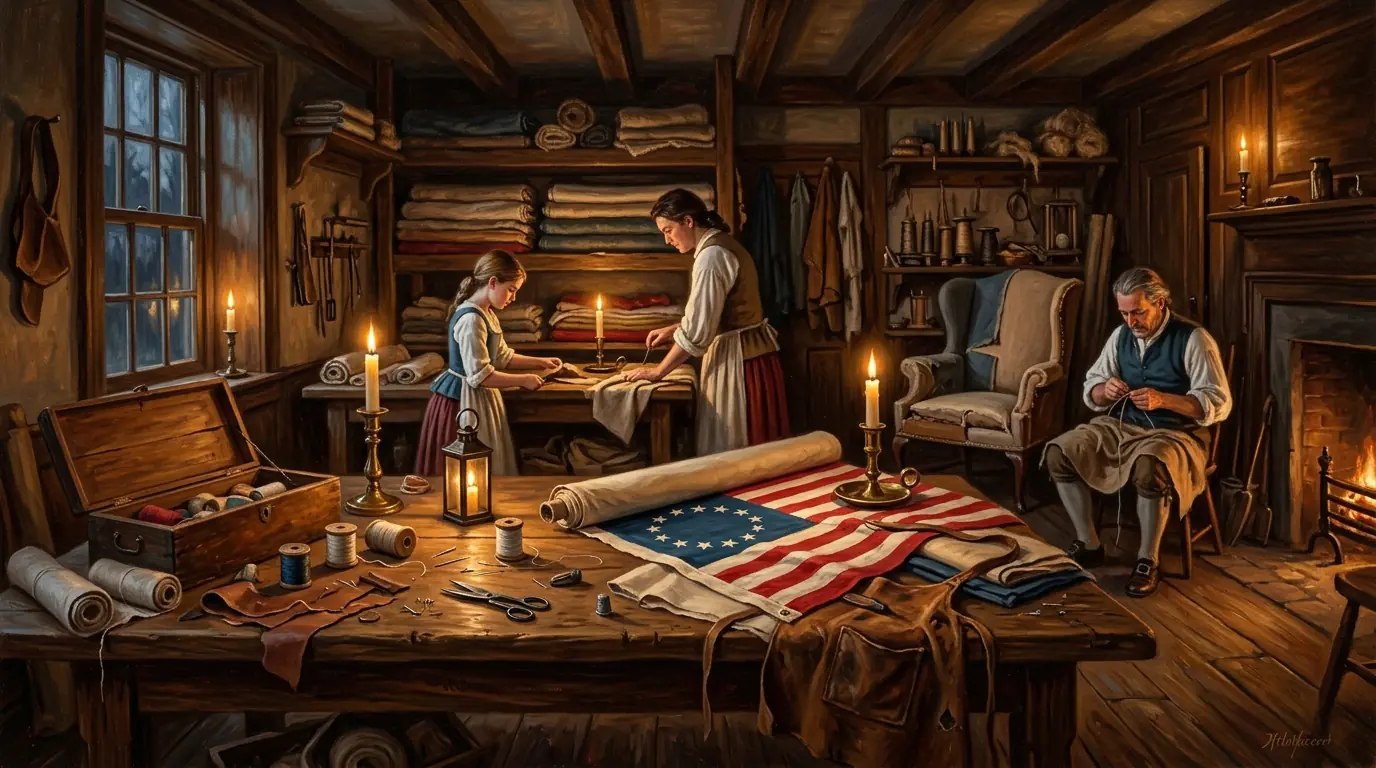
Every few years, someone finds an old flag in a grandparent's trunk — faded cotton, hand-stitched stars, a number that does not match the 50 they learned about in school. They usually ask the same question: how many flags has America had? The answer is 27 official versions since 1777, each one a record of the country growing, fighting, and remaking itself. The story runs from a congressional resolution so vague that no two flags looked alike, through a design mistake that produced the national anthem, to a high school project graded B-minus that became the longest-serving flag in American history.
27
Official Versions
249
Years of History
50
Stars Today
The First Flag Act of 1777 — How 13 Stars and Stripes Became Official
On June 14, 1777, the Second Continental Congress passed a resolution that most Americans today would call vague. The Flag Resolution asked for:
"Thirteen stripes, alternate red and white; thirteen stars, white in a blue field, representing a new constellation."
That was the full text. No star arrangement. No proportions. No instructions on whether stars should have five points or six.
This gap in detail meant early American flags looked different from one another. Some flagmakers arranged the stars in a circle. Others set them in rows. A few scattered them across the blue canton with no pattern at all. The only shared elements were the count — thirteen of each — and the colors.
Those colors carried meaning the Continental Congress borrowed from the Great Seal:
June 14 became Flag Day, though Congress did not recognize it until 1949 — 172 years after the original resolution.
The popular story credits Betsy Ross with sewing the first flag. But historians have found no direct evidence from 1777 to support it. The claim first surfaced in 1870, when her grandson William Canby presented it to the Historical Society of Pennsylvania. Ross was a real upholsterer in Philadelphia who made flags for the Pennsylvania navy. Whether she made the first national flag is still an open question — and a good reminder that national myths often outrun the historical record.
The 15-Stripe Mistake That Inspired the Star-Spangled Banner
Congress made a design decision in 1794 that it would spend the next 24 years trying to undo. The Second Flag Act added two stars and two stripes for Vermont and Kentucky. It was the only time the flag carried more than 13 stripes — and it created a problem nobody had thought through.
If every new state got its own stripe, the flag would become an unreadable mess of thin lines. But that 15-stripe version served a purpose no one planned for it. On the morning of September 14, 1814, it flew over Fort McHenry after a 25-hour British bombardment during the Battle of Baltimore. Francis Scott Key, held on a British ship in the harbor, watched through the night. The flag he saw at dawn — 30 by 42 feet, now preserved at the Smithsonian — inspired "The Star-Spangled Banner."
The stripe problem got its fix in 1818. Captain Samuel Reid, a naval hero, proposed what became the Third Flag Act:
The Third Flag Act (1818)
Lock the stripes at 13 for the original colonies, add one star for each new state, and update the flag on the following July 4. This framework still governs every flag change today.
So the 15-stripe "mistake" gave America its national anthem. Not a bad trade for a design error.
From 20 Stars to 48 — The Expansion Era Flags (1818–1912)
The Third Flag Act set the rules. It did not set the aesthetics. Between 1818 and 1912, the American flag went through 23 different versions — roughly one new design every four years. Star arrangements were left to individual flagmakers, and the results ranged from orderly rows to creative chaos.
The "Great Star" pattern was a popular choice in the 1830s and 1840s: arrange the smaller stars into the shape of one large star. It looked striking on a flagpole. It also meant no two flags were identical, since each flagmaker had a different idea of what a star-shaped star pattern should look like.
Abraham Lincoln made one of the most politically loaded flag decisions during the Civil War. Southern states had seceded, but Lincoln refused to remove their stars. The flag kept all 34 stars through the war — then 35 when West Virginia split from Virginia in 1863. The message was deliberate: these states had not left the Union, because the Union could not be divided. A flag with missing stars would have conceded the Confederate argument.
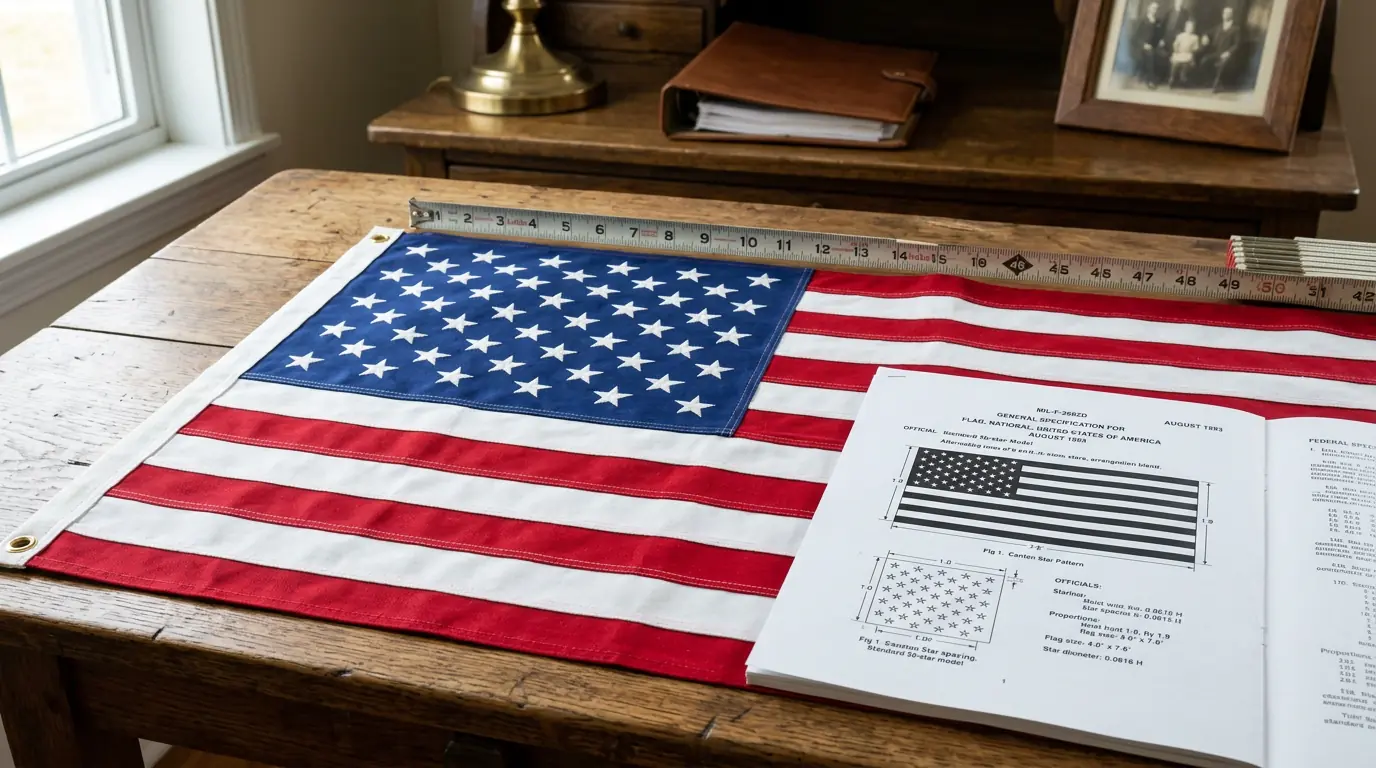
The era of freelance flag design ended in 1912. President Taft signed Executive Order No. 1556, which set the exact proportions (hoist-to-fly ratio of 1:1.9), the arrangement of stars (six rows of eight for the 48-star version), and the precise shades of red, white, and blue. For the first time in 135 years, every American flag was supposed to look the same.
The 48-Star Flag — America's Longest-Serving Design Before the Current One
Arizona and New Mexico joined the Union in 1912, and their admission triggered the flag that would serve longer than any previous version. The 48-star flag flew for 47 years — from July 4, 1912, to July 3, 1959.
Those 47 years covered more American history than any single flag design before or since (until the current flag beats it). Eight presidents served under the 48-star flag. American soldiers carried it through both World Wars and into Korea. It flew over the D-Day beaches, Iwo Jima, and the Berlin Airlift.
Taft's executive order gave this flag something no previous version had: exact specifications.
Executive Order No. 1556 Specifications
The canton covered seven stripes in height. Stars sat in six even rows of eight. The proportions were fixed at 1:1.9. A flag made in Maine looked identical to one made in California.
This standardization turned the flag from a general concept into a precise manufactured product.
For collectors and history buffs, the 48-star flag holds a sweet spot. It is old enough to carry real historical weight — two world wars will do that — but recent enough that original examples still survive in good condition. Many families have one folded in a closet or attic, handed down from a grandfather who served.
Pro Tip: For bulk orders of historical flag replicas over 100 pieces, contact our team for special wholesale pricing and custom sizing options.
Robert Heft's School Project — How a 17-Year-Old Designed the 50-Star Flag
In 1958, a junior at Lancaster High School in Ohio needed a project for his history class. Robert Heft had an idea that was either ambitious or naive, depending on your view of 17-year-olds. He would design a new American flag.
Heft spent $2.87 on materials at a local store. He took apart his parents' 48-star flag and rearranged the blue canton to fit 50 stars — five rows of six alternating with four rows of five. The work took him over 12 hours. He ironed the seams flat on his parents' living room floor.
$2.87
Material Cost
12+
Hours of Work
1,500+
Competing Designs
His teacher, Stanley Pratt, gave him a B-minus. "Too many stars," Pratt told him. There were only 48 states. Heft argued that Alaska and Hawaii were both on track for statehood. Pratt offered a deal: if the federal government accepted the design, he would change the grade.
Heft took the challenge at face value. He contacted his congressman, Representative Walter Moeller, who submitted the flag to the White House. Among more than 1,500 designs received from across the country, Heft's was the only one that came as an actual sewn flag rather than a sketch on paper. President Eisenhower called Heft to tell him his design had been selected. Executive Order 10834, signed August 21, 1959, made it official.
The 50-star flag first flew on July 4, 1960, at Fort McHenry — the same spot where the 15-stripe flag had inspired the national anthem 146 years earlier. Pratt changed the grade to an A.
Heft kept the original flag and spent decades traveling with it to schools and civic events. He also designed a 51-star flag, just in case. He died in 2009, but the flag he made as a teenager has now served for over 65 years — the longest run of any American flag design in history.
Why the Flag Keeps Evolving — Future Stars and the Push for Statehood
The American flag was built to change. The Third Flag Act of 1818 created a system that assumes new states will join. The process has not changed in over 200 years: Congress admits a state, and the next July 4, a new star goes on the flag.
That is not a hypothetical scenario.
Future Flag Readiness
The Army Institute of Heraldry maintains pre-designed flag layouts for up to 56 stars. D.C. statehood bills have passed the House twice, in 2020 and 2021. Puerto Rico voted 58.5% in favor of statehood in its 2024 referendum. Neither has cleared the Senate, but the designs are ready if Congress acts.
A 51-star flag would break the current 5-by-6 and 4-by-5 alternating pattern. Most proposed layouts use alternating rows of nine and eight stars, or a circular arrangement. The visual change would be subtle — one extra star on a field of blue — but the political significance would be enormous.
What makes flag history worth studying is the pattern it reveals. Each version marks a specific moment — a war, an expansion, a political compromise. The 15-stripe flag marked the anthem. The Civil War flag marked Lincoln's refusal to concede. The 50-star flag marked a teenager's stubbornness and a teacher who had the grace to admit he was wrong.
These are not just old designs on fabric. The 13-star Betsy Ross flag, the 48-star World War II flag, and Civil War-era variants remain some of the most requested historical replicas. They connect the people who fly them to specific chapters of American history — and that connection is worth preserving, whether the flag has 50 stars or someday 51.
Conclusion
The American flag has changed 27 times, and the system that governs those changes is still in place. Each version tells a specific story — the founding, the anthem, the Civil War, a 17-year-old's refusal to accept a bad grade. Understanding that history makes the flag more than a symbol. It becomes a timeline you can hold in your hands.
If a particular era of flag history resonates with you, a historical replica is one of the most direct ways to connect with it. The 13-star Betsy Ross flag, the 15-stripe Star-Spangled Banner, the 48-star flag of two world wars — each one carries the weight of the period it served. Custom flag makers can reproduce these designs on durable outdoor fabric, built to the same proportions the originals followed. Whether you are a collector, a history teacher, or someone who wants to fly a piece of the past, the flag's story does not end at 50 stars. It just has not written the next chapter yet.