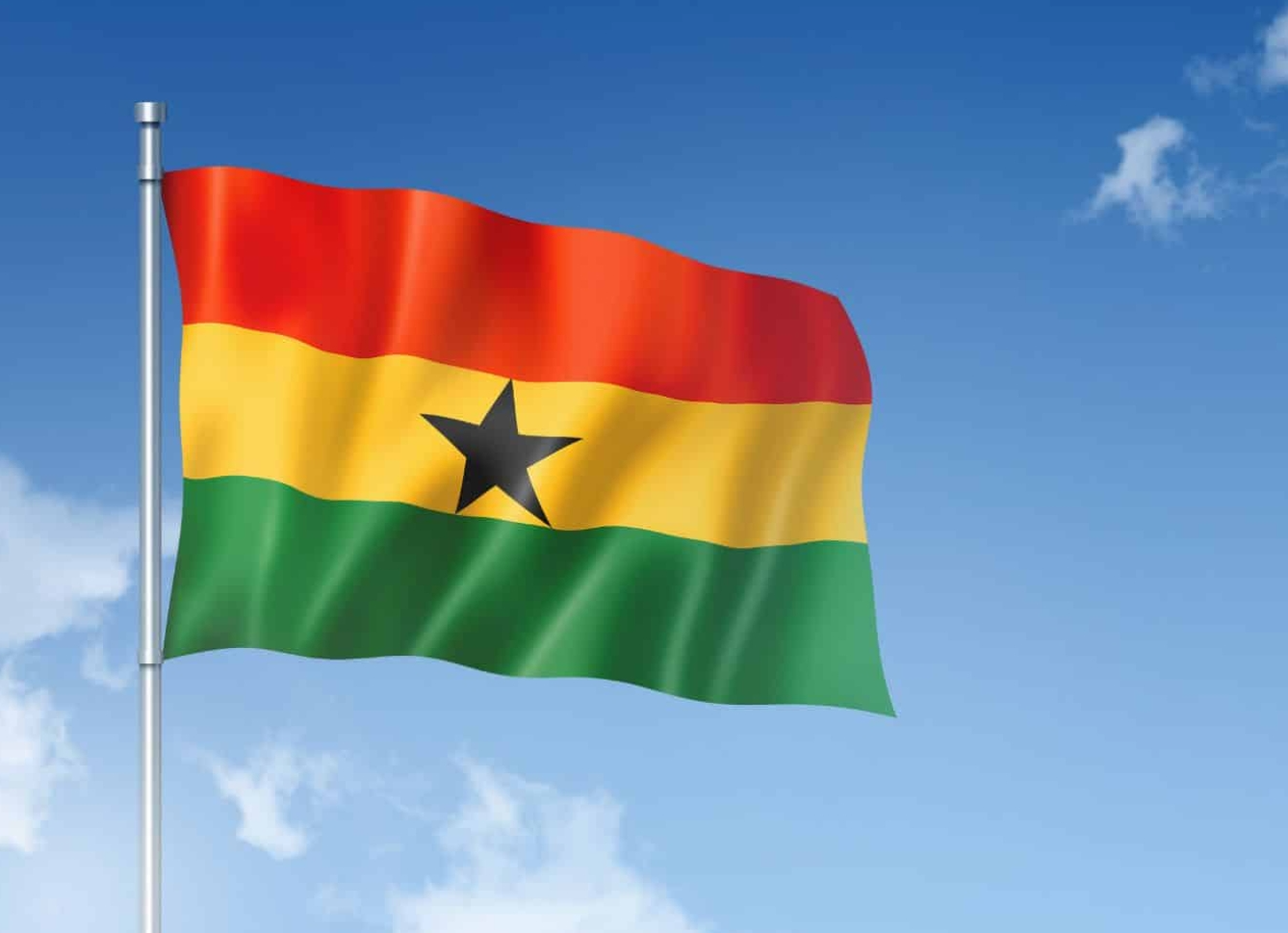
On March 6, 1957, a new flag rose over Accra. It showed three bold horizontal stripes — red, gold, and green — with a single black star at the center. That moment told the world a new nation had arrived.
Those colors were not random. A young Ghanaian artist named Theodosia Salome Okoh chose each one with purpose. She packed a whole civilization's history — its sacrifice, its wealth, its defiance — into a single piece of fabric.
Who designed the Ghana national flag? And why does every element look the way it does? The answers go far beyond design history. They reveal the soul of modern Africa's first independent republic.
1957
Independence Year
2:3
Official Ratio
4
Design Elements
Researching Ghana's founding story? You'll get the full picture here. Sourcing a custom Ghana national flag manufacturer for an upcoming event? You'll find that too.
Who Designed the Ghana National Flag: Theodosia Salome Okoh's Story
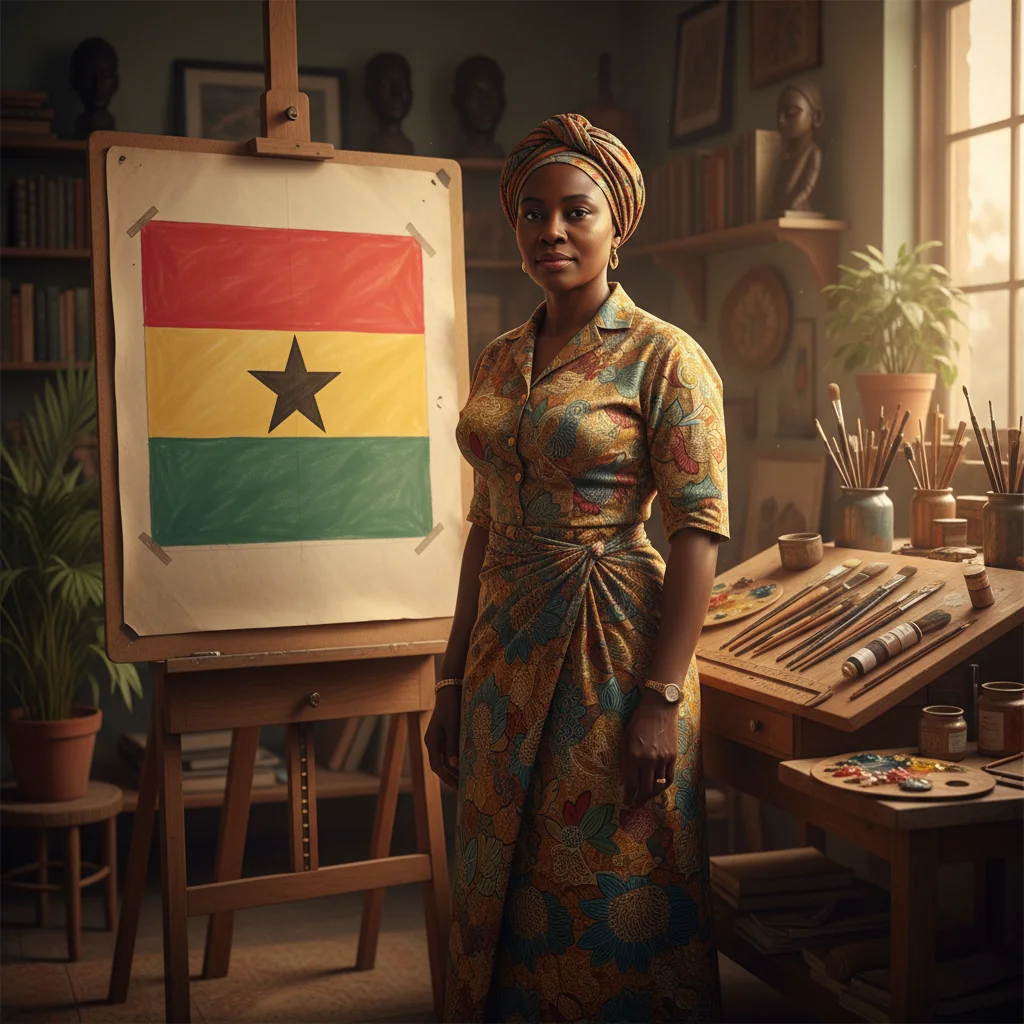
Theodosia Salome Okoh was not a politician. She was not a general. She was an artist — and in 1957, that turned out to be what Ghana needed most.
Okoh was born in 1922 in the Gold Coast, now present-day Ghana. She grew up watching a country struggle under British colonial rule. She was educated, sharp, and tied closely to the cultural identity of her people. Ghana's first Prime Minister Kwame Nkrumah put out a call for a national flag design before independence. Okoh answered that call.
Her submission won. And with it, she gave a nation its face.
The Woman Behind the Design
Okoh's design stood out because every choice had a purpose. Every color, every proportion, every placement carried meaning. This was not decoration. It was a declaration.
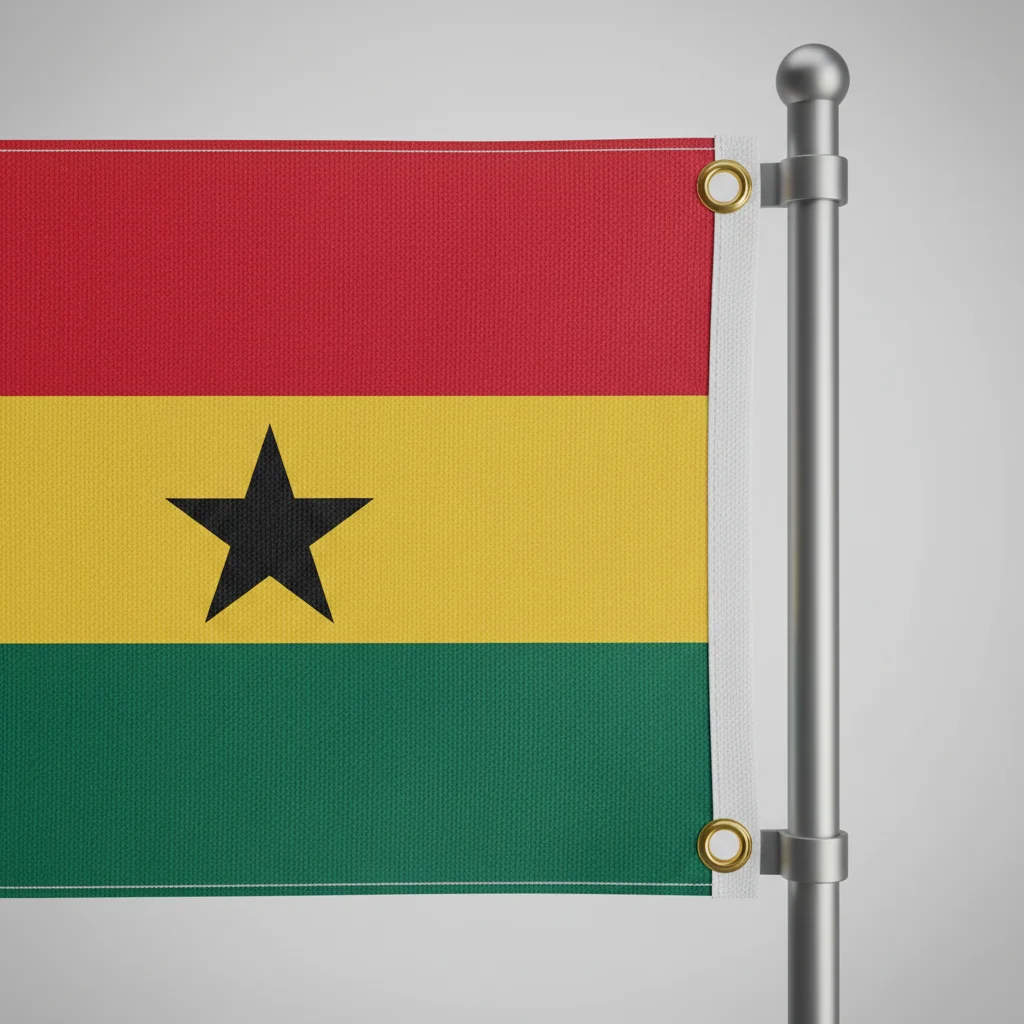
She built the flag as a horizontal tricolor — three equal bands of red, gold, and green. A black five-pointed star sits at the center of the gold stripe. The flag follows a 2:3 ratio (height to length). That ratio gives it a balanced, strong presence — whether it hangs in a government hall or moves through a crowded street.
The star spans the full width of the gold band. It does not tuck into a corner. It dominates. That was a deliberate choice.
Why Her Design Lasted
Flags get redesigned. Ghana's did too. Between 1964 and 1966, a one-party government replaced the green with white. But that government fell. The original Okoh design came back. Her color choices and layout returned untouched.
That kind of staying power is rare. It shows how strongly her design connected with Ghanaian identity.
The official color values show just how precise her vision was:
Red
#EF3340
Gold
#FFD100
Green
#009739
Black Star
#000000
These are not rough shades. They are exact specifications. The flag must look identical whether it's printed on paper, stitched onto fabric, or flying above a stadium. Those numbers make that possible.
Okoh kept working after 1957 — as a painter and a sports administrator. She passed away in 2015. But her most enduring work never stopped flying.
The Ghana independence flag she designed in 1957 remains one of the most recognized national symbols across West Africa. The red gold green black star flag still represents a continent's first step toward modern self-determination.
The Historical Moment: Ghana's Independence and the Flag's First Raising
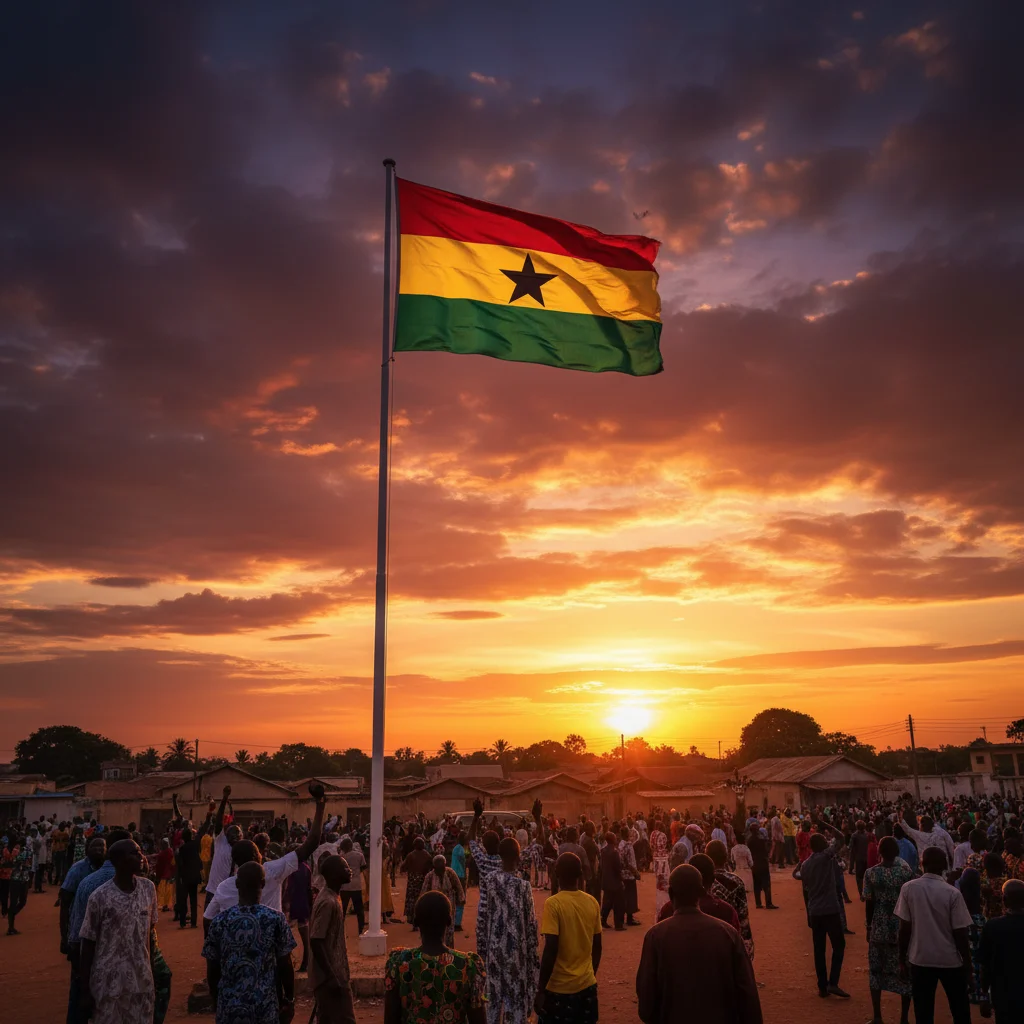
Eighty-three years of British colonial rule ended at midnight.
Not in stages. Not through slow negotiation. On March 6, 1957, at exactly midnight, the Union Jack came down at the Old Polo Grounds in Accra. Theodosia Okoh's red, gold, and green flag rose in its place.
The crowd had been counting down for hours. People whispered to each other:
"How many minutes to Freedom?"
Then the flag lifted. Shouts broke across the night sky. Ghana became the first sub-Saharan African country to win independence from colonial rule. The whole continent felt that moment.
A Night Built for History
The ceremony didn't begin at midnight. It built toward it.
The evening before, on March 5, workers unveiled an Independence Arch near Christiansborg Crossroads. It lit up with the words "Freedom and Justice 1957." Kwame Nkrumah — the man Ghana called Osagyefo , the Redeemer — stood at the Assembly Building with his ministers and delivered his freedom address. The atmosphere was already charged long before the flag went up.
After the raising, Accra didn't sleep. The city filled with state receptions and a formal ball. Nkrumah danced with the Duchess of Kent. Across the country, people took part in canoe races, hair braiding contests, and a Miss Ghana competition. Flags lined every street.
Martin Luther King Jr. attended the celebrations in person. He later wrote about what he saw. Witnessing Ghana's independence shifted how he thought about freedom movements across Africa and beyond.
That black star at the flag's center wasn't just Ghana's symbol. It became a signal for every African nation still living under colonial rule. It proved that independence was possible. The Ghana republic flag origin story carries weight far beyond one country's borders.
Ghana National Flag Colors and Symbolism: What Red, Gold, Green, and Black Star Mean
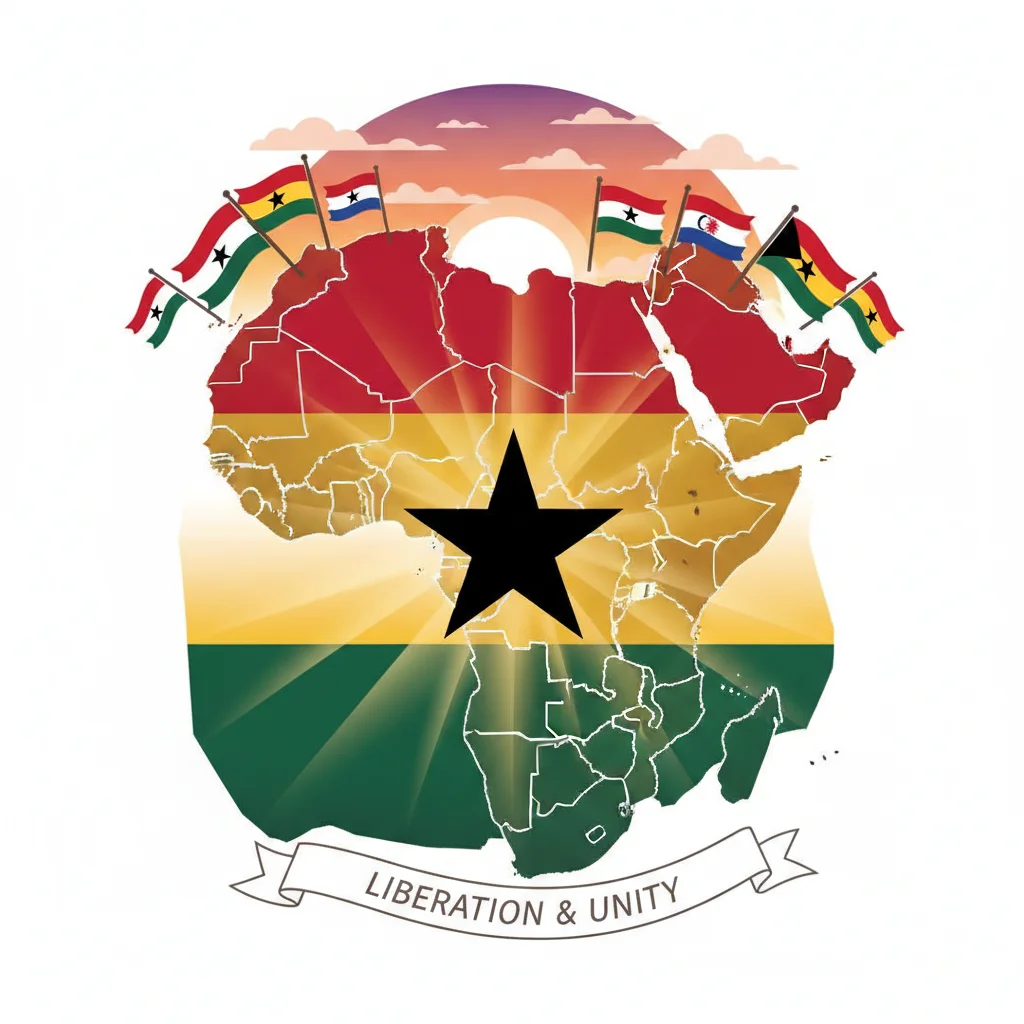
Four design elements. One unified message.
The Ghana flag carries no filler. Every color band and every point of that black star was placed with clear intent. Together, they tell a packed history of a continent's struggle — one you can read without opening a single book.
Red: The Cost of Freedom
The top stripe is red, and it doesn't apologize for what it represents.
This is the blood of Ghana's independence fighters — soldiers, civilians, traditional leaders, and political figures who pushed back against British colonial rule across generations. Freedom wasn't gifted. Real people paid for it, and they absorbed real consequences.
That's a heavy thing to stitch into fabric. Okoh did it anyway.
Gold: A Country Sitting on Wealth
The middle stripe is gold, and the reference is literal.
Before it was Ghana, this land was called the Gold Coast — named by European traders who knew what was here. The gold stripe points to that mineral wealth: the deposits, the resources, the economic base that the new republic would build on.
It also placed the black star at the nation's center — framed by prosperity, not poverty. That was a statement about identity and future potential, not just geography.
Green: A Land That Grows
The bottom stripe stands for Ghana's forests, farmland, and fertile soil. West Africa's tropical geography isn't a background detail — it's a foundation. The green stripe claims that agricultural abundance as a national asset.
Growth in every sense of the word.
The Black Star: Africa's Guiding Light
The five-pointed black star sits at the flag's center. It's the most recognized element on the flag — and the most charged with political meaning.
Okoh drew direct inspiration from Marcus Garvey's Black Star Line , a Pan-African shipping company founded in 1919 to connect African diaspora communities worldwide. Garvey saw the black star as a symbol of collective liberation. Okoh built that vision into Ghana's national identity for good.
The flag's designers called the star the "Lodestar of Africa" — a guiding beacon for the entire continent's push toward freedom.
Its influence spread fast. Ghana's black star design shaped the flags of Guinea-Bissau (1973) and São Tomé and Príncipe (1975). Similar red-gold-green palettes showed up in Cameroon , Guinea , and Senegal as each country gained independence. None were exact copies — but all carried signals of solidarity.
Ghana was the second African nation after Ethiopia to raise red-gold-green as a national banner. That color combination became a shorthand for Pan-African pride across the continent.
Today, the black star still names Ghana's national football team. You'll spot it in public art, cultural events, and independence ceremonies. The Ghana flag black star significance goes far beyond a design choice — it's the most lasting symbol of a movement that reshaped modern Africa.
Official Ghana Flag Specifications: Size, Ratio, and Design Standards
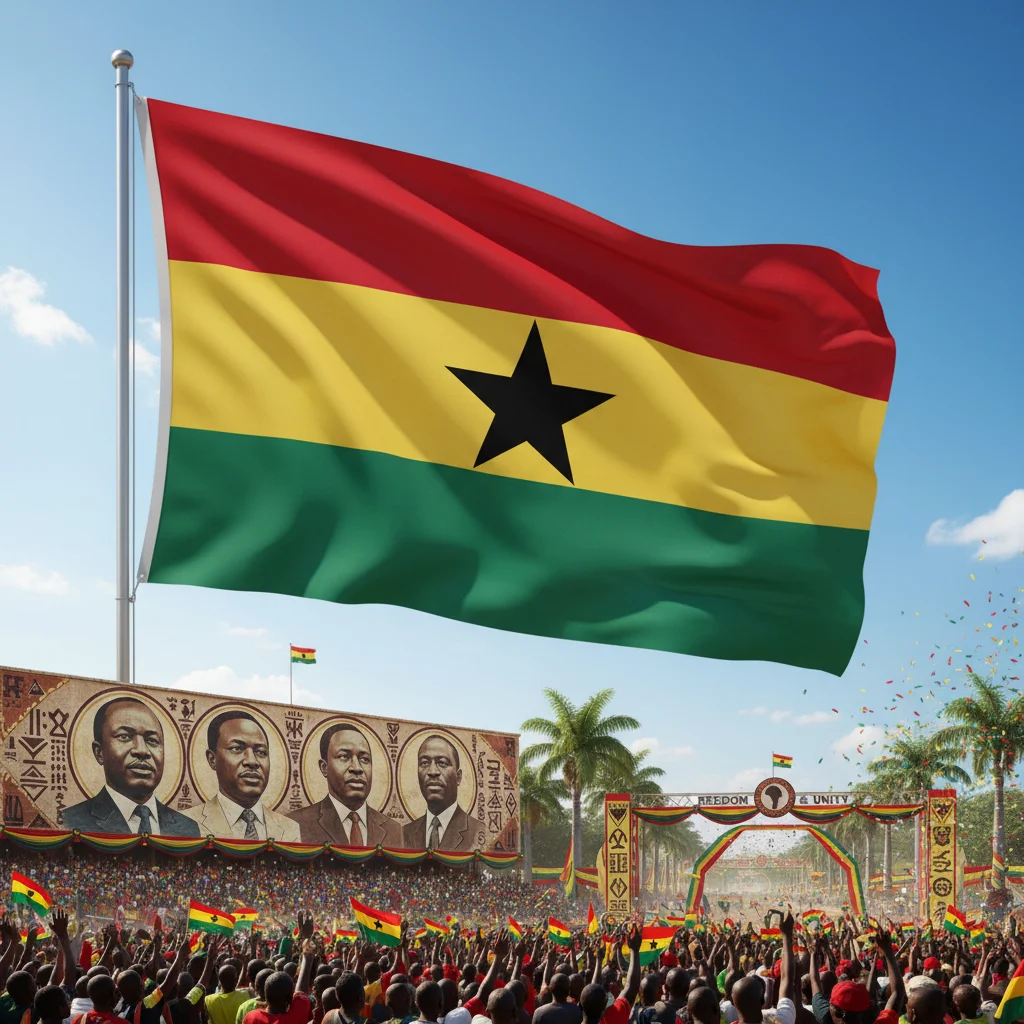
A flag represents a nation. Every measurement, color value, and placement rule must be exact. Ghana's official flag specifications are clear — no guesswork, no room for variation.
Dimensions and Layout
The flag uses a 2:3 aspect ratio (height to length). Three equal horizontal stripes make up the field:
Red — top band
Gold/Yellow — middle band
Green — bottom band
The black five-pointed star sits dead center in the gold stripe. It lines up on both axes — top edge touching the red band, bottom edge touching the green band. No offset. No variation. The standard version carries no coats of arms, extra stars, or inscriptions.
Official Color Standards
Color accuracy is critical for manufacturing. Use these verified values:
| Color | HEX | RGB | Pantone |
|---|---|---|---|
| Red | #EF3340 | 239-51-64 | PMS 032 |
| Gold | #FFD100 | 255-209-0 | PMS 109 |
| Green | #009739 | 0-151-57 | PMS 355 |
| Black | #000000 | 0-0-0 | Black |
For manufacturing, use Pantone® Color Bridge® values as your color standard. Print applications need CMYK color mode at a minimum resolution of 360 dpi on polyester fabrics .
One detail that catches manufacturers off guard: the red-gold-green stripe order is what sets Ghana's flag apart from other Pan-African designs. Flip or shift that sequence and you end up with a different flag.
How to Choose a Custom Ghana National Flag Manufacturer: Key Factors
Getting the Ghana flag wrong isn't a minor mistake — it's a representation failure. The wrong shade of red, a misaligned star, a stripe sequence out of order. Any one of those errors turns a national symbol into a generic piece of colored fabric.
Here's what separates manufacturers who can deliver from those who can't.
Color Accuracy Is Non-Negotiable
The Pantone system is your baseline. Demand it upfront. Ghana's official flag uses PMS 032 red , PMS 109 gold , PMS 355 green , and PMS Black for the star. Any Ghana national flag supplier who can't confirm these values — or who substitutes "close enough" alternatives — will produce a flag that fails color standards under outdoor light.
Request a physical pre-production sample before approving batch production. That sample takes 7–10 days. It's worth every one of them. Check UV-resistant ink saturation. Make sure double-sided prints show proper opacity — not a ghosted reverse image.
Material Determines Longevity
Three materials dominate custom flag production. Each fits a different use case:
| Material | Best For | Durability | Price |
|---|---|---|---|
| Polyester (105gsm) | Outdoor poles 6-20ft | High, weatherproof | Baseline |
| Nylon (200-denier) | All-weather, multi-flag displays | Highest, SolarGuard fade-resistant | +20-30% |
| Canvas header | Indoor or heavy-duty mounting | Medium | +10-15% |
For most outdoor applications, 200-denier nylon is the smart investment. It flies in light wind and holds color longer than standard polyester.
Vetting a Supplier Before You Commit
Five checkpoints to run through before placing any order:
1
Production History
Look for the Ghana national flag manufacturers with at least 10 years of verified experience
2
MOQ Flexibility
Minimum 1 unit for stock items, 5-10 units for custom runs
3
Lead Time
Custom orders run 2-4 weeks. Factor in a total procurement cycle of 4-6 weeks
4
Hardware Specs
Brass grommets (12mm diameter), reinforced canvas header, double-stitched hems
5
Real Sample Photos
Request Ghana-specific samples - 3x5ft is standard. Confirm single-reverse versus double-sided construction before signing off
The 3×5ft (90×150cm) format works for poles between 6 and 20 feet. Event organizers, community groups, and institutional buyers order this size most often. Start there unless you have a specific size requirement.
Pro Tip: For bulk Ghana flag orders over 100 pieces, contact RunCustomFlag for volume pricing and priority production scheduling.
Custom Ghana National Flag Options at RunCustomFlag: Materials, Sizes, and Printing Methods
RunCustomFlag builds Ghana flags the way Okoh designed them — with precision, not approximation.
Three decisions shape your custom Ghana national flag: material, size, and printing method. Get these right, and you get a flag that looks sharp, lasts long, and holds up to real-world conditions. Each choice has a direct impact on the final result.
Materials: Match the Fabric to the Job
Three core materials cover most use cases:
105gsm Polyester is the standard workhorse for outdoor flag poles between 6 and 20 feet. It's 25% heavier than regular polyester. That extra weight means better wind resistance and stronger tear durability. UV-resistant ink locks in Ghana's red, gold, and green — no fading under direct sun. Plus, it's washable, low-temp ironable, and built for repeated outdoor use.
100% Nylon is the premium choice. The dye runs through the entire fabric — not just the surface. That matters a lot for Ghana's bold color bands. Surface printing can crack or peel over time. Nylon avoids that problem entirely. You can also add golden rayon fringe for indoor ceremonies and parades. Both single-sided and double-sided builds are available.
Nautical Polyester handles large-format installations — sizes up to 400×600cm. Use this material where structural strength is the top priority.
For most buyers — event organizers, community groups, schools — 105gsm polyester in 3×5ft (90×150cm) is the best place to start.
Sizes: From Table Flags to Stadium Displays
| Size | Best Application |
|---|---|
| 4"x6" (10x15cm) | Handheld, desk, tabletop |
| 2x3 ft (60x90cm) | Indoor display, parades |
| 3x5 ft (90x150cm) Most Popular | Outdoor poles 6-20ft |
| 4x6 ft / 5x8 ft | Large outdoor, stadium perimeter |
| Up to 8x12 ft+ | Massive event installations |
Printing: Color Accuracy Is the Whole Game
Silk-screen printing puts high color saturation on both sides. The ink is UV-resistant and weatherproof. That's what keeps Ghana's exact Pantone values intact through sun, rain, and wind.
Full-dye construction on nylon matches UN flag specifications. Need diplomatic-grade color accuracy? This is the method to ask for.
Every outdoor build comes standard with brass grommets and reinforced canvas headers for a clean, durable finish.
Frequently Asked Questions About Ghana National Flag History and Custom Orders
These questions come up all the time — from students writing history papers to event coordinators placing bulk orders. Here are direct answers.
Who designed the Ghana national flag?
Theodosia Salome Okoh, a Ghanaian artist born in 1922. She submitted the winning design before Ghana's independence and passed away in 2015. Her original layout still stands today — no one has replaced it.
When was the Ghana flag adopted?
March 6, 1957 — the exact date of Ghana's independence from British colonial rule.
What do the colors on the Ghana flag mean?
Red represents the blood shed for independence. Gold reflects the country's mineral wealth — the land was once called the Gold Coast for good reason. Green stands for Ghana's forests and agricultural land.
What does the black star symbolize?
African freedom and unity. It comes from Marcus Garvey's Black Star Line. The star sits in the center of the gold stripe, touching both the red band above and the green band below.
What are the official flag dimensions?
The ratio is 2:3 height to length. Three equal horizontal stripes run across it: red on top, gold in the middle, green on the bottom.
Can I order a custom Ghana flag in a non-standard size?
Yes. RunCustomFlag makes Ghana flags from 4x6 inches up to 30x50 feet. Standard outdoor size is 3x5ft. Nylon works well for sizes up to 6x10ft. Need something bigger? Nautical polyester handles large-format orders up to 400x600cm.
What's the minimum order quantity?
Single units are available for stock items. Custom orders start at 5-10 units.
Which material should I choose?
For outdoor poles, 105gsm polyester gets the job done. For all-weather use and better color retention on Ghana's bold stripes, go with 200-denier nylon. It holds up longer and keeps colors sharp.
Conclusion
Theodosia Salome Okoh didn't just design a flag. She encoded an entire nation's soul into three colors and a single star. Every thread of red carries the weight of sacrifice. Every band of gold whispers of the continent's buried wealth. Every stripe of green breathes life into the land that sustains millions. And that black star? It still burns as a beacon of Pan-African freedom, decades after it first caught the wind on March 6, 1957.
Are you a researcher tracing the roots of West African national symbols? Or an event organizer looking for a trusted custom Ghana national flag maker to produce authentic, specification-accurate Ghana independence flags ? Either way, the story behind this flag matters — and so does the quality of how you represent it.
Don't settle for a flag that fades before the ceremony ends.
Get a custom Ghana national flag quote from RunCustomFlag today — and give this iconic symbol the quality it deserves.
Video Guide
Related Articles