If you're managing a postal facility and trying to figure out exactly which flags you're required to display — and which ones will actually get you in trouble — the regulations are more specific than most people expect. US post office flag requirements aren't governed by general patriotic guidelines. They fall under USPS-specific internal rules that carry real enforcement weight for facility employees. Getting the details wrong doesn't just look bad. It creates documented compliance gaps that surface during inspections. This guide breaks down the federal and USPS regulations that control flag display at postal facilities, the protocols that trip up even experienced managers, and where to source compliant American flags through approved channels.
Federal Flag Display Laws That Govern Every US Post Office
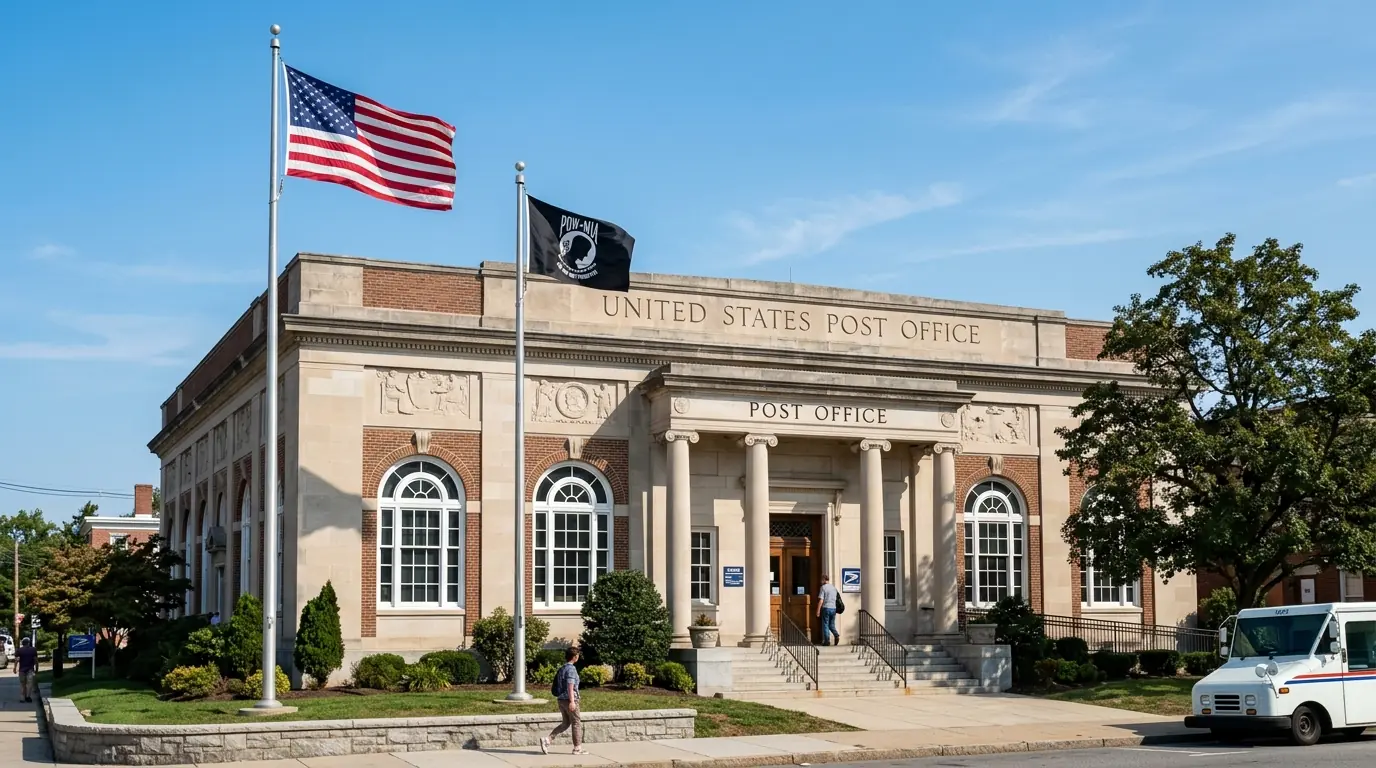
Two separate legal frameworks control what flies outside a post office, and confusing them causes most compliance headaches.
The first is 4 USC Chapter 1, the United States Flag Code. It covers flag display on government buildings and sets the protocols most Americans associate with proper flag etiquette. What catches facility managers off guard: the Flag Code is entirely advisory. No civil penalties, no criminal enforcement. It establishes norms, not mandates.
The second framework is what actually binds USPS employees. ASM Part 47 of the Administrative Support Manual contains mandatory flag display regulations specific to postal facilities. Violate these, and you're looking at internal disciplinary action — not a symbolic slap on the wrist.
The distinction matters because it narrows what you can display. Only four categories of flags are authorized at postal facilities:
That's it. State flags, county flags, city flags — all explicitly prohibited. A facility manager who hangs a state flag thinking it's patriotic is actually violating USPS internal policy.
Key Takeaway
If you manage a postal facility and you're only checking the Flag Code, you're reading the wrong rulebook. ASM Part 47 is where the enforceable requirements live.
When and How the US Post Office Flag Must Be Displayed
The display schedule is straightforward but leaves less room for judgment than most managers assume.
Whenever employees are on duty, the flag goes up. Raise it as soon after sunrise as practicable, and lower it at closing time or by sunset — whichever comes first. That's ASM 472.22, and it applies to every postal facility: post offices, branches, stations, terminals, garages, even leased or rented premises.
The 24-hour display option exists, but it comes with a condition that gets overlooked. The flag must be properly illuminated during darkness. A security light that happens to cast some glow doesn't cut it — you need dedicated illumination pointed at the flag. Facilities that fly the flag overnight without a proper light are technically out of compliance every night.
Severe weather triggers a mandatory takedown under ASM 472.14. The regulation doesn't define "severe" with precision, which puts the judgment call on the facility manager. The practical threshold: if conditions could damage the flag (high winds, heavy rain, ice), bring it down. Replacing flags repeatedly because you left them out in storms is both a compliance issue and a budget drain.
One detail that separates careful facility managers from the rest: the flag gets hoisted briskly to the peak, but lowered ceremoniously. It never touches the ground during either process. That ceremonial distinction isn't just tradition — it's specified in the ASM.
Half-Staff Protocols and Who Authorizes Them
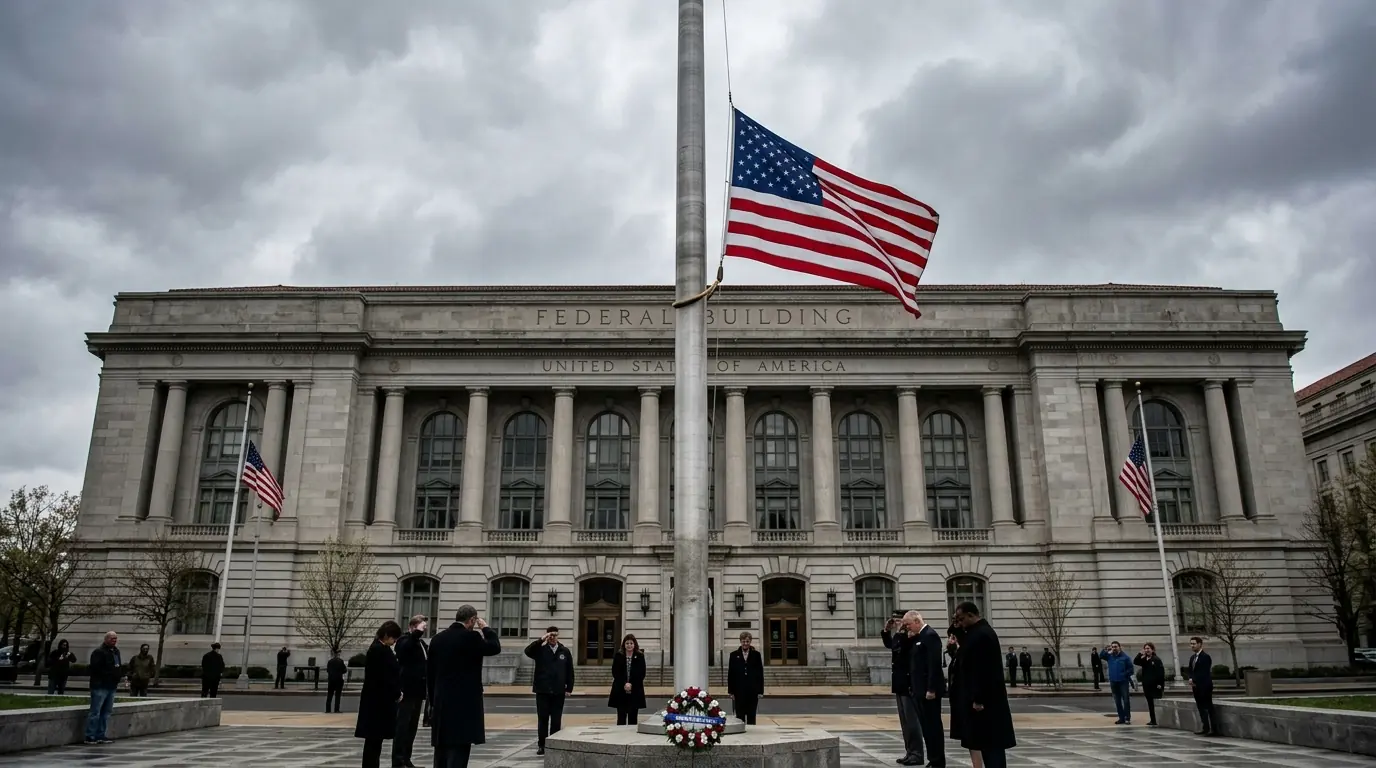
Flying at half-staff without proper authorization is one of the most common protocol violations at postal facilities, and it usually comes from good intentions.
Presidential proclamations set nationwide half-staff periods. When a sitting or former president dies, when there's a national tragedy, during designated memorial periods — these flow through official channels. The VP of Corporate Relations notifies area, district, and plant managers, who then pass the directive to individual facility heads. The chain exists so that every post office responds simultaneously, not piecemeal.
The procedural detail most people skip: you don't just lower the flag to half-staff. The correct procedure is a specific sequence:
1
Raise briskly to the peak
Always start by raising the flag all the way to the top
2
Lower to half-staff position
Halfway between the top and bottom of the staff
3
At day's end, raise back to peak
Before lowering for the night
4
Lower ceremoniously
Complete the lowering for the night
Skipping that initial raise-to-peak step is a protocol error that happens constantly.
Memorial Day Exception
Memorial Day has its own twist. The flag flies at half-staff only from sunrise until noon. After noon, it goes back to full staff for the rest of the day. Facility managers who leave it at half-staff all day on Memorial Day are making one of the most visible compliance mistakes on the calendar.
Local funerals of returned war dead present a judgment call. Federal facilities, including post offices, can follow state or territorial governor proclamations for half-staff. The practical rule: if municipal buildings in your area are flying at half-staff for a fallen service member, your postal facility should match.
The POW-MIA Flag Requirement Most Facilities Get Wrong
Public Law 116-67, signed in November 2019, changed the POW-MIA flag from a holiday-only display to a year-round requirement. That shift caught a lot of facilities flat-footed, and compliance gaps persist years later.
Under ASM Section 476.1, every postal facility must display the POW-MIA flag on each day the US flag is displayed. Not just on Veterans Day. Not just on National POW/MIA Recognition Day in September. Every single day. The law originally applied only to "Post Offices" in the narrow sense, but USPS extended the requirement to all postal facilities.
Placement rules trip people up more than the display schedule. On the same flagstaff, the POW-MIA flag flies immediately below the US flag. On a separate staff, it must sit at the same level or lower — and critically, it cannot be placed to the right of the US flag (the viewer's left). When the US flag goes to half-staff, the POW-MIA flag follows.
The scale of the compliance effort shows up in USPS procurement data:
28,000+
US Flags Replaced (2024)
35,000
POW-MIA Flags Replaced (2024)
Those replacement numbers suggest that even with awareness, flag wear is a persistent operational issue.
Compliance Alert
If your facility is only flying the POW-MIA flag on designated holidays, you've been out of compliance since late 2019. The fix is simple — get the flag up daily — but the awareness gap remains the biggest obstacle.
Flagpole Specifications and Proper Placement
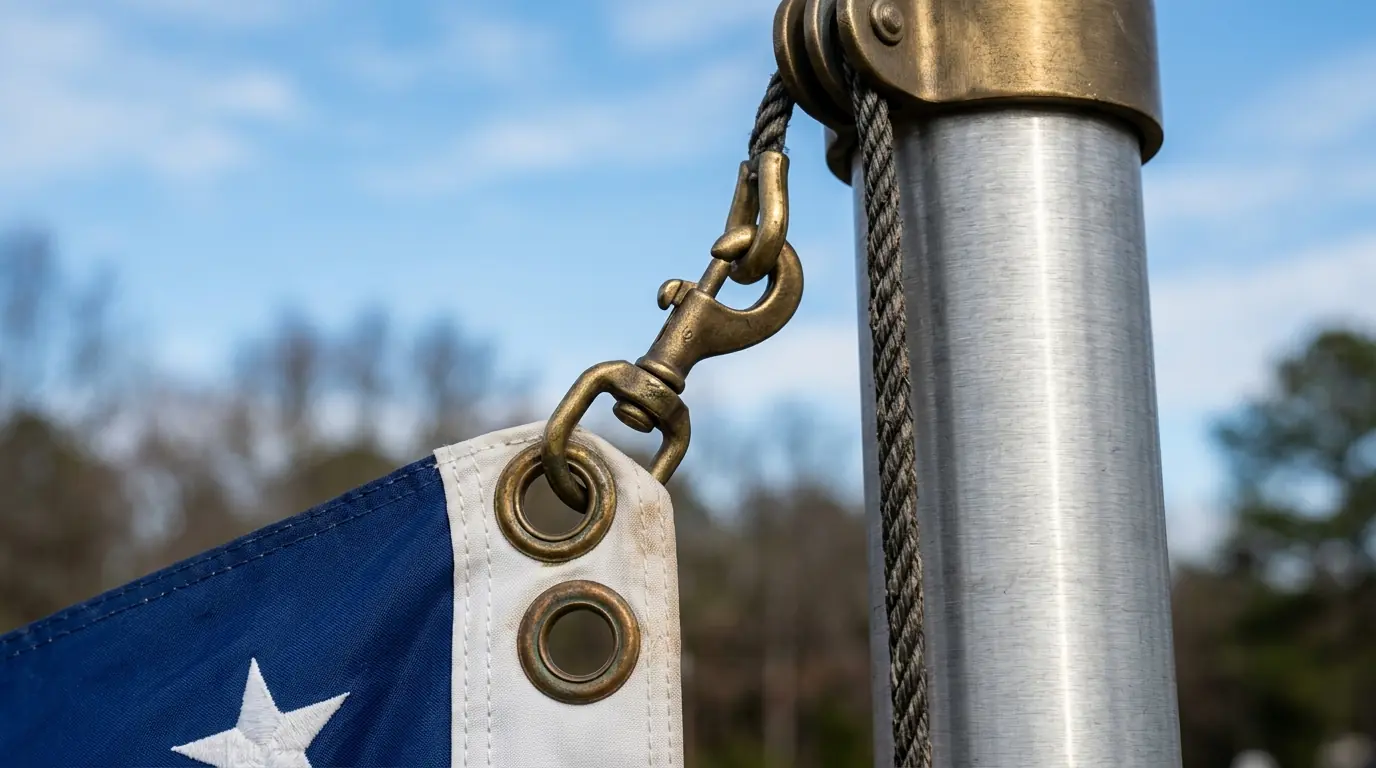
Hardware requirements are less glamorous than display protocols, but a flagpole in poor condition undermines every other compliance effort.
Stationary flagstaffs are required at all postal facilities. Temporary flag poles, portable stands, or improvised setups don't meet the standard. The flagpole itself needs to be structurally sound — free of rust, corrosion, properly anchored, and capable of raising and lowering the flag quickly. If the halyard is frayed or the pulley sticks, submit a maintenance work order. A flagpole that can't lower the flag promptly creates a half-staff compliance problem on the next presidential proclamation.
Position of honor follows a consistent rule: the US flag takes its own right, which is the viewer's left. When displayed with the USPS flag and the POW-MIA flag, the US flag occupies the tallest pole or the highest position. The union — the blue field with stars — stays at the peak of the staff unless the flag is at half-staff.
Night illumination is the most frequently neglected hardware requirement. If the flag stays up after sunset, a dedicated light source must illuminate it. Budget for a flag-specific spotlight if you're running a 24-hour display. The cost is negligible compared to the compliance exposure of flying an unlit flag every night.
Pro Tip: For bulk flag orders over 100 pieces with brass grommets and reinforced headers, contact our team for government-grade pricing.
Where to Buy USPS-Compliant Flags
Federal procurement channels exist specifically so facility managers don't have to guess whether a flag meets government standards.
GSA Advantage at gsaadvantage.gov is the primary platform. It's the federal government's electronic ordering system, and it's where most agencies — including USPS — purchase flags and ceremonial equipment. GSA Schedule 78 covers flags, banners, pennants, and related items, with roughly 500 approved vendors on the current contract cycle running through 2030.
The critical procurement constraint: all flags must be American-made. This isn't a preference — it's a federal Buy American requirement. Flags purchased outside approved channels risk violating this mandate, which creates a compliance problem that has nothing to do with how the flag is displayed.
Among Schedule 78 contract holders, Flags USA Inc. (contract GS-03F-0162Y) specializes in government-grade outdoor flags certified as 100% made in the USA. Several other vendors hold active contracts as well. The minimum order through GSA Schedule 78 is $150, with Net 30 payment terms — standard federal procurement structure.
Facility managers also have access to USPS internal supply channels for replacement flags. If a flag is worn, faded, or damaged, ordering through the internal chain is often the fastest path to a compliant replacement. Don't wait for a holiday inspection to discover the POW-MIA flag has faded to the point of being unrecognizable — check flag condition as a routine facility maintenance task.
Compliance Mistakes That Keep Showing Up
The same violations repeat across postal facilities, and most stem from outdated assumptions rather than willful disregard.
Flying state or local flags is the most clear-cut violation. USPS regulations explicitly prohibit anything beyond the authorized set — US flag, USPS flag, POW-MIA flag, and VP-approved flags. A Texas flag or a city banner outside your post office isn't a local touch. It's a policy violation.
The POW-MIA daily display requirement remains the biggest awareness gap. Facilities that only fly it on recognition days are operating on pre-2019 rules. The law changed. The display requirement is now year-round.
Worn and tattered flags create a different kind of problem — not a technical violation of display timing, but a failure to maintain the standard the ASM expects. A faded POW-MIA flag is barely better than no flag at all from a compliance standpoint. Build flag inspection into your regular facility walkthrough.
Incorrect flag precedence when multiple flags are displayed creates subtle but real protocol errors. The US flag must always occupy the position of honor. Getting this wrong is easy when you have three flags on separate poles and aren't sure which direction "the flag's own right" actually faces.
Sunset without illumination is the silent violation. If you don't have a light on the flag and it's still flying after dark, you're out of compliance every evening. Either install lighting or commit to raising and lowering the flag daily.
Making Your Facility Compliant
The gap between "we fly a flag" and "we're actually compliant" is wider than it looks. Most postal facilities get the basics right — the US flag goes up in the morning, comes down at night. Where compliance falls apart is in the details: the POW-MIA flag that should be flying daily but only appears on holidays, the state flag that somebody hung up years ago and nobody questioned, the after-dark display with no dedicated illumination.
If you're taking over a facility or auditing your current setup, start with three questions:
Those three checks catch the majority of compliance issues.
For replacement flags, go through GSA Advantage or your USPS internal supply chain. Verify the American-made requirement before ordering from any vendor. And build flag condition checks into your routine maintenance schedule — a tattered flag on a rusting pole sends a message, just not the one you want.
Video Guide
Related Articles