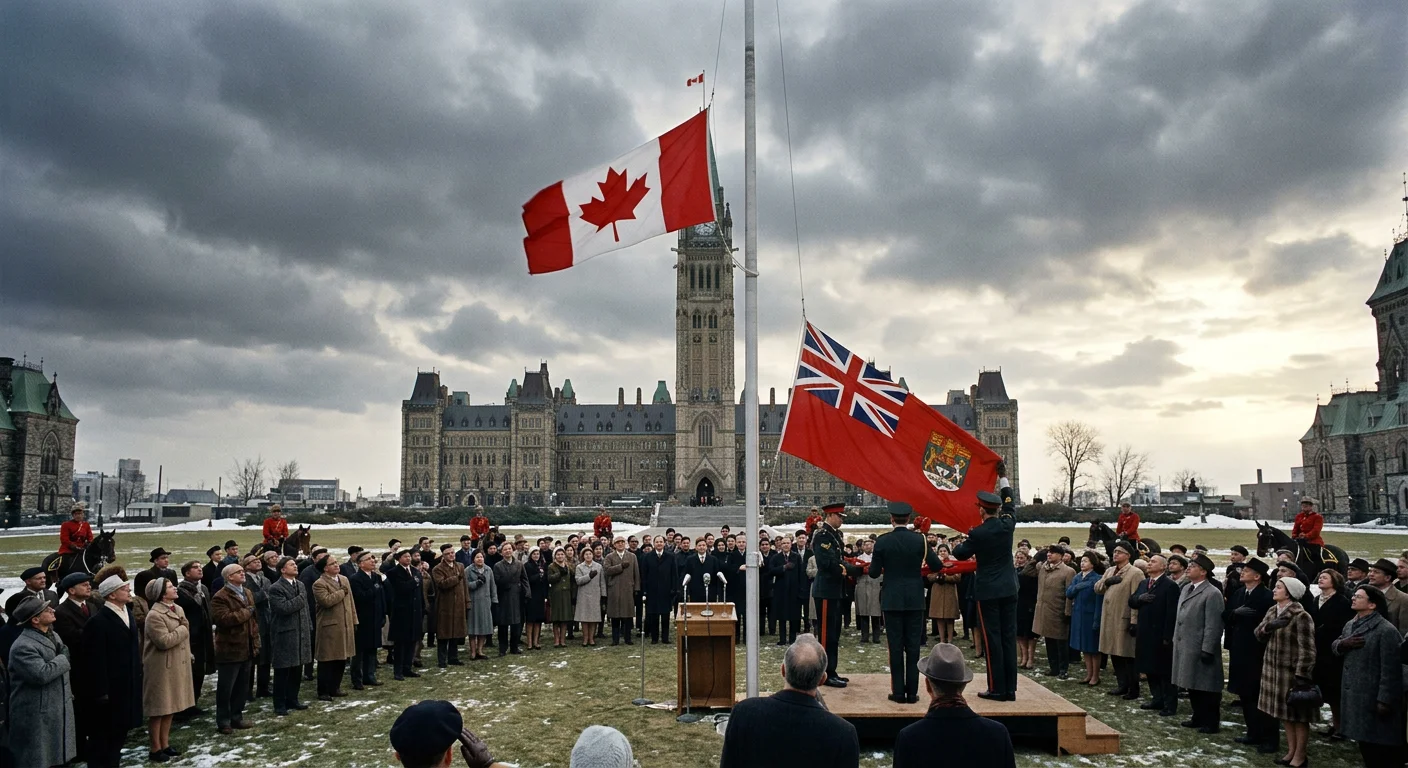
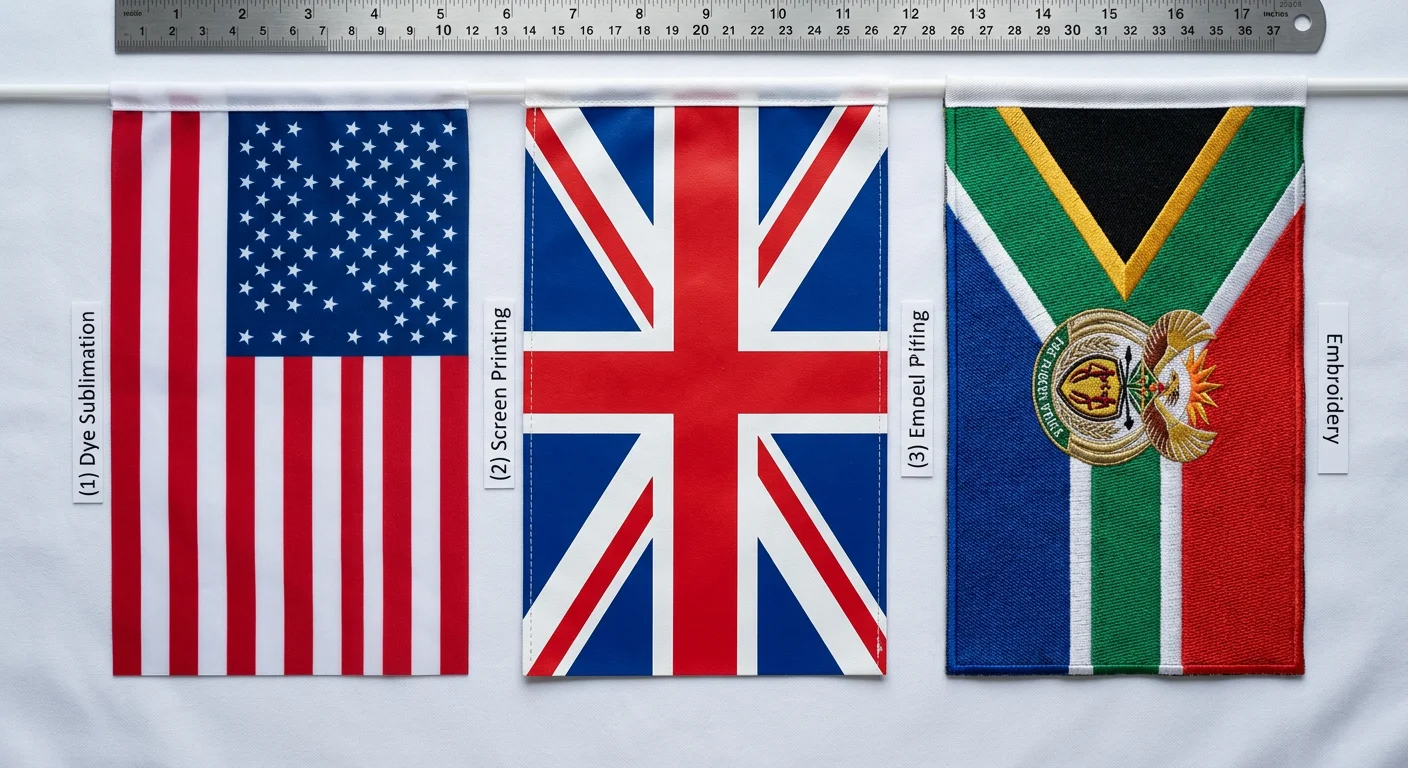
Every American knows the flag — the red, white, and blue, the stars, the stripes. But here's what most people don't know: the flag flying today is the 27th version of a design that kept changing for close to 250 years. Each time a new state joined the union, lawmakers debated, designers sketched, and seamstresses stitched a brand-new official flag into existence.For collectors, retailers, and institutions sourcing historical or modern designs, working with reliable American flags wholesalers ensures consistent quality across different versions of the flag — especially when accuracy in star count and layout matters.
The changes weren't random. Every new version captured a specific moment in American history — who the country was, and who it was becoming. From the scrappy 13-star Betsy Ross flag, sewn during the Revolutionary War, to the iconic 50-star flag that astronauts carried to the moon, each design tells its own story.
What follows is the complete Stars and Stripes history — all 27 official flags, why each one changed, and what the whole remarkable journey means.
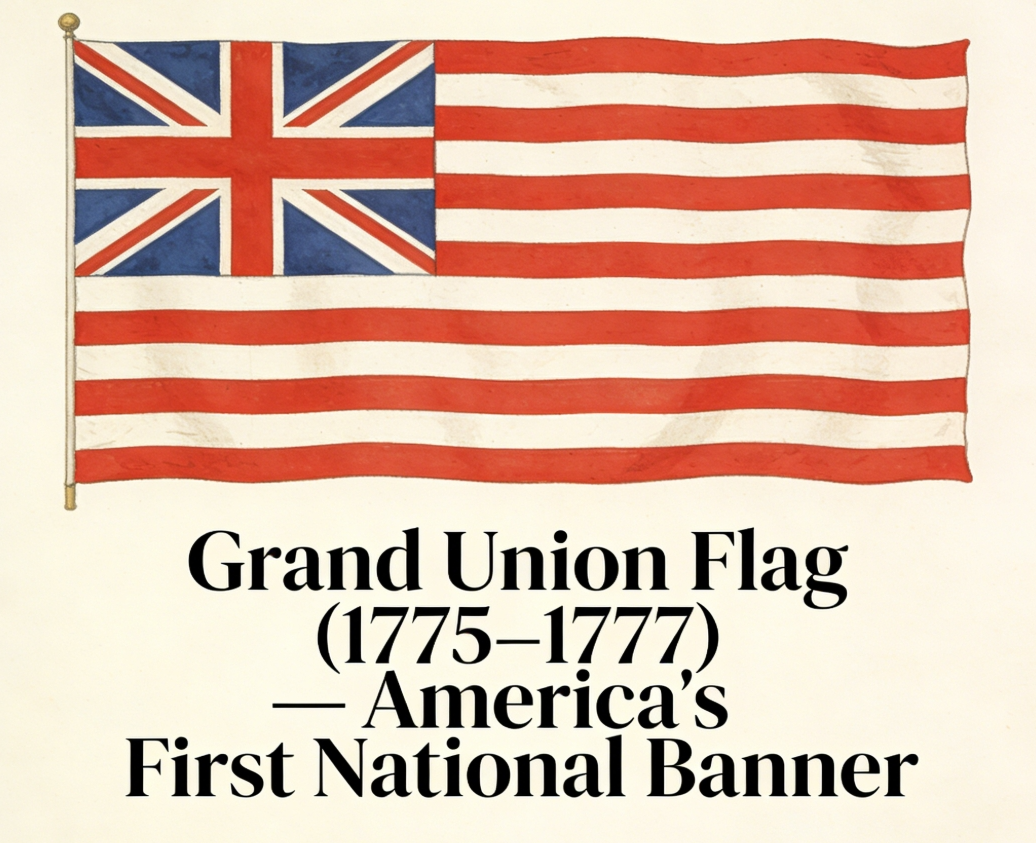
The Pre-Flag Era: Grand Union Flag (1775–1777) — America's First National Banner
Before the stars came the stripes — and a deeply tangled relationship with Britain.
The Grand Union Flag does not count among the 27 official versions. It predates the Flag Act of 1777. Yet no honest history of the Stars and Stripes skips past it. This was the banner American soldiers carried into battle during the earliest days of the Revolution.
The design captured a nation caught between two worlds:
13 red and white stripes — standing for the united colonies
The British Union Jack — still fixed in the upper corner
Loyalty and rebellion, stitched side by side on the same cloth.
Two moments mark its debut. On December 3, 1775 , Lieutenant John Paul Jones raised it aboard the USS Alfred on the Delaware River in Philadelphia. Then on January 1, 1776 , George Washington hoisted it near his Cambridge headquarters.
A Philadelphia resident who saw it put it plainly: "Union flag, with 13 stripes... emblematical of the Thirteen United Colonies." The British, for their part, mistook it for a surrender signal. The irony was not lost on anyone.
On June 14, 1777 , Congress passed the Flag Act. Out went the Union Jack canton. In came 13 stars on blue . The Grand Union Flag stepped aside. It had done its job — holding a young nation together just long enough for that nation to figure out what it wanted to be.
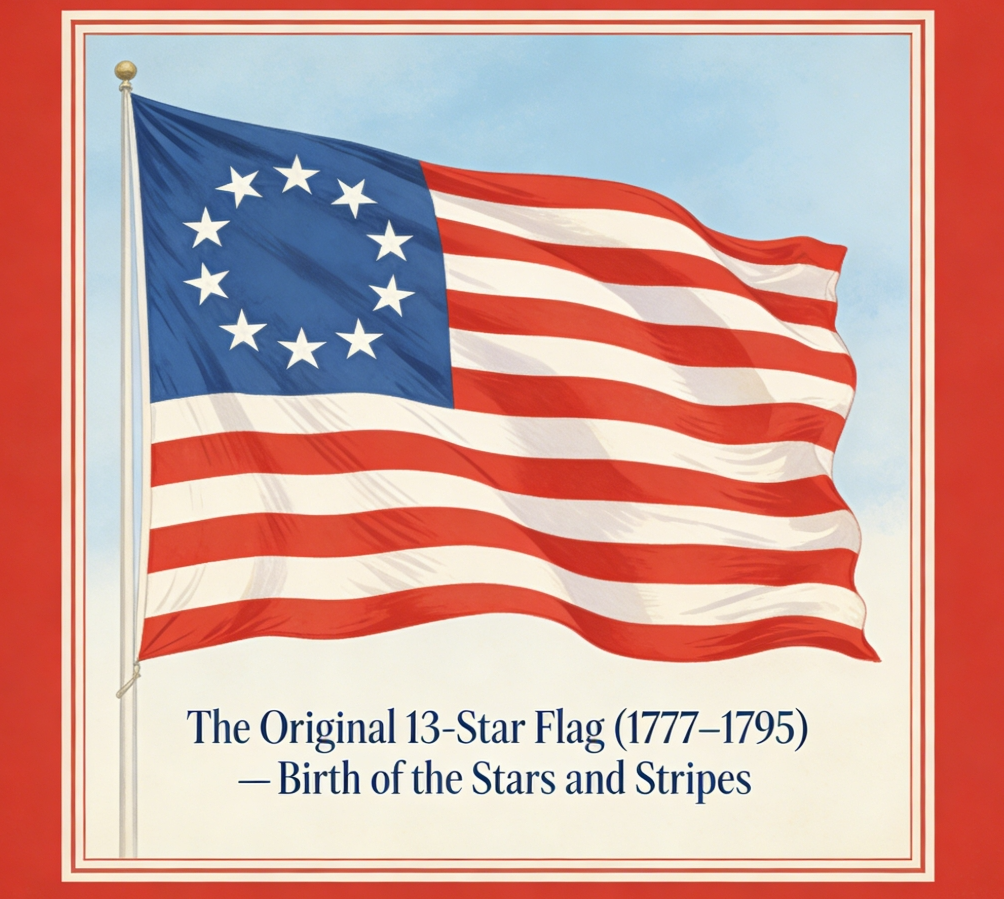
Version 1: The Original 13-Star Flag (1777–1795) — Birth of the Stars and Stripes
The resolution passed on June 14, 1777 was short — and vague.
Congress declared the new flag would carry thirteen stars and thirteen stripes. The stars were described as "representing a new constellation." Beautiful language. But no blueprint. No measurements. No instruction on where those stars should go.
So makers did what makers do: they improvised. Some arranged the stars in a circle. Others chose horizontal rows — easier to read at sea. A few created medallion patterns, with one star larger at the center. The flag above one battlefield looked nothing like the flag above another.
This era gave us the Betsy Ross legend — the seamstress, the president, the famous circular ring of five-pointed stars. Historians haven't confirmed it. What they do know: the circular design dates somewhere within the 1777–1795 window. That's the period when the 13-star flag was official.
The flag kept its design for 18 years . No new states joined, so nothing forced a change. Then Vermont and Kentucky arrived — and everything shifted.
Version 2: The 15-Star, 15-Stripe Flag (1795–1818) — The Flag That Inspired a Poem
Two new states. Two new stars. Two new stripes.
Kentucky and Vermont joined the Union. Congress did the logical thing — it added one of each for both. Simple math, beautiful symmetry. The result was the only U.S. flag ever to carry 15 stripes . It flew for 23 years .
It also flew over Fort McHenry on a September morning in 1814. A British bombardment hit so hard that smoke swallowed the sky. The flag — 30 by 42 feet , sewn over six weeks by Mary Pickersgill and her family — held.
A young lawyer named Francis Scott Key watched from a British ship. He was detained. He was helpless. Dawn broke. The flag still stood. He reached for a pen.
The rest became the national anthem.
That original flag now sits at the Smithsonian Institution in Washington, D.C. It's still breathtaking. Still a little ragged. You'd expect nothing less from something that survived that night.
The design didn't last, though. By 1818, Congress spotted the quiet problem: more states meant more stripes, and stripes couldn't shrink forever. So they drew a line — 13 stripes, permanent . Stars would keep growing. Stripes would not.
The 1818 Flag Act: The Rule That Froze the Stripes Forever
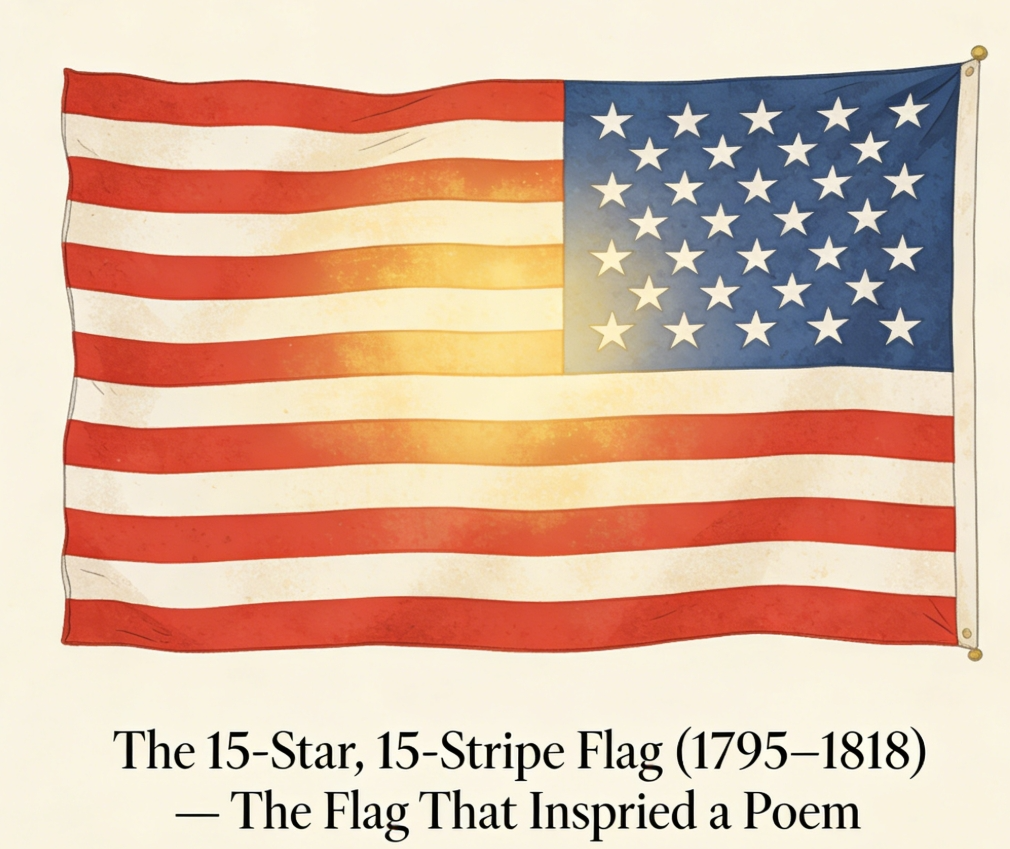
Thirteen stripes. That number has never changed — and thanks to a law passed on April 4, 1818 , it never will.
Congress saw the problem. Five states had joined since 1795. Stripes kept pace with stars, the flag would look more like a barcode than a banner. Something had to give.
The fix was clean and lasting. The Flag Act of 1818 locked the stripes at thirteen — a quiet tribute to the original colonies. The stars, though, could keep growing with each new state. The rule was simple: one new star per state, added on each July 4th after a state joined.
On that first July 4th under the new law, the flag carried 20 stars arranged in four rows of five . Months later, on September 18, 1818, Congress updated the layout to a cleaner vertical alignment.
Every American flag since has followed this same framework — stars change, stripes don't.
Versions 3–10: The Early Expansion Era (1818–1847) — Stars for a Growing Nation
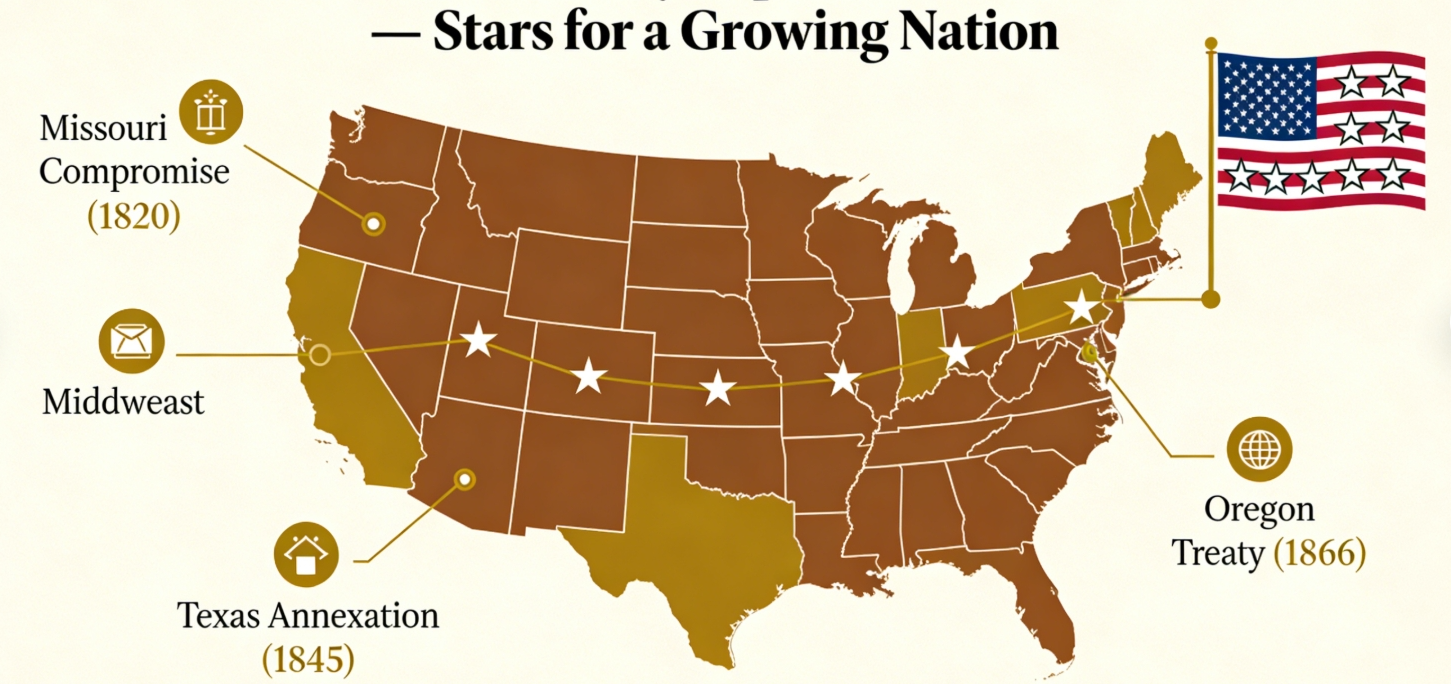
Eight flags in twenty-nine years. That's how fast America was growing.
The 1818 Flag Act passed — and the stars started multiplying almost immediately. Five states had been waiting for their place on the flag: Tennessee, Ohio, Louisiana, Indiana, and Mississippi. They all got it at once on July 4, 1818 . The 20-star flag (Version 3) was unlike anything before it. One design, catching up on close to twenty years of history in a single moment.
From there, the changes came fast — sometimes one right after another:
Version 4 — 21 stars (1819–1820): Illinois joins.
Version 5 — 23 stars (1820–1822): Alabama and Maine enter together under the Missouri Compromise. That means a 22-star flag never existed — the design jumped straight past it.
Version 6 — 24 stars (1822–1836): Missouri's admission brings this flag to life. It then holds for 14 years — the longest run of any design in the entire era.
Version 7 — 25 stars (1836–1837): Arkansas arrives, stays one year.
Version 8 — 26 stars (1837–1845): Michigan joins. Eight years of relative stillness follow.
Version 9 — 27 stars (1845–1846): Florida steps in.
Version 10 — 28 stars (1846–1847): Texas — a republic for a decade before this — becomes a state, and the flag changes again.
Each update carried real weight. The Louisiana Purchase doubled the country's land. The Missouri Compromise tried hard to hold a fracturing nation together. The annexation of Texas lit the fuse for the Mexican-American War. The stars weren't decorative. They kept a running count of a country in constant motion.
One detail that tends to surprise people: through this entire period, no official star arrangement existed . Flag makers chose their own layouts — neat rows, staggered grids, or the striking "Great Star" pattern , where individual stars came together to form one giant star shape. That version flew over the U.S. Capitol dome for months in 1818. It was striking. It was also, for all its drama, unofficial.
The rules — and the standardization — would come much later.
Versions 11–18: Civil War Era Flags (1847–1867) — Stars During America's Darkest Hours
Eight flags in twenty years. And then the country almost tore itself apart.
From 1847 to 1867, the Stars and Stripes went through eight updates — Iowa, Wisconsin, California, Minnesota, Oregon, Kansas, West Virginia, Nevada. Each new state got its star on the next July 4th, exactly as the 1818 Act had set out. The flag grew with purpose. It moved like a country that knew where it was headed.
Then came 1861.
The Flag That Flew Through the Fire
Kansas joined the Union on January 29, 1861. The 34-star flag became official that July 4th. Two months later, Confederate guns opened fire on Fort Sumter. Eleven Southern states seceded. And yet — the Union never pulled their stars off the flag. Not one. All 34 stars stayed through the entire war. That was a clear, quiet statement: these states still belong to us.
That choice carried real weight. The flag flying over Union soldiers wasn't just a battle standard. It was an argument.
The 35-star flag arrived July 4, 1863 — the same week as Gettysburg. West Virginia split off from Confederate Virginia during the war and earned that star. The 36-star flag came in 1865, adding Nevada. It outlasted the war itself.
Version | Stars | State Added | Active Period |
|---|---|---|---|
11 | 29 | Iowa | 1847–1848 |
12 | 30 | Wisconsin | 1848–1851 |
13 | 31 | California | 1851–1858 |
14 | 32 | Minnesota | 1858–1861 |
15 | 33 | Oregon | Jan–Jul 1861 |
16 | 34 | Kansas | 1861–1863 |
17 | 35 | West Virginia | 1863–1865 |
18 | 36 | Nevada | 1865–1867 |
The Confederacy flew its own flags at the same time — the Stars and Bars, the Stainless Banner, the Blood-Stained Banner. Four years. Four flags on opposite sides of the same country. The Union's answer never changed: keep adding stars, hold the stripes at thirteen, keep going.
Versions 19–26: The Western Expansion Flags (1867–1912) — Stars for the Frontier
Forty-five years. Eight flag versions. A country moving west so fast that Washington couldn't keep up with the paperwork.
After the Civil War, the frontier opened. Nebraska came in 1867, pushing the count to 37 stars . Colorado followed a decade later — 38 stars , 1877. Then 1889 hit like a flood. North Dakota, South Dakota, Montana, and Washington all joined at once. The flag jumped straight to 40 stars . The expected 39-star version — planned for a unified Dakota Territory — never happened. The territory split in two. The math changed overnight. Unofficial 39-star flags were already being stitched, and Congress had to rewrite the plan.
Idaho and Wyoming added up to 41 stars in 1890. Utah brought 42 in 1896.
Then things got messy.
Oklahoma's statehood process was complicated. It produced a tangle of disputed variants — 43, 44, 45, and 46-star flags spread across different years and makers. The 45-star flag saw real action. It flew during the Spanish-American War over Cuba, Puerto Rico, and the Philippines between 1898 and 1908. No official star arrangement existed during this stretch. Flag makers chose their own layouts — rows, grids, scattered clusters — and no two versions looked quite alike.
New Mexico and Arizona closed the chapter in 1912, bringing the count to 48 stars .
That same year, President Taft signed Executive Order 1556 . It set standard proportions and star placement for the first time in history. The chaos ended.
The 1912 Presidential Order: The Flag Gets Standardized Proportions
For 135 years, nobody could agree on what the flag was supposed to look like.
The Army used three different sizes with inconsistent ratios. The Navy ran nine sizes of its own — and arranged the Union canton in a different position than the Army did. Private American flags manufacturers did whatever they wanted. A flag sewn in Ohio looked nothing like one made in Boston. Proportions ranged from 10:17 to 10:20. Nobody was wrong, because nobody had written down what right meant.
President William Howard Taft put an end to it on June 24, 1912 , with Executive Order 1556 .
The order was more precise than any flag guidance before it:
Hoist to fly ratio: 1 to 1.9
Stripe width: 1/13 of the hoist
Union dimensions: 7/13 wide, 0.76 long
Star arrangement: 6 rows of 8 stars
Twelve standard government sizes were set — from a grand 20 × 38 feet down to a modest 1.31 × 2.5 feet . Every flag made or bought for government use after July 4, 1912 had to meet these specs. No exceptions.
The 48-star flag that came from that order flew for 47 years — longer than any other version in American history.
Version 27 (Part 1): The 49-Star Flag (1959) — Alaska Joins the Union
It lasted one year. Not a day more.
On January 3, 1959 , Alaska became the 49th state — the first to sit outside the continental United States. At 12:01 AM on July 4, 1959 , a brand-new flag rose over Fort McHenry . That's the same ground where the 15-stripe flag survived a British bombardment 145 years earlier. The moment felt deliberate. Ceremonial. Historic.
And then, 48 days later, Hawaii applied for statehood.
The 49-star flag never stood a chance. It holds the record as the shortest-lived official U.S. flag — active from July 4, 1959 to July 3, 1960. Most Americans didn't even have time to memorize its arrangement before it was retired.
That arrangement was a real puzzle. Forty-nine is an odd number. Odd numbers don't fit cleanly into a rectangular field. Designers solved it with offset rows in a 7-5-7-5-7-5-7-5-7 pattern — nine rows that alternated between seven stars and five stars. President Eisenhower locked in the design through Executive Order 10798 . He signed it on the same day Alaska achieved statehood.
A committee had been working on flag design ideas since 1958. They saw the change coming and got the math right. The timing, though, got overtaken by events almost straight away. Hawaii was already on its way in.
Version 27 (Part 2): The 50-Star Flag (1960–Present) — America's Longest-Serving Flag
Sixty-five years and still flying — no other version of the Stars and Stripes has come close.
Hawaii became the 50th state on August 21, 1959 . Less than a year later, on July 4, 1960 , President Eisenhower raised the new flag for the first time. It hasn't been replaced since.
Here's the detail people can't believe: the design came from a 17-year-old high school student . Bob Heft, from Lancaster, Ohio, drafted it as a class project. He took his family's 48-star flag. He cut it apart, then sewed two extra stars back in, arranged in a staggered pattern. His teacher gave him a B-minus .
Eisenhower reviewed 1,500 submissions . He picked Heft's design from three finalists. Then he called Heft directly to share the news. The grade changed to an A.
The layout solved the math cleanly — five rows of six stars alternating with four rows of five . That gives you perfect symmetry across a 10×5 grid. Fifty stars. No wasted space.
Executive Order 10834 fixed every proportion in place:
- Hoist-to-fly ratio: 1:1.9
- Stripe width: 1/13 of the hoist
- Star diameter: set to an exact measurement
The flag flying over a courthouse and the one folded over a casket share the same specifications. Every detail matches. No exceptions.
It has outlasted every version before it. And it's still counting.
Why Did the American Flag Keep Changing? The 4 Core Driving Forces
Key Insight
Four forces shaped every update. Once you see them, the flag starts to read like a living document — not a fixed symbol.
1. Statehood Was the Engine
Every flag change after 1777 traces back to one thing: a new state joining the Union. The rule was simple — one star per state, added on the next July 4th. Thirty-seven stars were added over 183 years. Each star marked a real political moment. A negotiation. A compromise. Sometimes a war.
2. Congress Had to Write the Rules
The 1777 resolution was vague. No arrangement. No proportions. Congress had to pass three more laws to fix that — the 1818 Flag Act, Taft's 1912 Executive Order, and Eisenhower's 1959/1960 orders. Each law tackled a real problem:
- Stripes were multiplying out of control
- Reliable American flags Manufacturers were producing designs that looked completely different from each other
- Odd star counts wouldn't fit into clean grid patterns
It took that entire body of legislation to build a framework that held up.
3. Manufacturing Demanded Consistency
After the Civil War, industrial production scaled up fast. The mix of unofficial star arrangements turned into a genuine logistical headache. Trusted American flags factories needed a single standard to follow. Standardization solved a practical problem — not just an aesthetic one.
4. The Flag Was Always Making an Argument
Lincoln kept all 34 stars on the flag during the Civil War — even as 11 Southern states seceded. That was a deliberate choice. The 13 stripes stayed fixed as a permanent tribute to the original colonies. The flag wasn't just recording history. It was pushing a position.
American Flag Symbolism: What the Stars, Stripes, and Colors Mean
The flag doesn't explain itself. It just flies — and most of us have stared at it our whole lives without ever asking what we're looking at.
Here's what's there.
The 13 stripes stand for the original colonies. Red and white, alternating — seven red and six white. They haven't changed since 1818, and they never will. That number is locked in by law. It's a permanent reminder of where the country started.
The 50 stars tell a different story. Each one represents a state. Add a state, add a star. It's the simplest math in American history — and also the most consequential.
The colors themselves carry meaning too, though not as formally as most people assume. Red stands for valor and hardiness. White stands for purity and innocence. Blue stands for vigilance, perseverance, and justice. Charles Thomson helped design the Great Seal. He described these color meanings in 1782. None of it was written into law. But it stuck anyway.
Red
Valor and Hardiness
White
Purity and Innocence
Blue
Vigilance, Perseverance, Justice
The flag's precision is what makes it stand out beyond the symbolism. The blue canton covers 7 of the 13 stripes . Each star is sized to 4/5 of one stripe's width . The full flag runs a 10:19 aspect ratio — not a perfect rectangle, but something more deliberate than that. Every element was calculated. Nothing was left to guesswork.
7/13
Canton Stripes
4/5
Star-to-Stripe Ratio
10:19
Aspect Ratio
It's a symbol built like a blueprint.
Complete Timeline Table: All 27 Official American Flags at a Glance
All 27 versions, every date, every president — laid out in one place.
# | Stars | Stripes | Effective Date | End Date | Duration | New State(s) Added |
|---|---|---|---|---|---|---|
1 | 13 | 13 | Jun 14, 1777 | May 1, 1795 | ~18 yrs | — (13 original colonies) |
2 | 15 | 15 | May 1, 1795 | Apr 13, 1818 | ~23 yrs | Vermont, Kentucky |
3 | 20 | 13 | Apr 13, 1818 | Jul 4, 1819 | ~1 yr | TN, OH, LA, IN, MS |
4 | 21 | 13 | Jul 4, 1819 | Jul 4, 1820 | ~1 yr | Illinois |
5 | 23 | 13 | Jul 4, 1820 | Jul 4, 1822 | ~2 yrs | Alabama, Maine |
6 | 24 | 13 | Jul 4, 1822 | Jul 4, 1836 | ~14 yrs | Missouri |
7 | 25 | 13 | Jul 4, 1836 | Jul 4, 1837 | ~1 yr | Arkansas |
8 | 26 | 13 | Jul 4, 1837 | Jul 4, 1845 | ~8 yrs | Michigan |
9 | 27 | 13 | Jul 4, 1845 | Jul 4, 1846 | ~1 yr | Florida |
10 | 28 | 13 | Jul 4, 1846 | Jul 4, 1847 | ~1 yr | Texas |
11 | 29 | 13 | Jul 4, 1847 | Jul 4, 1848 | ~1 yr | Iowa |
12 | 30 | 13 | Jul 4, 1848 | Jul 4, 1851 | ~3 yrs | Wisconsin |
13 | 31 | 13 | Jul 4, 1851 | Jul 4, 1858 | ~7 yrs | California |
14 | 32 | 13 | Jul 4, 1858 | Jul 4, 1859 | ~1 yr | Minnesota |
15 | 33 | 13 | Jul 4, 1859 | Jul 4, 1861 | ~2 yrs | Oregon |
16 | 34 | 13 | Jul 4, 1861 | Jul 4, 1863 | ~2 yrs | Kansas |
17 | 35 | 13 | Jul 4, 1863 | Jul 4, 1865 | ~2 yrs | West Virginia |
18 | 36 | 13 | Jul 4, 1865 | Jul 4, 1867 | ~2 yrs | Nevada |
19 | 37 | 13 | Jul 4, 1867 | Jul 4, 1877 | ~10 yrs | Nebraska |
20 | 38 | 13 | Jul 4, 1877 | Jul 4, 1890 | ~13 yrs | Colorado |
21 | 43 | 13 | Jul 4, 1890 | Jul 4, 1891 | ~1 yr | ND, SD, MT, WA, ID |
22 | 44 | 13 | Jul 4, 1891 | Jul 4, 1896 | ~5 yrs | Wyoming |
23 | 45 | 13 | Jul 4, 1896 | Jul 4, 1908 | ~12 yrs | Utah |
24 | 46 | 13 | Jul 4, 1908 | Jul 4, 1912 | ~4 yrs | Oklahoma |
25 | 48 | 13 | Jul 4, 1912 | Jul 4, 1959 | 47 yrs | New Mexico, Arizona |
26 | 49 | 13 | Jul 4, 1959 | Jul 4, 1960 | ~1 yr | Alaska |
27 | 50 | 13 | Jul 4, 1960 | Present | 65+ yrs | Hawaii |
A Few Things Worth Noticing
The table holds a few quiet surprises. Nine versions lasted less than a single year — each one replaced by the fast pace of westward expansion. A 22-star flag never existed at all. Alabama and Maine joined at the same time, so the count skipped right past it. The 48-star flag outlasted eight presidencies . The current 50-star design passed that record in 2007 — and it's still going.
One clear pattern runs through this table. After 1818, every flag holds 13 stripes . No more, no fewer. The stars kept growing in number. The stripes stayed the same and never changed again.
Custom American Flags: How to Honor This 250-Year Legacy with Your Own Design
Two hundred and fifty years of history, folded into cloth and color. That's what a flag carries.
That history runs deep. The American flag has gone through 27 versions across two and a half centuries. There's a real way to bring that story into your own hands. A custom American flag, built to the proportions of any official era, gives you one of the most direct connections to that history.
At runcustomflag.com , you can do that. Pick your era. The 13-star Betsy Ross design. The 15-stripe Fort McHenry flag. The clean 50-star grid that's been flying since 1960. Each version is reproduced with authentic proportions — a hoist-to-fly ratio of 1:1.9, stripes at 1/13 of the hoist, stars sized and spaced to the original specifications.
The details matter here. A few things to consider:
Nylon holds up outdoors. It handles wind and weather well.
Cotton gives you a softer, more historic texture. Great for display pieces.
Embroidered stars — raised, precise, and premium — are worth it for replicas built to last.
Whatever version you choose, you're not just ordering a flag. You're picking a moment in American history and saying: this one matters to me.
Conclusion
Two hundred and fifty years. Twenty-seven flags. One nation, still adding stars.
The American flag isn't extraordinary just because of its red, white, and blue. It's extraordinary because every change tells a real story. A new state earned. A war survived. A country that refused to stop growing. The Grand Union Flag came together in 1775. The 50-star Stars and Stripes followed — and has flown longer than any version before it. Each design was history made visible.
And here's what stays with you: the flag was never finished . It was always becoming.
This look at American flag history might have sparked something in you. Maybe it's a school project. Maybe it's a moment of real pride. Or maybe you just want to own a piece of that legacy. RunCustomFlag.com lets you bring that feeling to life. You can create a custom flag built the way you picture it.
Because some symbols are worth making your own.
Video Guide
Related Articles You May Enjoy