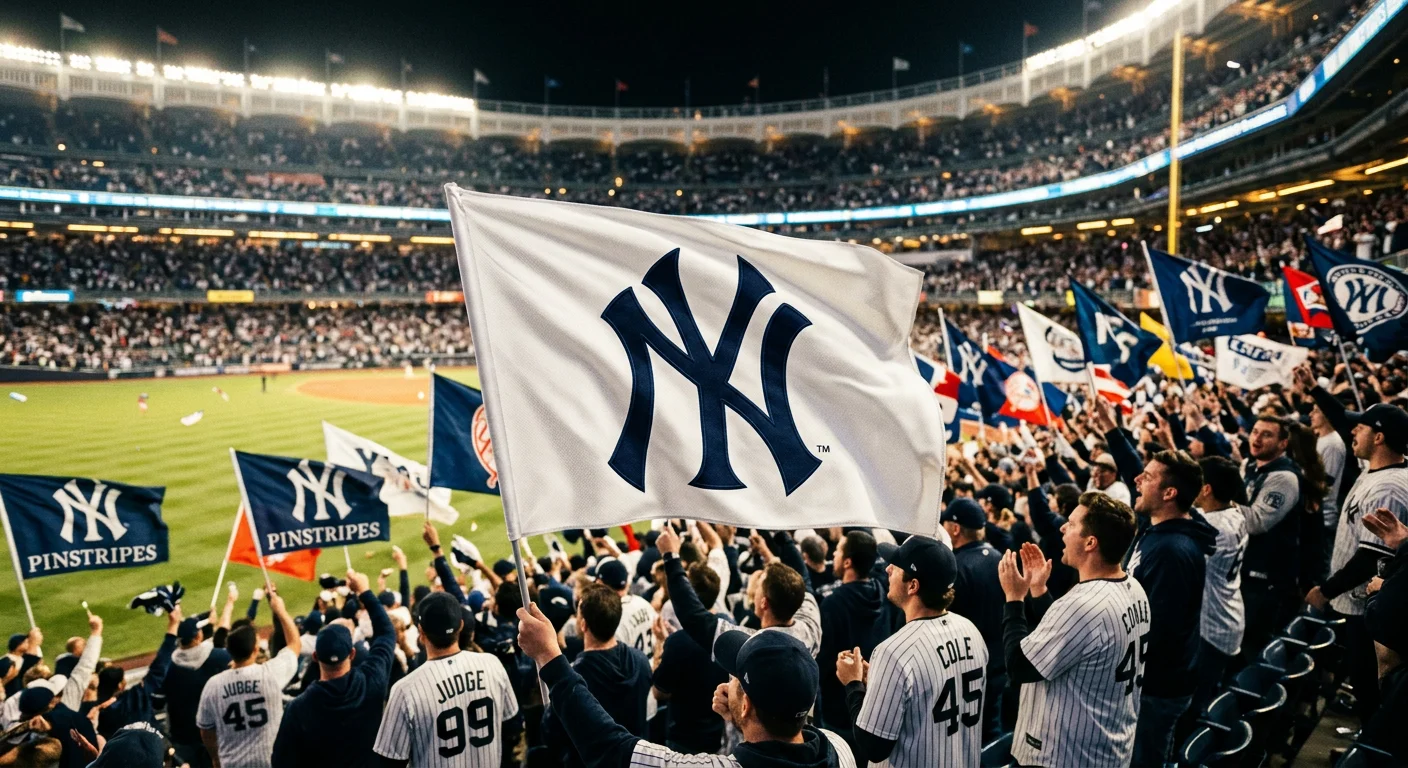
80,000 fans lift their flags at once. The whole stadium becomes a living, breathing wave of color. You've seen it a thousand times — and it never gets old.
That moment isn't accidental. It comes from decades of identity, passion, and design packed into every thread of a football team flag .For stadium merch planners and banner distributors, the demand behind moments like this is closely tracked by top 8 Most Popular Football Team Flags suppliers who study which club designs dominate global match-day displays.
So, who's this for? A few different people:
Die-hard supporters hunting for the most iconic football fan flags to add to a collection
Club organizers sourcing banners for match day
Anyone curious about what makes certain flags impossible to ignore in a crowd
You're in the right place.
From the Blaugrana stripes of Barcelona to Brazil's electric green and gold — we're breaking down the 8 most recognizable football stadium flags on the planet. We cover what makes each one unforgettable, and how you can own — or even create — one yourself.
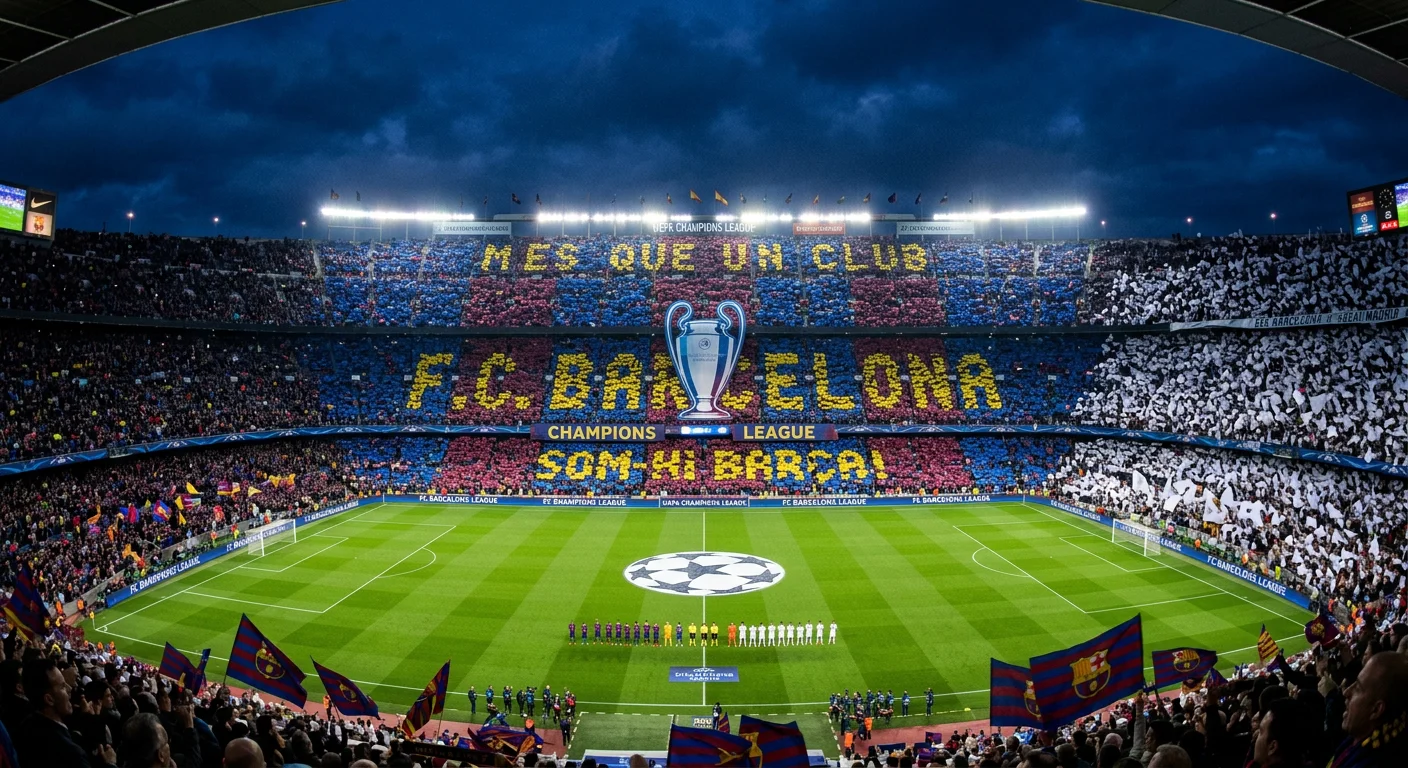
#1 FC Barcelona Flag — The Blaugrana Identity That Dominates Global Stadiums
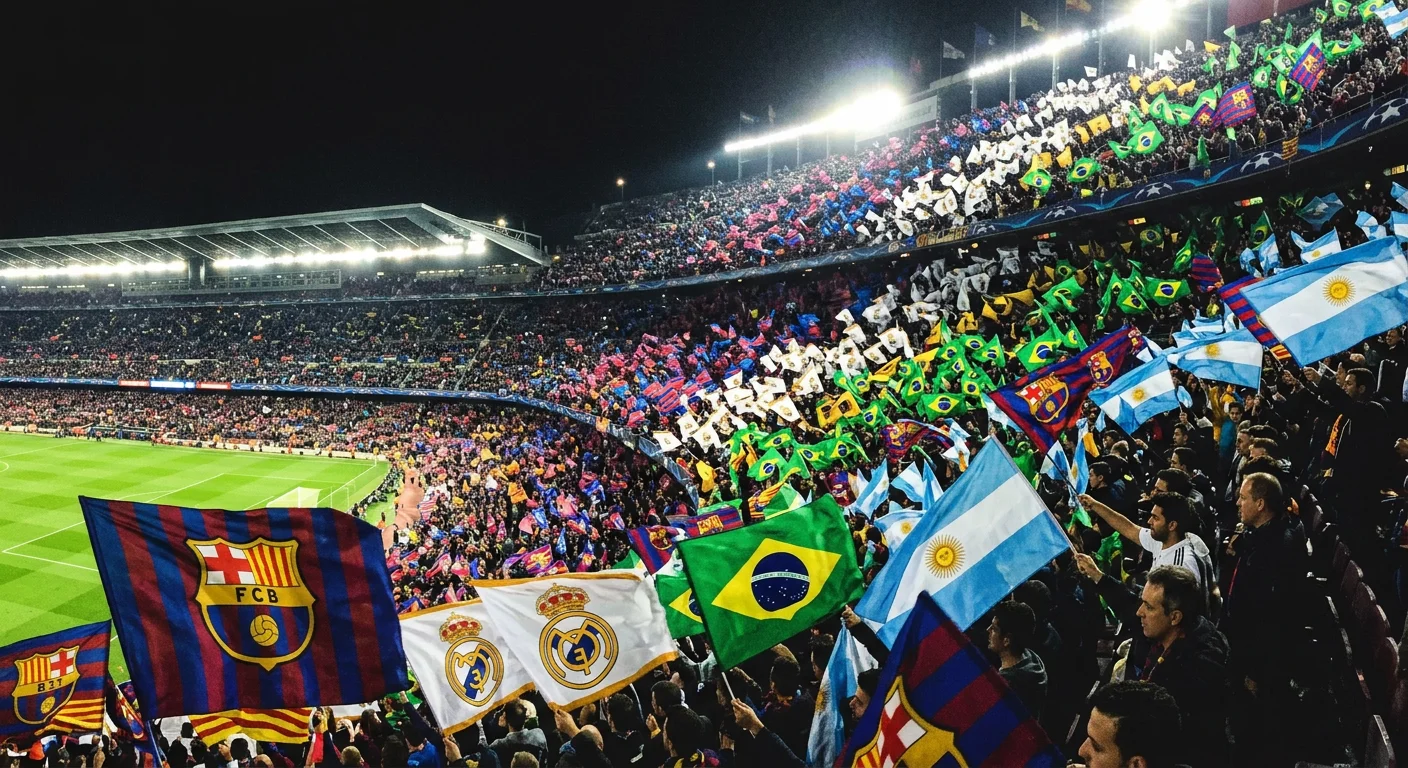
Few football flags carry the weight of an entire culture. The FC Barcelona flag does that.
Those iconic blue and maroon stripes — the Blaugrana — weren't chosen by accident. In 1899 , club founder Joan Gamper picked the diagonal color combination by hand. Design references like the Blaugrana pattern are often studied by custom Football Team Flags suppliers developing club-style supporter banners for international fan groups.It became one of the most recognized club flag designs on earth. Over 125 years later, every element still means something.
What Makes the Design So Powerful
Break the flag down and you'll find layers of identity most fans never notice:
The Senyera (top section): Four red vertical stripes on gold — taken straight from the Crown of Aragon coat of arms. It's a declaration of Catalan pride, not just a design choice.
Blue and maroon diagonal stripes : Loyalty and passion encoded into fabric since day one.
The white football : Subtle but deliberate — it's appeared on every official crest since 1908 .
"FUTBOL CLUB BARCELONA" + 1899 : The founding date isn't decoration. It's legacy made permanent.
Franco's regime forced the club to strip Catalan symbols and rebrand as Club de Fútbol Barcelona . Fans kept the identity alive anyway. The symbols returned. They always do.
How Fans Use This Flag
Football stadium flags come in every scale imaginable:
| Size | Best Use |
|---|---|
| 30×45 cm | Handheld in stands or fan parades |
| 60×90 cm | Balconies, tailgate setups |
| 90×150 cm | Stadium walls, large displays |
Standard flags use 100% polyester with anti-UV coating and two metal grommets . They're built for seasons of outdoor use — not just one match day.
On European nights, Barça tifos stretch goal to goal . Entire stands turn into one breathing mosaic. That's not merchandise. That's a statement.
#2 Real Madrid Flag — The Symbol of a Record 15-Time Champions League Club
Fifteen Champions League titles. No other club comes close. AC Milan has 7. Bayern Munich and Liverpool sit at 6 each. That gap isn't luck. It's a dynasty. The all-white flag of Real Madrid carries every bit of that weight.Large-scale match-day banners like these are typically produced in specialized football Team Flags factory facilities capable of handling oversized stadium displays.
A Design Built on Dominance
The Real Madrid flag keeps it simple. White base. Gold crown shield. Nothing more.
Los Blancos don't need color to command attention. Their record speaks for itself. The gold crown emblem holds the identity together — a royal symbol that has stayed fresh for decades without feeling dated.
Simple flags hit harder when the legacy behind them is this strong.
The Numbers Behind the Flag
Here's what those 15 titles look like in real terms:
First dynasty : 5 consecutive European Cups (1955–1960) — a record no club has matched
Modern era dominance : 3 back-to-back Champions League titles under Zidane (2016–2018) — no other club has done this in the UEFA era
2024 Wembley final : White flags with crown shields packed the stands as Madrid beat Dortmund 2–0
What This Flag Means on Match Day
At the Bernabéu, white flags don't just wave — they flood the entire bowl. Champions League nights turn the stadium into one blinding sea of white. That image is now tied directly to the club's identity around the world.
Real Madrid tops club merchandise sales across the globe. The club pulls in €1B+ per year — that's 20–25% more than its closest rivals. Football fan flags and icon items linked to UCL success hold strong price points because demand stays high. It never drops off.
This isn't just football merchandise . You're holding the most decorated crest in the sport's history — printed on fabric.
#3 Manchester United Flag — Red Devil Pride Spanning Six Continents
650 million followers. That's not a fanbase — that's a movement that rewrote what a football club could become.
Manchester United's red flag with the iconic Devil crest doesn't just stop at Old Trafford. You'll find it in Jakarta living rooms, Mumbai street markets, Lagos barbershops, and Mexico City sports bars. No other football team flag has rooted itself this deep across this many cultures at once.
A Flag That Crosses Every Border
The numbers don't lie. Here's where Manchester United's support actually lands:
| Country | Fan Support (Internet Users) |
|---|---|
| Indonesia | 39% |
| India | 31% |
| South Africa | 30% |
| Malaysia | 28% |
| Thailand | 27% |
| UAE | 26% |
| Mexico | 23% |
Latin America alone hits 52% support among internet users. Asia Pacific sits at 23% . Europe at 35% . North America punches hardest at a 4.32 engagement index — close to four times the average fan.
This isn't one region loving one club. This is six continents waving the same football fan flag .
Why This Flag Travels So Well
The design is easy to read from a distance. Bold red base. Sharp Devil emblem. Clean crest structure. At football stadium flags events during pre-season tours across Asia and North America, that red stands out under stadium lights like nothing else.
82% of United fans consume content on mobile. This flag lives on screens just as much as in stadiums. Fans share it, photograph it, and repost it millions of times a month. That adds up across 65.2 million global searches every single month.
That's the real reach for modern soccer supporter flags : the internet.
#4 Liverpool FC Flag — You'll Never Walk Alone & the Power of Kop End
No other football team flag carries a song inside it.
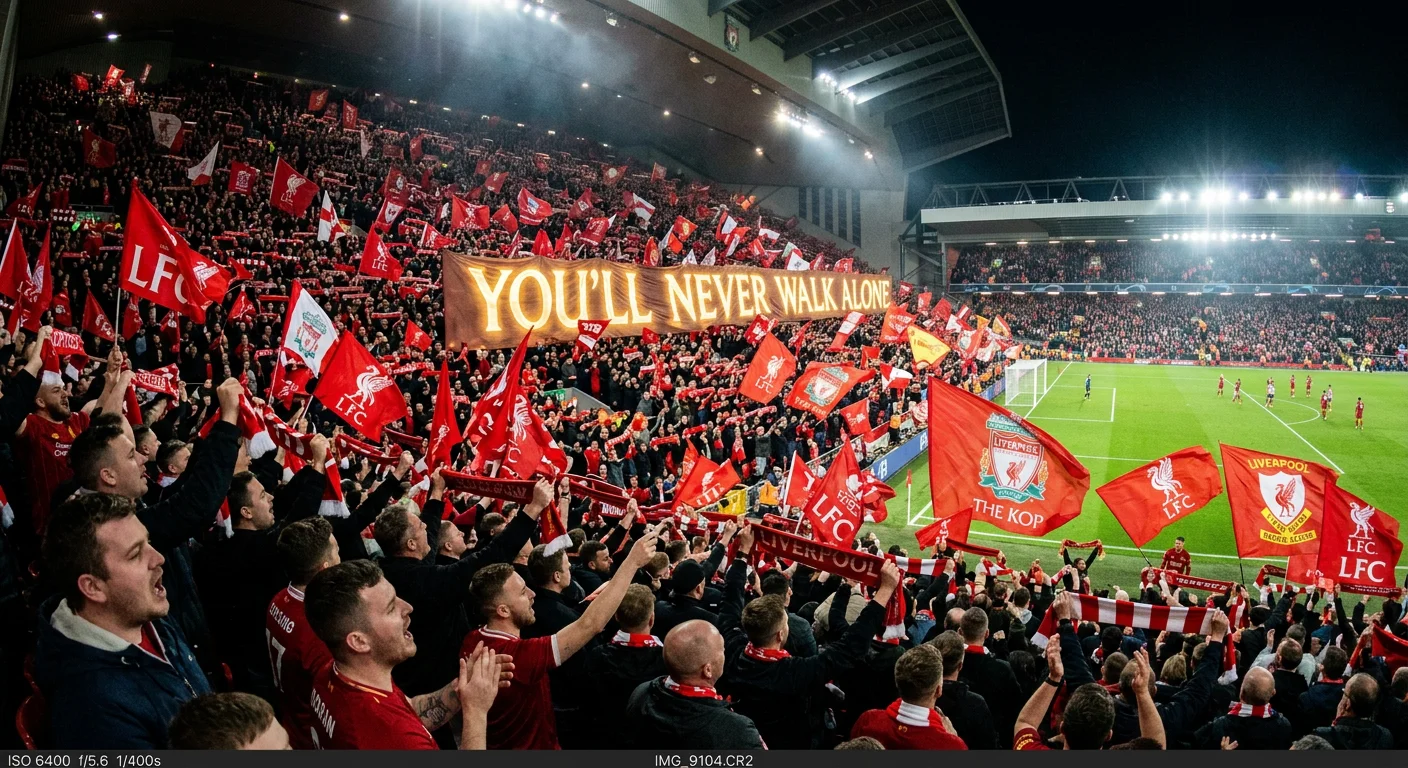
The Liverpool FC flag does. Those four words — You'll Never Walk Alone — aren't just embroidered text. They hold 60 years of identity in a single phrase, stitched into every soccer supporter flag that flies at Anfield.
Here's how it started: In 1963, Gerry Marsden's version of YNWA hit number one in the UK for four straight weeks. He gifted the single to manager Bill Shankly. The Kop End picked it up and made it their own. By 1965, fans were singing it at Wembley. By 1966, Celtic had adopted it after facing Liverpool in Europe.
That's how anthems spread.
The 1989 Hillsborough disaster — 96 lives lost — turned the song into something far heavier than football. It became a symbol of resilience. The Shankly Gates went up at Anfield in 1982, making the phrase a permanent fixture. Pink Floyd sampled the Kop's chorus in their 1971 track Fearless . Jürgen Klopp called it "simple but powerful" in 2023.
The numbers back that up. At a 2013 pre-season match in Melbourne, 95,000 fans sang YNWA together. That's not a crowd chant. That's a movement.
Liverpool's football stadium flags stand apart from the rest for one reason. The flag doesn't just represent a club. It carries a chorus. You don't wave it — you sing it.
#5 Bayern Munich Flag — Mia San Mia and the Bundesliga's Most Iconic Banner
Three words. That's all it takes.
Mia san Mia — "We are who we are" in Bavarian dialect — sits at the heart of every Bayern Munich flag inside the Allianz Arena. Back in 1987, players Hans Pflügler, Hansi Dorfner, and Ludwig Kögl started singing it after matches. It was during their European Cup run. Bayern lost the final 2–1 to Porto. The motto lived on anyway.
By 2010 — Bayern's 110th anniversary — the club turned it into 16 golden rules. These rules now hang at their Säbener Straße training base. Rule 16 says it straight: Mia san Familie . A lifelong bond. That's what the flag stands for.
A Design Rooted in Identity
The Bayern flag uses bold red and white. The crest draws from Bavaria's state flag — the blue-and-white lozenge pattern. Regional pride, stitched into fabric.
At the Allianz Arena's west stand, "Mia san Mia" fills the wall in giant letters. A sell-out crowd of 75,000 sees it every match. The Südkurve ultras are one of Europe's most organized fan groups. They plan and run mass banner displays at every home and away game.
The numbers speak for themselves:
33
German Titles
6
Champions League Trophies
8
Consecutive Bundesliga Crowns
The club holds ~400,000 members — the largest sports club in the world. In 2024–25, it pulled in €978.3M in revenue .
In the 2025–26 season, Bayern set a European record. They won 16 from 16 games across top-5 leagues. That broke AC Milan's legendary 1992–93 run. This is the weight the red-and-white football stadium flag carries.
#6 Borussia Dortmund Flag — Yellow Wall, Yellow Flags, Global Fan Movement
24,454 people. One stand. One color. That's the Yellow Wall.
Signal Iduna Park's Südtribüne is the largest standing terrace in Europe. On match day, every single person in it wears Dortmund yellow and black. Shirts, scarves, football fan flags — all moving as one. Nothing else in world football comes close.
The numbers speak for themselves. During the 2011–12 season, BVB averaged 80,588 fans per game across 17 home matches. That's 1.37 million supporters in a single season — a European attendance record that still stands. Their current average of 80,830 per game beats Manchester United's famous Old Trafford by more than 6,000.
Euro 2024 showed just how far the stadium's pull reaches. Six matches at Signal Iduna Park drew crowds between 59,127 and 61,612 every single time. Packed. Loud. No exceptions.
A Flag Design That Demands Attention
The Dortmund club flag design works because it's dead simple. Bold black. Electric yellow. No clutter. From the upper tier, one flag stands out. From the Yellow Wall, 25,000 flags form a sea of bright color that TV cameras can't pull away from.
That yellow isn't soft. It's sharp. It cuts through stadium lights, through rain, through the noise of 80,000 voices. This color was built to be seen from a distance — and it delivers every time.
The BVB-FanWelt store at Signal Iduna Park backs up just how strong the demand is. At 2,000 m² , it ranks among Europe's largest club shops. It stocks thousands of products, and football cheering flags and soccer match flags sit among the top-selling items on match days.
That's what a true football stadium flag looks like. The design ties so deeply to a place, a terrace, and a community that the flag and the wall have become one single identity.
Pro Tip: Planning a large supporter display for your club? For bulk flag orders over 100 pieces, contact our team for special stadium pricing and free design assistance.
#7 Argentina National Football Team Flag — World Cup Glory and the Messi Effect
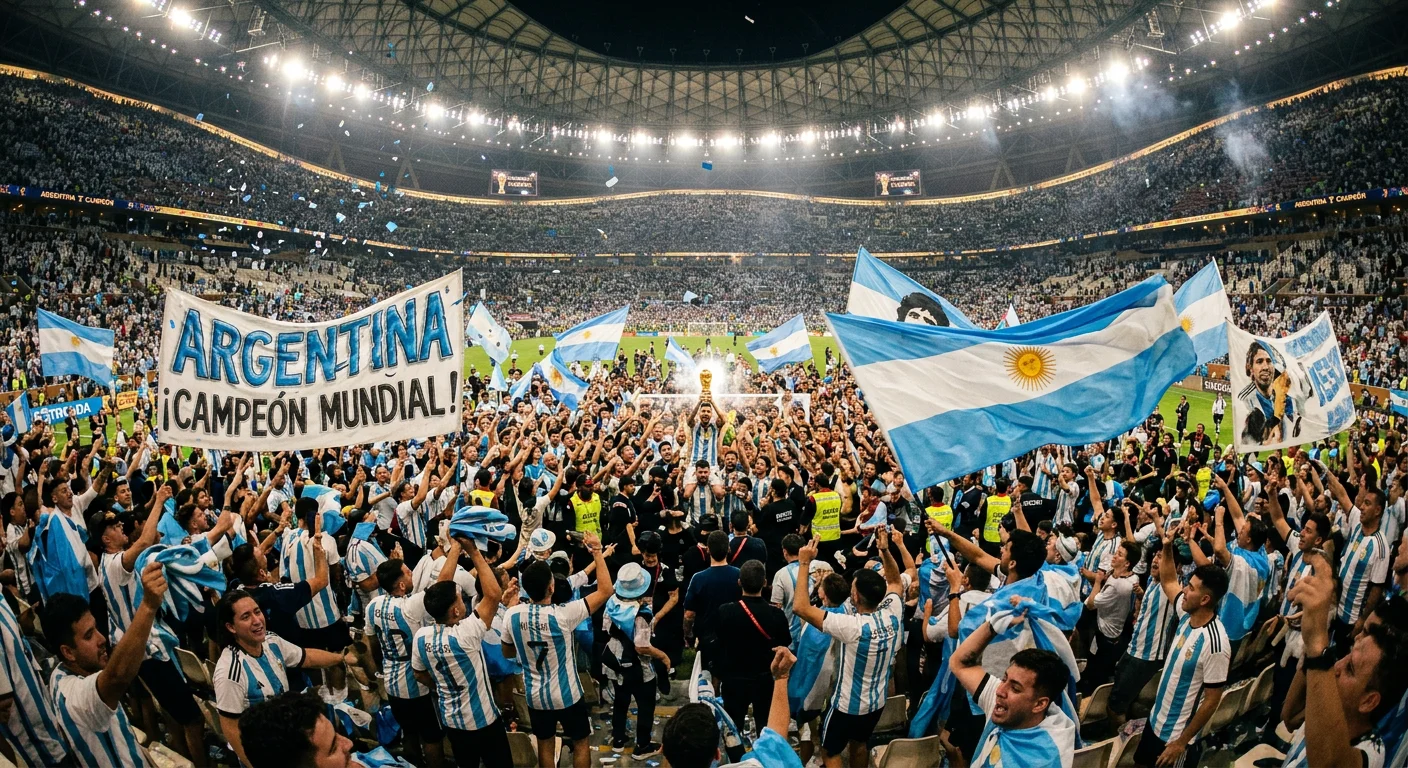
Three World Cup titles. Six final appearances. A 36-year drought ended by one man in Qatar.
The sky-blue and white stripes of Argentina's flag aren't just national colors — they're a scoreboard. Each stripe carries a championship, a generation, a moment football fans still talk about decades later.
The Numbers That Define a Dynasty
Argentina's World Cup record stands as one of the most dominant in history:
| Metric | Data |
|---|---|
| Finals appearances | 6 (1930, 1978, 1986, 1990, 2014, 2022) |
| Titles won | 3 |
| Total matches played | 88 |
| Win percentage | 53.4% |
| Goals scored | 152 |
Brazil and Germany are the only nations with more final appearances. Argentina ranks 4th all-time in World Cup titles — behind Brazil (5), Germany (4), and Italy (4). That legacy lives in every Argentina football fan flag sold worldwide.
What the 2022 Final Did to Demand
Qatar 2022 didn't just end a drought. It created a global merchandise wave.
Messi scored 7 goals in the tournament — including two in the final against France. Argentina won 4–2 on penalties after a 3–3 draw. He took home his second Golden Ball. His 196 international appearances and 115 goals for Argentina make him the single most important figure in the nation's football history.
7
Goals in Qatar
196
International Caps
115
Argentina Goals
The final whistle blew. Soccer supporter flags in sky-blue and white flooded streets from Buenos Aires to Barcelona. The "Messi Effect" turned a national flag into a global football cheering flag . Fans in countries with no connection to Argentina at all wanted one. That kind of reach is rare — and it shows exactly what a World Cup winner does to a flag's demand.
That's what a World Cup winner does to a flag's reach.
#8 Brazil National Football Team Flag — Seleção's Green and Gold Seen in Every Stadium
Five World Cup titles. The most of any nation on earth. Brazil's football team flag doesn't need an introduction — it needs a stadium.
The green and gold of the Seleção stands out from the upper tier of any ground on the planet. That green-yellow dominance isn't an accident. It's law. Brazil's Law No. 5,700 (1971) locks down every detail of the national flag with precise rules: a 10:7 aspect ratio , a yellow rhombus placed 1.7 modules from the frame, and a blue circle carrying 27 stars mapped to real constellations.
Those 27 stars have grown over time — 21 at independence in 1889, then additions in 1960, 1968, and 1992. Each one represents a Brazilian state. Under stadium floodlights, those stars catch the eye even on standard 152cm × 91cm polyester soccer supporter flags .
Built for the Stadium Environment
Brazil's football cheering flags are made to perform. The spec matters:
100% polyester construction — lightweight, durable, holds color under UV exposure
Brass grommets — secure hanging on stadium railings or poles
Standard fan sizes : 152cm × 91cm (5ft × 3ft) or 150cm × 90cm licensed variants
Picture 70,000 fans raising these in unison. The green-gold wave rolls across the stands — a visual that football fans worldwide recognize in seconds. It's also one of the most searched football merchandise flags on the market after every World Cup cycle. That kind of demand doesn't happen by chance. It comes from a flag design so bold and so deeply tied to national identity that it carries weight both on the pitch and in the stands.
What Makes a Great Football Flag? Key Design Elements Every Fan Should Know
Design is never accidental. Every flag on this list — from Barça's Blaugrana to Brazil's green and gold — works because it nails a clear set of principles. These principles separate forgettable banners from iconic ones.
Here's what matters.
Color Is Your First Weapon
Bold, high-contrast colors rule football culture for a reason. They're easy to read at distance. They photograph well. And when 80,000 fans raise them at once, they create real visual unity.
The flags that stand out most — Real Madrid's white, Dortmund's electric yellow, Argentina's sky-blue — all share one thing: instant recognition from the upper tier . A fan shouldn't need to squint. The design has already failed if they do.
Symbol Depth Drives Emotional Connection
The best club flag designs carry meaning beyond decoration. The Senyera on Barcelona's crest. The crown on Madrid's shield. The 27 stars on Brazil's national flag — each one represents a real state, fixed by national law. These aren't just visual choices. They're symbols fans defend, celebrate, and fight for.
A flag with a story gets waved harder. That's not sentiment — that's psychology.
Build Quality Determines Longevity
Great design means nothing if the flag falls apart after two matches. The best football stadium flags are built to a real standard:
100% Polyester Construction
Lightweight, colorfast, UV-resistant
Brass or Metal Grommets
Solid attachment to railings and poles
Tear Resistance Min. 300 Newton
Flags take a beating through a full season. They get pulled, grabbed, and battered. You need this rating
Standard Fan Sizes
90×150 cm for stadium display, 60×90 cm for balconies, 30×45 cm for handheld use
Simplicity Scales
Complex logos blur at distance. Strong football stadium flags keep the core design clean. One or two dominant colors. A single clear emblem. Strong contrast. That's it. Simplicity isn't laziness — it's a deliberate strategy.
That's the formula. Bold color. Meaningful symbols. Durable materials. Clean execution. Every flag on this list earned its spot by getting all four right.
How to Get Your Own Custom Football Team Flag — From Design to Delivery
Custom football team flags aren't just for professional clubs anymore. Any fan, supporter group, or club organizer can now use the same process that produces stadium-grade football stadium flags . Here's how it works at runcustomflag.com :
1
Submit Your Design
Upload vector files (AI/EPS/PDF) for the sharpest print quality. Extend your background into the bleed zone. Keep your emblem inside the safe area. Simple rule: what's inside the dotted line is what makes it onto the final flag.
2
Choose Your Material and Size
100% polyester is the go-to for durable custom sports flags. It's UV-resistant, colorfast, and lightweight. Most football setups use 3'x5'. Bigger crowds call for 4'x6' or 5'x8'.
3
Proof and Approve
Your first proof lands in 4-5 business days. Look it over carefully. Check the spelling. Confirm the colors look right. Once you approve, production kicks off right away.
4
Receive Delivery
Your flag ships out within two weeks of approval. Every flag comes with double-fold hems, machine-cut edges, and metal grommets — punched and ready to hang.
Starting out? Single units are available for individual fans. Bulk orders get a smoother proofing process after the first batch — which means faster turnaround and better pricing as your order scales up.
Ready to build yours? Upload your design or grab a free quote in under 10 minutes at runcustomflag.com.
Conclusion
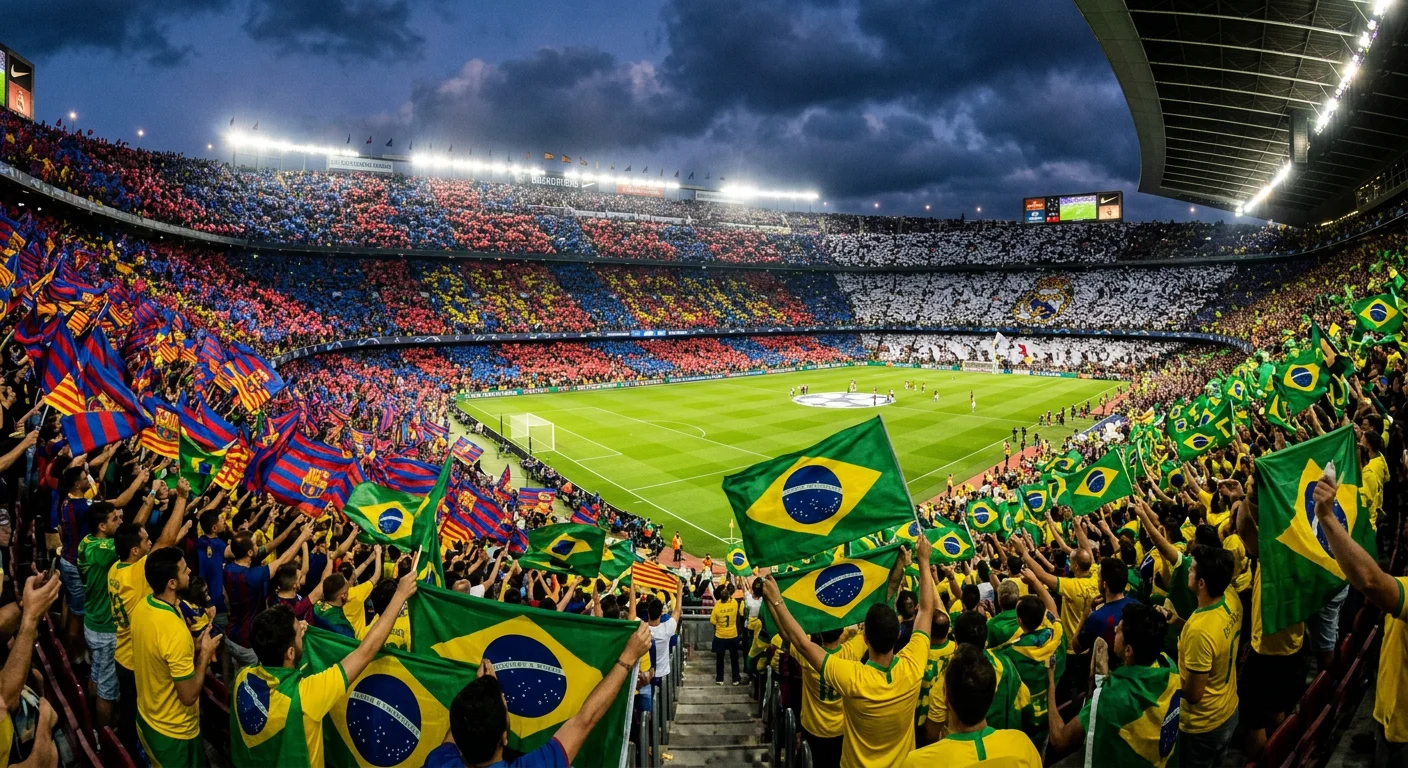
From the Blaugrana stripes of Camp Nou to the green and gold of the Seleção, the most iconic football fan flags share one truth: they're never just fabric. They carry identity, history, and belonging. Raised above 90,000 roaring fans, they mean everything.
The data is clear. Clubs with the most recognized flags aren't just winning trophies. They're winning hearts . A great flag design builds that emotional bond. It turns a simple piece of cloth into a global symbol.
A fan wanting to rep your club louder? A team organizer ready to create something that makes the stands erupt? You don't have to settle for generic.
Ready to design a flag as legendary as the clubs on this list?
👉 Visit runcustomflag.com and get a custom football team flag built around your team's identity, your colors, and your story.
Your flag. Your legacy. Let's build it.
Video Guide
Related Articles