Your team runs onto the field. The flag snaps in the wind, bold colors pulling every eye in the stadium. That's not just fabric. That's identity, energy, and team pride — all in one shot.
But turning that vision into an actual custom unique sports team flag? Most people hit a wall here. Size confusion, fabric questions, design decisions — it all piles up fast and feels harder than it needs to be.
This guide clears all of that up. Organizing a championship tournament? Rallying a school sports team? Running a fan section? You'll finish this knowing:
Which fabric holds up outdoors
Which flag size gets noticed from the bleachers
How to turn your team logo into a print-ready design — no graphic design degree needed
Let's build something worth waving.
What Makes a Great Custom Team Flag for Sports Events (Core Identity Foundation)
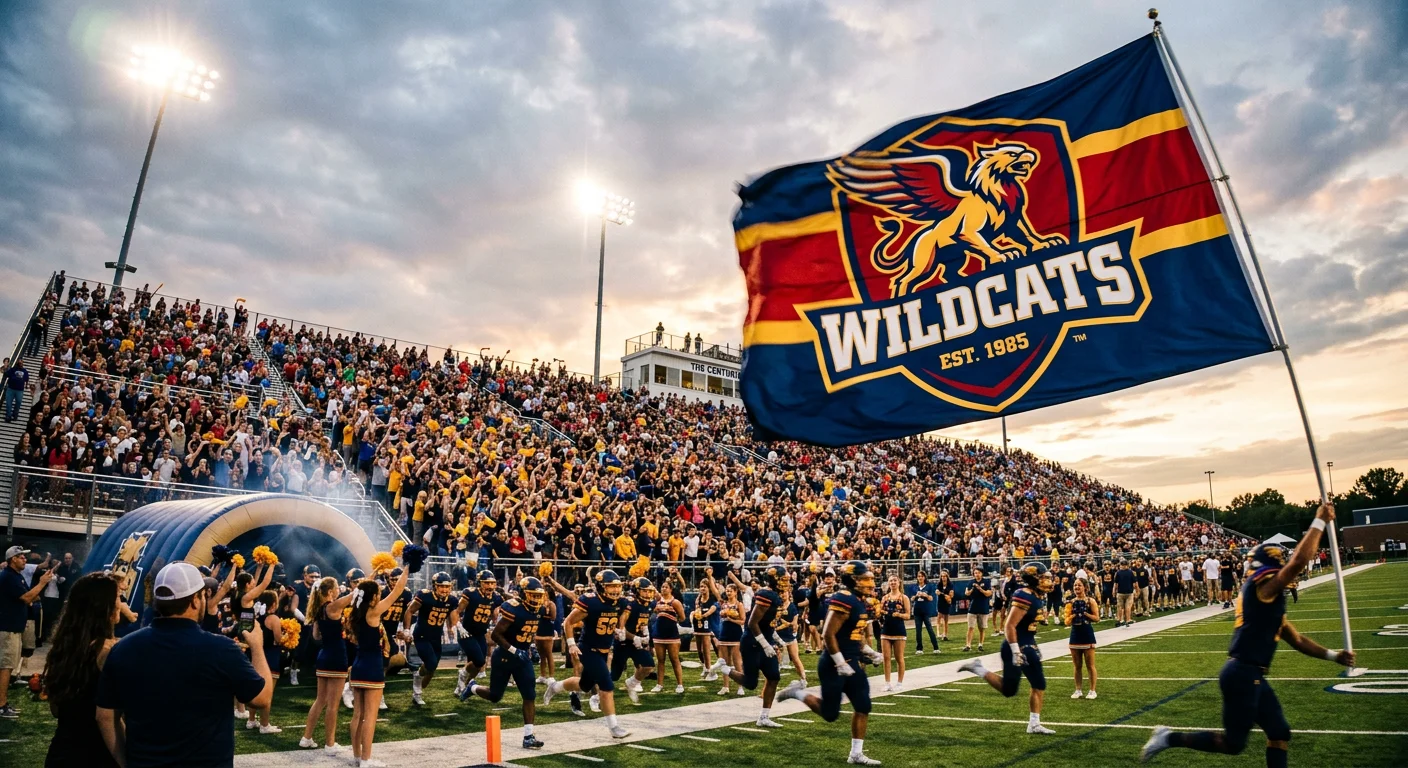
A great sports flag does three jobs at once — and it has about two seconds to do all of them.
It identifies your team. It unites your people. And it stops a stranger from 200 yards away dead in their tracks.
That's a lot to ask of a piece of fabric. But when a flag gets it right, you feel it. Players feel it. The whole stadium feels it.
It's Not About Pretty. It's About Instant Recognition.
Most people make the same mistake designing a custom professional team flag: they chase aesthetics over identity. A flag flapping in a 20 mph wind isn't a canvas — it's a signal. Detail gets lost. Subtlety disappears. What survives is bold contrast, strong color, and a logo that reads from bleacher distance .
At a packed pro match or a college championship, your flag competes with dozens of other flags, team colors, and signage. It needs to cut through that noise — not blend into it.
Here's the standard that works: your logo should occupy at least 50% of the flag's surface area , set against high-contrast colors (think team color against white or black). That combination reads at 100–200 yards. That's the real distance between your sideline and the upper deck.
Different Events, Different Flag Priorities
Not every sports event needs the same thing from a flag. Great flag design shifts based on context:
| Event Type | What the Flag Needs to Do | Design Focus |
|---|---|---|
| Campus League / Pep Rally | Create student energy, move well in crowds | Lightweight, 3-6 ft, handheld-friendly |
| Pro Matches / Sidelines | Represent at stadium scale, visible from 200+ yards | High-contrast logo, 17 ft teardrop format |
| Fan Sections | Show team pride from multiple angles | Double-sided design, 6-17 ft heights |
| Tailgate & Entrances | Draw foot traffic, create photo moments | Feather/teardrop style, sponsor branding |
A student section flag and a professional sideline flag are two different objects. One travels through a crowd. The other anchors a stadium. Where your flag lives shapes every design decision. Get clear on that first.
The Four Things Every Great Sports Flag Has
Set aside style preferences and event-specific details. The best custom team flags share four core qualities:
Visibility
Readable at distance (6-17 ft tall for bleacher-level exposure)
Distinctiveness
Your logo and colors are yours alone, not anyone else's
Durability
Colors stay vibrant outdoors; fabric holds up in the wind without tearing
Purpose
Every design choice serves the event, not just the design brief
Get those four right, and your flag isn't just decoration. It becomes a rallying point — for your players before the game, for your fans during it, and for your brand long after the final whistle.
Step 1: Define Your Team Flag Design Concept (Color, Logo & Layout Strategy)
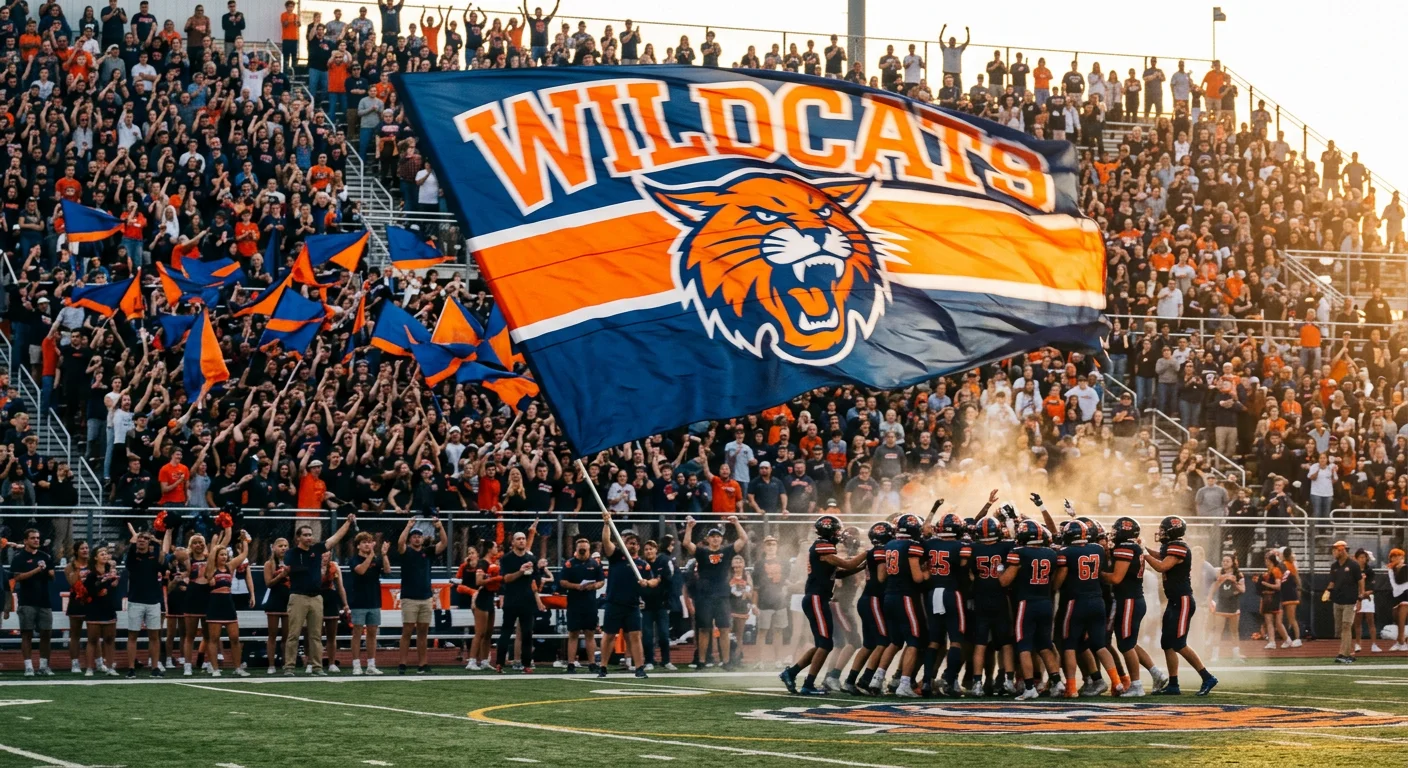
Design decisions made in the first five minutes of a project tend to haunt you for the rest of it. Flag design works the same way — but the stakes are more exposed. Your flag flaps at 20 mph in front of every person you're trying to impress.
So before you open any design tool, lock in three things: your colors, your logo treatment, and your layout. Everything else builds from there.
Color: Fewer Is Smarter, Contrast Is Everything
534
Flags Rated
3,770
Respondents
2-4
Optimal Colors
Flag researchers rated 534 flags across 3,770 respondents. The result was clear: flags with 5 or more colors rated lower across the board . The sweet spot is 2 to 4 colors . Three-color and 4-color designs ranked at the top, nearly tied.
That's not about minimalism. It's physics. At 100+ yards, complex color palettes collapse into visual noise. What actually reads is contrast — light against dark, bold against neutral.
Color combinations that hold up at distance:
- White on deep red (classic, easy to spot)
- Black on gold or yellow
- Navy on white or cream
What breaks down: blue next to green, red next to orange, any two shades from the same color family. Similar hues bleed together in wind and sunlight. Your flag turns unreadable before anyone gets close enough to notice it.
Logo: Graphical, Bold, and Built for Both Sides
Realistic illustrations fail on flags. Small fonts fail too. Fine outlines fail. Anything that needs a second look to understand — that fails as well. Your flag has less than five seconds to communicate. Your logo must land before someone finishes reading it.
Go with graphic symbols over photorealistic art. Your team name can appear, but choose large, mirror-symmetric letterforms — think A, M, H. These letters read the same front and back on a double-sided print. Also skip portrait-oriented elements on a landscape flag. They compress poorly and eat into your usable design space.
Your logo should dominate — not just decorate.
Layout: Shape and Symmetry Do More Than You Think
Standard flag ratios — 2:3 or 3:5 — exist because they work. Hundreds of years of flag production have tested these proportions. Stick with one unless you have a clear reason to go a different direction.
For team flags, pennant shapes give you the most design flexibility. They also read as "sports" at a glance. Rectangle flags are the easiest to produce and the most widely recognized. Feather, teardrop, or sharkfin formats work well for sideline or tailgate use — but start from a template. Those proportions are less forgiving and harder to eyeball.
On symmetry: mirrored designs outperform asymmetric ones in recall and readability. A symmetric flag also solves the "upside-down" problem. No one waves it wrong.
Hit at least 4 of the 5 core Good Flag, Bad Flag principles — simplicity, meaningful symbolism, limited colors, no lettering, distinctiveness. Do that, and the quality gap between your flag and the average one becomes measurable and visible. That gap matters.
Step 2: Select the Right Custom Flag Size for Your Sports Event
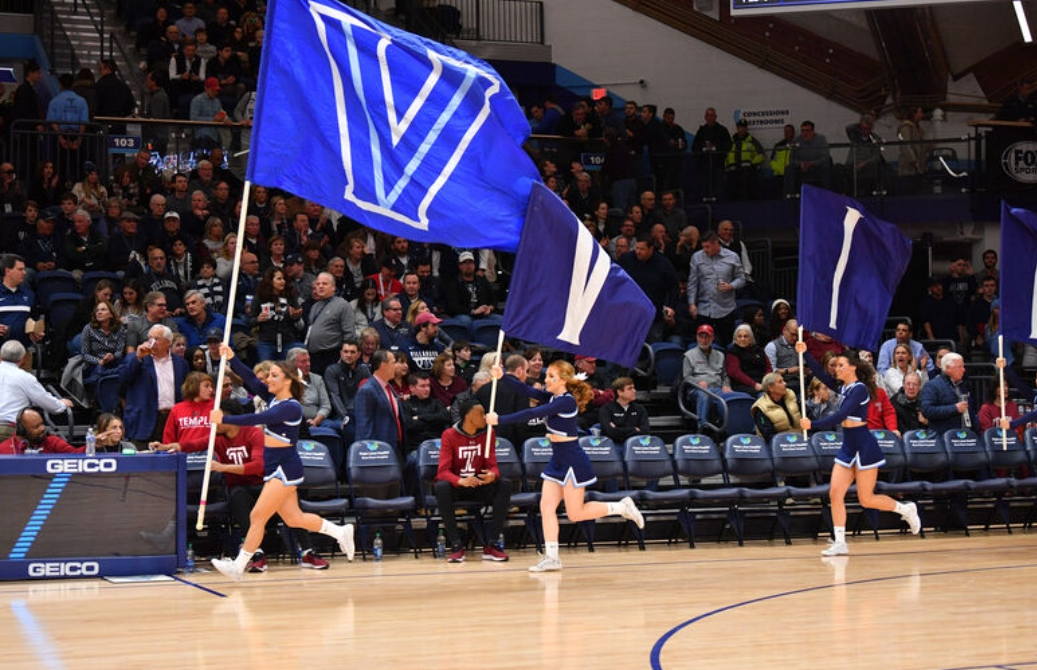
Size is the one decision most people get wrong. Not because it's hard — but because they guess instead of measure.
A flag that's too small disappears into the crowd. Too large, and it fights the pole, the wind, and itself. The right size doesn't just fit — it performs . Here's how to find it.
Match Your Flag to Your Pole, Not Your Preference
Flag makers have followed a simple rule for decades: your flag length should equal one-third to one-quarter of your flagpole height . That ratio exists for a reason. It keeps the flag visible, proportional, and stable in the wind.
Use this as your starting reference:
| Flagpole Height | Recommended Flag Size |
|---|---|
| 20 ft | 36"x60" or 48"x72" |
| 25 ft | 60"x96" |
| 30 ft | 72"x120" |
| 40 ft | 96"x144" |
| 50 ft | 10'x15' |
| 60 ft | 12'x18' |
Custom sports flags come in sizes from 12"×18" all the way up to 10'×15' . You have plenty of room to work with, no matter what venue you're in.
Handheld and Spirit Flags: Size by Situation
Not every flag lives on a pole. Spirit flags — the kind carried into the crowd, waved from the student section, or raised at a rally — follow their own sizing logic.
Standard spirit flag sizes are 3'×5', 4'×6', 5'×8', and 6'×10' . These pair with a 4-segment adjustable pole (39" per segment). For handheld poles, match your flag size to your pole height:
6–7 ft pole → 2'×3' flag
7–8 ft pole → 3'×5' flag
9 ft pole → 4'×6' flag
12 ft pole → 5'×8' flag
For stadium sidelines and large open fields, go with 5'×8' or 6'×10'. More surface area means more visibility — and that's the whole point.
Feather Flags: Sideline Presence That Holds Up
Feather flags are the workhorses of sports events. They anchor sidelines, mark entrances, and stay steady in the wind.
The 12'/15' kit is the most popular choice -- tall enough to read from a distance and easy to set up without a crew. Pick your size based on your venue's ceiling height for indoor events, or based on how far away your farthest viewer stands.
Quick rule: Not sure? Size up by one. A flag that runs a bit large commands attention. One that runs a bit small just fades into the background.
Step 3: Choose the Best Fabric for Your Custom Sports Flag
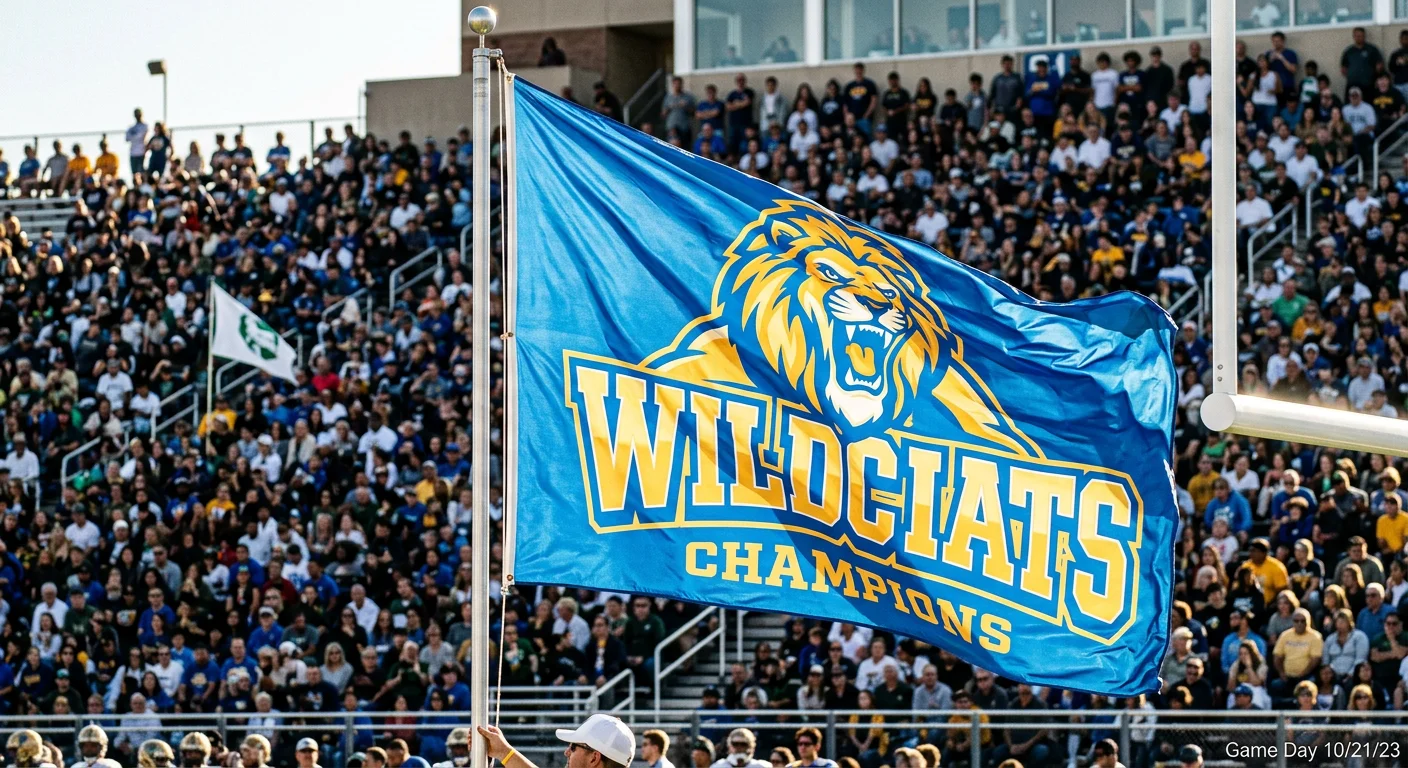
Fabric is the decision most people make last — and feel first. Understanding the best material for outdoor flags saves you from costly surprises down the road.
Your flag tears on a windy Saturday afternoon. The colors wash out after three weeks of sun. You feel it. The team feels it. And you can't un-see it for the rest of the season.
The good news: four fabric types are worth knowing. Each one has a clear job to do.
The Four Fabrics — And What They're Good At
Nylon is the go-to for outdoor sports events with unpredictable weather. It's built at 70 denier with 100% SolarGuard® UV protection and a one-year colorfast guarantee. It flies in the slightest breeze, dries fast after rain, and holds color under direct sun. Wind resistance, water resistance, and durability all rate four stars out of five. Your venue is exposed and your flag needs to perform every day? Nylon is your baseline.
2-Ply Spun Polyester — sold under names like Tough-Tex® and Polywavez® — is the heavyweight option. Its open weave construction cuts wind stress at the fabric level. That makes it the strongest choice for large flags, available from 2.5×4 ft up to 30×60 ft. Durability and wind resistance both earn five stars. Your flag lives outdoors long-term, through harsh weather and intense sun? This is what holds up.
Knitted Polyester sits in premium territory. It's a bit elastic, carries top-tier UV colorfastness, and performs well in both high winds and rain. Teams that refuse to compromise go with this one. It covers every condition without giving anything up.
Printed Polyester is the budget-smart starting point. It offers solid general durability, supports full-color dye-sublimation printing for sharp logo reproduction, and works well for indoor events or shorter-run displays.
Match Fabric to Your Situation
| Your Sports Flag Need | Best Fabric | Why It Works |
|---|---|---|
| Open stadium, high winds | Nylon or 2-Ply Spun Poly | 5-star wind rating, fast-drying |
| Rainy outdoor events | Nylon or Knitted Poly | Water-resistant, mildew-resistant |
| Long-term team display | 2-Ply Spun Poly (Tough-Tex) | 1-yr colorfast guarantee, withstands sun, wind, moisture |
| Budget custom sports team flag printing | Printed Polyester | Dye-sublimation compatible, cost-effective |
| Premium all-weather use | Knitted Poly | Elastic, UV-excellent, top-tier durability |
One more thing worth knowing: custom sports flags factory use a polyester-nylon blend. It's engineered to support full-color dye-sublimation printing. That's different from standard U.S. flag material. The difference matters — your flag needs to carry a team logo in sharp, vibrant color under outdoor conditions.
The bottom line: Don't choose fabric by price. Choose it by where your flag will live.
Step 4: Design Tools & File Preparation for Custom Flag Printing
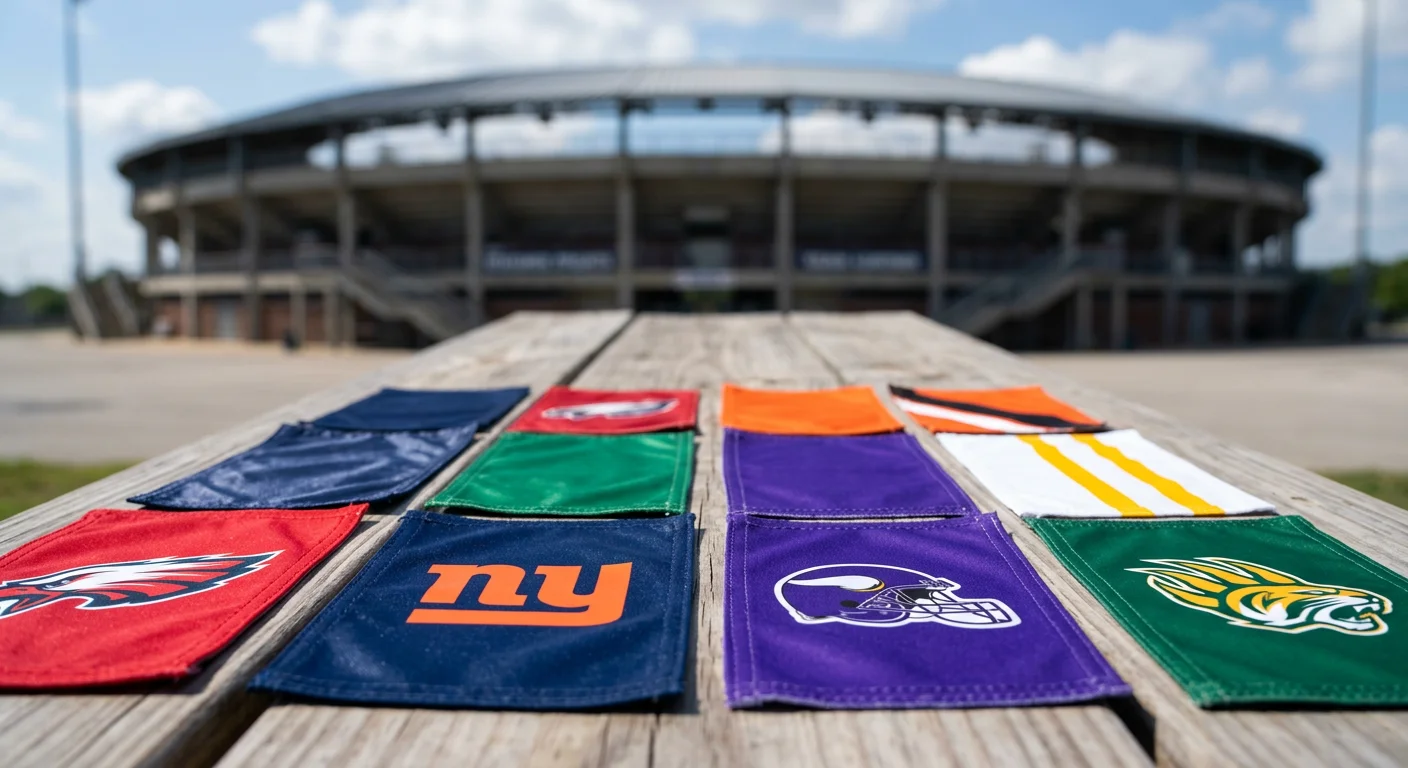
Here's where most custom sports team flag orders go wrong — not in the design, but in the file.
Your artwork arrives at the printer. It gets scaled up to full flag size. Then your crisp team logo turns into a pixelated smear. No warning. No do-overs. Just a flag that looks nothing like what you had in mind.
Get the file right from the start. That's how you avoid all of it.
Pick the Right Design Tool
Adobe Illustrator is the industry standard for flag design — and for good reason. Vector files scale to any size without losing a single edge. Your logo looks just as sharp on a 3'×5' spirit flag as it does on a 10'×15' stadium banner.
Not a designer? Canva works. It offers flag templates and enough flexibility to build a solid draft. Just check its output limitations before you submit.
Skip these programs: Word, PowerPoint, Excel, Publisher, Corel Draw, and Quark. None of them are built for print production. Files from these sources cause problems almost every time.
File Formats That Print Well
| Format Type | Accepted Formats | Notes |
|---|---|---|
| Preferred (Vector) | .ai, .eps, .pdf | Scales without quality loss -- use these first |
| Acceptable (Raster) | .psd, .tiff, .png | Fine if resolution specs are met |
| Use with caution | .jpg | Compression degrades quality at large sizes |
Resolution, Color Mode & Document Setup
Resolution matters most with raster files. The minimum is 150 DPI at actual print size. 300 DPI is where things look sharp and clean. Here's the math that catches people off guard: a file at 1,000 DPI enlarged 15× drops to just 66 DPI — well below usable quality. Scale your resolution before you scale your file.
Color mode: CMYK only. Not RGB. RGB colors shift during conversion. Your team's red can come back looking orange. Submit Pantone® Solid Coated (PMS) numbers or specific CMYK values with every file.
For black: use C=0, M=0, Y=0, K=100% — pure black, nothing else. Mixed-channel blacks produce uneven results across large fabric surfaces.
Set your document to actual size in inches. A 3'×5' flag builds as a 36"×60" file. Add 0.5 inches of bleed on all sides for background colors and images. Keep logos and text at least 2.5 inches from the edge — the sewing process during finishing cuts into that margin.
One last thing: convert all fonts to outlines before you submit. Your printer may not have your font installed. The text then reflows or drops out of the file. Outlines lock every letterform in place. It takes 30 seconds and saves you from a full reprint.
Pro Tip: Not sure about your file setup? Send us your design and our team will check resolution, color mode, and bleed for free before production starts.
Step 5: How to Order Your Custom Team Flag Online (Submission to Delivery)
Good preparation pays off here — or skipped steps catch up with you.
Here's what happens between "I'm ready to order" and "flag in hand." If you're wondering how much a custom flag costs, factor in your print method and quantity before you begin.
Know Your Production Timeline Before You Click Submit
Turnaround time varies by printing method. Plan backward from your event date, not forward from your order date.
| Print Method | Lead Time | Minimum Quantity |
|---|---|---|
| Vinyl Print | 1-2 weeks | None |
| Digital Print | 2-3 weeks | None |
| Screen Printed | 2-3 weeks | 6-12 flags |
| Embroidered | 3-4 weeks | None |
| Applique/Sewn | 3-4 weeks | None |
Standard production runs two weeks after file approval. Large orders — 100+ flags — take longer. Rush options are available for tight timelines. Your event is close? Call before you submit.
One rule: give your event date upfront. Don't drop it in after the proof stage. A deadline shared early is a deadline that can be met. For anything time-sensitive, a phone call beats email every time.
The Approval Step Most People Get Wrong
We send you a digital proof before production starts. Check every detail — logo placement, colors, spelling, size.
Approval Phrase
To approve, use this exact phrase: "Approved, please proceed with production."
Not "looks good." Not "this works." Those phrases don't count as formal approval. They can stall your order.
Once you approve, no changes are possible. Production starts right away.
Common Custom Team Flag Design Mistakes (And How to Avoid Them)
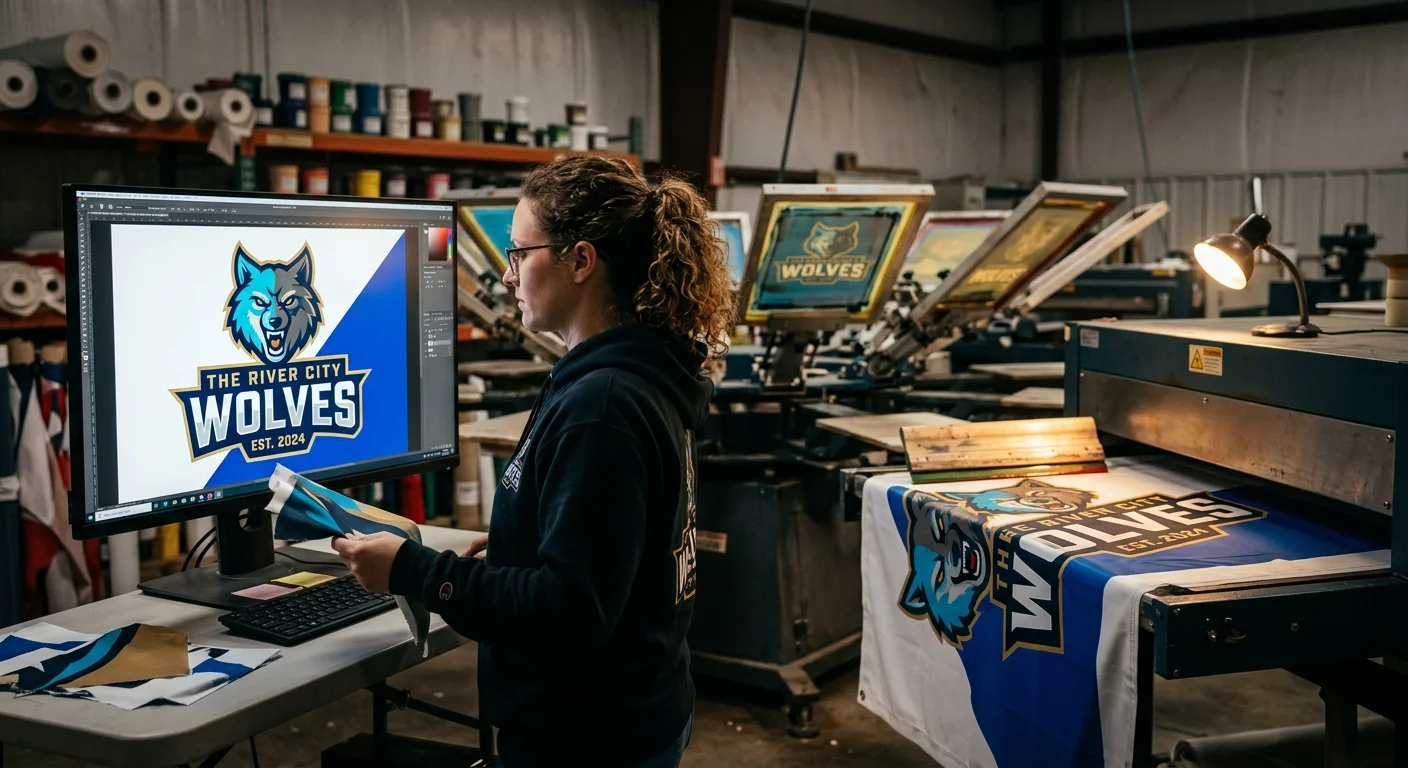
Most custom sports and event flag orders don't fail at the printer. They fail weeks earlier — at the design stage, in decisions that felt fine at the time.
Here are the ones that show up most often, and how to sidestep each one.
Low resolution files. Submit anything under 300 DPI and your crisp team logo prints as a blurry smear. Vector formats — AI, PDF, EPS — fix this problem for good. They scale to any size without losing a single edge.
Designing in RGB instead of CMYK. Your monitor lies to you. That electric blue looks stunning on screen. It prints muted and flat on fabric. Build your file in CMYK from the start. What you see will be much closer to what you get.
Too much going on. Intricate illustrations, stacked text, five competing graphic elements — flags are brutal on busy designs. All that detail collapses into visual noise the moment the flag hits wind. Strip it back to the essentials. Someone should be able to read it at 50 yards. That's the test.
Low-contrast color choices. Blue next to green. Red next to orange. Those combinations bleed together under sunlight and movement. Go high contrast instead — dark against light, bold against neutral. That's what reads from the stands.
Oversized or undersized proportions. A flag that doesn't match its pole or venue just looks wrong. Stick to standard 2:3 or 3:5 ratios. Match your dimensions to where the flag will hang or fly.
Skipping the proof review. This one is avoidable every single time. Check your digital proof before you approve production — colors, layout, spelling, logo placement, all of it. Once production starts, there's no going back.
Pre-Submission Checklist
Run through this before you hit submit:
✓
File is 300 DPI minimum; vector format preferred
✓
Color mode is CMYK, not RGB
✓
Design reads from a distance -- no clutter
✓
Strong color contrast throughout
✓
All text is large and minimal
✓
Dimensions follow standard flag ratios
✓
Finishing details confirmed (grommets, sleeves, reinforced edges)
✓
All logos and images are copyright-cleared
Catch these before you submit. Your flag — and your event — will be better for it.
Conclusion
Your team deserves a flag that does more than wave — it should ignite something in the crowd the moment it unfolds.
You now have what you need to make that happen:
A design concept rooted in your team's identity
The right size for your specific venue
A fabric that handles any weather
A clear path from first sketch to final delivery
Custom sports team flag printing doesn't have to feel overwhelming. Break it into simple steps — design, size, fabric, file prep, order. Each step is straightforward. The whole process starts to feel good once you see it laid out.
So here's your next move: head to runcustomflag.com and upload your artwork. The team will walk you through the rest. Rallying a stadium crowd or firing up a local league sideline — your flag is ready to be made.
Make it bold. Make it yours. Make it unforgettable .
Video Guide
Related Articles