Most brands searching for a flag manufacturer think they're choosing between two production models. They're not. They're choosing between speed and differentiation — and the right answer depends on where their business is right now, not where they want it to be in three years.
I've watched dozens of companies burn through budgets and timelines because they picked the wrong model for their stage. A startup with zero design assets insisted on full OEM. A mid-size retailer with a strong brand kept using ODM and couldn't figure out why competitors sold identical products. The model matters less than the timing. Here's how to get both right.
OEM vs ODM — The Real Decision Behind the Labels
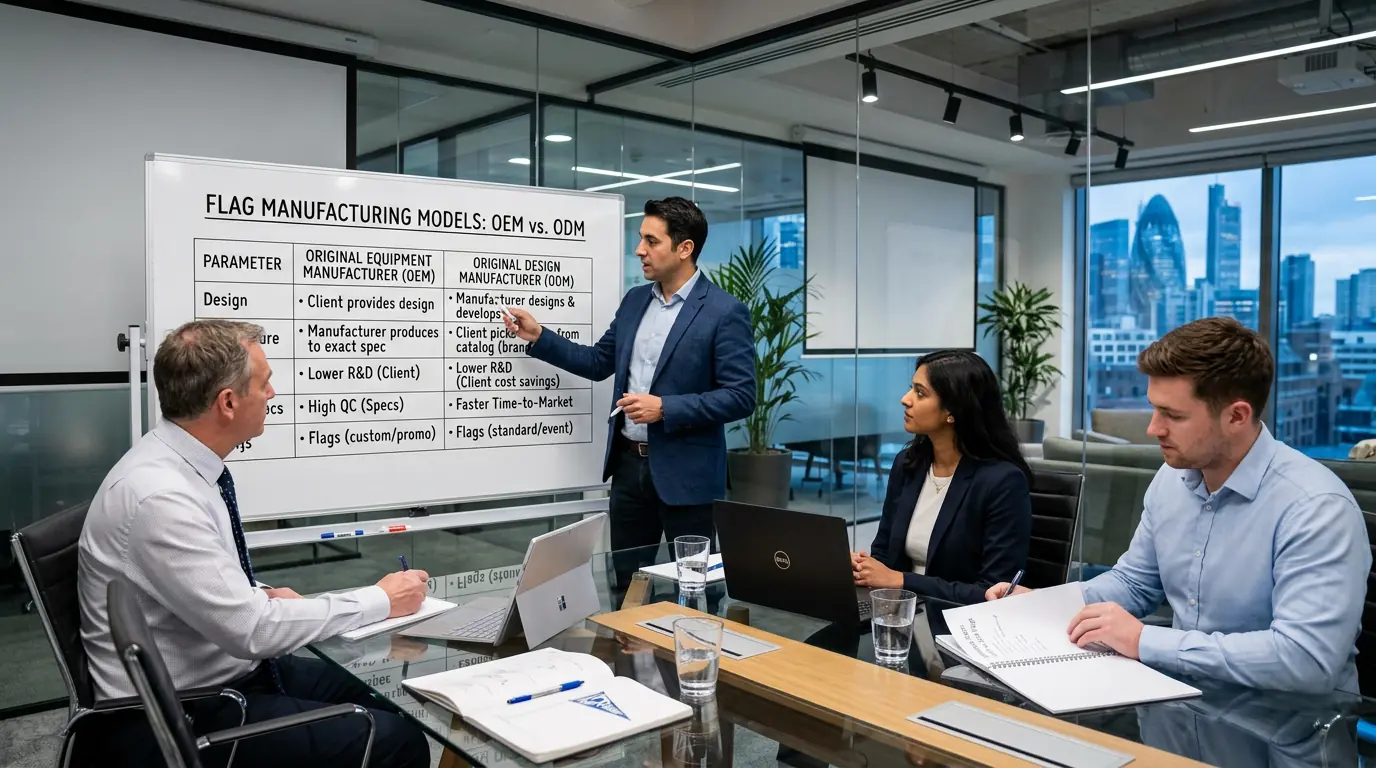
The question most purchasing managers ask first is "what's the difference between OEM and ODM?" But that's the wrong starting point. The better question is: do I have something worth manufacturing, or do I need a partner who already does?
Here's the practical split. With OEM, you bring the design — the artwork, the specs, the material choices — and the factory executes. You own the IP outright. With ODM, the factory already has designs ready. You pick one, maybe tweak it, slap your brand on it, and sell. The factory retains base IP unless you negotiate a buyout, which typically adds 15-30% to your unit cost.
If you're a first-time buyer thinking "I'll just go OEM because I want something unique," slow down.
$101.6M
US Flag Market 2024
60-70%
Hybrid Orders
15-30%
IP Buyout Premium
The US flag market hit $101.6M in 2024, and 60-70% of orders placed with Chinese manufacturers fall into a semi-custom hybrid — not pure OEM, not pure ODM. Most buyers land somewhere in between, and that's not a compromise. It's a strategy.
The real IP question isn't "who owns the design" but "does owning the design actually give me a market advantage at this stage?" For a company selling custom national flags to government accounts, yes — design control matters. For someone testing a new line of seasonal garden flags on Etsy, owning the base design is a cost you don't need yet.
ODM isn't the budget option. It's the smart-stage option. And most people who dismiss it early end up circling back to it after an expensive lesson in how long custom development actually takes.
When ODM Makes More Sense Than You Think
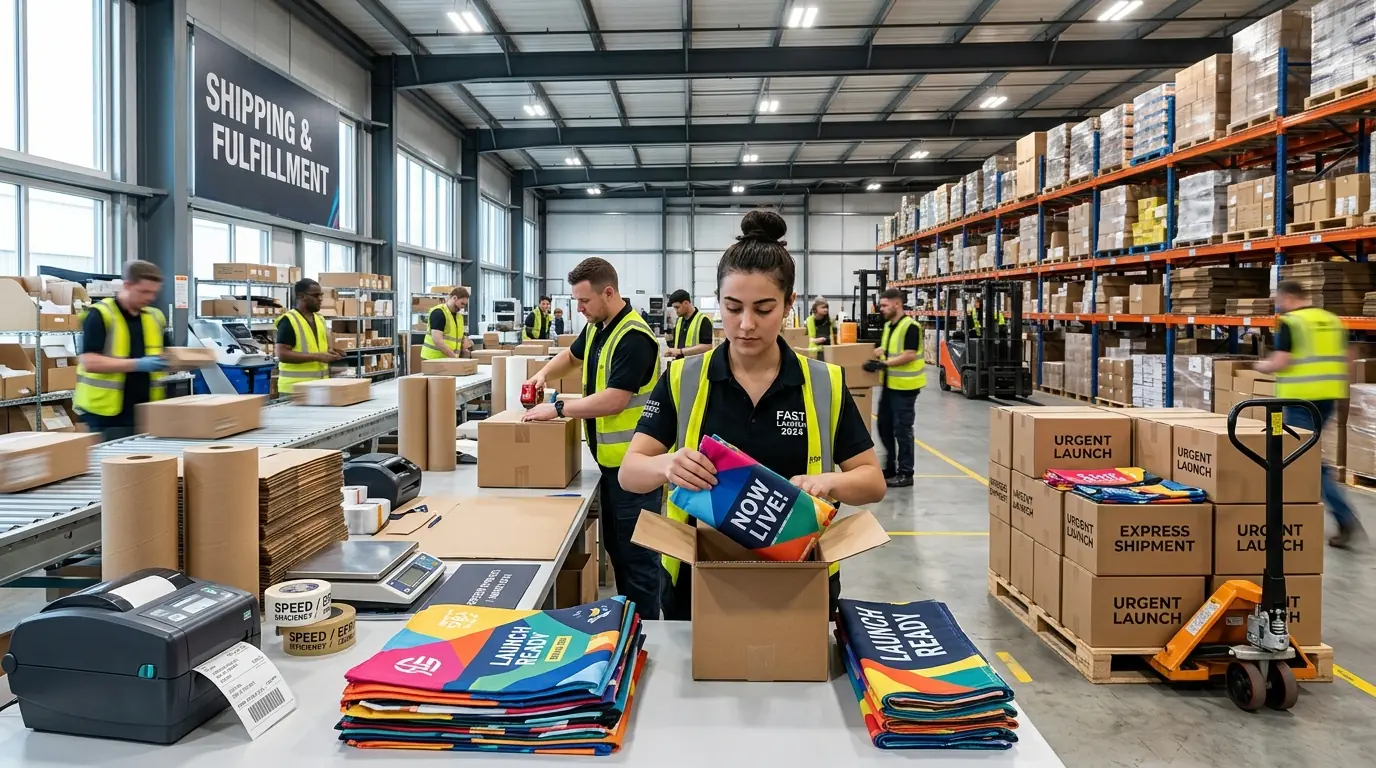
A lot of brands assume they need OEM because they want to "stand out." But standing out requires more than a custom design — it requires a design team, revision cycles, and a budget that can absorb mistakes. If you don't have an in-house designer, going OEM means hiring one or paying $300-$2,000 per design to a freelancer. Multiply that across a product line of 20-30 SKUs, and you're looking at $5,000-$15,000 before a single flag is printed.
ODM eliminates that cost entirely. You're selecting from proven designs, which means the factory has already worked out the print alignment, color registration, and material compatibility. That's not just cheaper — it's faster.
ODM Timeline
2-3 Weeks
Order to shipment
OEM Timeline
3-5 Weeks
Minimum lead time
That 7-14 day gap is the difference between catching a seasonal window and missing it.
If you're launching a line of garden flags — standard 12x18" — and your first order is 12+ units to hit bulk pricing, ODM gets you to market at roughly 50% less per unit than a fully custom run at the same volume. That math matters when you're testing whether a product category even sells.
I've seen purchasing managers reject ODM because it feels like "settling." It's not. It's the fastest way to validate demand without overcommitting capital. Many successful feather flags sellers started with ODM catalogs, proved the margins worked, then graduated to OEM for their best-performing SKUs. That's not settling — that's sequencing.
The catch is this: ODM speed only works if your partner has a deep enough catalog. A factory with 15 designs isn't an ODM partner — it's a factory that made 15 flags once. The depth of the catalog tells you how seriously they take the ODM side of their business.
When You Actually Need OEM — And When People Get It Wrong
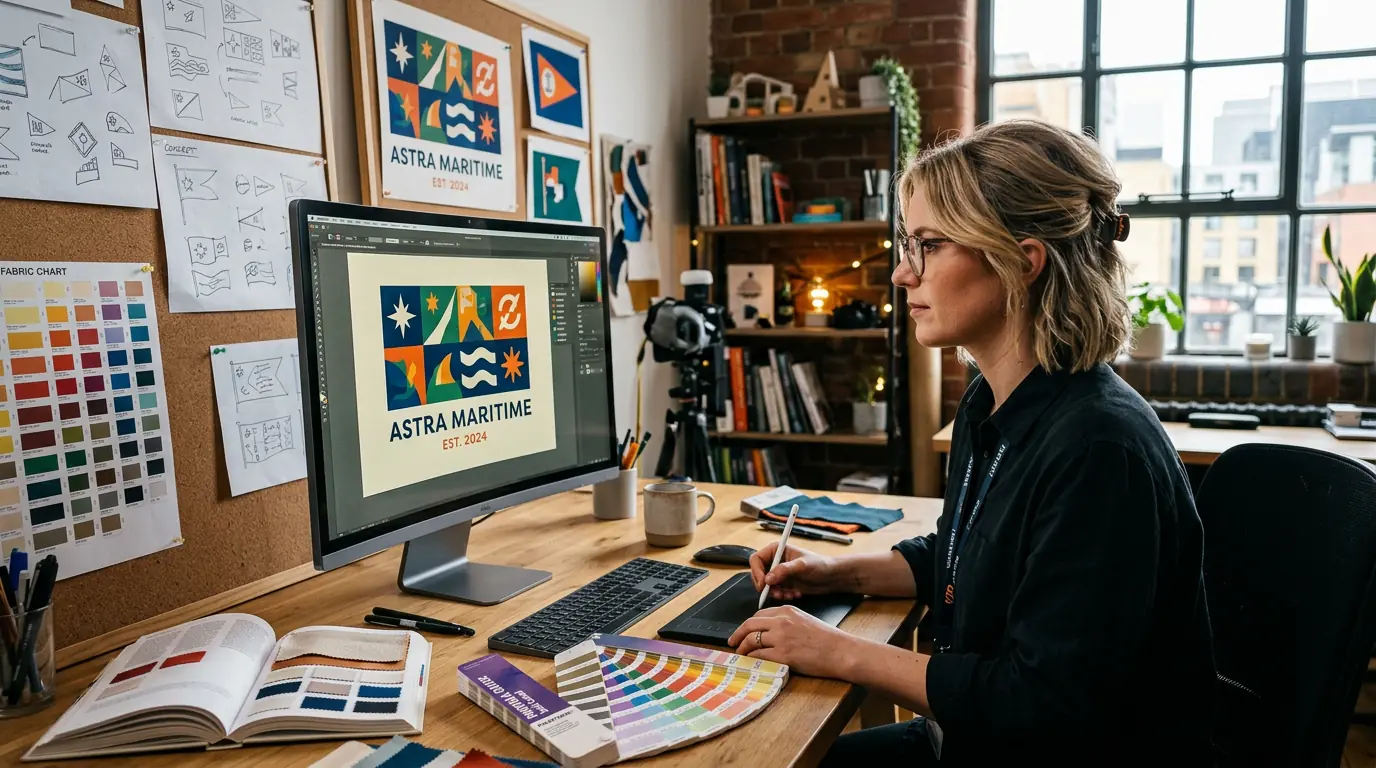
Here's the thing about OEM: it gives you uniqueness. But only if you can turn "unique" into consistent output. Without that, OEM isn't an advantage — it's a cost multiplier.
You need OEM when your product requires Pantone-precise color matching, custom fabric blends, or structural specs that don't exist in any catalog. Corporate flags with exact brand colors, flags with proprietary finishing techniques, products that integrate hardware mounting systems — these are OEM territory. No ODM catalog covers that level of specificity.
But here's where most brands miscalculate. They look at their competitors' products, see something generic, and assume OEM will differentiate them. Maybe. Or maybe the market doesn't reward differentiation at the price point you're selling. A hot-selling ODM garden flag design will show up across 5-8 competing brands within 12-18 months. That's real. But if you're selling at $12.99 on Amazon, customers aren't paying for exclusivity — they're paying for the design they like at the price they want.
The $25 Breakpoint
Below $25 retail, brand protection through OEM rarely justifies the investment. Above $25, buyers start caring about provenance, quality signals, and whether they've seen the same flag at three other stores. That's when OEM becomes a competitive necessity rather than a nice-to-have.
Many first-time importers of advertising flags go full OEM because their marketing team insists on "brand consistency." But brand consistency in flags comes from print quality and material choice — both of which a good ODM partner handles through their existing flag materials and printing capabilities. You don't always need to own the design to own the quality.
The real question isn't "do I want something unique?" Everyone does. The question is: "will my customer pay enough more for uniqueness to cover the 30-50% premium in development costs?" If the answer is no, OEM is a vanity play, not a business decision.
How to Evaluate an ODM Partner (Beyond the Sales Pitch)
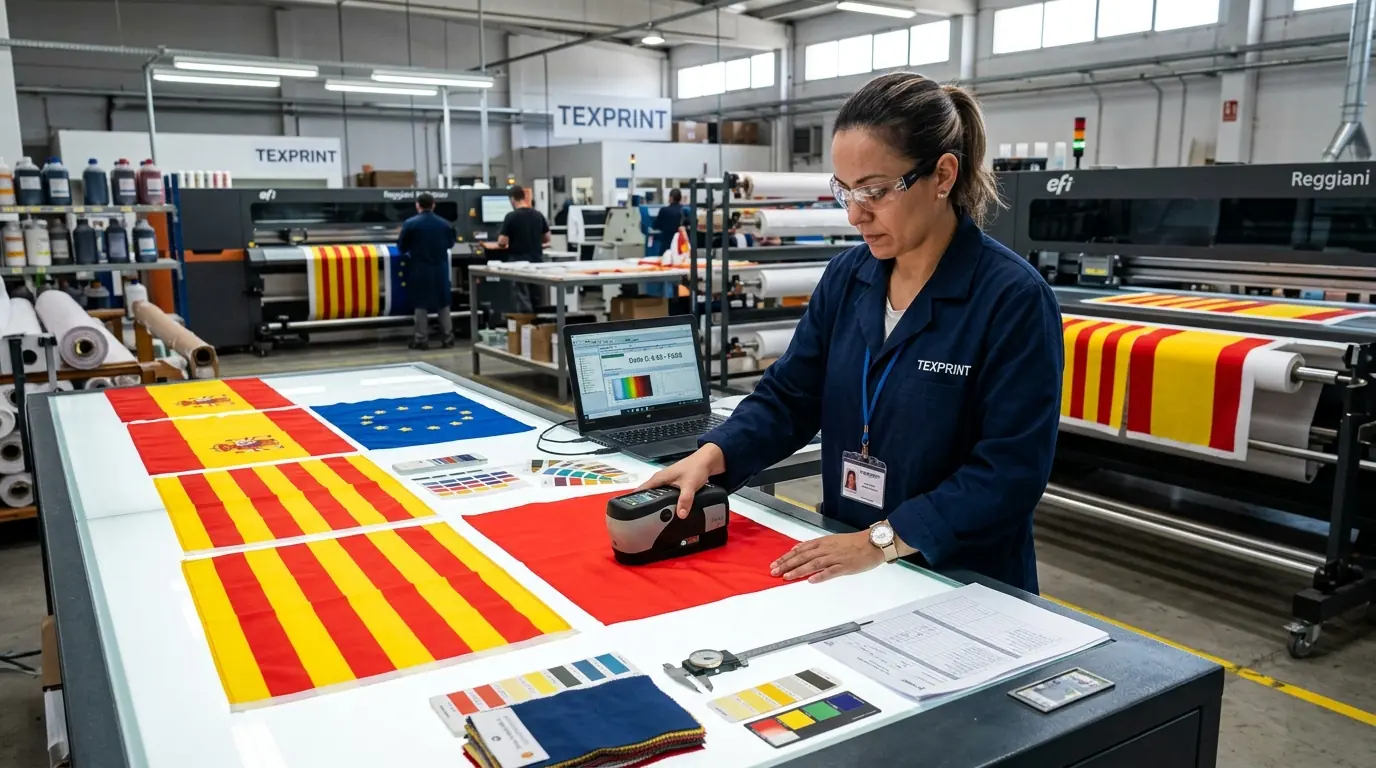
Factories are great at selling. They're not always great at delivering. The gap between a polished Alibaba listing and actual production capability is where most sourcing headaches begin. So stop evaluating partners by what they say and start evaluating them by what they can prove.
A mature ODM partner maintains a live catalog of 50-500+ designs. Not "we can make anything you want" — that's an OEM pitch disguised as ODM. A real ODM operation has designs in stock, organized by category, with production-ready files. Ask to see the full catalog. If they hesitate or send you a PDF from 2021, move on.
Sample quality tells you everything the sales call won't.
Request samples and measure two things: turnaround time and color accuracy. A capable partner delivers samples in 5-7 days. Color deviation should stay under Delta E 2.0 — that's the threshold where the human eye starts noticing differences. If your sample arrives with visible color drift, production will be worse, not better.
I've seen brands skip factory verification because the samples looked good. Don't. An SGS factory audit runs $200-400 and confirms whether the facility that made your sample is the facility that will fill your order. Many trading companies outsource production to shops you've never vetted. That $300 audit can save you a $30,000 disaster.
Here's a framework for what to negotiate before signing:
| Protection | Recommended Terms | Why It Matters |
|---|---|---|
| Design exclusivity | 12-24 months minimum | Prevents your ODM pick from appearing under competing brands |
| Modification rights | Cap at 5-10% of base price | Controls cost creep on design tweaks |
| Breach penalty | $10,000-$50,000 clause | Makes exclusivity enforceable, not just aspirational |
The table gives you the numbers. Here's the judgment: exclusivity agreements are only as strong as your willingness to enforce them. A $10,000 penalty clause means nothing if you can't monitor the market for violations. Before signing exclusivity, ask yourself whether you have the resources to actually police it. If not, a shorter exclusivity window (12 months) with a renewal option is more realistic than a 24-month lock you can't enforce.
For brands sourcing sports event flags or seasonal products, turnaround consistency matters more than one-time sample quality. Ask for shipping records from their last three bulk orders. Patterns in delivery dates reveal operational discipline better than any certification.
Pro Tip: For bulk flag orders over 100 pieces, contact our sourcing team for volume pricing and dedicated quality inspection.
The Decision Framework — Score It, Don't Guess It

Most sourcing decisions go wrong not because people lack information, but because they weigh the wrong factors. You don't need more research. You need a structured way to evaluate what you already know.
Rate your business across five dimensions, each scored 1-5:
| Dimension | Score 1 (Low) | Score 5 (High) |
|---|---|---|
| Design capability | No in-house design team | Full design department |
| Budget for development | Under $2,000 for initial run | $15,000+ allocated |
| Time to market | Need product in 2-3 weeks | Can wait 5+ weeks |
| Order volume | Under 50 units first order | 500+ units committed |
| Uniqueness requirement | Functional/seasonal product | Brand-defining flagship |
Now add your scores:
The hybrid approach deserves special attention because most people skip past it. Running 70% ODM and 30% OEM means your ODM revenue funds your OEM experimentation. Your proven sellers keep cash flowing while your custom designs get tested without bet-the-company pressure.
If you scored 11-15 and you're eyeing full OEM anyway, ask yourself: is that based on market data or ego? I've watched brands with perfect hybrid potential blow their budgets on full-custom runs because "we're a premium brand." Premium is what customers decide, not what your product brief says. Check how flag manufacturers in the USA structure their own sourcing — most of them use hybrid models too.
Conclusion
You now have the framework. The question isn't OEM vs ODM — it's which model fits your current stage, budget, and competitive reality. Score yourself honestly. If you're below 15, ODM or hybrid isn't a compromise; it's the move that keeps you in the game long enough to graduate to full OEM when the margins justify it.
Your next steps:
1
Run the 5-dimension scorecard
With your actual numbers, not aspirational ones.
2
Request catalogs from 2-3 ODM partners
Compare catalog depth (50+ designs minimum) and sample turnaround (under 7 days).
3
Order samples before committing
Measure color accuracy (Delta E < 2.0) and stitch quality yourself.
4
Get an SGS audit
$200-400 on any factory you're considering for orders above $5,000.
5
Negotiate exclusivity terms in writing
Before your first bulk order, not after.
6
Start hybrid if you're unsure
70/30 ODM-to-OEM lets you test without overcommitting.
Ready to compare options? Get a quote from a manufacturer who handles both OEM and ODM, and bring your scorecard to the conversation.
Related Articles