Engines roar. Machines blur past at 200mph. Then a marshal on the trackside raises a flag — and everything changes.
Most F1 fans in the grandstands or on the couch barely notice those colored flags. But drivers, engineers, and race stewards depend on them. These flags are the language that keeps motorsport alive and safe— a visual system as critical as the custom racing flags used by motorsport event organizers worldwide. Miss one signal, and a race — or a career — falls apart in seconds.
New to F1? These flags help you decode what's happening on track. A longtime fan? Knowing the essential racing flags in Formula 1 takes you from watching a race to understanding it. Here's what each flag means, when marshals wave it, and why it matters more than most fans know.
Green Flag — The Signal That Racing Begins
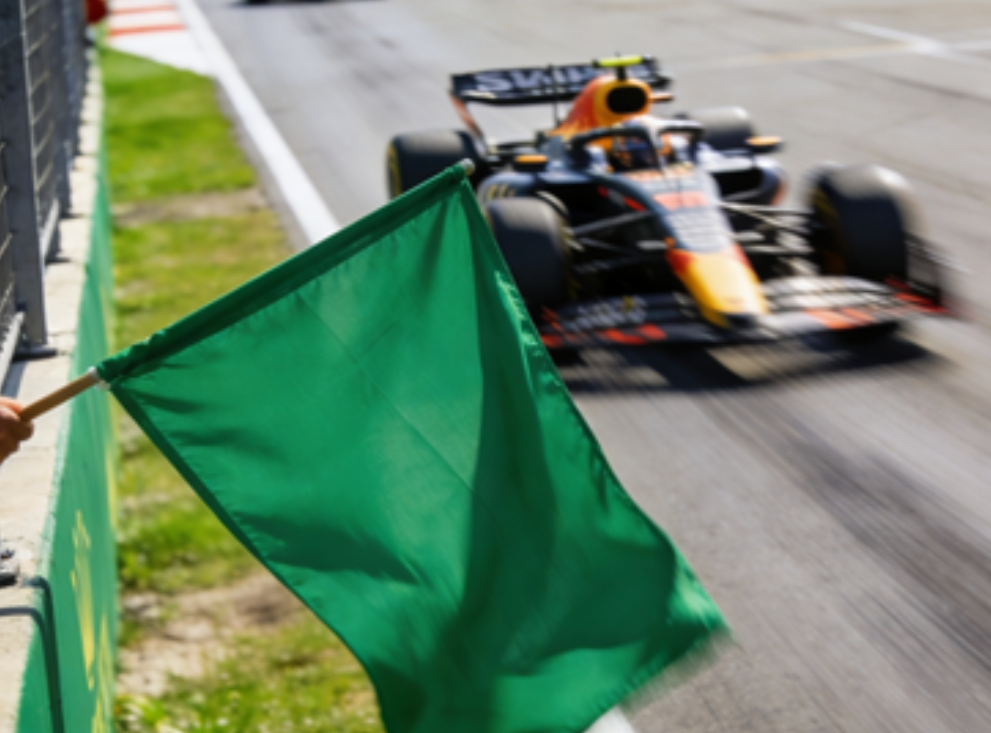
The green flag is the simplest signal in F1 — and the most electrifying.
It means one thing: go . But the rules behind it are more layered than most fans expect.
Marshals use the green flag in three distinct situations, often relying on high-visibility racing flags supplied for professional track operations to ensure instant recognition at high speeds:
Race or qualifying start — shown stationary at the formation lap to begin tire warm-up. Once cars grid up, the five red lights take over as the actual race start signal
Hazard cleared — after a yellow flag zone is resolved, a green flag must appear at that exact sector's end. This closes the danger zone and tells drivers the threat is gone
Safety car restart — the safety car pulls into the pit lane. The green flag drops. Every driver's speed restriction lifts at the same instant
That last moment is where races are won or lost. The lead driver controls the restart timing. Everyone behind reacts. Overtaking chances compress into the first few corners after the green flag appears.
Key Distinction
A stationary green flag signals the formation lap. A waved green flag means a hazard zone has cleared — racing speed is back, and overtaking is allowed again. Same color, two very different instructions.
Yellow Flag — The Most Misunderstood Flag in Formula 1
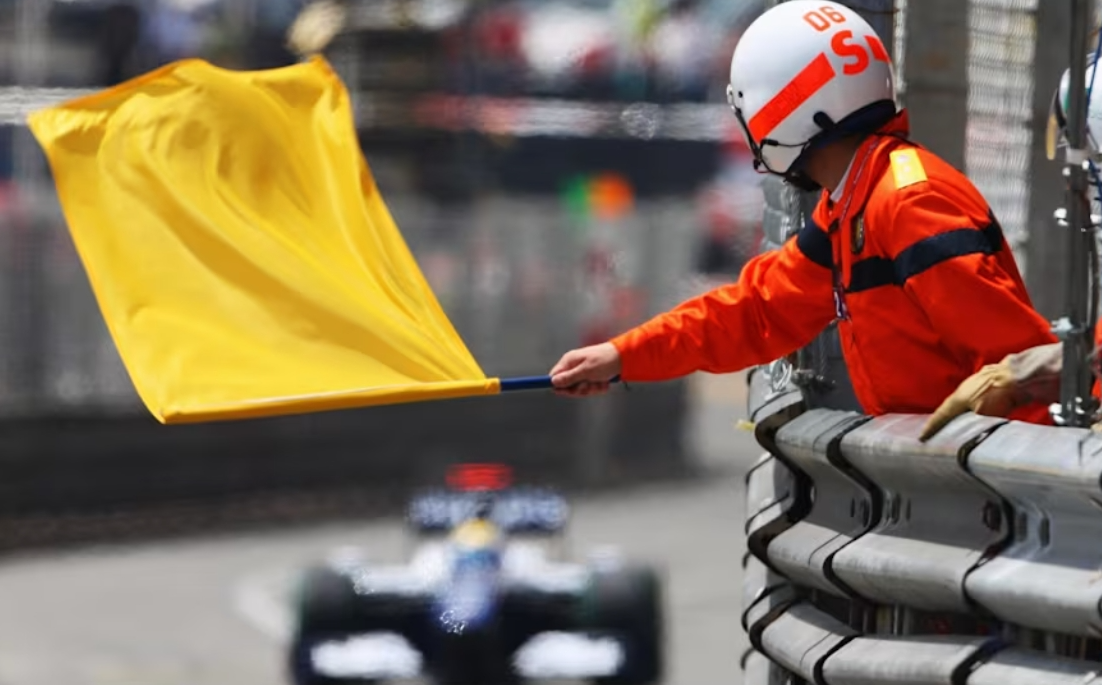
Drivers get penalized for yellow flag violations every season. Half the time, even hardcore fans can't explain why.
That's the yellow flag problem. It looks simple. It isn't.
There are two versions of the yellow flag— a distinction that professional circuits standardize through bulk motorsport safety flag suppliers for racing events and track management. Most new fans mix them up — and that's where confusion starts:
Single Yellow Flag
A hazard exists in that sector. Drivers must reduce speed and cannot overtake until a green flag appears
Double Yellow Flag
The situation is more serious. Speed must drop to a "greatly reduced" level, not just a noticeable dip
That word "greatly" is where careers get complicated.
The Enforcement Problem Nobody Talks About
The FIA doesn't publish a precise speed threshold for yellow flag compliance. Words like "significantly" and "greatly reduced" sit in the rulebook with no hard numbers attached. Stewards read them case by case — using telemetry data, not driver feel.
Case Study: Hamilton at Monza
Lewis Hamilton learned this the hard way at Monza. He reduced his speed by 20 kph through a double yellow sector. He braked 70 meters earlier than his normal entry point. He cut throttle by 10–20%. Stewards still gave him a 5-place grid penalty — ruling that none of those actions met the "greatly reduced speed" standard.
That case set the benchmark. 20 kph isn't enough. A small lift off the throttle isn't enough. The bar sits higher than most drivers expect.
When the System Gets It Right — and Wrong
The 2024 Singapore Grand Prix put yellow flag enforcement under a microscope. Pierre Gasly stopped at Turn 11. Five drivers faced investigation. The outcomes showed just how many variables decide guilt or innocence:
George Russell got cleared right away. The single yellow hadn't registered in race control yet. The marshal post was blocked by a wall — the flag was invisible from the cockpit
Yuki Tsunoda and Nico Hülkenberg were both cleared after their engineers radioed warnings in real time. Telemetry showed slower mini-sectors. That radio call made the difference
Lance Stroll wasn't even on a push lap. Cleared without question
The pattern matters. Drivers whose engineers flagged the hazard early showed cleaner telemetry compliance. Those without that radio call faced far more scrutiny. It's not just about driving instinct — it's about team infrastructure.
What This Means for Watching F1
Next time you see a yellow flag on screen, ask two questions: Is it single or double? Has race control registered it yet?
Both answers shape the penalty outcome. They also shape your understanding of why a driver just lost five grid positions before the race even starts.
Red Flag — When the Entire Race Comes to a Halt
99
Red Flags Since 1950
90
Championship Races
76yr
Of F1 History
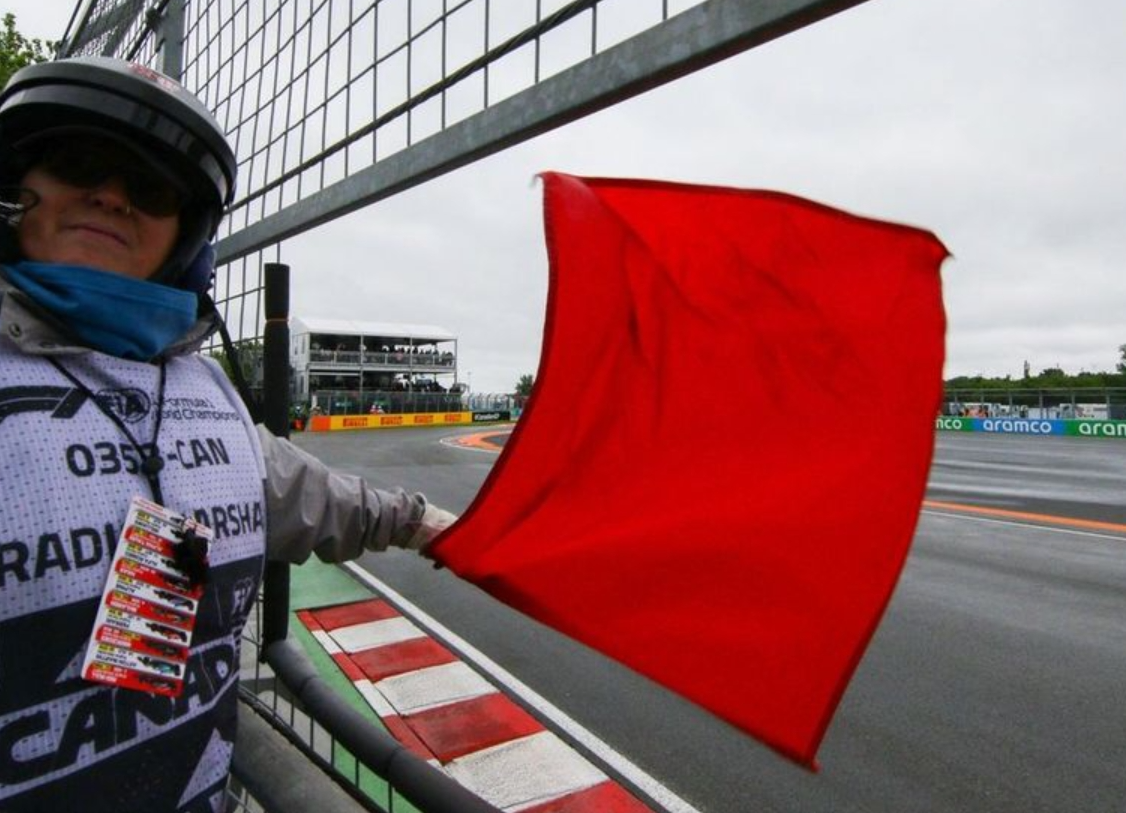
Since 1950, red flags have appeared in F1 just 99 times across 90 championship races. That rarity is what makes them so significant — and so disruptive.
A red flag doesn't mean slow down. It means stop everything .
Race control displays the red flag, typically using professional-grade track flags manufactured for FIA-standard racing environments. Every driver on the circuit must cut speed and head to the pit lane. No racing. No positioning battles. No defending. Drivers form a queue at the pit lane exit and wait for instructions. In practice or qualifying sessions, everyone returns to their garage.
What Triggers a Red Flag
Race directors don't wave the red flag without serious reason. The bar is high — conditions must become too dangerous to continue racing at all . That threshold covers a wide range of scenarios:
Major multi-car crashes with serious injury risk or extensive debris cleanup
Vehicles on fire or leaking significant fluid onto the racing surface
Severe weather that makes the track undriveable
Medical helicopter grounded — evacuation of an injured driver becomes impossible
Security breaches, including trespassers on the circuit
One detail most fans miss: the medical helicopter rule. Emergency air transport can't take off or land, the race cannot continue by law .
The Strategic Wildcard Teams Don't Ignore
Here's where the red flag shifts from a safety measure to a race-changing event. During the stoppage, teams can change tires and perform repairs — a window that exists under no other flag.
That rule rewrites race strategy in real time. A driver who gambled on the wrong tire compound gets a free reset. A car damaged in an earlier battle gets patched up at no cost. The entire grid reshuffles before the restart even begins.
The 2020s alone have already matched the combined red flag frequency of the entire 1980s and 1990s . More red flags mean more strategy pivots — and more races decided not by speed, but by how fast a team adapts once everything stops.
Blue Flag — The Lapping Rule Every F1 Fan Must Understand
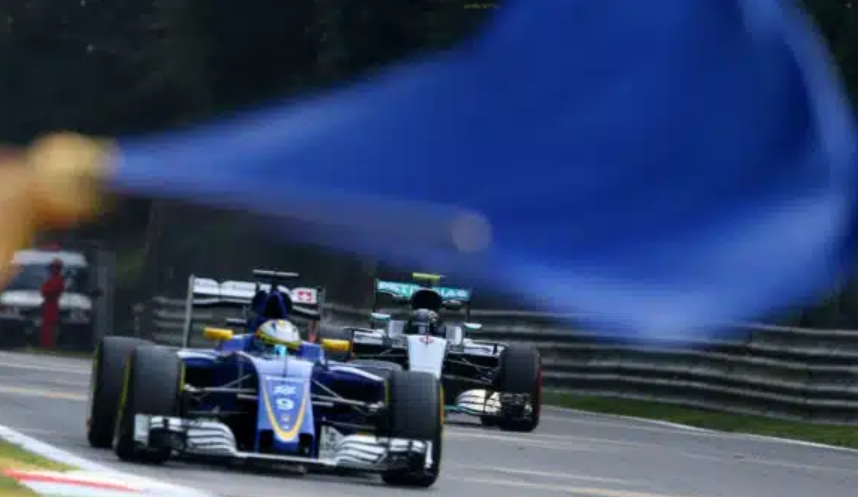
Not every driver on the grid is racing for the win. Some are just trying to survive the lap without becoming an obstacle.
That's the blue flag situation. A lead driver closes in on a slower, lapped car. The blue flag tells that slower driver one thing: get out of the way .
Here's how the timing works. Marshals raise the blue flag once the faster car sits within 3 seconds behind. The gap then drops to 1.2 seconds — that's when the blue cockpit lights and trackside light panels switch on together. From that point, the lapped driver has a hard deadline. Yield to the faster car within three marshal post sections of the flag. No exceptions.
Miss that window three times in a row? The penalties are concrete:
5-Second Time Penalty
First offence in most cases
10-Second Time Penalty
More serious obstruction
Nikita Mazepin learned just how strict that rule is at the 2021 Portuguese Grand Prix . He ignored three back-to-back blue flags from the race leader and took the penalty. In Spain the year before, both Sergio Perez and Daniil Kvyat each picked up 5-second penalties for failing to yield to Hamilton during a lapping attempt.
The Rule Changes Depending on the Session
This surprises most fans: blue flags don't carry the same weight in every session.
| Session | What It Means | Penalty Risk |
|---|---|---|
| Race | Lapped car must yield within 3 post sections | High — 5 to 10 seconds |
| Practice | Advisory warning only | Low, unless deliberate |
| Qualifying | Yield to driver on a timed flying lap | High — can invalidate a lap |
| Pit Exit | Traffic approaching on track | Must yield to avoid blocking |
In a race, the rule is non-negotiable. In practice, it's closer to a courtesy signal. Qualifying lands somewhere in between. Obstruct a flying lap, and both drivers pay the price.
One final detail worth knowing: leading drivers plan their approach with purpose . Clean passes happen on straights, not through tight corners. The faster car can't force an unsafe move. The lapped driver picks the safest spot to yield. Both sides follow that logic — lapping goes smoothly. One side ignores it — the stewards step in fast.
Chequered Flag — The Most Iconic Symbol in Motorsport
Every motorsport fan knows it the moment they see it. That black-and-white chessboard pattern waving at the finish line — it's the most recognized signal in racing history.
But most fans have no idea where it came from.
The earliest documented use dates back to 1906 , at the Vanderbilt Cup race on Long Island, New York. Fred Wagner waved it to mark Louis Wagner's victory. That driver averaged 62.7 mph across a brutal 297.1-mile course. Sidney Waldon, working at Packard Motor Car Company, locked in the design that same year. He used it for checkpoint stations during Glidden Tour rallies.
The black-and-white pattern wasn't random. It was engineering logic . On dusty, dirt-covered early racetracks, a single-color flag vanished into the chaos. The high-contrast alternating squares cut through the dust. Drivers spotted it at full speed — no guesswork needed.
Formula 1 made it official on 13 May 1950 , at the British Grand Prix in Silverstone. Nino Farina took the win that day.
Here's something worth knowing: the chequered flag has no formal FIA regulations on its exact dimensions or design. The chessboard print stays — that's it. Everything else is open.
Its reach goes far beyond the track:
1.NFL end zones at Yankee Stadium used it from 1956 to 1973
2.Porsche built it into their performance branding
3.It became a global symbol for completion, victory, and peak achievement
The flag that ends races started something much bigger.
White Flag — The Warning You Can't Afford to Ignore
Most fans assume the white flag signals surrender. In Formula 1, it means the opposite.
A white flag warns drivers of a slow-moving vehicle ahead on the circuit. That could be an injured car crawling back to the pits, a safety vehicle, or a medical car out on track. It's a precision alert. One sector. One threat. Pay attention or pay the price.
Here's why drivers underestimate it: the white flag rarely shows up. Drivers can go full seasons without seeing one mid-race. That rarity leads to complacency. Complacency at 180mph has real consequences.
The flag doesn't tell drivers to stop. It demands sharp, immediate awareness . Speed drops. No overtaking. Eyes stay locked ahead, scanning for the slow vehicle before the next corner arrives.
Simple flag. Zero margin for error.
Looking for custom racing flags? Whether it's a custom flag for your team or a full set of motorsport signal flags, we manufacture to FIA specifications. Contact us for bulk pricing.
Beyond the Basics: 4 Additional F1 Flags Serious Fans Should Know
Six flags cover the essentials. But four more sit in the marshal's toolkit — and most fans have never had them explained.
These aren't obscure trivia. They show up on track all the time. Miss them, and you'll misread situations that seasoned fans catch without thinking.
Black Flag — The Nuclear Option
The black flag is the harshest signal in motorsport. It means one thing: you're out . The driver's race number appears alongside it. That flag shows, and the driver must return to the pits and stop racing. No appeal. No delay.
Here's the reality though. You'll almost never see a pure black flag in modern F1.
Since the 1990s, race control shifted toward drive-through penalties and time additions — 5 seconds, 10 seconds — over outright disqualification. The black flag became a last resort. Race stewards save it for situations where every other option has failed.
That shift matters. A black flag today means something has gone badly wrong. Not just a rules breach — a full breakdown of the entire penalty system.
Black and White Flag — The Yellow Card of F1
Think of this one as a formal warning. The flag is split on a diagonal — half black, half white — and it targets unsportsmanlike behavior or repeated track limit violations.
The threshold is clear. Exceed track limits more than four times on a single lap , and this flag comes out. First offense gets a warning. Do it again, and stewards add a 5-second time penalty . Push further, and a 10-second stop-go lands on your race.
The 2021 Abu Dhabi Grand Prix put this flag front and center. Multiple drivers — including Max Verstappen — got it for track abuse during one of the most watched races in F1 history. Most fans in the grandstands had no idea what it meant. Now you do.
Black and Orange Flag — The "Meatball" Flag
Drivers hate seeing this one. It's nicknamed the meatball flag — a black flag with a solid orange disc on it. Marshals show it alongside a car number. That driver has a mechanical problem bad enough to need an pit stop right away.
No debate. No radio negotiation. The car must come in.
The purpose is pure safety. A loose wheel, a hydraulic leak, a dragging part — any of these can drop debris at racing speeds and turn one car's problem into a multi-car incident. At the 2023 Qatar Grand Prix , Oscar Piastri's McLaren got called in under this flag for a hydraulic fault. He pitted. The team fixed it. A potential crash — avoided.
Ignoring the meatball flag isn't just reckless. You risk disqualification and a safety investigation.
Red and Yellow Striped Flag — The Slippery Surface Warning
This flag has nothing to do with a competitor doing something wrong. It signals a track condition that nobody caused on purpose .
Oil on the surface. Standing water stretching 50 meters or more. Debris larger than a square meter. Any of these trigger the red and yellow striped flag at the affected marshal post. Drivers ease off through that sector. Overtaking stops. No one pushes tire limits until the hazard is cleared.
Unlike most flag signals, this one is always displayed stationary — never waved. That's a deliberate choice. It tells drivers: this is a fixed, localized threat, not a fast-moving situation.
The 2022 Monaco Grand Prix put this flag to work in Sector 2 after debris from Max Verstappen's crash spread across the racing line. Marshals tracked the danger zone using delta time data. Cars dropped more than 2% off their normal pace through that section — so the flag stayed up. The track cleared, pace returned to normal, and the flag came down.
Four flags. Four very different situations. Each one demands a specific response — and each one tells a story that the basic flag design guide never covers. The more you spot them, the more you see what's really going on during a race.
F1 Flag Rules FAQ: Quick Answers to Common Questions
Eight flags. Hundreds of rules. One race weekend where everything can go wrong if you misread a single signal.
These are the questions fans ask most — answered straight, no fluff.
How many flags are used in Formula 1?
F1 uses eight primary flag types. Together, they cover every race control signal you'll see on track: green, single yellow, double yellow, red, blue, black and white diagonal, black, black with orange disc, and the red-yellow striped flag. Each one carries a clear, non-negotiable instruction. You don't get to guess what it means.
What does the yellow flag mean in F1?
It depends on how many flags you see.
A single yellow means a hazard is beside or partly on the track. You reduce speed, no overtaking, stay sharp.
A double yellow is more serious. The hazard is blocking the track, or marshals are on the circuit working. You drop speed hard. Overtaking is banned. Drivers must be ready to stop on the spot.
What are the F1 flag rules in 2024?
The core signals have stayed the same. The big enforcement change came in 2021. That's when the FIA rolled out automated detection systems to catch drivers who didn't slow through double yellow sectors. That system is still running today. Yellow flags are now the most-enforced signal in the sport — stewards take them seriously, and so do the penalties.
What happens when a red flag comes out?
Racing stops. Every driver slows and heads to the pit lane. No overtaking during the neutralization — full stop.
In a race, teams use the stoppage to change tires and make repairs. That's a strategic window you won't get under any other flag. It can flip the race outcome entirely.
Does the blue flag rule apply in qualifying?
Yes, and it has real consequences. Block a driver on a flying lap, and that lap gets invalidated. Both drivers can walk away losing time.
In a race, ignore three consecutive blue flags and you get a time penalty. Nikita Mazepin learned that at the 2021 Portuguese Grand Prix — the hard way.
When was the black flag last used in F1?
The last confirmed race use was the 2007 Canadian Grand Prix . Both Felipe Massa and Giancarlo Fisichella got black-flagged for exiting the pit lane against a red light. Modern race control leans on drive-through penalties and time additions instead. A pure black flag today means the normal penalty system has broken down completely — it's the nuclear option.
Custom F1 Racing Flags: Bring the Motorsport Spirit to Your Event
Understanding the flags is one thing. Owning them is another.
Organizing a track day, a corporate motorsport event, or building a collection that means something? Custom F1-spec racing flags turn any venue into a real circuit. The energy shifts the moment a proper chequered flag goes up. Everyone in the room feels it.
At runcustomflag.com, every flag meets motorsport-grade standards. We use 100% polyester construction, built to the same minimum dimensions race marshals use:
Customization comes included — no extra cost. Add your name, team logo, driver number, or corporate branding. Pick your interior fabric color, then choose a matte or glossy finish. Hans-Anchors come standard on every flag.
Every order ships free via FedEx priority worldwide . That's 2 days to the US and 4 days to Europe. Got a tight deadline? Rush processing is ready for you. Plus, the 30-day money-back guarantee with free returns means you take on zero risk.
The flags you just learned to read? You can now fly them yourself.
Conclusion
Every flag waved on an F1 circuit tells a story — danger, dominance, drama, or pure triumph. You now know what each signal means. Watching a Grand Prix will never feel the same again. You'll catch details that casual fans miss.
F1 isn't just speed — it's a language. The checkered flag drivers chase. The yellow flag that demands respect. The red flag that freezes an entire race. These signals are the invisible rulebook, playing out in real time, right in front of you.
The more fluent you get in that language, the deeper your connection to the sport grows.
Ready to go further? Share this guide with a fellow racing fan who still thinks the blue flag is just decoration. Or host a race event, karting day, or motorsport watch party — check out our custom F1 racing flags and bring real trackside energy to your crowd.
Real fans don't just watch the race — they understand every signal that shapes it.