Every Flag Decision Starts With a Room
You're outfitting a new office, planning a corporate event, or both — and someone just asked you to "handle the flags." That sounds simple until you realize how many variables are hiding behind it. Indoor or outdoor? How tall should the pole be? Where does the company flag go relative to the national flag? What fabric won't look washed out after two months?
Most companies get this wrong not because they pick ugly flags, but because they treat it as a decoration decision when it's actually a space-planning decision. The flag that works in a trade show booth will look absurd in a boardroom. The one that looks sharp in your lobby will shred itself on an outdoor pole within weeks.
This guide walks through the real decisions — setting by setting, flag type by flag type — so you can build a corporate flag display system that actually holds up.
Mapping Corporate Flag Solutions to Your Specific Setting
The lobby, the boardroom, the outdoor entrance, and the trade show booth are four completely different flag environments. Treating them as one is the most common mistake.
An office lobby typically calls for a 3x5 ft flag on an 8 ft indoor pole. That's the standard, and it works for rooms with standard ceiling heights. But if your lobby has an atrium or double-height ceiling, a 3x5 flag looks like an afterthought. Scale up to 4x6 ft or the proportions feel off.
Boardrooms are a different problem entirely. Wall-mounted flags between 3 and 6 feet work best here, and the design needs to be simplified — icon-only, no thin outlines, bold sans-serif text if any. The viewing distance is short, so cluttered logos become unreadable fast. Most companies skip this step and hang the same flag they'd use outdoors. It never looks right.
Outdoor entrances follow a ratio rule: flag length should be roughly one-quarter to one-third of the pole height. A 20 ft pole takes a 3x5 ft flag. A 25 ft pole works with a 4x6 ft. Go too large and the flag strains the hardware; too small and it disappears against the building. For sidewalk-level visibility, feather flags in the 8-15 ft range pull more attention than a traditional flag on a tall pole ever will.
Event settings demand portability above all else. Trade show booths lean on feather and teardrop flags because they're lightweight, set up in minutes, and fit into a carry bag. Corporate ceremonies call for presentation flags — rectangle or square, more formal — while grand openings benefit from oversized sail flags on 25 ft+ poles where sheer size does the branding work.
Which Flag Type Fits Which Scenario
Not every flag shape serves the same purpose, and picking the wrong one wastes money faster than picking the wrong color.
Feather flags are the workhorses of corporate events. Tall, curved at the top, and designed to catch wind without toppling — they're ideal for store entrances, roadside displays, and any setting where you need height without a permanent pole. They range from 8 to 15 ft and hold up surprisingly well in moderate wind. If you only buy one type of portable flag, this is it.
Teardrop flags fill a narrower role. The rounded top with a pointed bottom keeps the material taut, which means better legibility in breezy conditions. They work well for outdoor markets, sporting events, and fairs where you need the design to stay readable — not flapping into itself. Typical heights run 7 to 12 ft.
Sail flags go taller and narrower. They're the ones you see lining car dealership entrances or flanking building facades. The vertical format is perfect for logos and short call-to-action text, but it's a poor choice for anything with detailed messaging. Rectangular flags or blade flags handle detail better because of the wider printable area.
Tabletop flags are easy to overlook, but they matter in boardrooms and at conference registration desks. A 4x6 inch to 8x12 inch flag on a small stand reinforces branding in settings where a full-size flag would be overkill. Wall-mounted flag sets, with 45-degree brackets, work for building facades where you want branding without a freestanding pole.
The real question isn't "which flag looks best" — it's which one survives your specific environment while staying legible from the distance your audience will see it.
Multi-Flag Protocol That Won't Embarrass Your Company
Flag arrangement at formal events trips up more companies than you'd expect. The mistakes are usually small — a corporate flag hung at the same height as the US flag, or national flags in the wrong order — but at a public event, someone always notices.
The US Flag Code is clear on positioning: the US flag goes to its own right, which means the observer's left. In a multi-pole setup, it should be center and highest. If you're running a three-pole arrangement — the most common corporate setup — the US flag takes the center position at the highest point, the state flag goes to the observer's left, and the corporate flag to the observer's right.
Corporate flags must always sit below the US flag. Never on the same pole. Never at the same height on adjacent poles. This sounds obvious, but I've seen it done wrong at ribbon-cutting ceremonies where the facilities team just matched all the pole heights for visual symmetry. That's not how it works.
International events add another layer. All national flags must be displayed at equal height, equal size, in alphabetical order by English name, with the host country's flag at the position of honor. No national flag may be placed above another. The US flag still gets hoisted first and lowered last, but it doesn't get a height advantage when other nations' flags are present.
One rule people consistently miss: when flying multiple corporate flags alongside the US flag, all corporate flags should be the same size, and all should be equal to or smaller than the US flag. A 3x5 ft corporate flag under a 4x6 ft US flag is correct. Two 4x6 ft flags side by side — one US, one corporate — is not.
Material Decisions That Determine How Long Your Flags Last
Indoor and outdoor flags need different fabrics. Full stop. Using an indoor flag outside is a guaranteed replacement within weeks, and using a heavy outdoor flag indoors looks bulky and won't drape properly.
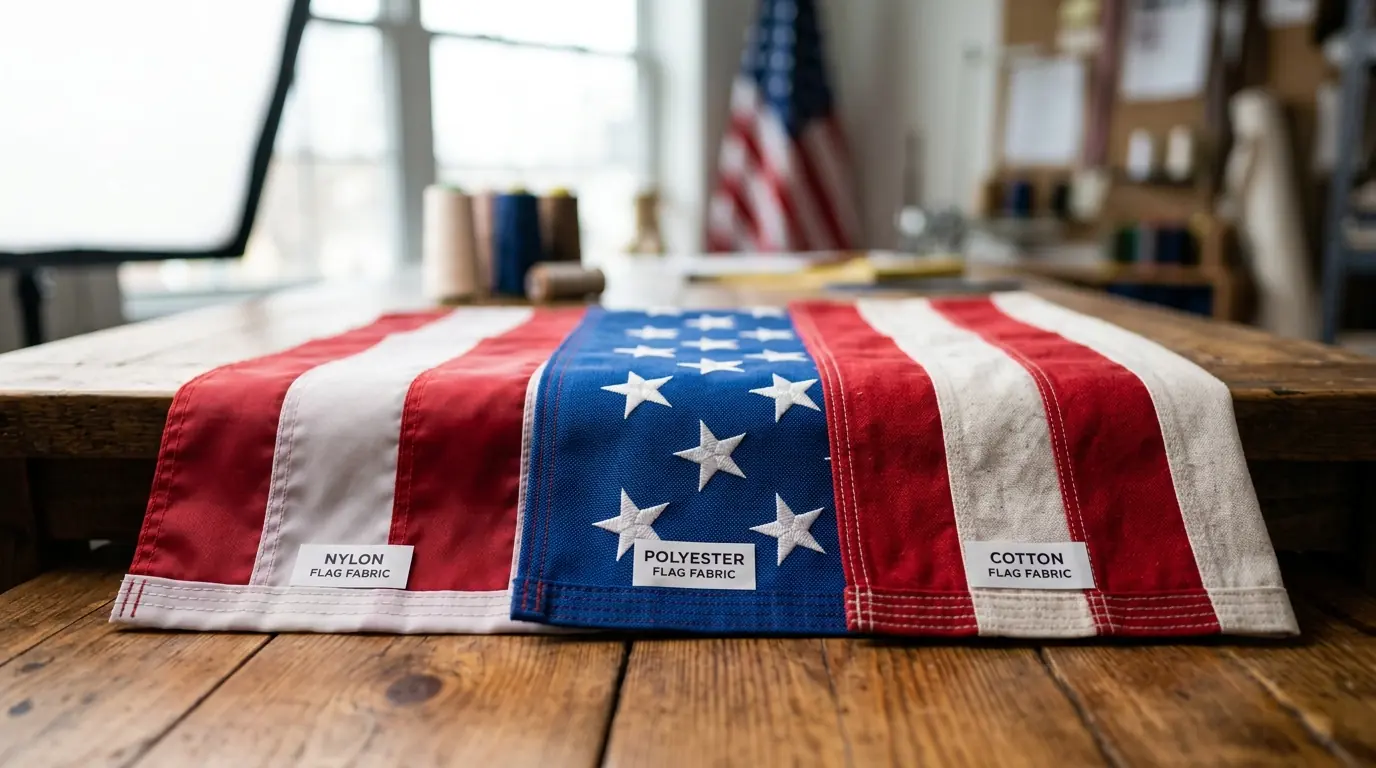
For outdoor use, the choice comes down to nylon or polyester. Nylon at 200 denier is the default all-purpose outdoor flag material — lightweight, flies in a light breeze, dries quickly. Expect 6 to 12 months of life with daily flying. Polyester at 250 denier is heavier, holds color better in harsh weather, and resists wind damage. It lasts roughly 12 to 18 months but needs a stronger breeze to fly properly. If your flagpole is in a sheltered courtyard, polyester might just hang limp most days. Nylon is the better call there.
Printing matters more than most buyers realize. Dye sublimation is the standard for corporate flags with complex logos or gradients — it reproduces full color without the heavy ink buildup of screen printing. The bigger decision is single-sided versus double-sided printing. Single-sided flags show a mirror image on the reverse, which looks fine from a distance but becomes distracting up close. Double-sided flags cost 30 to 50 percent more, but both sides read correctly. For a corporate headquarters entrance, double-sided is worth the premium. For an event booth where people only approach from one direction, single-sided saves budget without any real compromise.
Indoor flags can use softer, lighter fabrics without UV resistance. They won't fade, they won't get rained on, and they don't need anti-microbial treatment. The cost savings versus outdoor-rated materials is meaningful — often 30 percent or more — and there's no reason to over-spec them.
Getting Flag Size Right for Your Space
Oversized flags on short poles and undersized flags on tall poles are both common. Neither looks professional.
The sizing math for outdoor commercial poles is straightforward: flag length should be one-quarter to one-third of pole height. Here's what that looks like in practice — a 20 ft pole takes a 3x5 ft flag, a 25 ft pole works with 4x6 ft to 5x8 ft, and a 30 ft pole pairs with 5x8 ft to 6x10 ft. Large corporate campuses running 40 to 60 ft poles can go up to 8x12 ft or larger, but at that scale you're dealing with flags that weigh significantly more and need commercial-grade hardware.
Indoor sizing is simpler. A 3x5 ft flag is standard for most corporate interiors. Conference halls with high ceilings can scale to 4x6 ft. Going larger than that indoors usually creates more problems than it solves — the flag dominates the room instead of complementing it.
For events, feather flags between 8 and 15 ft tall work for most booth configurations. Teardrop flags at 6 to 10 ft handle tighter spaces. Wall-mounted flags should match the facade proportionally, usually 2x3 ft to 3x5 ft on 5 to 8 ft poles.
When flying multiple corporate flags together, all of them should be the same size. Mixing sizes between company divisions or brands reads as hierarchy, whether you intended it or not. The US flag, if present, should be equal to or one size larger than the corporate flags.
Pro Tip: For multi-location flag setups, contact us for volume pricing and consistent Pantone color matching across all your offices.
Ordering Corporate Flags: What Vendors Won't Tell You
Most flag vendors make ordering seem simple — pick a size, upload a logo, pay. The problems show up after you've committed.
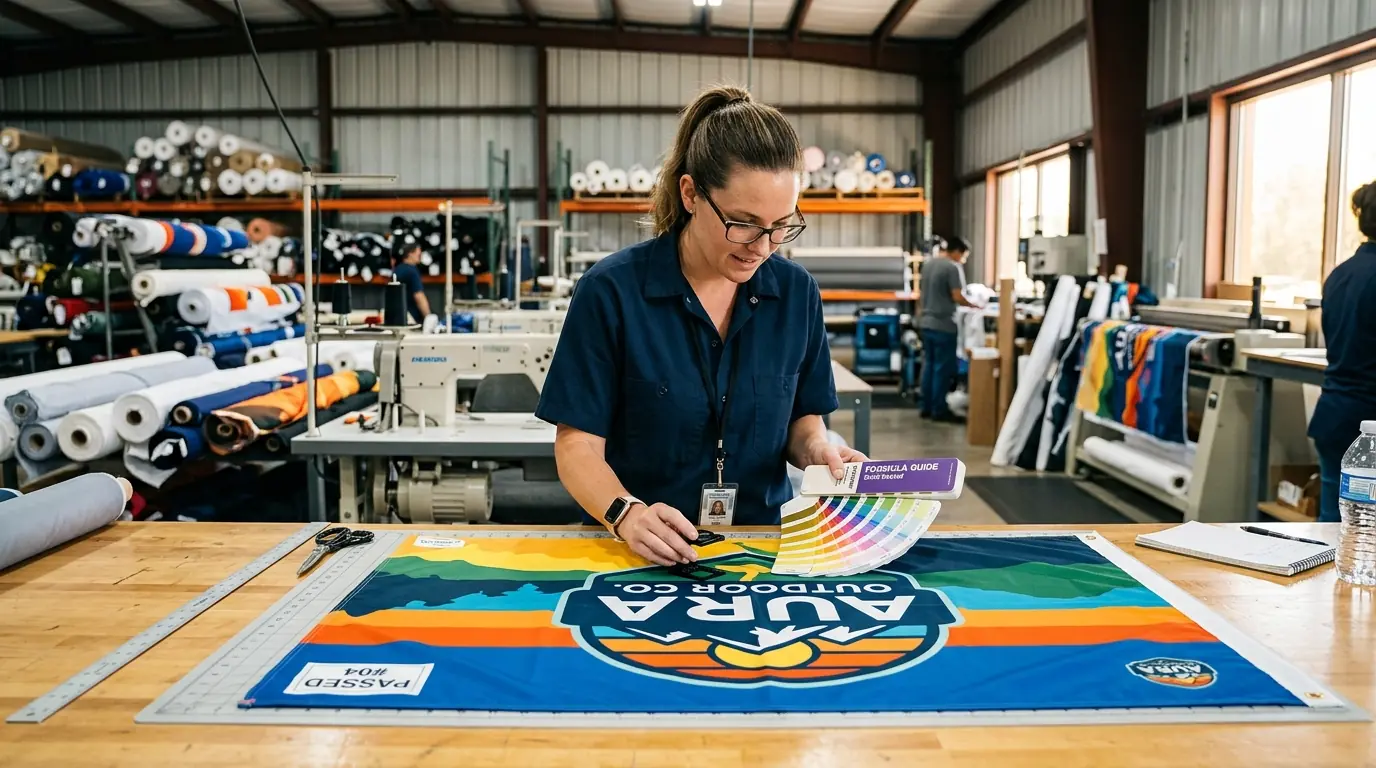
Color matching is the first gap. Your brand's Pantone colors and what comes out of a dye sublimation printer are not automatically the same thing. Vector art files produce the most accurate results, but many companies send JPGs or PNGs and then wonder why the flag color doesn't match the business cards. Send the vector file. If your vendor can't process AI or EPS files, that's a red flag about their production capabilities.
Minimum order quantities are lower than you'd expect — most custom flag vendors will produce a single piece. But the per-unit economics only start making sense around 10 to 50 units. Below 10, you're absorbing setup and production overhead that can push a $25 flag to $50 or more. If you're ordering for multiple office locations, batch the order. The savings compound fast.
Lead times vary widely. Standard production runs 5 to 10 business days. Rush orders can happen in 2 to 3 days at a premium, but rush quality isn't always the same as standard quality — stitching gets less attention, colors get less calibration. For events with fixed dates, order at least three weeks out. The small premium for standard-speed production is cheaper than the stress of a rush job that arrives wrong.
Hardware bundling is where vendors pad margins. Poles, bases, brackets, and carrying cases sold as a "complete kit" often cost 20 to 40 percent more than buying components separately. Unless you genuinely need the convenience, price the hardware individually.
Maintenance Schedules That Actually Protect Your Investment
Flags deteriorate. The question is whether you replace them proactively or wait until a client notices the fraying.
Outdoor flags flown daily have a functional lifespan of roughly 90 days for nylon, longer for polyester. That means budgeting for about four replacements per pole per year if the flag flies every day from sunrise to sunset. Most facilities managers plan for two to three replacements and end up with a ratty-looking flag for the last quarter. Budget for four.
Inspection should happen at minimum every three months, and after any severe weather event. Check the fly end for fraying first — that's where damage starts. Then look at grommets for wear or rust, seams for pulling, and color for fading. The replacement trigger is simple: if the flag looks worn from 20 feet away, it's already overdue.
Cleaning is less complicated than people make it. Nylon flags can go through a washing machine on a delicate cycle with mild detergent. Oversized or delicate flags need professional cleaning. The critical step most people skip is drying thoroughly before storage — folding a damp flag creates mold that ruins the fabric permanently.
Storage means a breathable bag, away from direct sunlight and moisture. Not a plastic bin in the warehouse. Not folded in a desk drawer. And always keep a spare flag on hand. The day you realize a flag needs replacing is never the day a replacement conveniently arrives.
Building Your Corporate Flag System: Where to Start
If you're setting up corporate flags for the first time, the sequence matters more than the budget. Start with the settings that get the most visibility — typically the main entrance and the lobby — and get those right before worrying about boardroom table flags or event inventory.
For a single office location, the first purchase should be one outdoor flag set (pole, flag, hardware) and one indoor set for the lobby. Budget roughly $500 to $1,500 for outdoor and $50 to $150 for indoor, depending on pole height and flag material. Add a spare outdoor flag immediately — you'll need it sooner than you think.
If you're planning for events too, add three to five feather flags with carrying cases. They'll cover trade shows, grand openings, and temporary promotions without requiring new purchases each time.
For multi-location companies, standardize everything — flag sizes, pole heights, hardware, vendor. Inconsistency between locations looks worse than having no flags at all. Batch your orders, set a quarterly replacement schedule, and assign one person to own the flag inventory. It sounds bureaucratic, but the alternative is the Tampa office flying a sun-bleached flag while the Chicago office just installed new ones.
The flags themselves are not expensive. The cost of getting them wrong — in protocol violations, shabby appearances, or event-day scrambles — is always higher.
Video Guide
Related Articles