Overview of Standard Sizes

American flags come in many different sizes. Three main sizes lead the market based on where and how you display them. When choosing an outdoor flag, understanding standard dimensions ensures proper display and longevity.
The 3 x 5 feet flag (91.44 x 152.4 cm) is the standard for homes. Walk through any American neighborhood on Independence Day. About 70% of the flags you'll see are this exact size. This size works for typical suburban settings. Think wall-mounted brackets, front porch poles, and garden flagpoles between 15-20 feet tall. A 3' x 5' flag stretched out equals the arm span of someone standing 5'4" tall.
The 4 x 6 feet option sits in the middle. You'll find this size on larger homes, business storefronts, and community buildings. The flag needs to grab attention from across a parking lot or down a long street. "Visible from the neighbor's yard" isn't enough. You need "visible from two blocks away."
Commercial and government sites use bigger flags: 5' x 8', 6' x 10', and beyond. Auto dealerships, corporate campuses, and municipal buildings display 8' x 12' or even 10' x 15' flags. The largest standard size—30' x 50'—goes on massive flagpoles over 100 feet tall. These are the ones you spot from highway exits.
These size categories aren't just marketing tools. Engineers calculate them based on flagpole height ratios and wind load. Decades of field testing show what looks right and survives weather.
Official U.S. Government Specification Sizes
Executive Order 10834 changed how federal agencies buy flags. Commercial manufacturers can use rough ratios like 2:3 or 3:5. Government buyers can't. They must order flags with a precise 1:1.9 hoist-to-fly ratio. The length is 1.9 times the width.
These flags look longer and narrower than the 3' x 5' version hanging in your neighbor's yard. Federal buildings, military bases, and official ceremonies use these G-spec flags. The dimensions aren't round numbers. They're calculated to maintain that exact ratio.
Standard G-Spec Dimensions and NSN Codes
Government-spec flags carry a National Stock Number (NSN) for tracking orders. Here's the official lineup:
Small Installation Flags:
- 1'8" x 2'2" (NSN# 8345-00-2452040) — The smallest G-spec size, designed for 10' to 15' poles
- 2'4-7/16" x 4'6" — Storm flag dimensions for harsh weather
- Nylon: NSN 8345-00-753-3230
- Cotton: NSN 8345-00-682-6857
- Pole height: 15' to 20'
Daily Use Sizes:
- 3'6" x 6'7-3/4" — Common at smaller federal offices
- Nylon: NSN 8345-00-753-3234
- Cotton: NSN 8345-00-682-6856
- Pole height: 20' to 25'
The Dual-Purpose Flag:
- 5' x 9'6" — Serves as both the standard "Post" flag and the official casket flag for military burials
- Nylon: NSN 8345-00-753-3235
- Cotton: NSN 8345-00-753-3232
- Pole height: 30' to 40'
Large Visual Impact:
- 8'11-3/8" x 17' (sometimes listed as 9' x 17')
- Nylon: NSN 8345-00-753-3231
- Pole height: 50' to 60'
- 10' x 19' — Largest standard garrison size for 60' to 65' poles
Monumental Displays:
Federal specs include massive flags for landmark installations. 20' x 38' up to 30' x 50' sizes fit poles between 90' and 100' tall. These are the flags you see from interstate highways.
Mathematical Precision Behind G-Spec Flags
Every measurement ties back to the hoist (width). The government uses precise calculations:
- Union (canton) width: 0.5385 of the hoist (7/13)
- Union length: 0.76 of the fly
- Each stripe: 1/13 of the hoist
- Star diameter: 0.0616 of the fly
This math ensures visual consistency. A 2' flag and a 30' flag maintain the same proportions.
Manufacturing Requirements
G-spec flags must match dimensions. Plus, they must meet strict production standards:
- Materials: Nylon for outdoor weather resistance; cotton for indoor or ceremonial use
- Construction: Lock-stitched seams throughout (no weak points)
- Thread: Color-matched to red, white, and blue fabric (invisible stitching lines)
- Origin: 100% manufactured in the U.S.A.
These are firm requirements. A federal buyer would reject a flag with visible white thread on red stripes.
Right Flag Size for Flagpoles
The flag-to-pole ratio makes your display look professional or awkward. Your flag's length should measure one-quarter to one-third of the flagpole height. This ratio comes from decades of engineering tests and visual design work. Proper flag pole selection is crucial for optimal display.
Take a 20-foot home flagpole. The flag length should be 5 feet (25% of pole height) to 6.6 feet (33%). A 3' x 5' flag falls just under this range but works for most suburban homes. A 4' x 6' flag lands in the sweet spot. A 5' x 8' flag exceeds the upper limit and creates problems.
The Three-Step Sizing Formula
Measure your flagpole before ordering a replacement flag:
- Record the pole height from ground level to the top finial
- Calculate the minimum length: Pole height × 0.25
- Calculate the maximum length: Pole height × 0.33
You get a range. Pick the closest standard flag size within those numbers.
Test this on a 25-foot pole (common for businesses):
- Minimum: 25 × 0.25 = 6.25 feet
- Maximum: 25 × 0.33 = 8.25 feet
- Recommended flag: 4' x 6' or 5' x 8'
The 4' x 6' sits at the conservative end. The 5' x 8' gives maximum visual impact without being oversized.
Standard Flagpole-to-Flag Matches
Home installations (15-25 feet):
- 15-foot pole: 3' x 5' flag — The baseline for small yards and garden displays
- 20-foot pole: 3' x 5' to 4' x 6' — Most American homes fall here. Choose 3' x 5' for modest curb appeal. Choose 4' x 6' for bold patriotic presence.
- 25-foot pole: 4' x 6' to 5' x 8' — Large properties or homes set back from the street
Business and institutional displays (30-50 feet):
- 30-foot pole: 5' x 8' to 6' x 10' — Standard for car dealerships, retail plazas, schools
- 35-40 foot pole: 6' x 10' to 8' x 12' — High-traffic areas where the flag competes with building signs and vehicle movement
- 50-foot pole: 8' x 12' to 10' x 15' — Corporate headquarters, large municipal buildings
Large installations (60+ feet):
- 60-65 foot pole: 10' x 15' to 10' x 19' — Government buildings, state capitols
- 90-100 foot pole: 20' x 38' to 30' x 50' — Highway-visible installations, sports stadiums
Why the Ratio Matters
A flag shorter than 25% of pole height disappears against the sky. Drivers passing at 45 mph won't register it. A flag exceeding 33% creates stress on the pole.
The wind load problem: Oversized flags act as sails. A 6' x 10' flag on a 20-foot pole catches enough wind to bend aluminum poles during 40+ mph gusts. The leverage effect grows fast. The flag's center point sits far from the pole's base. Storm conditions can snap the upper third of an undersized pole. Using proper flag grommets and hardware helps distribute stress evenly.
The ground contact issue: Flags hung too large will brush the ground on pulley systems. Flag code prohibits ground contact. You'll damage the fabric and break display rules at the same time. Understanding proper outdoor flag display techniques prevents these issues.
Multi-Flag Displays
Flying a state flag or business banner beneath the American flag requires size adjustment. The U.S. flag maintains standard sizing for the pole height. The second flag should drop one size smaller.
Example for a 25-foot pole:
- Top position: 4' x 6' American flag
- Lower position: 3' x 5' state flag
This creates visual order. It prevents the bottom-heavy look of equal-sized flags stacked on top of each other.
Flag Proportion Details (Executive Order 10834)
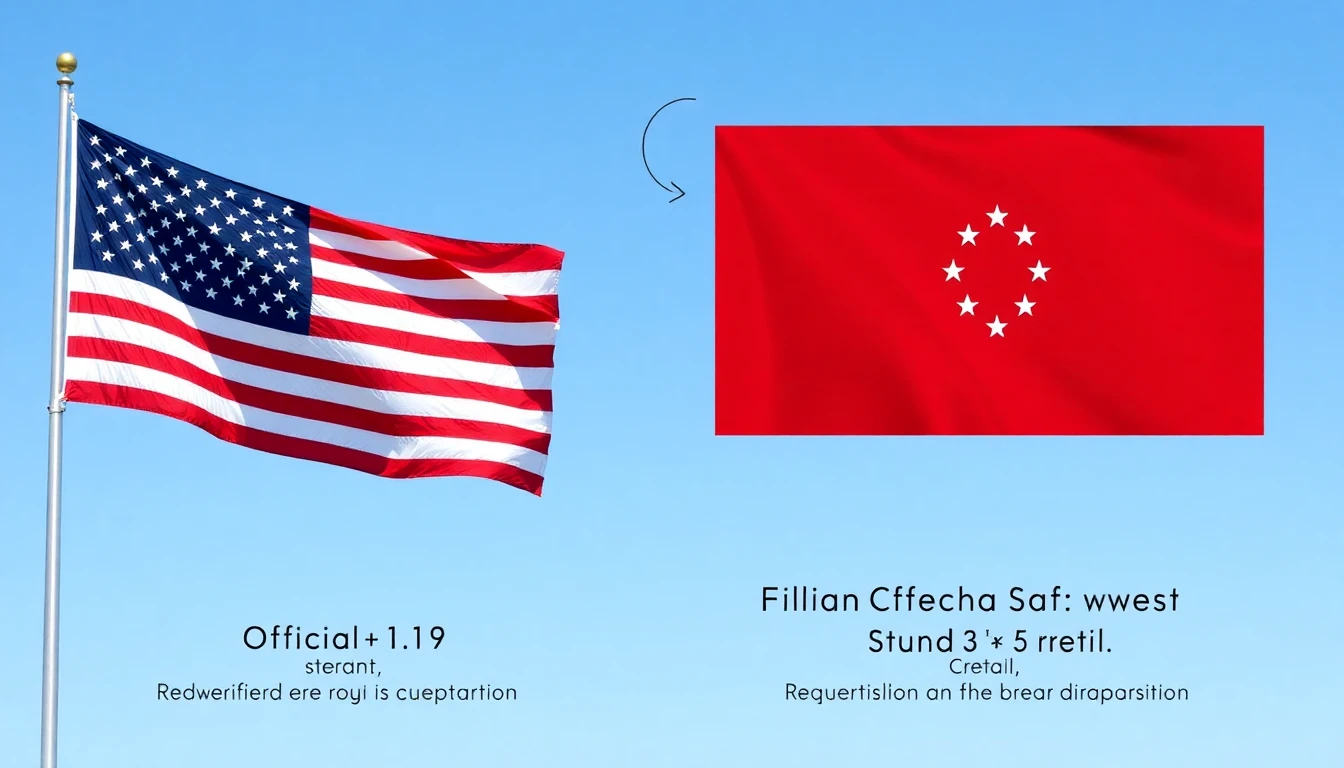
The 1:1.9 ratio sits at the heart of every official American flag. Executive Order 10834 makes this proportion federal law. The fly (length) must measure 1.9 times the hoist (width). No rounding. No approximation. This math precision sets government-spec flags apart from retail versions hanging outside suburban homes.
Understanding Hoist and Fly Measurements
Two terms control flag dimensions:
- Hoist: The vertical measurement (width as the flag hangs from a pole)
- Fly: The horizontal measurement (length from pole to outer edge)
Commercial flags skip the 1:1.9 standard. Walk into any big-box store and you'll find 3' x 5' flags everywhere. That's a 1:1.67 ratio. The flag looks stubbier. The stars bunch up in the canton. Federal buildings can't use these. Military ceremonies won't accept them. Put both flags side by side and the visual difference jumps out.
Internal Element Proportions
Executive Order 10834 covers more than outer dimensions. Every internal part follows exact formulas tied to the hoist measurement.
Stripe construction:
- The flag divides into 13 equal-width stripes (seven red, six white)
- Each stripe width equals 1/13 of the total hoist
- On a 36-inch hoist flag, each stripe measures 2.77 inches
The union (blue canton):
- Height spans the top 7 stripes (7/13 of the hoist, or 0.5385)
- Length extends 2/5 of the fly (0.4), which equals 0.76 of the hoist
- A 36-inch hoist creates a union measuring 19.4" tall × 27.36" wide
Star specifications:
- Each five-pointed star has a diameter of 4/5 the stripe width (0.0616 of the hoist)
- Stars arrange in 9 horizontal rows
- Rows alternate between 6 stars and 5 stars for balanced distribution
- On our 36-inch example, stars measure 2.22 inches in diameter
Proportions in Practice
Take a theoretical flag with a 3-foot (36-inch) hoist:
- Required fly: 36" × 1.9 = 68.4 inches
- Commercial 3' x 5' fly: 60 inches
- The difference: 8.4 inches short of official spec
That 8.4-inch gap changes how the flag waves. It affects how fabric stress spreads during wind gusts. It also changes how the proportions look from 100 feet away. Government buyers check these dimensions with precision tools before accepting delivery.
Perspectives and Use Cases
Different places need different flag sizes. A 3' x 5' flag works great on a suburban home but looks tiny on a corporate campus. Context drives the decision.
Residential Applications
Standard suburban homes stick with the 3' x 5' flag for good reason. This size fits typical American home design. Mount it on a 20-foot pole in your front yard. You get balanced curb appeal without overpowering a single-story ranch or two-story colonial. The flag fills your view as you pull into the driveway. But it doesn't fight with the house itself.
Larger properties need more presence. Estates with long driveways work better with 4' x 6' flags. Same goes for homes set back 100+ feet from the street. Or properties with big landscaping. The extra size matters as viewing distance grows. A 3' x 5' flag vanishes against a three-story home with 40-foot setback. The 4' x 6' keeps visual weight.
Small decorative displays drop to 12" x 18" dimensions. These compact flags work for garden stakes, mailbox decorations, or Memorial Day table centerpieces. You're not trying to show patriotism from across the street. You're adding accent details to flower beds or porch railings.
Marine Display Standards
Boats follow strict sizing rules based on vessel length. These aren't suggestions. Maritime tradition and Coast Guard guidelines enforce them.
- Under 20 feet: 8" x 12"
- 20-29 feet: 10" x 15"
- 30-39 feet: 12" x 18"
- 40-49 feet: 14" x 21"
- 50-59 feet: 16" x 24"
- 60-69 feet: 20" x 30"
The formula stops flags from creating safety risks. An oversized flag on a 25-foot sailboat catches wind. This affects handling. Undersized flags vanish to other vessels at distance. That's a safety concern in busy harbors.
Military Honors and Burial Flags
The casket flag measures 5' x 9'6". This size isn't random. The flag must drape correctly over a standard military casket. It folds into the traditional triangle presentation during burial ceremonies. The 1:1.9 government ratio creates the exact length needed for the 13-fold ceremony. Each fold carries symbolic meaning. The dimensions allow correct execution without extra fabric bunching at the corners.
Public Events and Ceremonial Displays
Community gatherings need visibility across crowds. Parades, town hall meetings, and outdoor ceremonies use 4' x 6' to 6' x 10' flags. These sizes stay readable from 200+ feet away. That's the typical view across a park or plaza. A 3' x 5' flag gets lost with 500 people spread across an open field.
Major government buildings use garrison-sized flags. Think 20' x 38' up to 30' x 60' dimensions. These massive displays appear on state capitols. Also federal courthouses and military memorials. The scale shows authority and permanence. You spot these flags from highway exits half a mile away. That's the goal—maximum visual impact for landmark locations.
Core Numeric Size List (Top Sellers)

Flag retailers track sales data year after year. The same dimensions dominate purchase records across the United States. Makers focus on these proven sizes because demand stays steady.
The Universal Home Standard: 3' x 5'
Dimensions: 91.44 cm x 152.4 cm
This size accounts for most residential flag sales in America. Hardware stores stock it. Online retailers feature it first. The industry treats 3' x 5' as the baseline.
Why this size wins:
- Works with standard wall-mount bracket kits. No changes needed.
- Ships in compact packaging. Lower delivery costs.
- Fits the 15-20 foot flagpoles in most suburban yards
- Price sits between $15-$35 for nylon construction
You'll find this exact size pre-packaged with pole kits at home improvement stores. Stores call them "complete flag sets" because the proportions match right out of the box.
Enhanced Residential: 4' x 6'
Dimensions: 121.92 cm x 182.88 cm
Sales reports show this as the second most popular choice. Homeowners upgrade to 4' x 6' when a 3' x 5' flag feels too small for their property.
Target installations:
- Large estate homes with extended driveways
- Properties over one acre
- 20-25 foot flagpoles on corner lots
- Homes competing with tall trees or neighboring structures
The price jump runs $25-$45 for quality nylon. That small increase buys better street visibility.
Commercial Entry Point: 5' x 8'
Dimensions: 152.4 cm x 243.84 cm
Business districts run on this dimension. Schools adopt it. County government offices display it. The 5' x 8' flag creates a professional presence. No massive infrastructure needed.
Common applications:
- Public schools and community colleges
- City service buildings
- Corporate office parks
- Shopping center entrances
Expect 25-30 foot poles paired with this size. The flag stays readable from across parking lots measuring 200+ feet.
Large Institution Standard: 6' x 10'
Dimensions: 182.88 cm x 304.8 cm
This size marks where flags become event-worthy. Stadiums use it. Large public gatherings feature it. These dimensions create focal points at outdoor ceremonies.
Installation requirements:
- 35-40 foot commercial-grade poles
- Reinforced grommets. Wind stress increases at this size.
- Heavy-duty halyard systems rated for weight
Manufacturing costs climb here. Quality 6' x 10' flags start around $80-$120. The fabric weight doubles compared to residential options.
Major Buildings: 8' x 12'
Dimensions: 243.84 cm x 365.76 cm
Government centers and corporate headquarters invest in this scale. The flag shows institutional authority. You can see it from highways and multi-block distances.
Poles reach 40-50 feet. Wind load calculations matter at this level. A single storm gust puts hundreds of pounds of force on fabric this large.
The Casket Flag Exception: 5' x 9'6"
Dimensions: 152.4 cm x 289.56 cm
Military tradition demands this exact measurement. The 5' x 9'6" size allows proper draping over standard caskets. The same flag works on 30-40 foot poles at military bases.
This is the one common size that follows the government 1:1.9 ratio you'll see in civilian retail channels.
Monument Scale: 20' x 38'
Dimensions: 609.6 cm x 1158.24 cm
State capitols and federal landmarks operate at this level. These garrison flags need 90-100 foot poles. A single flag can cost $800-$2,500 depending on material grade.
Weather resistance becomes an engineering issue. Fabric must survive sustained 50+ mph winds. No shredding allowed. Replacement cycles run shorter—often yearly for highway-exposed installations.
Additional Sizing Tips
Geography and purpose change the standard sizing rules. This happens faster than you'd think. Atlantic coast winds need different math than calm inland valleys. Memorial displays use different logic than outdoor flags you fly every day.
Wind-Prone Locations Require Size Reduction
Coastal properties and prairie spots face 25+ mph winds on a regular basis. The standard flagpole-to-flag ratio fails here. A 3' x 5' flag works fine in suburban Atlanta. But along the North Carolina Outer Banks? It tears apart in six months.
The downsize strategy:
- Drop one size below the pole height recommendation
- A 20-foot pole takes a 2.5' x 4' flag instead of 3' x 5'
- A 25-foot pole uses a 3' x 5' flag instead of 4' x 6'
This isn't about looks. Wind force grows fast with flag surface area. Cut the size by 20%. You reduce stress on the pole by 40%.
Material selection matters as much as size. Polyester beats nylon in high-wind zones. The tighter weave resists tearing. Polyester costs $5-$10 more per flag. But you'll replace it less often - every 18 months instead of 8. The math works in your favor. Learn more about outdoor flag materials for your climate.
Compact Spaces Need Scaled-Down Options
Not every property has room for a 20-foot flagpole. Townhome groups limit pole heights. Urban front yards measure 15 feet from door to sidewalk. Garden flags solve these problems.
Garden mount sizing:
- 2' x 3' flags fit yard stakes between 5-7 feet tall
- Common for flower bed accents and walkway markers
- Price range: $10-$18 for nylon construction
Mid-size residential (2.5' x 4') bridges the gap between garden stakes and full setups. Works for:
- Porch-mounted bracket poles (10-12 feet)
- Mailbox displays in subdivisions with strict rules
- Balcony displays on apartments and condos
These smaller sizes keep proper proportions. The stars don't crowd together. Stripes stay balanced. You're not flying a tiny novelty item. You're using the right size for your available space.
Seasonal Display Rotation
Winter weather calls for smart size swaps in northern states. Snow load on fabric creates ice damage. Frozen flags whip against metal poles. They shred faster than summer flags.
The two-flag system:
- Keep your standard 3' x 5' flag for April-October
- Switch to a 2' x 3' storm flag November-March
- The smaller flag survives freeze-thaw cycles better
- Less fabric means less ice weight builds up
Businesses in Minnesota, Wisconsin, and Montana use this rotation as standard practice. Owning two flags costs a bit more upfront. But you avoid mid-winter replacements. That saves money over time.