You just got put in charge of flag protocol at your installation, or maybe you're on the facilities committee at a veterans' cemetery, and someone asks: "Are we supposed to fly the big flag on Armed Forces Day?" You're not sure. You've seen the massive flag go up on the Fourth of July, but Armed Forces Day? Is that mandatory or optional? And how big is "the big flag" supposed to be, anyway — is there an actual spec, or does every base just pick one that looks right?
These are not hypothetical questions. Getting garrison flag protocol wrong is the kind of mistake that draws attention from exactly the people you don't want noticing. The regulations exist, they're specific, and they've been refined over more than a century. This guide lays out the exact dimensions, the federal authority behind them, and the complete list of days when that flag has to go up.
What a Garrison Flag Actually Is: The Exact Dimensions
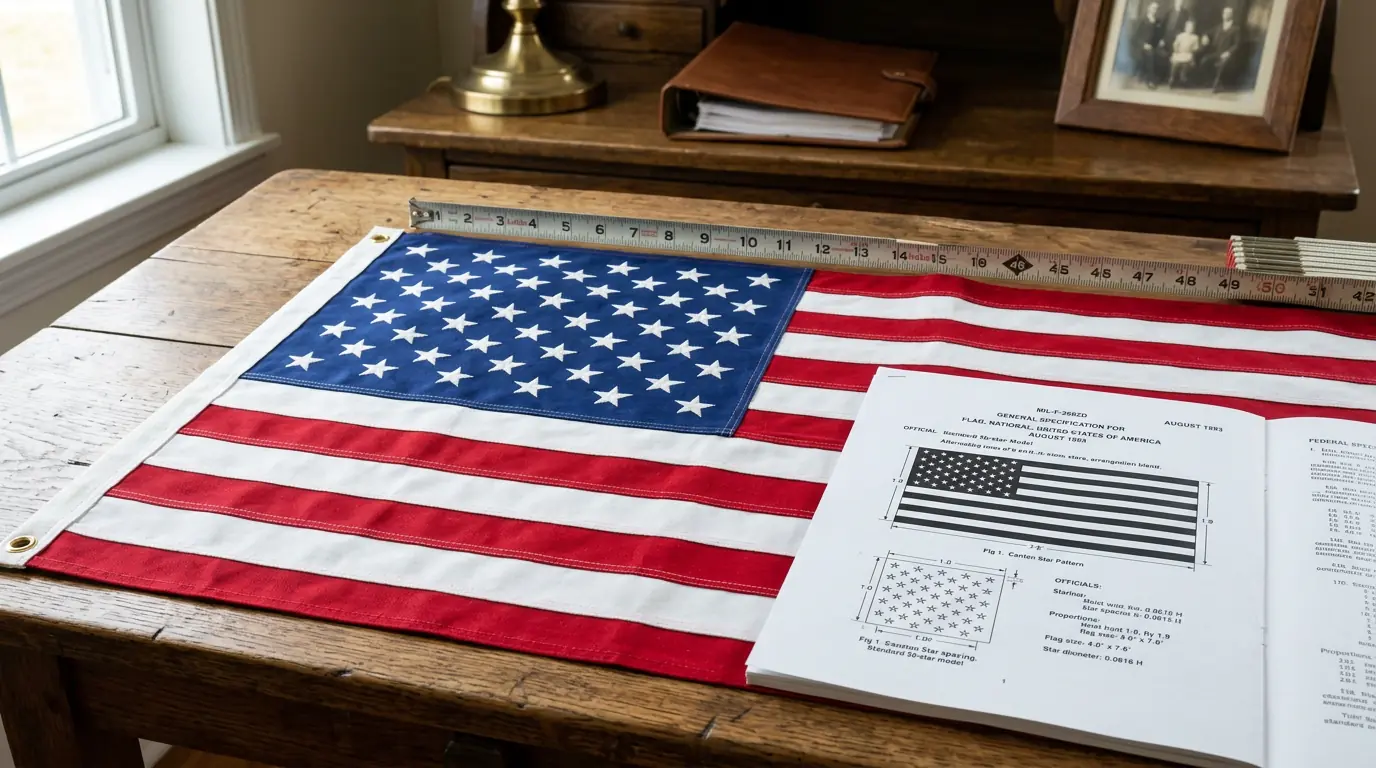
The garrison flag is the largest of three official U.S. military flag sizes. It measures 20 feet on the hoist (the vertical edge, attached to the pole) by 38 feet on the fly (the horizontal edge that catches the wind). That works out to roughly 760 square feet of fabric — about the floor area of a two-car garage, hanging from a pole.
20' x 38'
Official Size
760 ft²
Total Area
1:1.9
Aspect Ratio
65 ft
Min. Pole Height
The aspect ratio is 1:1.9. That number matters because it's codified in U.S. Code, Title 4, and it separates a regulation garrison flag from the oversized novelty flags you sometimes see at car dealerships. A flag that's 20 by 36 feet (the 1:1.8 ratio that was the Army standard back in 1885) is close, but it's not current spec. If you're buying for an installation that needs to pass inspection, 20 by 38 is the only number that counts.
The union — the blue field with the stars — has its own proportional rules: width is 7/13 of the hoist, height is 1/3 of the fly. These are G-Spec requirements, binding for military uses. Commercial flags often fudge these ratios slightly, which is fine for a front porch but not for a military installation.
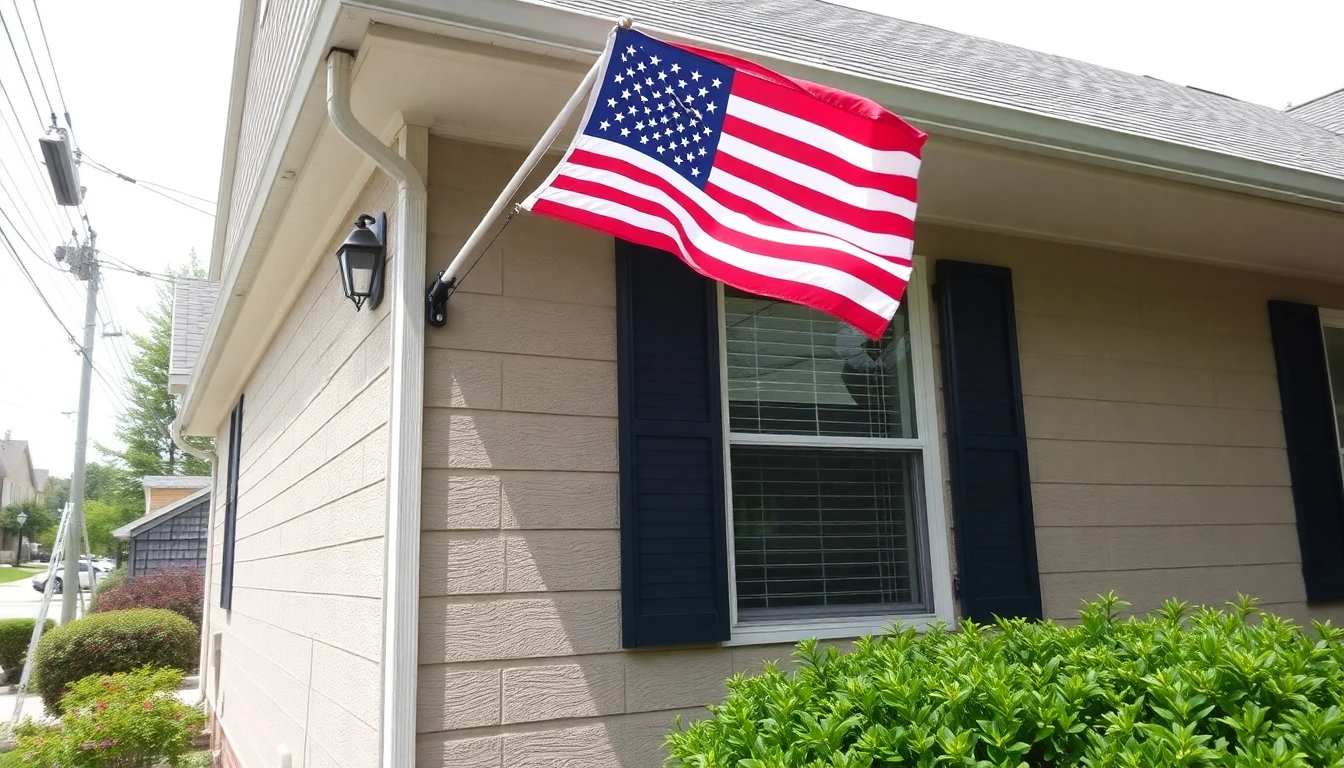
One detail that trips people up: this flag needs a tall pole. The minimum is around 65 feet. Standard residential or commercial poles top out at 25 feet, sometimes 35. If your installation doesn't already have a pole rated for this size, you're looking at a significant infrastructure project before you even buy the flag.
AR 840-10: The Regulation That Governs All of This
Army Regulation 840-10 is the document you cite when someone questions your flag decisions. Its full title — Flags, Guidons, Streamers, Tabards, and Automobile and Aircraft Plates — is broader than most people expect. The version currently in effect was revised on 15 June 2017 as an expedited update to the December 1998 edition.
AR 840-10 applies to the Regular Army, Army National Guard, and U.S. Army Reserve. It prescribes everything from design and acquisition to display, disposition, and use. For garrison flags specifically, it establishes the three-tier size system and dictates which occasions call for which flag.
The regulation also covers details most people never think about until they're standing at the base of a flagpole making decisions. For example: the U.S. flag must be the same size or larger than any other flag flown alongside it. The finial — the ornament on top of the pole — is specified too:
Getting that wrong is a protocol error that's immediately visible to anyone who knows the regulation.
The installation commander has discretion to fly the garrison flag beyond the mandatory occasion list, which creates a gray area that's worth understanding. "Commander's discretion" means the garrison flag can go up for distinguished visitors or regional celebrations. It does not mean the commander can skip mandatory display days.
Every Day the Garrison Flag Must Fly
AR 840-10 and related federal directives spell out exactly when the garrison flag goes up. Missing one of these dates isn't a judgment call — it's a compliance failure.
| Date | Occasion |
|---|---|
| January 1 | New Year's Day |
| Third Monday in January | Martin Luther King Jr.'s Birthday |
| January 20 (every four years) | Inauguration Day |
| Third Monday in February | Washington's Birthday |
| Variable (spring) | Easter Sunday |
| Second Sunday in May | Mother's Day |
| Third Saturday in May | Armed Forces Day |
| Last Monday in May | Memorial Day |
| June 14 | Flag Day |
| July 4 | Independence Day |
| First Monday in September | Labor Day |
| September 17 | Constitution Day |
| Second Monday in October | Columbus Day |
| October 27 | Navy Day |
| November 11 | Veterans Day |
| Fourth Thursday in November | Thanksgiving Day |
| December 25 | Christmas Day |
The table gives you the mandatory list, but the column you should really pay attention to is the one that isn't there: half-staff requirements. Memorial Day is the critical one.
Memorial Day Protocol
The garrison flag flies at half-staff from sunrise until noon, then gets raised to full-staff for the rest of the day. That noon transition is not optional, and it requires someone physically present at the pole at the right time.
Beyond these fixed dates, Presidential Proclamations can add days on short notice. HQDA can designate special occasions. Installation commanders can direct garrison flag display for events specific to their post. So the list above is the floor, not the ceiling. A facility manager who only tracks these 17 dates and ignores Presidential Proclamations will eventually get caught off guard.
Post Flags, Storm Flags, and How the Three Sizes Work Together
The garrison flag doesn't fly alone in a vacuum. It's part of a three-flag rotation system, and understanding the system matters more than memorizing any single flag's dimensions.
| Flag Type | Army Dimensions | MC / Navy / CG Dimensions | When It Flies |
|---|---|---|---|
| Garrison | 20' x 38' | 20' x 38' | Holidays and designated occasions |
| Post | 8' 11 3/8" x 17' | 10' x 19' | Every standard day |
| Storm | 5' x 9' 6" | 5' x 9' | Severe weather |
The post flag is the daily workhorse. It goes up every morning at reveille and comes down at retreat. On designated holidays, you swap it for the garrison flag. If weather turns severe, the storm flag overrides everything — it replaces whichever flag is currently flying to prevent wind and rain damage to the larger, more expensive flags.
Notice the dimensional split between branches. The Army post flag is 8 feet 11 3/8 inches by 17 feet, while the Marine Corps, Navy, and Coast Guard use a 10-by-19-foot version. The storm flags differ slightly too. These differences are easy to overlook if you're managing a joint installation.
The Air Force is the odd branch out. It uses a base flag sized at 8' 11 3/8" by 17' for daily display but does not fly garrison-size flags at all. If you're transferring from an Air Force base to an Army post and you've never dealt with a 20-by-38-foot flag before, the logistics alone — rigging, halyards rated for 50 pounds of wet nylon, the pole height — will be an adjustment.
All three sizes must be maintained and available at major Army installations per AR 840-10. That's not a suggestion. An installation that lets its garrison flag deteriorate and can't fly one on Veterans Day has a readiness problem, not just an aesthetic one.
The Fort McHenry Flag: Where the Garrison Tradition Started
In the summer of 1813, Major George Armistead took command of Fort McHenry in Baltimore harbor and made a request that still echoes through military flag protocol:
"so large that the British will have no difficulty in seeing it from a distance."— Major George Armistead, 1813
He hired Mary Pickersgill, a 37-year-old ship and signal flag maker who ran her workshop on Pratt Street. Pickersgill assembled a small crew — her 13-year-old daughter Caroline, two teenage nieces, and Grace Wisher, a 13-year-old African-American indentured servant. They worked for seven weeks. The finished flag was enormous even by garrison standards: 30 feet by 42 feet, roughly 1,260 square feet of loosely woven English wool bunting. Each stripe was two feet wide. Each star was about two feet across. The completed flag weighed around 50 pounds dry.
The sewing crew needed more floor space than Pickersgill's house could offer, so they laid the flag out in a nearby brewery — the building that's now the Star-Spangled Banner Flag House Museum in Baltimore.
Armistead also ordered a smaller storm flag, 17 by 25 feet, which proved critical on the night of September 13, 1814. During the 25-hour British bombardment, it was this storm flag that flew through the rain and darkness. Francis Scott Key, watching from a truce ship in the harbor, could barely make it out. At dawn on September 14, the defenders raised the massive garrison flag. Key saw it clearly. The poem he wrote that morning — Defence of Fort M'Henry — became "The Star-Spangled Banner."
The original Fort McHenry garrison flag now lives at the Smithsonian's National Museum of American History. A 15-star, 15-stripe replica flies day and night at Fort McHenry National Monument. The modern garrison flag standard — 20 by 38 feet — is smaller than Armistead's original, but the principle he established holds: the garrison flag is meant to be seen from a distance, on the days that matter most.
Pro Tip: For bulk flag orders over 100 pieces, including garrison flags, post flags, and storm flags,
contact our team for special military and institutional pricing.
Buying a Garrison Flag: What You Actually Need to Know
If you're procuring a garrison flag for an installation, the spec sheet is non-negotiable: 20 feet by 38 feet, 1:1.9 ratio, per U.S. Code Title 4.
G-Spec Construction Requirements
Heavyweight nylon (SolarGuard or equivalent), double-stitched seams with back-stitch reinforcement, six rows of lock stitching on the fly end, appliqued white stars, and sewn stripes. The header should be nylon rope with galvanized metal thimbles.
Not every flag manufacturer can produce to these specs. Gettysburg Flag, US Flag Supply, and All Star Flags are among the known G-spec suppliers. Expect to pay several hundred dollars at minimum, and over a thousand for top-grade construction. That price doesn't include rigging hardware, halyards, or the pole itself.
For civilian buyers — and there's no federal law preventing a private citizen from flying a garrison-size flag — the practical barriers are steep. You need a pole in the 60-to-80-foot range. Professional installation is required for anything over 25 feet. Your grommets, halyards, and cleats have to be rated for the flag's weight, which can exceed 50 pounds when the fabric is wet. And before you start shopping for poles, check local zoning ordinances and HOA restrictions. A 70-foot flagpole in a residential neighborhood will generate phone calls.
You'll also find non-standard sizes sold commercially: 20 by 36 feet, 22 by 38, 18 by 34. These are not G-spec compliant. For a private display where compliance doesn't matter, they'll fly fine. For any government or military application, they won't pass. Understanding the custom flag cost factors upfront saves procurement headaches later.
Getting Garrison Flag Protocol Right
If you're managing flag protocol at any federal or military facility, start with two things: confirm your flagpole meets the 65-foot minimum for garrison display, and print the mandatory occasion list where your duty staff can see it. Those two steps prevent the most common failures.
If you're at a joint installation, double-check which branch's dimensional standards apply to your post and storm flags. The garrison flag is the same across all branches — 20 by 38 — but the daily and storm flags are not, and mixing them up is an easy mistake on a multi-service post. Proper flag display infrastructure matters as much as the flag itself.
For civilian buyers who want a garrison flag for a private outdoor display, the honest assessment is that most residential properties can't support one. The pole alone is a five-figure investment. A 10-by-19 post flag or even a 5-by-9.5-foot storm flag on a 25-foot residential pole will look sharp and fly properly without the structural engineering. Save the garrison size for a property that can handle it.
The garrison flag exists for a specific purpose: to mark the most significant days on the calendar at the most visible point on an installation. Armistead understood that in 1813. AR 840-10 codifies it today. The size is intentional, the occasions are deliberate, and the protocol is worth getting right. If you're sourcing a regulation flag or need guidance on flag printing and fabric selection, make sure your supplier understands G-spec requirements.
Related Articles