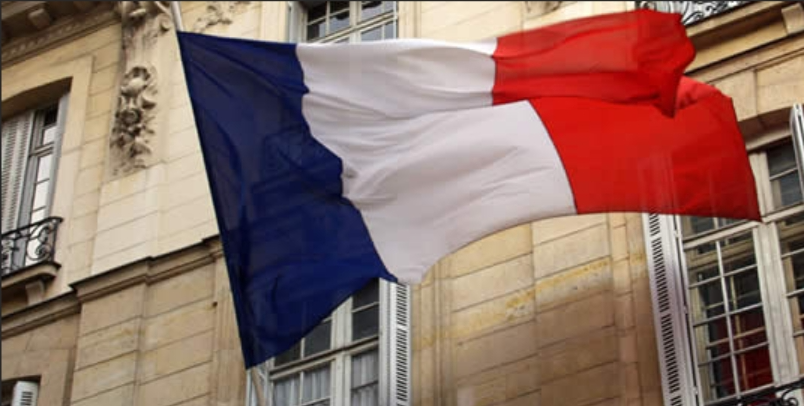
Few flags carry as much weight — historical, political, emotional — as the blue, white, and red of France. The tricolore wasn't a planned design. It was born from revolution. Chaos of 1789 shaped it, and it has waved through wars, republics, and the reinvention of an entire nation ever since.
Institutions that curate historical exhibits or civic ceremonies often collaborate with a custom French flag manufacturer for heritage displays to ensure the tricolour's proportions and shades match official historical specifications rather than modern approximations.
So what do those three colors mean? Why vertical stripes instead of horizontal? And how did a flag born out of such violent upheaval become one of the most recognized and imitated symbols on earth? The answers are richer — and stranger — than you'd expect. Let's get into it.
The Meaning of Each Color on the French Flag
Three colors. Three ideas. Three centuries of blood, belief, and politics packed into vertical stripes.
Each band of the tricolore carries its own story — and they don't fully agree with each other. That's sort of the point.
The History of the French Flag: From Royal Banners to the Tricolour
Before the tricolore existed, France had gold lilies on blue — then white — then centuries of kings who treated the flag as personal property. They weren't far off. For a long time, it was.
France's earliest royal standard carried the fleur-de-lis — that elegant stylized lily scattered across a blue field. By 1376 , Charles V had stripped it down to three lilies. Cleaner design. Simpler to rally behind during the brutal grind of the Anglo-French wars. Then the Bourbons arrived, and white took over — plain white military ensigns, white fields with gold lilies. It was the visual language of divine kingship and inherited power. Clean. Certain. Absolute.
That certainty didn't survive 1789.
The Cockade That Started Everything
On July 13, 1789 — one day before the Bastille fell — Parisian citizens were already pinning blue and red cockades to their coats. Small ribbon rosettes, almost decorative. But the colors carried real weight. Blue stood for Saint Martin. Red stood for Saint Denis. Both colors ran deep in Paris's identity and coat of arms.
Camille Desmoulins pushed green as the revolution's color — a symbol of hope and new growth. The militias ignored it. They were already wearing blue and red. Green never had a real shot.
Then came Lafayette.
Named commander of the National Guard in 1789, the Marquis de Lafayette added white to the cockade on October 17, 1789 , at Paris City Hall. He then pinned the blue-white-red rosette straight onto Louis XVI. It was equal parts gesture and statement. The monarchy was acknowledged — but also contained, folded into a new order it never chose and couldn't escape.
From Cockade to Flag: The Official Adoption
The tricolore didn't become the flag right away. A transition period followed. France adopted a horizontal red-white-blue naval ensign on October 24, 1790 , drawing influence from the Dutch Prinsenvlag . The layout kept changing.
For governments, embassies, and international events displaying national symbols, working with a professional French national flag manufacturer ensures the legally defined 2:3 ratio and stripe alignment are produced exactly as standardized in 1794.
The version you recognize today — vertical stripes, blue at the staff, white at center, red at the fly edge — got its official status from the National Convention on February 15, 1794 . Painter Jacques-Louis David refined the design. Equal stripes. 2:3 ratio . That was it.
What followed was anything but stable:
Napoleon added gold eagles.
The Bourbon Restoration (1814–1830) scrapped the tricolore and brought back plain white.
The July Revolution of 1830 restored it. Louis-Philippe made it a centerpiece of his reign.
In 1848 , communist factions pushed an all-red banner. It lasted about two weeks. The tricolore returned on March 5, 1848 .
One footnote stands out. In 1871 , the Count of Chambord was offered the French crown. He turned it down. His one condition for accepting — restoring the white flag — got rejected. The tricolore stayed. That refusal reshaped the entire path of the French Third Republic.
The flag's specs haven't changed since: Pantone 286C blue , white, Pantone 485C red . Vertical. Equal. Just as David drew it.
Key Milestones in French Flag History: A Timeline
Eight hundred years of French history, packed into three vertical stripes. Here's how it happened — date by date, decision by decision.
Look at the pattern across these dates. Someone tries to replace the tricolore. It survives. Every time. The Bourbons swapped it out. The Revolution took it straight back. Radicals pushed red in 1848. It lasted eleven days. Chambord held out for white. He got nothing.
“The flag didn't last because people guarded it. It lasted because each time someone came for it, enough people decided it was worth fighting to keep.
Why Are the French Flag Stripes Vertical? Design Origins Explained
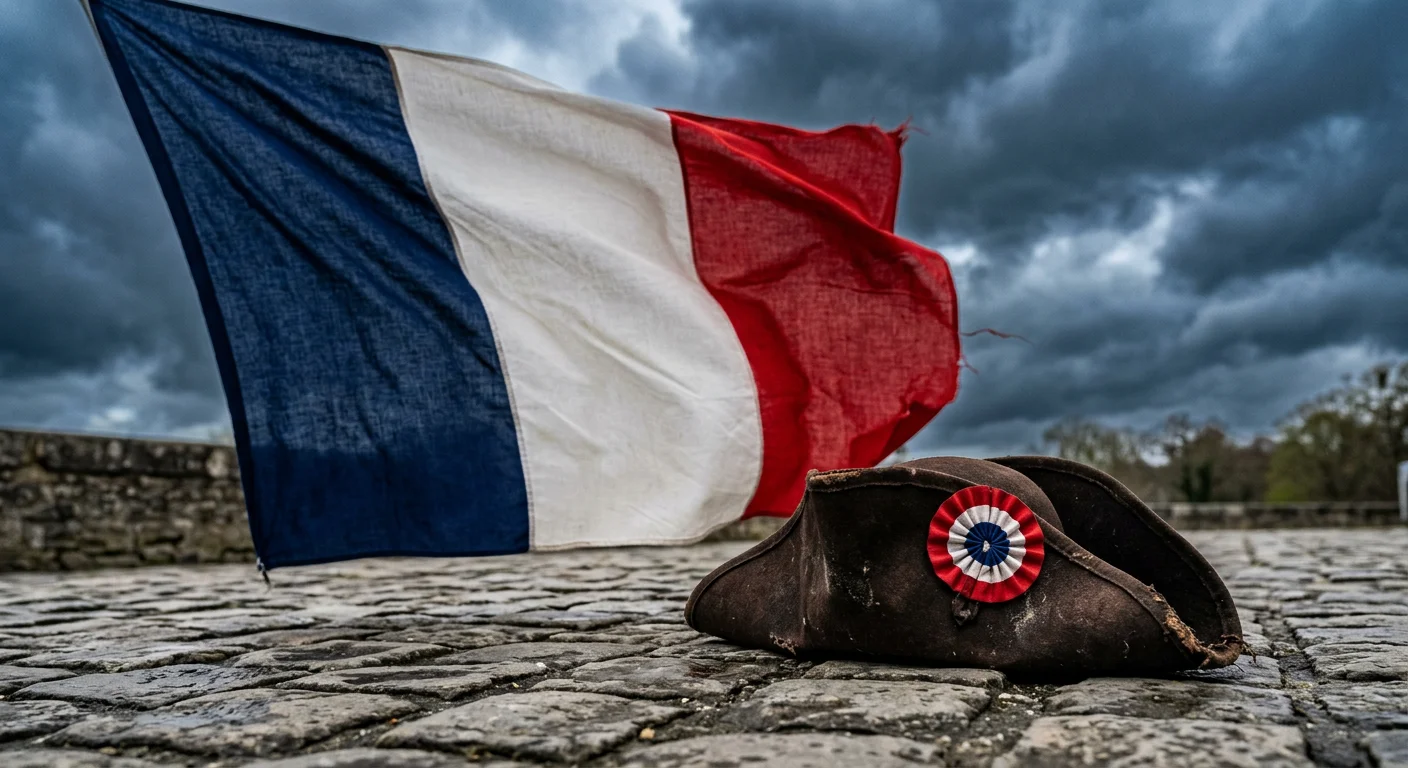
The vertical stripes weren't a design choice. They were an accident of anatomy — the anatomy of a hat.
Those first revolutionary cockades were small circular ribbons pinned to headwear. They hold the key to understanding the whole design. Parisians wore blue-red cockades in July 1789. The colors sat side by side in a ring. Lafayette added white in the middle. So you had blue, white, and red arranged in a circle around a hat brim. Unfold that circle flat, and a vertical stripe sequence appears. The flag didn't come from a drafting table. It came from the way colors fell into place on someone's coat.
The formal steps looked like this:
July 12, 1789 : Camille Desmoulins hands out green cockades in the Palais-Royal. Nobody takes to them.
July 17, 1789 : Lafayette adds white to Paris's existing blue-red cockade. Louis XVI wears it. The three colors are now joined together for the first time.
October 24, 1790 : A tricolor naval ensign appears — vertical red-white-blue stripes set within a white field.
February 15, 1794 : The National Convention locks it in. Equal vertical bands, blue at the hoist, white in the center, red at the fly. Standard 2:3 ratio . Done.
The vertical layout also solved a real problem. France needed to stand apart from the Netherlands. The Dutch flag used the same red-white-blue colors — just arranged in horizontal stripes. The Dutch had run with horizontal stripes since the mid-17th century. France chose vertical stripes to set its revolutionary flag apart from that older, monarchy-linked style.
That choice caught on fast. Italy, Ireland, and Romania all picked up vertical tricolors in the years that followed. Each one pointed back to where the idea started.
One surviving object shows how much the French valued this flag. A Napoleonic tricolore measuring 16 meters by 8.3 meters — taken by the British from Le Généreux in 1800 — still exists in Norwich today. Someone built that flag to be massive on purpose. Vertical stripes hold up well at large scale. That turns out to be no small thing.
The French Tricolour's Influence on World Flags
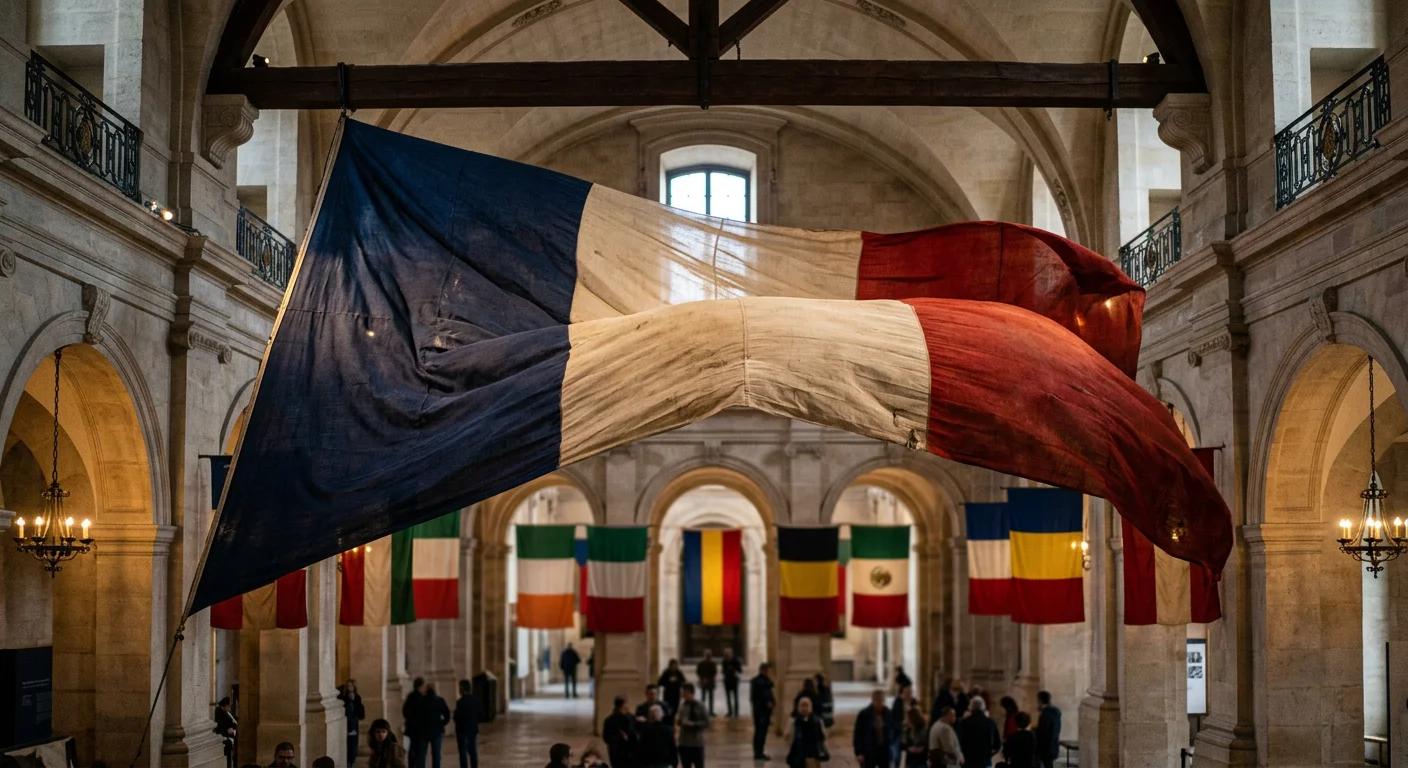
In 1794, something happened that no border could hold back. The vertical tricolour did more than define France. It gave the rest of the world a blueprint for what a republic's flag could look like.
Because the French tricolour inspired dozens of later national flags, educational institutions and diplomatic organizations sometimes order comparative displays from a custom tricolour flag manufacturer for international exhibitions to illustrate how the design spread globally.
The reach is striking:
60+
Countries With Tricolours
30%
Use Vertical Format
12
UN States Exact Match
That's not coincidence. It's an idea that spread through revolution, invasion, and independence movements across two centuries.
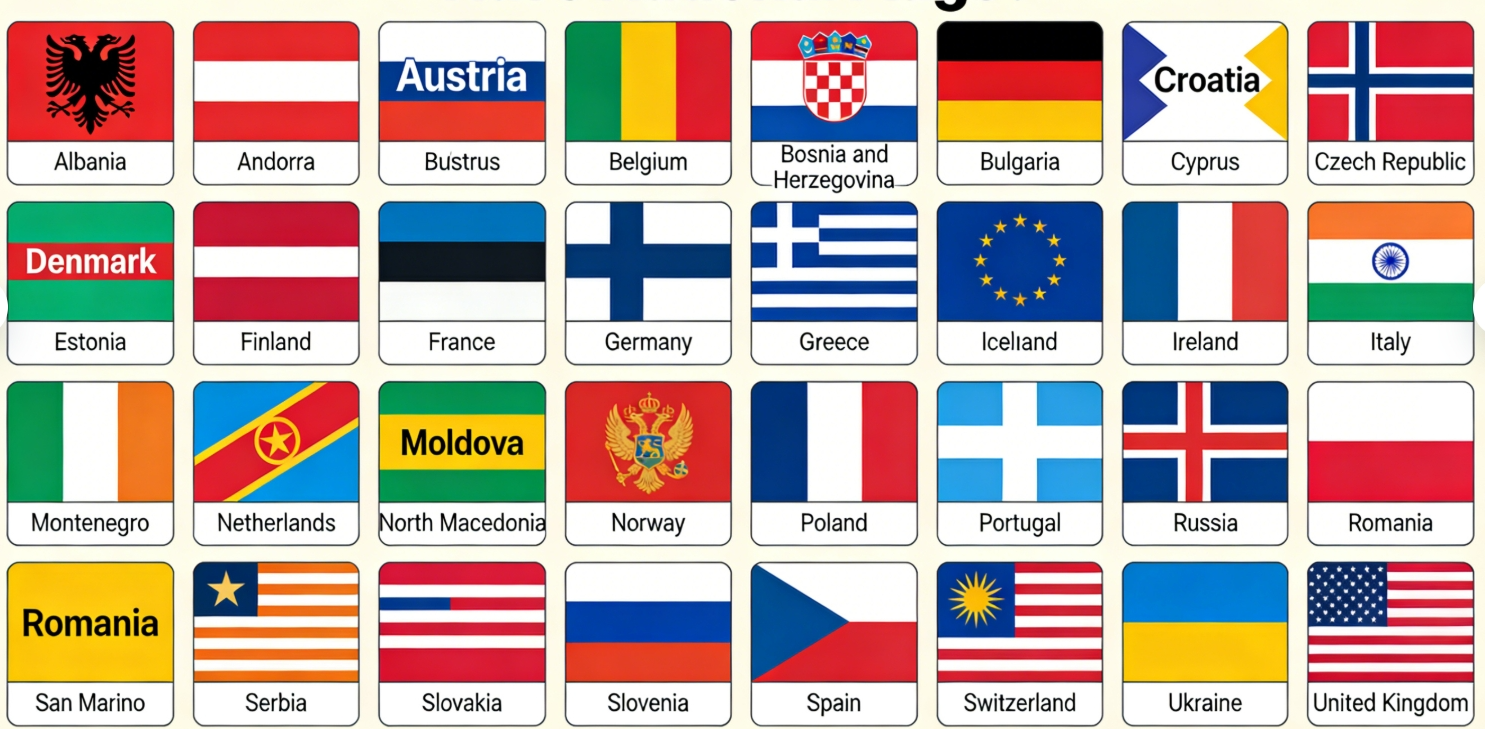
The Flags That Borrowed the Format
Italy was first. Napoleon's armies brought the tricolore into the peninsula. The Risorgimento movement then took that visual language of liberation and made it their own. The Italian flag — vertical green, white, red — appeared in 1848 . Blue was swapped for green to represent Italian plains and national hope. Same structure, local soul.
Ireland took a different road to the same place. The green-white-orange tricolour appeared during the 1916 Easter Rising . It echoed French republican ideals on purpose. Green stands for Catholics. Orange stands for Protestants. White stands for the peace between them. The French flag didn't just shape the design — it shaped the thinking behind it.
Belgium adopted the vertical format during its 1831 independence from the Netherlands. It kept the French structure but filled it with colors from the old Brabant coat of arms. Mexico did something similar. The country absorbed French revolutionary ideas during its own independence wars and raised a green-white-red tricolour in 1821 .
Wider Ripples
The influence stretched far past Europe and the Americas. 20+ West African nations — Mali, Niger, Chad, Côte d'Ivoire among them — chose tricolour layouts after gaining independence post-1960. They swapped France's specific colors for their own. But they kept the three-band format as a clear statement of republican self-determination.
Think about that for a moment. These were anti-colonial flags. Yet they were built on a colonial power's visual grammar. The irony is real — and entirely intentional.
12 UN member states use the exact vertical band structure of the French tricolore. The broader family of tricolour nations tops 50. Each one of them traces something back to Paris in 1789 — a color choice, a stripe direction, or a political idea.
Looking for bulk national flags? We manufacture tricolour flags for 60+ countries with exact Pantone color matching. Explore our custom national flags or request a wholesale quote.
FAQ: Most Asked Questions About the French Flag
These are the questions people look up most — with clear, straight answers.
What is the French flag called?
The official name is the Drapeau tricolore — or the French Tricolour. Three vertical bands: blue at the hoist, white in the middle, red at the fly edge. That's it. That's the whole thing.
When was the French flag adopted?
It happened twice. The National Convention adopted it on February 15, 1794 — the 27th of Pluviose, Year II, in the revolutionary calendar. Then it got confirmed again on March 7, 1848, after the turmoil of the mid-century republic battles. The navy received its own set of proportions on May 17, 1853.
What are the correct proportions?
The standard national flag uses a 2:3 ratio with three equal-width stripes. The navy ensign runs a bit different — 30:33:37 (blue:white:red). That adjustment makes the stripes appear equal to the eye while the flag flies in the wind. A small tweak. A real difference.
What do the three colors mean?
Blue and red come from Paris — the city's traditional colors, worn on cockades during the Revolution. White came from the monarchy. Here's the part most people don't know: no law defines what each color symbolizes. The meanings — liberty, equality, fraternity — got attached later, through culture, not through legislation.
How is the French flag different from the Dutch flag?
Easy to mix up. Same three colors. Very different flags. France uses vertical stripes, blue at the hoist. The Netherlands uses horizontal stripes, red on top, blue on the bottom. The orientation is what sets them apart.
What are the exact color specifications?
The French government publishes these official values:
Save this table. You'll want it for official flag production or custom French flag print orders where color accuracy matters.
Custom French Flags for Events, Businesses, and Bulk Orders
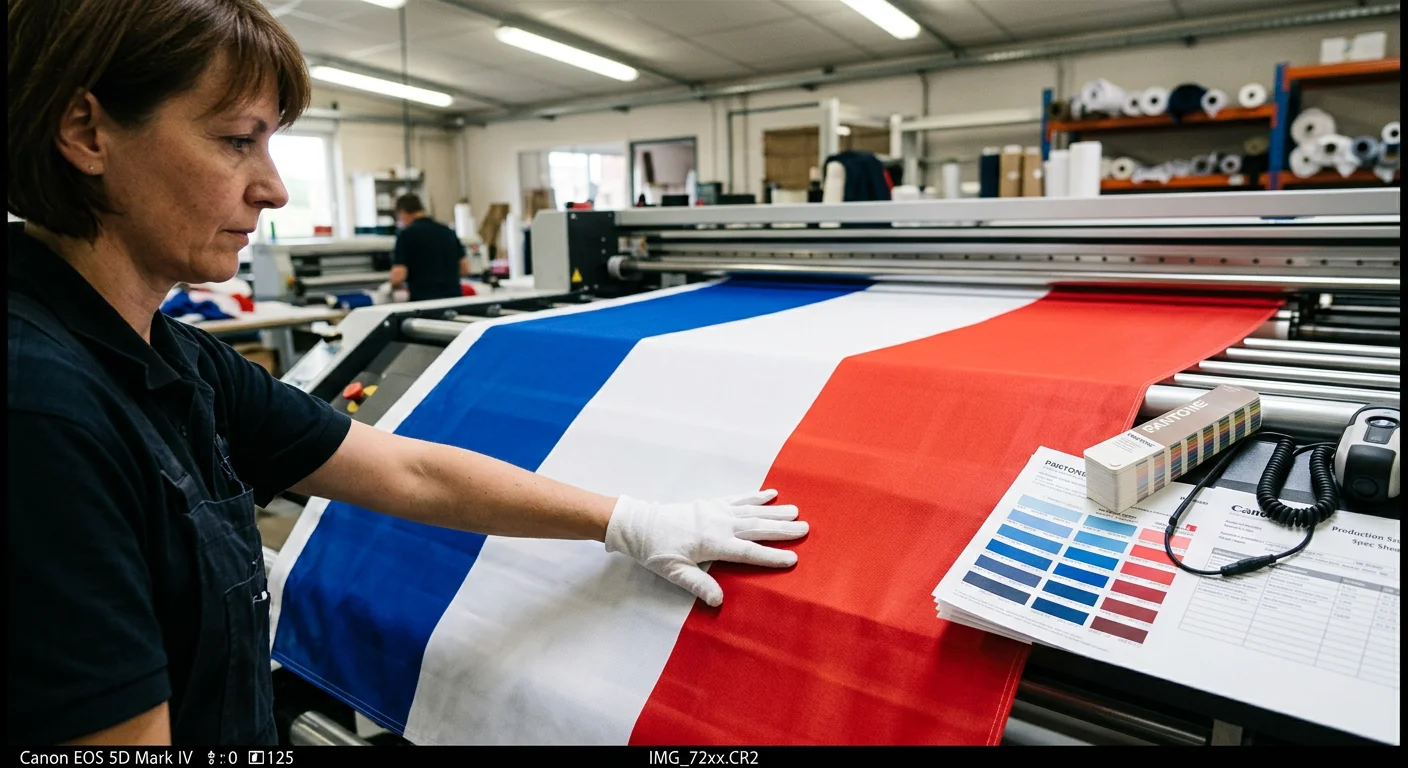
The tricolore looks simple. Three stripes. But getting it right is a different story. The exact Bleu de France. The precise equal widths. The red that stays red — not pink — after two weeks outdoors. That part takes real care.
Bastille Day, a corporate event, a bulk retail order — here's what matters:
Regional variants are available too — Brittany, Corsica, historical designs. One-sided or double-sided. Any size.
Get an instant bulk quote → or design yours online with 24-hour print turnaround.
Conclusion
Few flags carry as much weight as the French tricolour.
A revolutionary cockade pinned to a hat in 1789. That small act sparked something huge. Blue, white, and red became one of the most recognized symbols in human history — not just as colors, but as a promise: liberté, égalité, fraternité .
The meaning of the French flag didn't stop in the past. It kept moving. It shaped dozens of national flags across the world. You'll spot it at football stadiums and state funerals alike. It still feels urgent today.
Now you know what it stands for. What it truly stands for. That matters.
Need an actual flag? For an event, a classroom, a business, or just because you love France — we make custom French flags that honor that history. Browse our custom flag options and bring the symbolism to life.
Some flags are just fabric. This one never was.
Watch: The Story of the French Tricolour
Related Articles