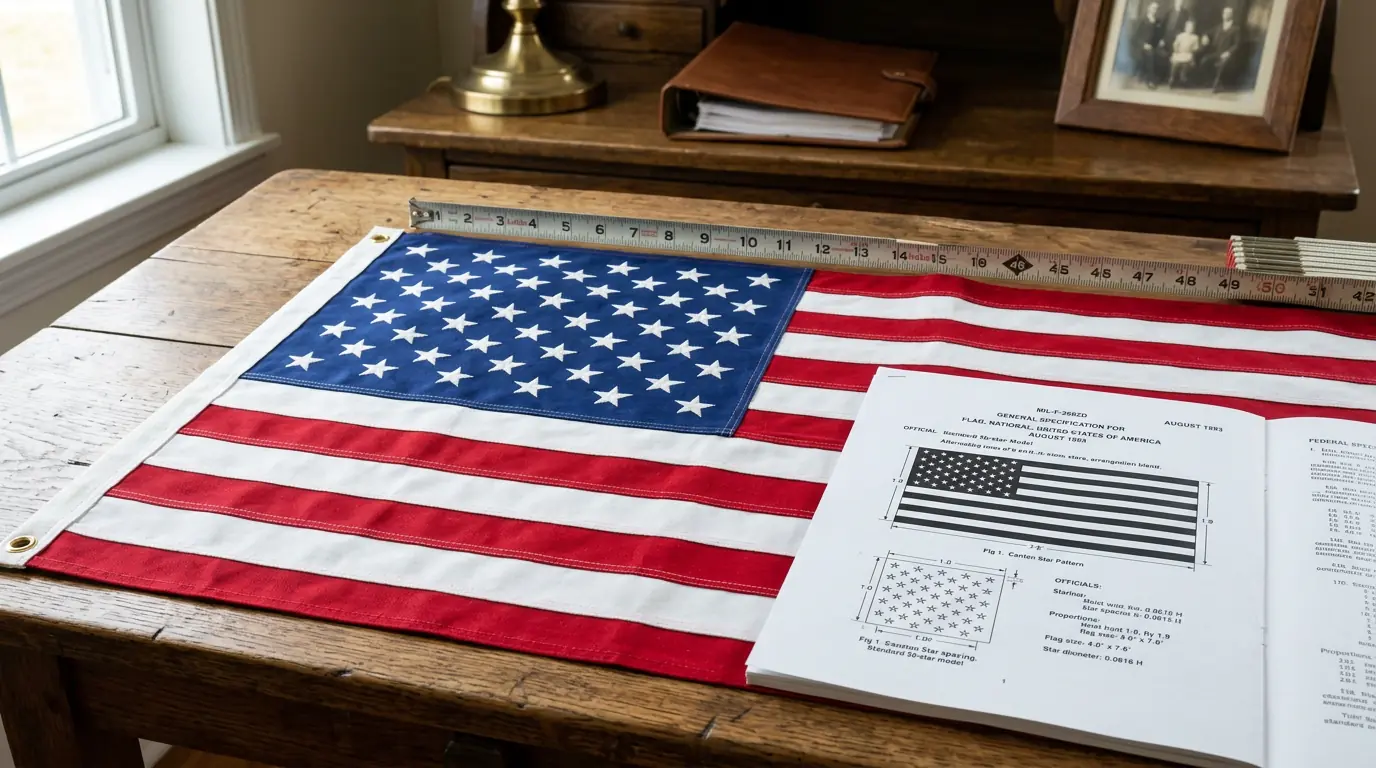
You signed off on a 5,000-flag order, the flag manufacturer sent shipment photos, everything looked fine — then 15% of the batch showed up with flag grommets pulling loose and colors two shades off spec. No formal inspection plan, no defect criteria in the purchase contract, no grounds for a claim. This happens more often than most flag buyers admit. This guide walks through AQL sampling plans built for flag products, defect classifications that match real failure modes, stage-by-stage inspection checklists, and the technical test numbers that separate enforceable specs from vague quality language. Whether you order 500 flags or 50,000, these standards give you a system that catches problems before they become expensive.
Why Flags Fail Batch Inspection (And What It Actually Costs You)
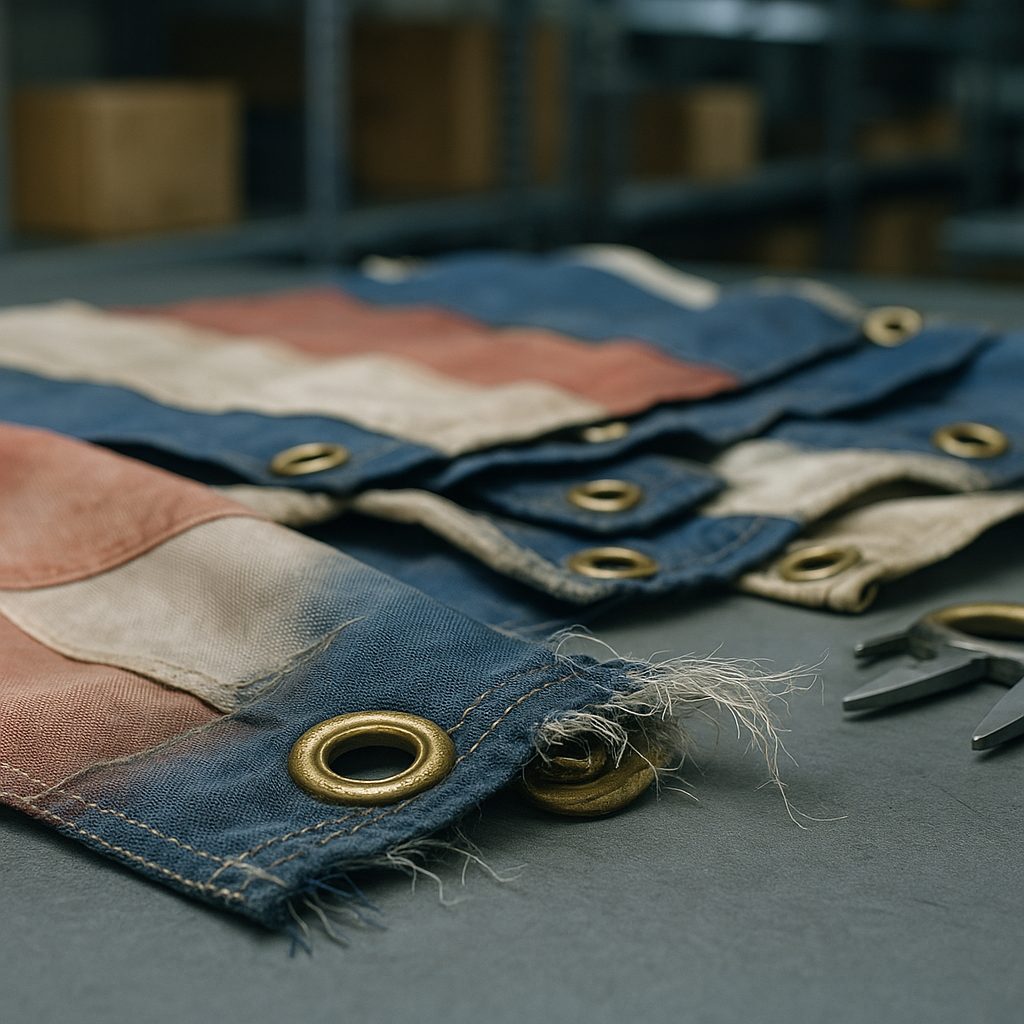
A 5,000-piece flag order lands at your warehouse. Your team spots faded colors on 400 units, grommets pulling loose on another 200, and fly ends already fraying before a single flag gets hung. You just lost weeks of lead time and thousands in rework custom flag pricing — or worse, you ship them and deal with returns.
Most buyers treat flag QC as a quick visual scan before shipment. That approach misses up to 70% of flaws in textile products. The problems that slip through — color deviation, weak grommet attachment, tearing at hems — are exactly the ones customers notice on day one.
flag production process yield below 95% signals trouble. I aim for 98% or higher, and anything less means the factory’s process has gaps. The textile industry averages a 4-9% destruction rate on defective goods, which eats margin fast. Your total cost per unit from quality failures needs to stay below 50% of your average selling price, or the math stops working.
The fix is not inspecting harder at the end. It is building a system that catches problems at each stage — incoming materials, mid-production, and pre-shipment. That system starts with AQL standards built for flag products, not borrowed from generic textile guides.
AQL Fundamentals for Flag Products: Choosing the Right Sampling Plan
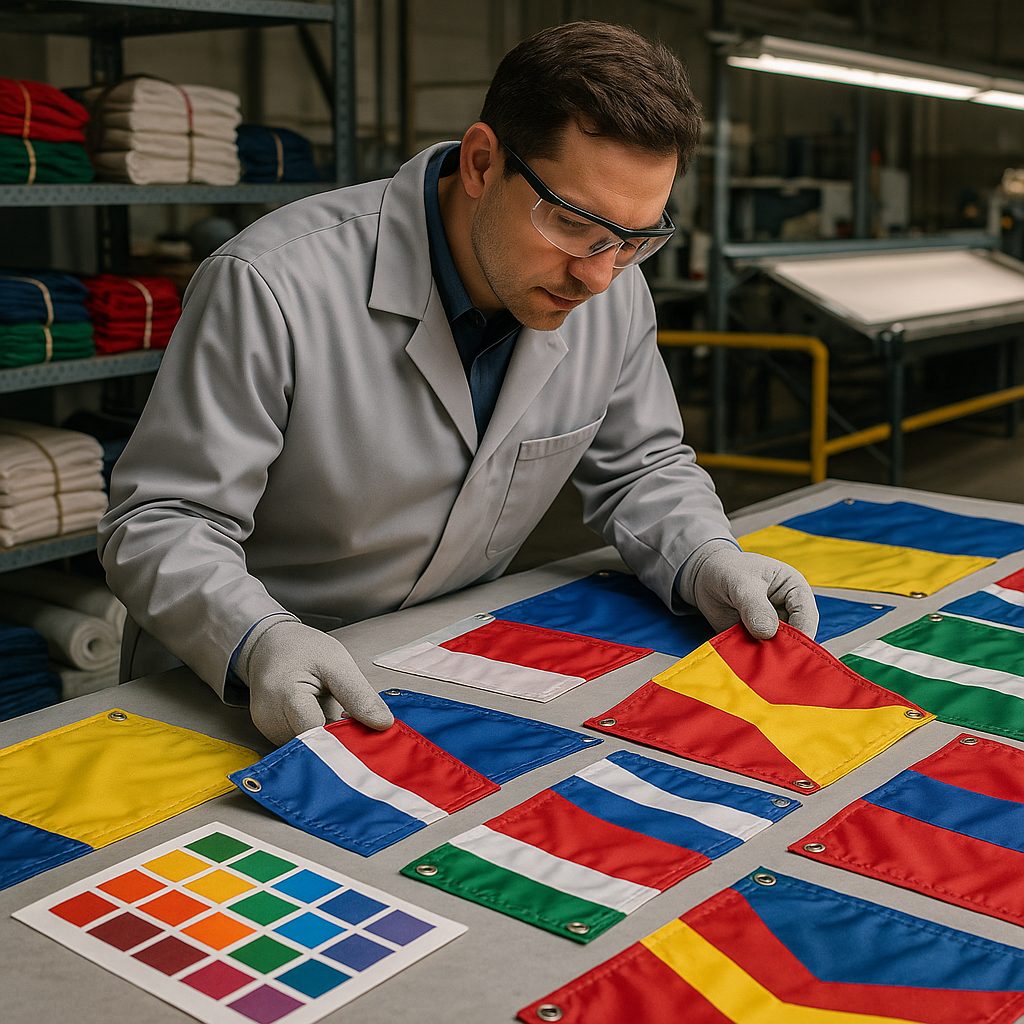
AQL stands for Acceptable Quality Level, and it comes from ISO 2859-1 (also called ANSI/ASQ Z1.4). The standard defines how many units to pull from a batch, how many defects trigger rejection, and how to adjust strictness based on supplier track record. If you have never used it, the learning curve is about 30 minutes — the payoff lasts years.
For flags, I recommend splitting defects into three tiers with different AQL levels. Critical defects get 0.0% — zero tolerance. Major defects sit at AQL 2.5%. Minor defects allow AQL 4.0%. These numbers are not arbitrary. A critical defect like a detached grommet creates a safety issue. A major defect like noticeable color shift causes customer complaints. A minor defect like an untrimmed thread under 10mm bothers almost nobody.
0.0%
Critical AQL
2.5%
Major AQL
4.0%
Minor AQL
The sampling plan depends on your lot size. Under ISO 2859-1 General Inspection Level II, a lot of 5,000 flags uses Code Letter L. At AQL 1.0%, that means pulling 200 samples. If you find 5 or fewer defects, the lot passes. Six or more means rejection. For a smaller lot of 500 flags, you drop to Code Letter H and pull 50 samples.
Single sampling plans work best for most flag buyers — whether sourcing from overseas manufacturers or buying domestically — pull one set of samples, make one decision. Double sampling exists for borderline cases where you want a second draw before rejecting, but it adds complexity. Unless your volumes justify it, stick with single sampling at Level II. That balance catches real problems without over-inspecting small lots or under-inspecting large ones.
Flag Defect Classification: Critical, Major, and Minor Defined
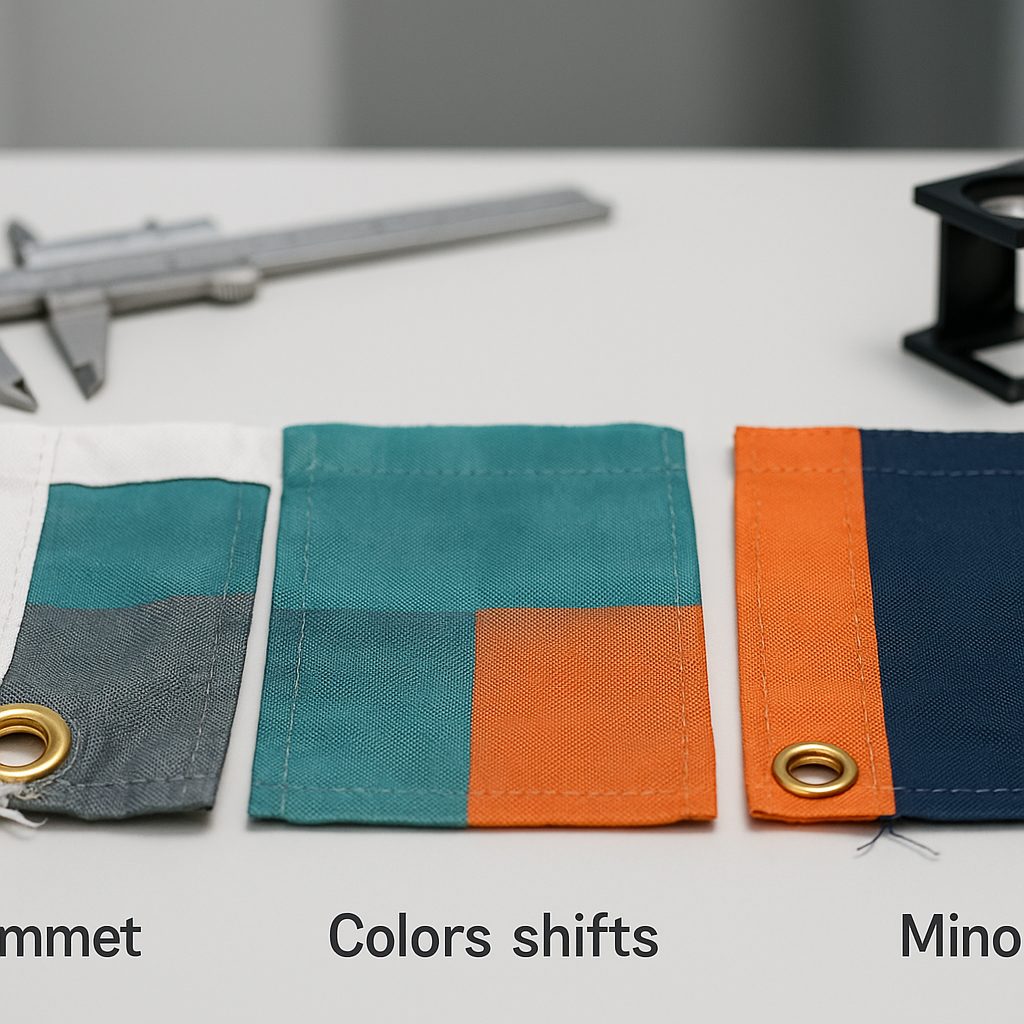
Getting the defect categories wrong costs more than skipping inspection entirely. If you label a grommet failure as "minor," you accept a batch that falls apart on the flagpole. If you label a tiny thread tail as "critical," you reject good product and burn supplier relationships.
Critical defects (AQL 0.0%) are non-negotiable rejections. For flags, this list is short but absolute: size deviation beyond ±3% of specification, wrong national or corporate flags pattern (a compliance and legal risk), metal debris or sharp objects in packaging, grommet detachment or pull-through failure, and any chemical content exceeding REACH or CPSIA limits. One critical defect in the entire sample set means the lot gets rejected. No discussion, no discount negotiation.
Major defects (AQL 2.5%) affect function or appearance enough that customers will complain. Color deviation with a ΔE above 2.0 falls here — that is the threshold where the human eye reliably spots the difference. Print misalignment beyond 3mm, open seams at the fly end, and sizing that falls outside your spec tolerance all count as major. These are the defects that drive returns and bad reviews.
Minor defects (AQL 4.0%) are cosmetic issues that most end users will not notice. A skipped stitch — two or fewer in a row — qualifies. Untrimmed thread tails over 10mm but under 20mm belong here too. These imperfections exist in every production run. Trying to eliminate them completely pushes costs up without meaningful quality gains.
For fabric-level inspection before cutting, the 4-Point System works well. You score defects by length: under 3 inches gets 1 point, 3-6 inches gets 2 points, 6-9 inches gets 3 points, and over 9 inches gets 4 points. Most flag fabric should score below 28 points per 100 square yards. Anything higher, and the finished flags will carry those flaws through to the final product.
4-Point System Quick Reference
1 pt
< 3 inches
2 pts
3-6 inches
3 pts
6-9 inches
4 pts
> 9 inches
Pass threshold: < 28 points per 100 sq. yards
Inspection Checklist: What to Check at Each Stage

Relying on a single pre-shipment check is the most common QC mistake in flag procurement. By the time flags are packed in cartons, your bargaining power with the factory is gone — rework delays the order, and rejection means starting over. A three-stage approach catches problems when fixing them is still cheap.
1
Incoming Material Inspection
Starts before a single flag gets cut. Test fabric weight with a GSM cutter — your spec should allow ±5% tolerance, so 115 GSM polyester flag fabric passes between 109 and 121 GSM. Run colorfastness to rubbing per ISO 105-X12 and demand minimum Grade 4. Verify Pantone colors under D65 daylight illuminant, not office fluorescent lighting. Colors that match under one light source can look wrong under another — that is called metamerism, and it causes half of all color disputes with suppliers.
2
During Production Inspection (20-40% Complete)
Check stitch density against your spec (typical flag construction runs 3-4 stitches per centimeter on hems). Test grommet installation by running a fatigue test — cycle each grommet 20 times with the rated load to confirm it holds. Run needle detection at 1.2mm sensitivity on finished units to catch broken needle fragments. This mid-production check gives you time to correct course before the full run is done.
3
Pre-Shipment Inspection
Your final gate. Pull samples per AQL Level II and run the full checklist: quantity verification against the packing list, packaging integrity, style and logo accuracy, dimensional measurements on at least 10% of samples, grommet function tests, print alignment, and overall workmanship. Add a carton drop test per ISTA 1A if the flags ship long distances. I have seen orders arrive with perfect flags inside crushed cartons that damaged grommets during transit — the drop test prevents that specific failure.
Key Technical Tests: Numbers You Need to Know
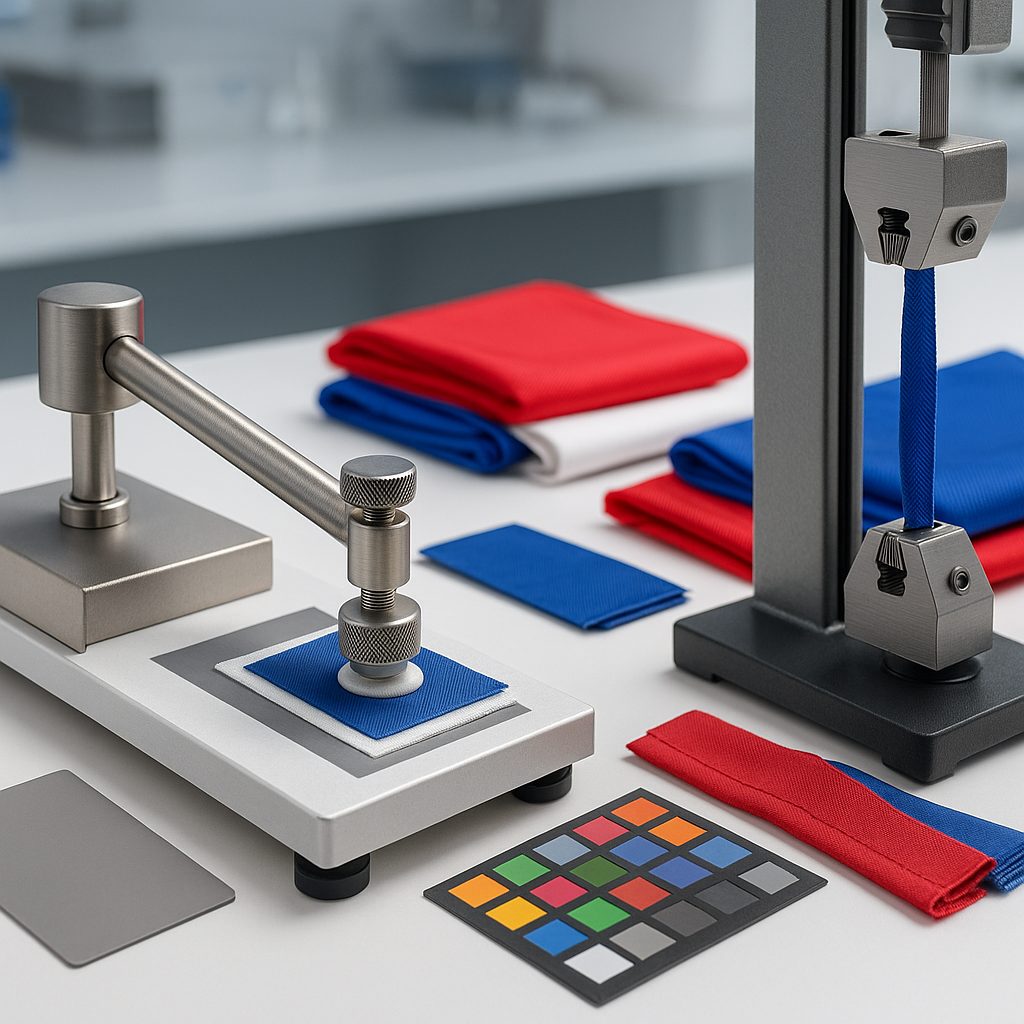
Specifications without numbers are just opinions. When you tell a factory "the color must be good" or "the fabric should be strong," you get whatever they decide meets that standard. These test benchmarks remove the guesswork.
Light fastness matters most for outdoor flags. Test per ISO 105-B02 and require minimum Grade 4 on the blue wool scale. Grade 3 flags start fading visibly within 4-6 weeks of sun exposure. For indoor or event flags used once, Grade 3 is acceptable — no point paying for durability you will not use.
Rub fastness under ISO 105-X12 should hit Grade 4 dry and Grade 3 wet at minimum. Flags that fail wet rub fastness bleed color in rain, which stains adjacent fabrics and looks terrible.
Grommet pull strength needs to reach 20 kg (196 Newtons) minimum. Test this with a simple pull gauge — if a grommet pulls free below that threshold, wind loads will rip it out within days. Some buyers spec 25 kg for large flags over 3x5 feet, which makes sense since wind load scales with surface area.
Color deviation measured by spectrophotometer should stay at ΔE 2.0 or below. Between 2.0 and 3.0 is a gray zone — some customers notice, some do not. Above 3.0 is visible to everyone. I would push back on any batch above 2.0 rather than gamble on customer tolerance.
Tear strength per ASTM D1424 varies by fabric. Polyester flags should test at 800-1000 gf in the warp direction. Nylon flags run higher at 1000-1200 gf. If your supplier quotes tear strength without specifying direction, ask for both warp and weft — weft is typically 10-15% lower, and that is where flags tear first in wind.
UV longevity depends on print method and fabric type. Sublimation-printed polyester holds color for 3-6 months outdoors. Solution-dyed nylon lasts 6-12 months. If a supplier promises 12 months on sublimation polyester, they are overpromising — the dye sits on the fiber surface and UV breaks it down faster than solution-dyed yarn where color is locked inside the fiber.
Acceptance and Rejection: Making the Final Call
The sampling plan gives you clear numbers: accept if defects found are at or below the acceptance number (Ac), reject if they hit the rejection number (Re). For a 200-sample pull at AQL 2.5%, that means Ac=10 and Re=11. Sounds simple, but the real decisions happen in the gray zone.
Accept (Ac ≤ 10)
Defects at or below the acceptance number. Lot ships.
Reject (Re ≥ 11)
Defects hit or exceed the rejection number. Lot held.
Zero Tolerance Rule
One critical defect anywhere in the sample — the entire lot gets rejected. This is the only rule without flexibility. A wrong national flags pattern or a grommet that pulls free is not a negotiation point.
The harder call comes when major defect counts land right at the acceptance limit. Say you find exactly 10 major defects in your 200 samples at AQL 2.5%. Technically, the lot passes. But 10 is not 3. I treat anything above 70% of the acceptance number as a warning sign and push for root cause discussion with the factory, even if the lot technically ships.
Conditional acceptance exists for lots that fail but remain usable. If defects cluster in specific cartons or production runs, you can negotiate a 5-20% price deduction and accept the batch. This works when your timeline cannot absorb a full rework cycle. But set a hard ceiling — I would never conditionally accept anything with a defect rate above 150% of the rejection number.
Switching rules keep suppliers honest over time. After two lots get rejected out of five consecutive inspections, move from Normal to Tightened inspection — smaller acceptance numbers, same sample size. Stay on Tightened until five consecutive lots pass, then return to Normal. If ten consecutive lots pass on Normal, you can drop to Reduced inspection with smaller sample sizes. These rules reward consistent suppliers and pressure inconsistent ones without burning the relationship.
Need a reliable flag supplier? Our factory maintains documented QC records and provides test certificates with every bulk order.
Talk to our quality team for samples and inspection reports.
Building Your Flag QC System: Practical Next Steps
A quality system that lives only in your head fails the moment you hand off procurement to someone else. Document it, embed it in contracts, and track results.
Start with your request a quote and purchase agreement. Include the full defect classification table, AQL levels for each category, and penalty clauses for lots that fail inspection. Vague quality language in contracts gives factories room to argue. Specific language — "grommet pull strength minimum 196N per ISO test method, AQL 0.0% for failure" — does not.
Build a color baseline archive for every flag design you order. Store approved Pantone references and CIE Lab values, not just physical swatches. Physical swatches fade over time and become unreliable references after 6-12 months. Digital Lab values are permanent.
Audit new suppliers more aggressively than established ones. Quarterly reviews during the first year cover raw material sourcing, production checkpoints, packaging standards, and final audit results. After a year of consistent quality, move to semi-annual reviews. Dropping audits entirely because a supplier "has been great" is how quality problems develop — factories cut corners gradually, and without periodic checks, you discover it through customer complaints.
Retain all QC records for a minimum of three years. Inspection reports, test certificates, defect photos, and corrective action responses form your evidence base if disputes reach legal channels. They also reveal quality trends — a supplier whose minor defect rate creeps up 1% each quarter is heading toward a major quality event.
Conclusion
Flag quality control comes down to three things: defining defects precisely before production starts, inspecting at each stage rather than only at the end, and holding suppliers accountable through documented standards with real numbers behind them. The AQL framework — 0.0% for critical, 2.5% for major, 4.0% for minor — gives you a decision system that removes opinion from acceptance calls. The technical benchmarks (ΔE ≤2.0, grommet pull ≥196N, tear strength per ASTM D1424) turn quality conversations from subjective arguments into measurable pass/fail decisions.
Next steps to implement this system:
- Draft your defect classification table using the critical/major/minor categories in Section 3 and add it to your next purchase order
- Set up a color baseline archive with CIE Lab values for every active flag design
- Schedule a during-production inspection on your next order — do not wait for pre-shipment
- Request test certificates for grommet strength, colorfastness, and tear strength from your current supplier
- Run one full AQL Level II inspection on your next incoming shipment to establish your supplier’s actual defect rate
Video Guide
Related Articles