You finally got a quote back from a flag manufacturer, and now you're staring at the numbers wondering if you're about to get ripped off. That's the exact spot most brand owners find themselves — excited about launching custom flags but completely unsure whether the pricing makes sense. The sample fee looks steep, the unit price seems too good to be true, and nobody mentioned shipping until you asked twice. I've seen e-commerce sellers leave thousands on the table because they never calculated their true landed cost before placing an order. The difference between a profitable product and a money pit comes down to understanding every single dollar baked into that quote — from the first sample all the way to your warehouse door.
The Real Cost of a Custom Flag Sample Before You Place a Bulk Order
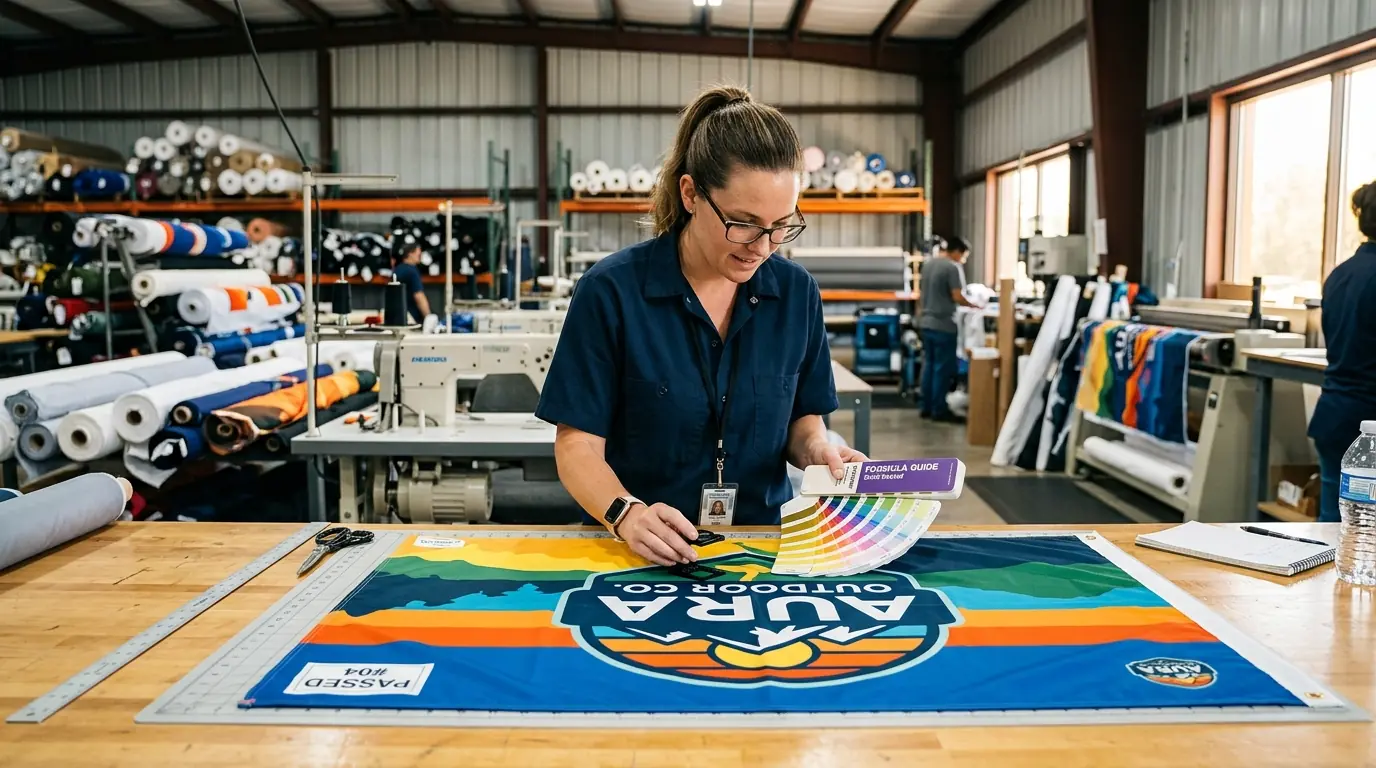
Last month, a brand owner I know almost wired $3,400 for 500 custom flags based solely on a digital proof. No physical sample. The colors on the final product looked nothing like what she approved on screen. That's a $3,400 lesson most people can't afford.
Here's the thing — digital proofs are free from virtually every OEM flag manufacturer in China. They'll send you a nice-looking mockup within 24 hours. But a digital proof on your laptop screen is NOT the same as ink on fabric. Screen calibration, fabric texture, color absorption — all of these create gaps between what you see digitally and what you hold in your hands.
So get a physical sample. Every single time.
The cost is surprisingly reasonable, and here's what you're actually looking at:
| Sample Type | Cost Per Piece | Turnaround |
|---|---|---|
| Standard printed (dye-sub on polyester) | $20–50 | 5–7 working days |
| Complex (embroidery, applique, double-sided) | $50–100 | 5–7 working days |
| Rush service surcharge | +$10–20 | 3–5 working days |
Most factories will deduct that sample fee from your first bulk order. So you're essentially paying nothing for insurance against a costly mistake.
Say you're launching a line of branded garden flags for your e-commerce store. You've got a gradient logo with six colors. A $35 sample tells you whether that gradient holds up on polyester or turns into a muddy mess. That's worth every penny.
The catch is revisions. Most manufacturers include 2–3 free design revisions, which is generous. After that, expect $10–15 per round. My honest take: if you need more than three revisions, your design file isn't production-ready. Fix it before you submit.
Key Takeaway
Skipping the sample phase to save $50 is the most expensive shortcut in the custom flag business. Budget the time, budget the dollars, and protect your bulk order from preventable disasters.
Unit Price Breakdown — What You Pay Per Flag and Why
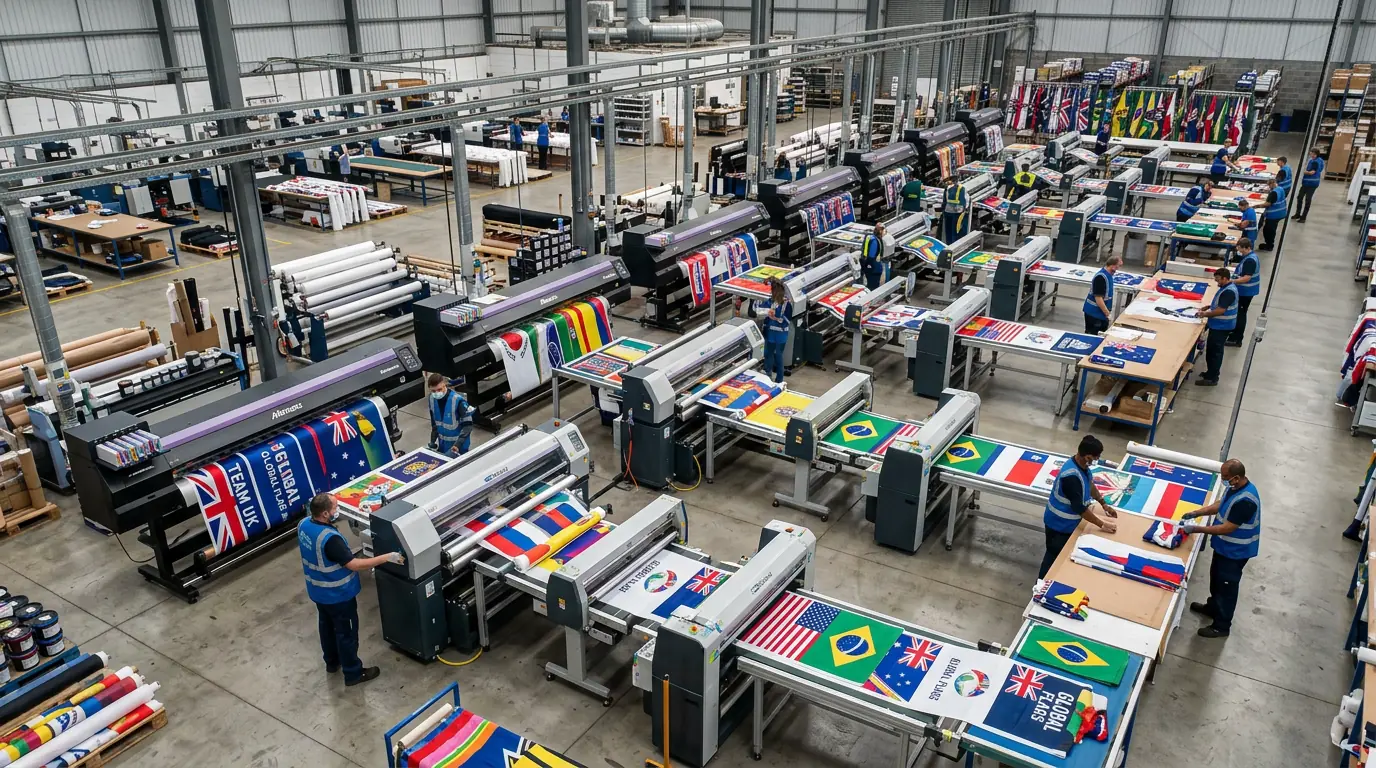
A standard 3x5ft custom flag in polyester with dye-sublimation printing runs $2.50–$3.50 per unit at 100 pieces. Order 500 and that drops to $1.50–$2.50. Cross the 1,000-unit mark and you're looking at $0.80–$1.50. At 5,000+, you can push below $0.80 per flag. Those numbers matter because the difference between ordering 100 and 1,000 units isn't incremental — it's a completely different margin structure for your business.
$2.50–3.50
100 Pieces
$1.50–2.50
500 Pieces
$0.80–1.50
1,000 Pieces
<$0.80
5,000+ Pieces
But the unit count only tells part of the story. Four cost drivers shift your actual price, and most brand owners only pay attention to one of them.
Fabric choice is the first lever. 110g knitted polyester is the industry default and the cheapest option. It works fine for promotional giveaways, indoor displays, and events where the flag isn't fighting weather. Step up to 200D nylon or satin and you're adding 20–40% to your per-unit cost. My honest take: unless you're selling flags meant to fly outdoors for months, knitted polyester at 110g hits the sweet spot between perceived quality and margin. Nylon is great, but your customer probably can't tell the difference at a trade show booth.
Size is the trap nobody talks about. A 4x6ft flag uses roughly 60% more material than a 3x5ft, yet suppliers sometimes quote it as only "a little more." Do the math yourself — that material increase compounds across every unit in your order.
Printing method barely needs debate. Dye-sublimation is the most cost-effective approach for full-color custom work, and it's what 90% of OEM flag suppliers default to. Unless you have a specific reason to go another route, don't overthink this one.
Finishing details — grommets, pole sleeves, canvas headers — each add $0.10–$0.30 per feature. Small on a single unit, but at 5,000 flags, an extra pole sleeve you didn't actually need just cost you $500–$1,500.
One more thing to budget for: double-sided flags run 30–40% higher because they require either a blockout layer or true two-ply construction. If your design reads fine from one side, skip the upcharge. Save double-sided for hero placements where it actually matters.
Hidden Costs Most First-Time Buyers Miss
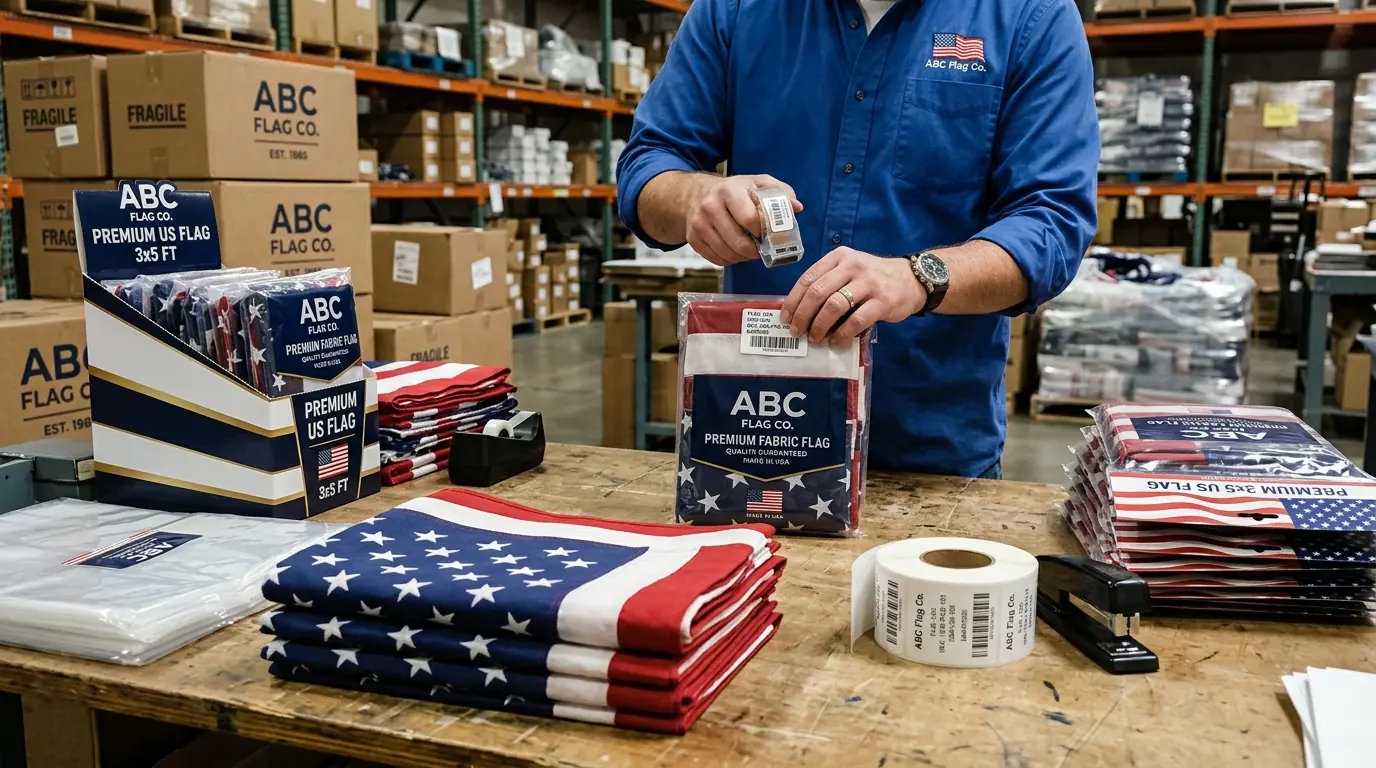
The quote you get from a flag supplier is never the final number. First-time buyers routinely underestimate their true landed cost by 15-25%, and it's the line items they never asked about that eat their margins.
Setup fees are the first gut punch. If you're using screen printing for a four-color logo, expect $120-$320 in one-time setup charges before a single flag gets printed. That math destroys small runs — on a 200-unit order, setup alone adds $0.60-$1.60 per flag. Dye-sublimation skips the plate fees, but suppliers still slip in a digital file processing fee of $10-$25. It's small, but it's the kind of charge that shows up on your invoice without ever appearing in the quote. Always ask for an all-inclusive price breakdown before you approve production.
Packaging is where "cheap" gets expensive fast. A standard OPP bag runs $0.05-$0.10 per piece — perfectly fine for wholesale or B2B. But if you're selling direct to consumers and want custom retail boxes, you're looking at $0.30-$1.00 per unit. Header cards land somewhere in between at $0.03-$0.08. Here's my honest take: unless your retail price is above $25 per flag, custom boxes rarely justify the cost. A branded header card on a clear poly bag looks professional enough and keeps your per-unit packaging under $0.15.
Third-party QC inspections are non-negotiable but wildly inconsistent in pricing. A standard man-day inspection runs $200-$350 through most agencies, though budget options like TESTCOO offer $149/day rates while premium services like AQI charge $299/day. What catches people off guard is travel surcharges — most inspectors include up to 60km of travel, but if your factory is 120km out you'll add $50, and factories 400km+ trigger a 50% surcharge on the entire inspection fee.
Add all of this up before you finalize your retail price. The suppliers who don't mention these costs aren't necessarily dishonest — they're just waiting for you to not ask.
Shipping and Landed Cost — From Factory Door to Your Warehouse
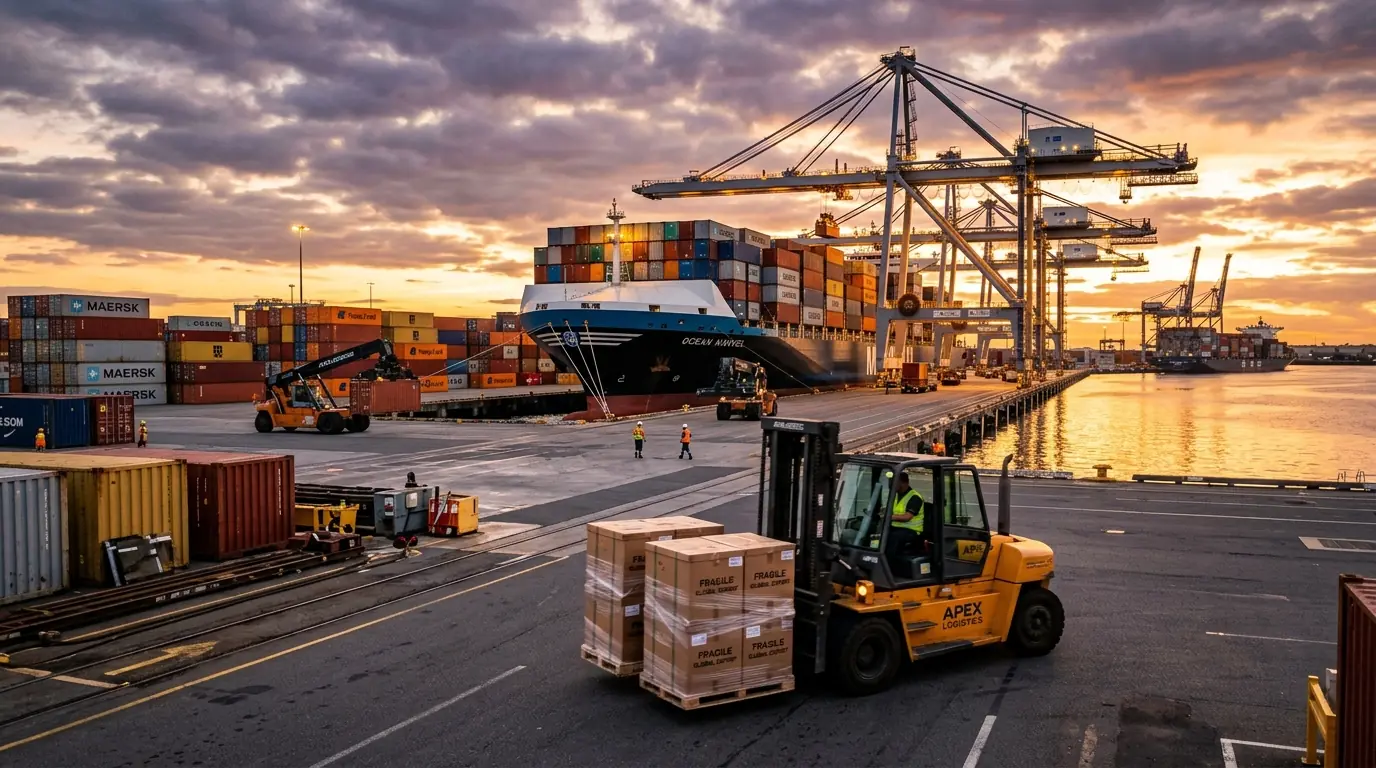
Most brand owners obsess over unit pricing and completely ignore that shipping can add 15-40% to their per-flag cost depending on order size. That percentage swing is often larger than the difference between a "cheap" and "expensive" supplier.
Here's where the math gets interesting. A typical order of 1,000 custom flags weighs about 80-100kg and occupies only 0.3-0.5 CBM. Ocean LCL freight for that volume runs roughly $32. Yes, thirty-two dollars — basically a rounding error. But LCL transit takes 4-6 weeks, and your freight forwarder's minimum charge will likely bump you to $75-150 anyway. Air freight for the same shipment costs $200-250 at standard rates, or $400-600 if you need express. For most flag orders under 2,000 units, air freight is the smarter play because the per-unit hit ($0.20-0.50) is tiny compared to the cash flow cost of having inventory floating on the ocean for six weeks. FCL containers only make sense for orders of 10,000+ flags alongside other products — you'll never fill a 20ft container with flags alone unless you're running a massive operation.
The landed cost calculation is where people get tripped up. Custom flags classify under HTS 6307.90.9889 at a 7% duty rate. On a $2,000 shipment, that's $140 in duty, plus Merchandise Processing Fee (0.3464%, minimum $31.67), Harbor Maintenance Fee (0.125%), and customs brokerage ($100-250 for a simple entry). Altogether, expect $300-450 in import fees on a mid-size order. Divide that across 1,000 flags and you're adding $0.30-0.45 per unit.
My recommendation: build a landed cost spreadsheet before you finalize any supplier. Take your quoted unit price, add shipping, duty, brokerage, and MPF, then compare. I've seen "cheaper" suppliers lose their advantage entirely once landed costs were factored in.
💡 Pro Tip: For bulk orders over 500 pieces, contact our team for factory-direct pricing with full landed cost estimates included.
How to Calculate Your True Per-Unit Landed Cost
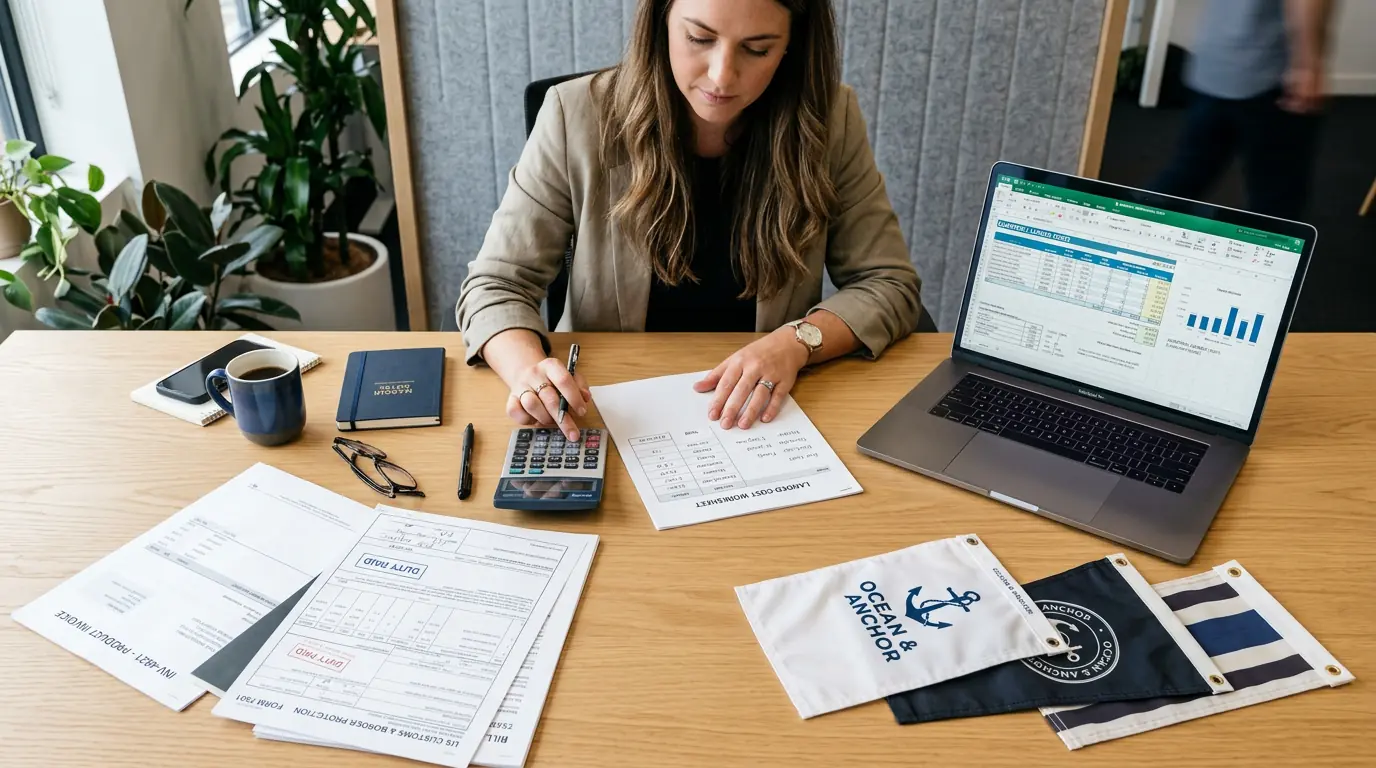
Here is the exact formula I use every time I source a new flag product:
Landed Cost Formula
(Unit Price × Qty + Shipping + Duty + Packaging + Inspection + Insurance + Brokerage + MPF + HMF) ÷ Qty = True Landed Cost
Most brand owners stop at FOB price and wonder why their margins evaporate. Let me walk through a real example so you can see how dramatically the numbers shift.
Worked example: 500 pieces of custom 3×5ft flags at $1.80 each
Your FOB cost is $900. Straightforward enough. Now stack on the rest: $60 shipping, $67 duty, $40 packaging, $250 for third-party QC inspection, $15 insurance, $150 customs brokerage, $28 Merchandise Processing Fee, and $1.20 Harbor Maintenance Fee. Your total lands at $1,511.20 — which means each flag actually costs you $3.02, not $1.80. That's a 68% increase over what the supplier quoted you.
Quoted FOB Price
$1.80
per flag (500 pcs)
True Landed Cost
$3.02
per flag (+68% increase)
This is why I get frustrated when I see people comparing factory quotes side by side without running landed cost math. A supplier quoting $1.50/flag with expensive packaging requirements and problematic QC history can easily cost you more than one quoting $2.00 with everything dialed in.
Now figure out if the product actually makes money. For retail, you need 3-4× landed cost to cover overhead and profit — so $3.02 means you're pricing around $9-$12 retail. For wholesale, target 2-2.5× landed, putting you at $6-$7.50. Selling on Amazon? Factor in the 15% referral fee plus $3-5 in FBA fees per unit on top of your landed cost, which means your listing price needs to clear roughly $11-$13 minimum to leave anything worth keeping.
One rule I never skip: build in a 10-15% contingency buffer on your total landed cost. Exchange rates shift, freight surcharges appear out of nowhere, and sometimes a shipment needs re-inspection. If the math only works with perfect conditions, the math doesn't actually work. Run your numbers with $3.32-$3.47 per flag and see if the product still makes sense before you wire that deposit.
Conclusion
Getting custom OEM flags manufactured doesn't have to drain your budget, but you need to understand the real numbers before placing that first order.
The biggest mistake brand owners make is fixating on the $0.80-$3.50 unit price while ignoring setup fees, packaging costs, QC charges, and shipping duties that add $0.30-$0.50 per unit. That "cheap" $1.80 FOB flag actually costs you $3.02 landed — a 68% increase over the quoted price.
Your Next Steps:
1
Budget $20-100 per sample and compare quality side by side
2
Calculate your true landed cost
Use the formula above before committing to any order
3
Ask every supplier to itemize hidden fees
Setup, packaging, and QC charges specifically
4
Start with a 500-unit test order
Validate quality before scaling to thousands
Run these numbers first. Your margins depend on it.
Video Guide
Related Articles