Every year, sports teams, school athletic departments, and event organizers waste thousands of dollars on flags. Those flags fade after one season, unravel at the seams, or arrive looking nothing like the approved artwork. The problem almost never comes down to budget — it comes down to not knowing what to ask before placing the order .
Picking the right sports team flag manufacturer in the USA takes some homework. You need to know the real differences between polyester and nylon. You need to understand why sublimation flag printing outperforms screen printing in certain applications. And you need to spot which "custom options" add real value versus which ones are upsells you don't need.
This guide cuts through the noise. Finish reading, and you'll know how to evaluate suppliers, read a quote like a pro, and walk away with flags your team will be proud to carry.
Looking for inspiration? Check out the most iconic sports team flags in stadium history to see what great flag design looks like in action.
Flag Materials Compared: Polyester vs Nylon vs Hand-Sewn Fabric for Sports Teams
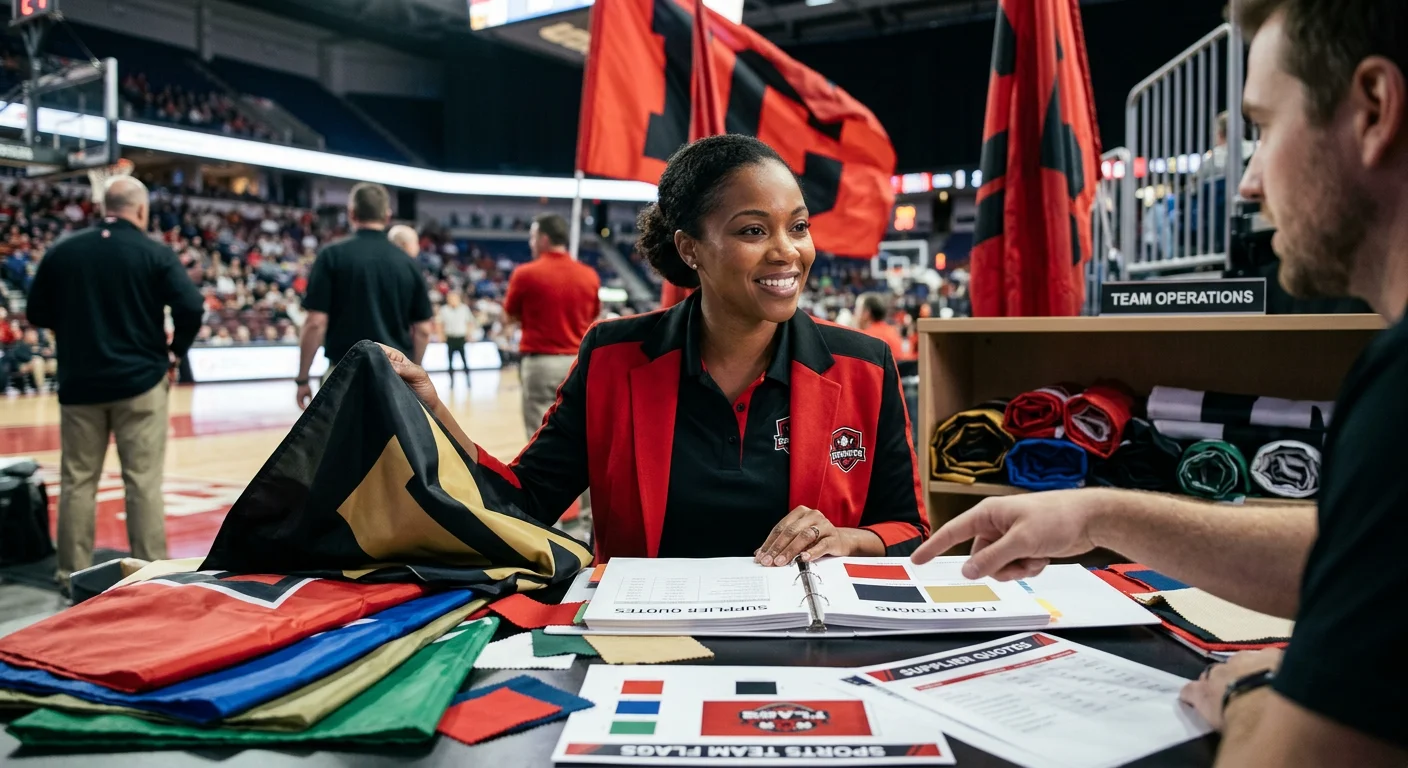
Material choice is the single decision that determines whether your flags last one season or three. Most buyers get it wrong because they never ask the right question upfront.
Here's the truth: no flag fabric is "best" for every situation. There's only the right material for your specific conditions. Let's break down what that means.
Polyester - Durability King
- 12+ months outdoor lifespan
- Superior UV resistance
- Handles high-speed winds
- Best for permanent display
Nylon - Visual Impact
- 6-12 months lifespan
- Vibrant glossy colors
- Flies in gentle breezes
- Cost-effective for events
Polyester: Built for Punishment
Polyester is the workhorse of outdoor sports flags . It's heavier and coarser, with a matte finish that gives it a traditional, authoritative look. It doesn't have much visual gloss. But it more than makes up for that in raw durability.
Where polyester wins:
- UV resistance — Built-in UV inhibitors hold colors longer under direct sun exposure
- Wind tolerance — The open-weave construction handles high-speed gusts without fraying or tearing
- Lifespan — Expect 12+ months of continuous outdoor display, even in coastal or stadium environments
- Abrasion resistance — Stronger polymer bonds help it survive the repeated stress of flag poles and hardware
Your team plays at a coastal venue or a high-wind stadium? Or you need flags displayed 24/7? Polyester is your material.
Nylon: Visibility First
Nylon delivers strong visual impact. Its smooth, silky surface produces vibrant, glossy colors that make team logos pop — from far away too. At around 200 denier weight, it's much lighter. So it catches the air and flies well in even a gentle breeze.
Where nylon wins:
- Low-wind environments — Flags flutter and stay visible without needing strong gusts
- Rapid drying — Water beads off the surface; no sagging after rain delays
- Color vibrancy — Premium gloss finish delivers bold visual impact at launch
- Cost efficiency — Lower price point makes it practical for single-event or seasonal use
The trade-off? Nylon fades faster under long UV exposure and can fray in harsh wind conditions. Lifespan runs 6 to 12 months under normal use.
Hand-Sewn Fabric: Not for the Field
Hand-sewn flags — most are cotton-based — belong in a display case, not on a sideline pole. They offer craftsmanship and tradition, but zero weather resistance. No solid durability data exists for outdoor sports use. That's because these flags aren't built for it. Save them for ceremonial presentations or indoor trophy rooms.
The Practical Decision Framework
Stop guessing. Use this simple checklist before you order:
Condition | Recommended Material |
|---|---|
Wind speed under 15 mph | Nylon |
Wind speed over 15 mph | Polyester |
Daily outdoor exposure / UV-heavy climate | Polyester |
Single event or short-term use | Nylon |
Season-long or permanent installation | Polyester |
Quick Field Test
Rub the fabric -- slick and silky means nylon; coarse and cotton-like means polyester. Sprinkle water on it. It beads off fast? That's nylon's water resistance doing its job.
Get the material right first. Everything else — printing, sizing, hardware — builds on top of this foundation.
Printing Processes Decoded: Digital Sublimation vs Screen-Dyed vs Sewn Lettering
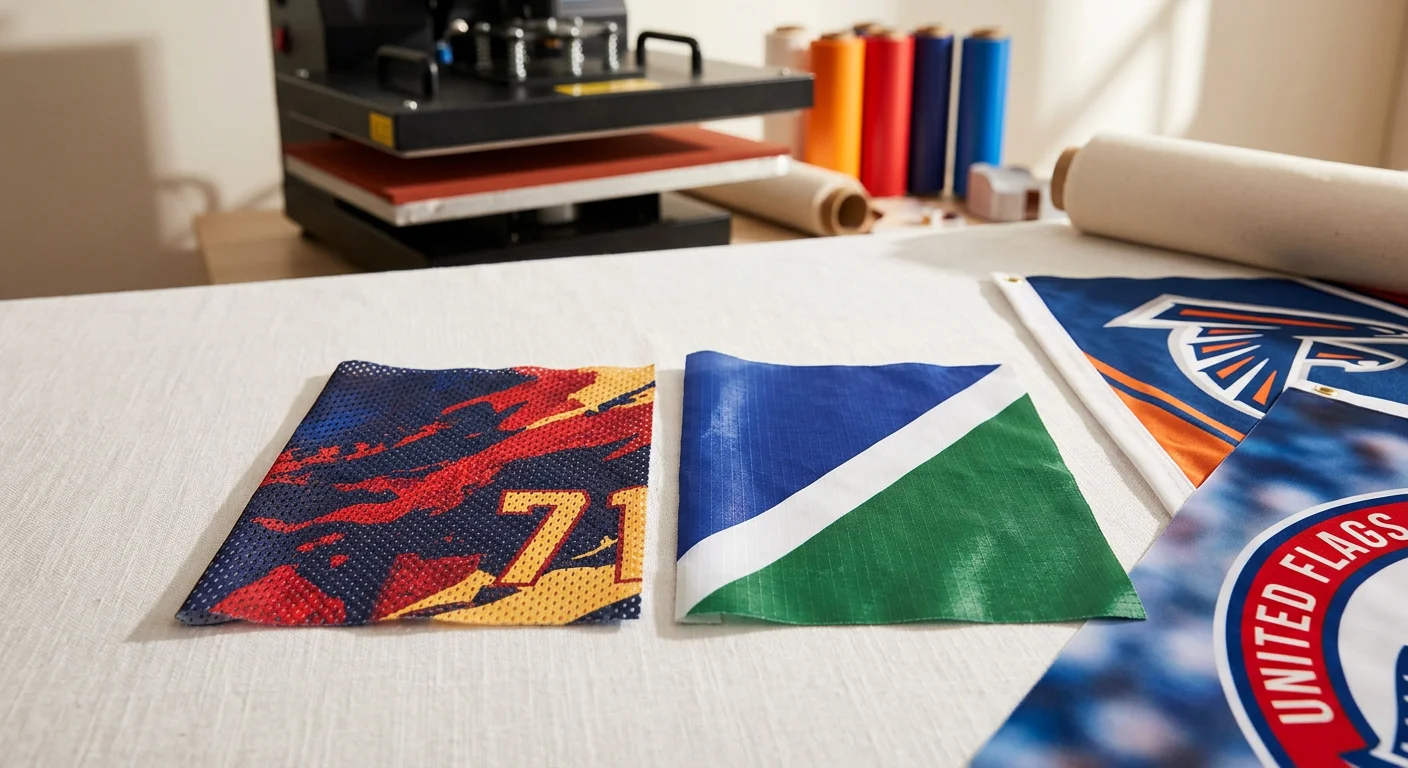
The printing method you choose determines how your flag looks on day one — and whether it still looks that way on day 300.
Three methods dominate the sports flag market. Each produces very different results. Know the difference before you order. It separates smart buyers from frustrated ones.
Digital Sublimation: The Industry Standard for a Reason
Dye sublimation doesn't print onto fabric. It prints into it.
Here's the science in plain English: sublimation inks shift from solid to gas at temperatures between 350°F–450°F . That gas pushes into polyester fibers at the molecular level. It bonds with the material itself — not on top of it. No surface layer. No cracking. No peeling.
The result? Colors that won't fade after a season of UV exposure, rain delays, or rough handling.
What sublimation delivers:
- Edge-to-edge full-color printing — complex gradients, photographic logos, and multi-color designs all come out sharp and clear
- Permanent color bonds — the dye becomes part of the fiber, not a coating sitting on top
- Zero color limitations — no per-color pricing, no design restrictions
The catch: Sublimation works on polyester-based materials — and nothing else. Cotton and blended fabrics won't take the dye transfer. That's just how the chemistry works. There's no workaround.
Screen-Dyed Printing: Built for Simplicity
Screen printing works well for bold, solid-color designs with minimal detail. It's cost-effective at high volume. You get consistent results, but only when the artwork stays simple.
The limitation is real: each color needs its own separate screen setup. Add gradients or fine detail, and costs climb fast. Quality also drops with more complex designs.
Best for: Large bulk orders, simple team wordmarks, single or dual-color applications.
Sewn Lettering: Ceremonial Use Only
Sewn or embroidered lettering belongs on presentation flags — not sideline banners. It adds texture and craftsmanship. But it's heavy, stiff, and not practical for outdoor pole display.
Bottom Line
For sports team flags built to perform outdoors, sublimation wins every time. Inks bond at 350-450F directly into polyester fibers -- no cracking, no peeling, no fading.
Sports Team Flag Pricing Breakdown: What Drives the Cost Per Unit
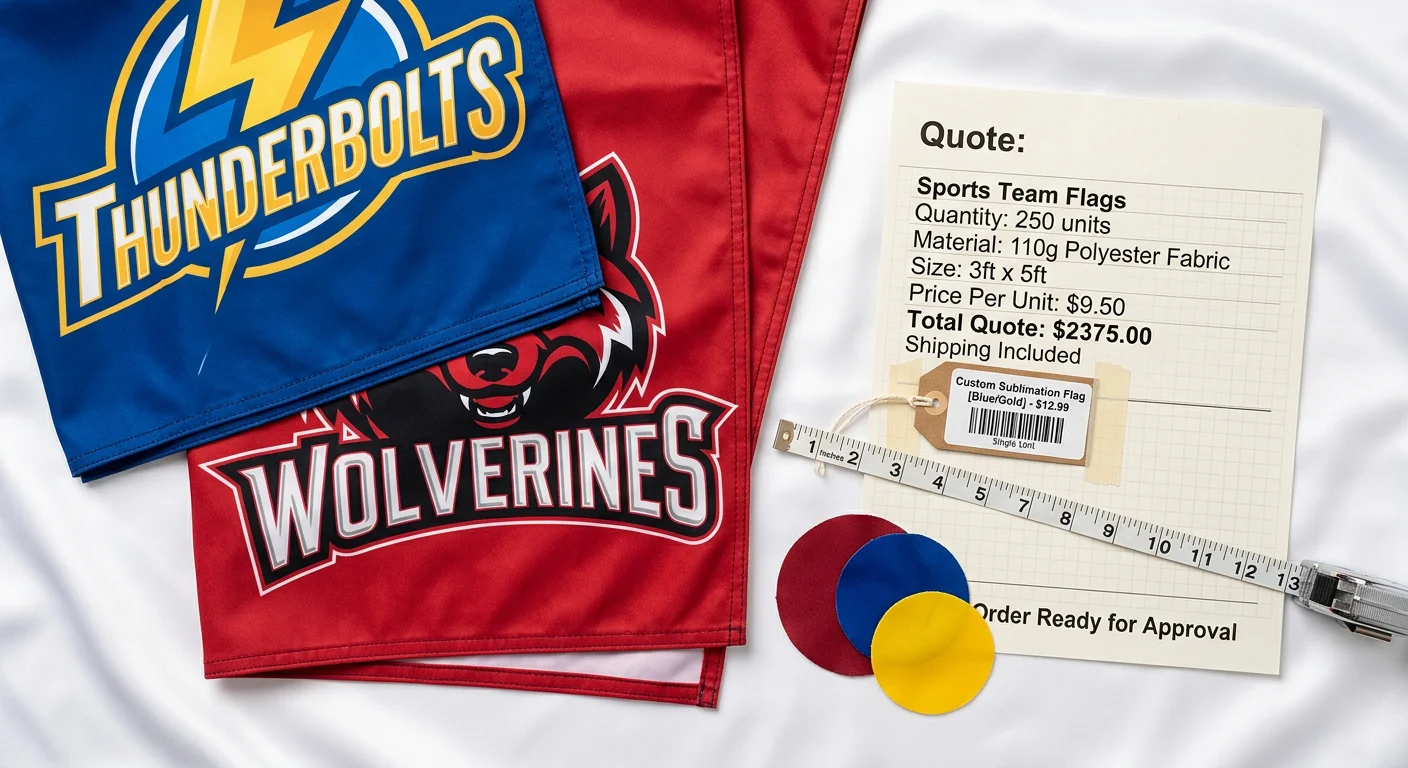
Flag quotes confuse buyers. One sports team supplier sends you $25/unit. Another sends $75. Same size, same order quantity — completely different prices. Here's what's happening behind those numbers.
$20-$75
Price Range Per Flag
60-80%
Double-Sided Premium
50-65%
Bulk Savings (250+)
Material Grade Is the Biggest Lever
Fabric choice moves the price more than any other single variable. Standard 110gsm polyester is your entry-level baseline. Step up to 150–200gsm and you're adding $5–$15 per flag to the total. US-made high-strength nylon sits at the top of the cost ladder. It earns that position through wind and UV durability — but budget orders often can't absorb that premium.
Single-Sided vs. Double-Sided: The 2x Rule
This one catches buyers off guard every time. A double-sided flag is not "slightly more" than single-sided. It runs 60–80% more expensive . Why? It needs two separate fabric panels stitched back-to-back with an internal liner. That adds real material and labor costs. Plan for this up front. Your design must be readable from both sides? Build that cost into your budget before you go out for quotes.
Size Scales the Price Fast
Larger flags don't just cost a bit more — the price jumps. Standard sizing scales at a steady per-square-foot rate. Move into oversized territory, though — 15ft+ display flags, 18ft giants — and expect 25–75% above standard per-unit rates. Material waste, production complexity, and handling all add up at that scale.
Quantity Breaks: Where the Real Savings Hide
Bulk custom sports team flag orders get cost-effective through volume pricing:
Order Quantity | Estimated Price/Flag | Savings vs. Single Unit |
|---|---|---|
1–9 | $55–$75 | Baseline |
10–24 | $45–$60 | 10–20% |
25–49 | $35–$50 | 25–35% |
50–99 | $30–$45 | 35–45% |
100–249 | $25–$40 | 45–55% |
250+ | $20–$35 | 50–65% |
The key quantity breaks to target: 25, 50, and 100 units . Each tier delivers a meaningful per-unit drop. Your team needs 22 flags? Round up to 25. You'll almost always spend less overall.
Customization Add-Ons That Push Quotes Higher
Complex multi-color graphics add 15–30% over simple designs. Full-color photo prints and Pantone-matched team colors push toward the top of that range. Finishing hardware matters too. Standard grommets and headers are usually included in the base price. Pole sleeves, on the other hand, become a separate line-item cost once you hit six or more units.
Bottom line: get itemized quotes. A solid quote breaks out material grade, printing specification, size, quantity tier, and finish as separate line items. Any sports team supplier who can't show you that breakdown clearly is not one you want managing your team's merchandise budget.
Custom Options That Matter for Sports Teams: Sizes, Shapes, Finishing & Accessories
Most buyers treat customization as an afterthought. They nail down the material, lock in the quantity, then rush through the options list at the end. That's where orders go wrong.
Custom sports team flag options aren't upsells. Size, shape, finishing, and accessories — get these right, and your flag performs in the real world. Get them wrong, and it looks great in a product photo but falls apart on the field.
Size: Match the Venue, Not the Catalog
Flag sizes range from 2×3 ft (handheld sideline flags) to 4×6 ft (pole display), 5×8 ft (stadium rail banners), and 8×12 ft or larger for arena installations. Don't just order what seems "standard." Think about viewing distance first. A 3×5 flag that looks bold in a high school gym disappears inside a 10,000-seat stadium. Let the venue guide your size choice, not the catalog defaults.
Shape: Beyond the Rectangle
Rectangle isn't your one option. Good sports team flag manufacturers carry a range of formats:
Custom sports team pennant cuts — tapered triangle shapes that work well for rally events
Feather/teardrop formats — built for high-visibility outdoor display with ground stakes
Die-cut shapes — team mascots, state outlines, or logo silhouettes for premium merchandise
Finishing: The Details That Determine Lifespan
Your finishing choices have a real impact on how long the flag holds up in the field.
Finishing Option | Best Use Case |
|---|---|
Brass grommets | Fence mounting, rope attachment |
Canvas header | Flagpole display |
Pole sleeve | Ground stake or horizontal pole |
Reinforced stitching | High-wind or continuous outdoor use |
Heat-sealed edges | Prevents fraying on lightweight nylon |
Double-sided flags need an internal liner between the panels. Skip it, and colors bleed through. The design also shows up as a mirror-image mess on the reverse side. Confirm liner inclusion before approving a double-sided order — don't sign off until you see it on the spec sheet.
Accessories Worth Budgeting For
The flag covers one part of the setup. Build out your order checklist with:
Carrying cases for travel-heavy teams
Ground stakes and aluminum poles sized to your flag dimensions
Bungee clips or carabiner sets for rail mounting at stadium events
Get the custom options right, and your flags work as hard as your team does.
The Manufacturer Vetting Checklist: 7 Non-Negotiable Criteria Before You Place an Order
Bad sports team suppliers don't announce themselves. They send samples that look great, quote prices that seem fair, and then deliver 500 flags with bleeding colors and crooked seams — three days after your season opener.
Gartner puts the average cost of poor sports team supplier vetting at $15 million per year for enterprise buyers. Your flag order isn't that scale. But the core idea is the same: skipping due diligence costs you more than doing it right the first time.
Here are the seven criteria that separate trustworthy manufacturers from the ones that will burn your budget.
<2%
Target Defect Rate
95%+
On-Time Delivery
<4 Wks
Max Lead Time
1. Production Capacity That Matches Your Peak Demand
Ask for proof — not promises. A solid sports team merchandise supplier can show that their current capacity goes beyond your projected peak demand by at least 30–50% . Ask for specifics: number of active production lines (minimum two to five for mid-volume orders), workforce size, and confirmed lead times. Look for suppliers with a sub-four-week lead time and an on-time delivery rate above 95% . No examples of large fulfillments — say, 10,000+ units in 30 days? That's a red flag.
2. Verified Quality Control Standards
Your benchmarks are defect rates below 1–2% and first-pass yield above 95% . Check whether they hold ISO 9001 certification and whether their contracts include a right-to-audit clause. Any sports team flag manufacturer serious about flag manufacturing quality standards keeps dedicated QC staff, in-house testing equipment, and a clear process that fixes issues within 30 days.
3. Regulatory and Material Compliance
For textile products, OEKO-TEX certification confirms fabrics are free from harmful substances. This is critical for orders that include youth team merchandise. Make sure compliance is current — not just printed on a document. Ask for third-party audit confirmation. Also check that no environmental or labor violations appear on record within the past three years.
4. Financial Stability
You don't need a forensic accountant. You need three clear signals:
- Debt-to-equity ratio below 2:1
- Positive operating cash flow
- No bankruptcy filings in the past five years
Ask for two to three years of audited financial statements on any high-value or recurring order. A supplier that vanishes mid-production is a far bigger problem than paying a slightly higher per-unit price from a stable one.
5. Documented Track Record at Your Order Scale
Case studies and references need to match your scope. Placing bulk custom team flag orders at 250+ units? Ask for client references who placed orders of similar size. The minimum bar: three verifiable references with delivery accuracy above 98% and client satisfaction scores above 90%.
6. Operational Consistency Under Pressure
Most buyers skip this criterion. Most of them regret it. Ask straight out: what happens when your top raw material supplier of sports team flag raises prices by 20%? How do you manage a production bottleneck during peak season? Solid manufacturers track specific risk numbers: zero cyber incidents per year, fewer than 1% disputed orders, and cost deviations under 5% from the quoted price.
7. Legal and Reputational Standing
Run a basic check. No active litigation. No unresolved contract disputes in the past two years. Clean credit profile. A manufacturer offering UV resistant outdoor sports flags and premium sublimation flag printing may look great on paper. But supplier disputes or IP violations put your order at risk before production even begins.
Use This Scoring Framework Before You Sign Anything
Score each supplier on hard data — not gut feel. Weight each criterion and compare results side by side:
Criterion | Weight | What to Look For |
|---|---|---|
Production Capacity | 25% | Lead time <4 weeks, delivery rate >95% |
Quality Control | 20% | ISO 9001, defect rate <2%, first-pass yield >95% |
Financial Stability | 20% | Positive cash flow, debt-to-equity <2:1 |
Compliance | 15% | OEKO-TEX certified, no violations past 3 years |
Track Record | 10% | Matched-scope references, delivery accuracy >98% |
Operational Risk | 10% | Dispute rate <1%, cost deviation <5% |
Pass Threshold
Approve suppliers who score above 80%. Run reviews every quarter after that.
The ones who push back on transparency? They're already telling you something important.
Red Flags to Avoid When Choosing a Sports Flag Supplier (Common Buyer Mistakes)
Most buyers don't get burned by bad suppliers they can spot from a mile away. They get burned by suppliers who look legitimate — right up until the moment they aren't.
Here's how it plays out. A supplier sends a sharp sample, quotes a competitive price, and clears a quick website check. The order goes in. Then the flags arrive — colors bleeding, seams crooked, delivery two weeks late. By then, your season has started and your budget is gone.
Don't let that be your story. These are the warning signs that should stop you before you sign anything.
Watch for these hard signals during supplier evaluation:
Defect rates above 2% — Ask for production logs from the last 30 days. Check scrap bins and customer return records. Any supplier who resists sharing this data is protecting something you need to see.
Samples that don't match the spec sheet — Pay close attention here. Dimensions, material weight, or color accuracy that drift from the approved drawing before production will drift even further during it. What you see in the sample is the best it will ever look.
Vague or missing production reports — A serious sports team flag manufacturer tracks quantities, scrap rates, and corrective actions every 30 days. No documentation means no quality control. Full stop.
Overdue equipment calibration — Outdated calibration logs and missing service signatures are not just paperwork gaps. They point to deep operational neglect. That neglect shows up in your finished product. Crooked seams, off colors, inconsistent sizing — it all traces back here.
Frequent late shipments — Ask straight out: what's your on-time delivery rate over the past 12 months? Also check the production floor. Rework piles stacked up are a clear sign. Both point to a supplier that can't manage its own production schedule, let alone meet yours.
Unusual vendor payment requests — Mid-order changes to bank details or wire instructions are active fraud signals. Call the supplier on a verified number. Confirm all payment details by voice, one-on-one. Do this every single time, no exceptions.
The one on-site check most buyers skip: Walk the shop floor. Can't get there in person? Request a live video facility tour. Look at the aisles — crowded or clear? Check exits, storage areas, and whether workers have proper safety gear. Overcrowded aisles, blocked exits, makeshift storage, and missing PPE tell you a lot. They show you how this operation holds up under real pressure. Chaotic facilities produce chaotic results.
The suppliers worth trusting will welcome every question on this list. The ones who push back are already giving you your answer.
How to Get the Best Value: Ordering Strategy for Teams, Schools & Sports Organizations
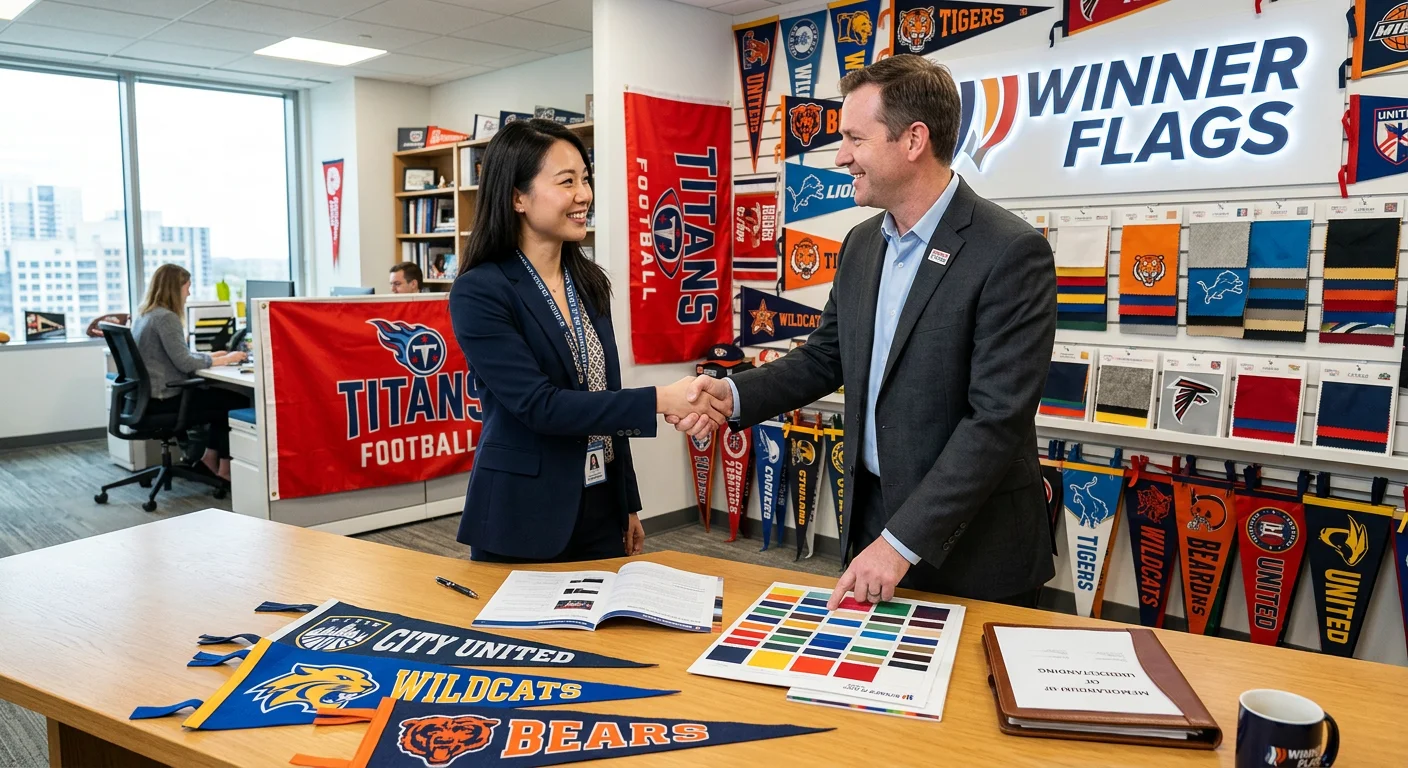
Smart buyers don't just find the right sports team flag manufacturer — they order the right way.
20-25
Standard Days
10
Rush Days (+25%)
25+
Best Price Break
Timing is your biggest lever. Standard production takes 20–25 business days . Rush orders drop that to 10 days, but you pay a 25% premium for it. Map your season calendar backward from game day. Do that, and you won't need to rush.
Quantity strategy is where most teams leave money on the table. The pricing tiers covered earlier show the biggest per-unit drops at 25, 50, and 100 units . Build your order quantity with purpose:
Active roster flags: one per player per display context
Coaching staff and support personnel: one set each
Replacement buffer: 2–3 units in your most common sizes — every order
New player contingency: budget 2–3 extra sets per season
Don't guess at size distribution. A solid split for most teams looks like this: 10% small, 25% medium, 30% large, 25% XL, and 10% 2XL. Use real roster data — not assumptions.
One cost saver most teams miss: consolidate artwork across your order . Group shared design elements into one production run. Setup costs drop, and you keep full customization.
Last step — confirm every name and number before you approve production. Reprints from spelling errors fall outside any standard manufacturer warranty. They won't be cheap.
FAQ: Quick Answers for Sports Team Flag Buyers
These questions come up on almost every order. Here are straight answers.
What's the most common flag material for sports teams?
110gsm knitted polyester is the industry standard. It hits the right balance of durability, print quality, and cost — better than any other option. Most bulk custom flag orders start here.
How far can a flag be seen?
Size drives visibility. An 8.5ft flag reads well at 75–100 feet. The 11.5ft standard covers 150–200 feet — the right call for most stadium sidelines. Need 250+ feet of visibility? Go with a 15ft display flag.
Are double-sided flags worth the extra cost?
For permanent installations and branded team merchandise, yes. Plan your budget ahead — double-sided flags run 60–80% more than single-sided. That's not a surprise fee. It's a real production cost.
What's the minimum order for bulk pricing?
Meaningful savings start at 25 units. That's the point where per-unit cost drops 25–35% below single-digit orders.
How long does production take?
Standard lead time runs 20–25 business days. Plan around that window. Rush production is available — but it adds 25% to the cost and puts pressure on quality control.
Does sublimation work on all flag materials?
No. Dye sublimation bonds with polyester fibers. It won't transfer onto cotton or blended fabrics.
Conclusion
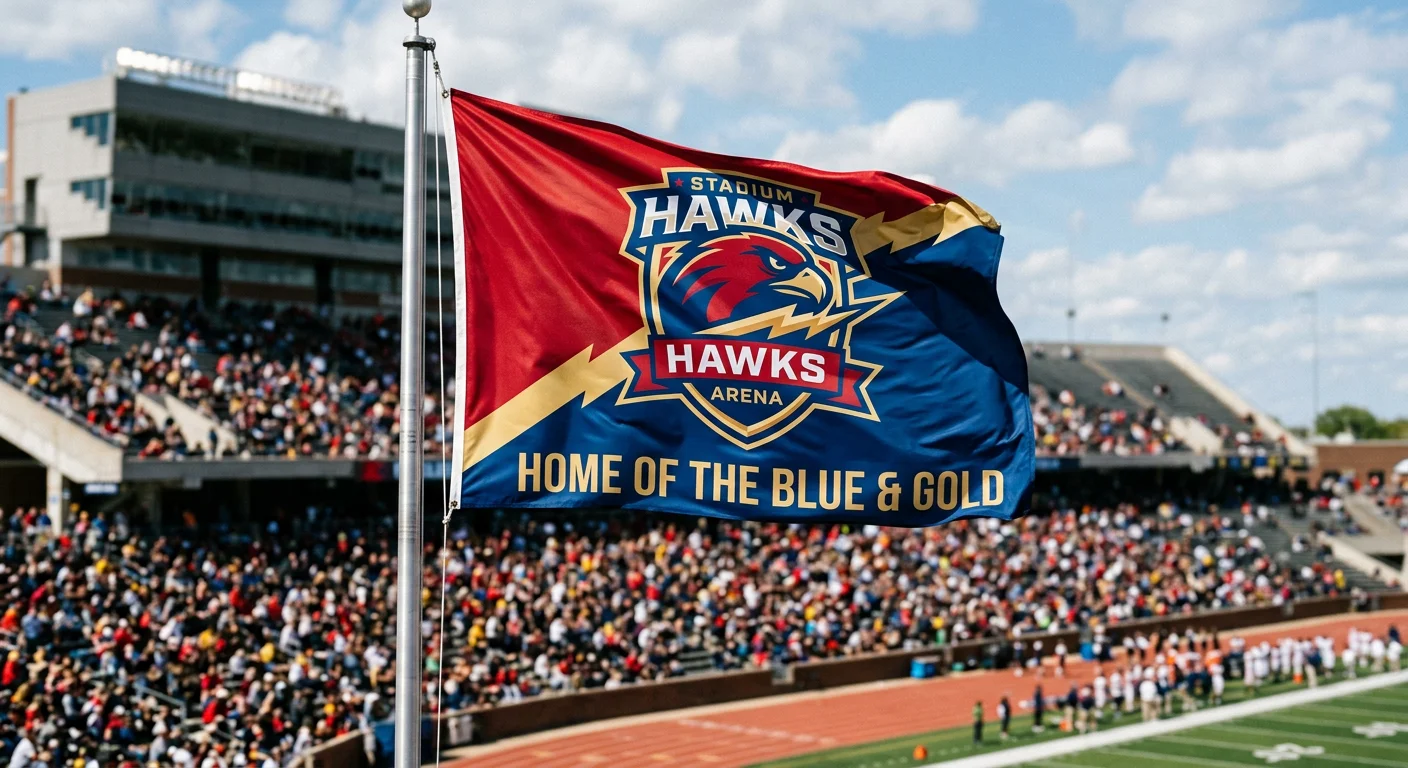
Picking the right sports team flag manufacturer is more than a purchase. It reflects your team's identity and professionalism.
The best buyers get a few things right:
Match materials to environment — polyester for outdoor durability, nylon for premium presentation
Insist on dye sublimation printing for color accuracy that holds up over time
Always check a sports team flag supplier's samples, turnaround guarantees, and bulk pricing before signing off
The teams that regret their choice? They rushed and skipped the checklist.
You now have everything you need to talk to any supplier with confidence. You know the right questions to ask, the red flags to spot, and a clear way to compare quotes side by side.
Your next move is simple : head to runcustomflag.com , request a free custom quote, and let a dedicated specialist help you put together the exact flag package your team deserves.
Great teams deserve great flags. Don't settle for less.
Video Guide
Related Articles