Pick up almost any Australian flag — at a school fete, a government office, a sporting event — and flip it over. The label almost always reads Made in China . That's not a scandal. It's the reality of how the global flag manufacturing industry works.
Sourcing bulk Australian flags for an official ceremony, a retail range, or a custom branded event? Knowing where your flag comes from matters. So does understanding what that means for quality, compliance, and cost. Most buyers don't dig into this — and that's where things go wrong.
This guide breaks down the full supply chain. You'll see who makes Australian flags, where production happens, what materials and methods are used, and how to find a trusted Australian flag supplier that delivers on specs.
Major Australian Flag Manufacturers and Their Production Locations
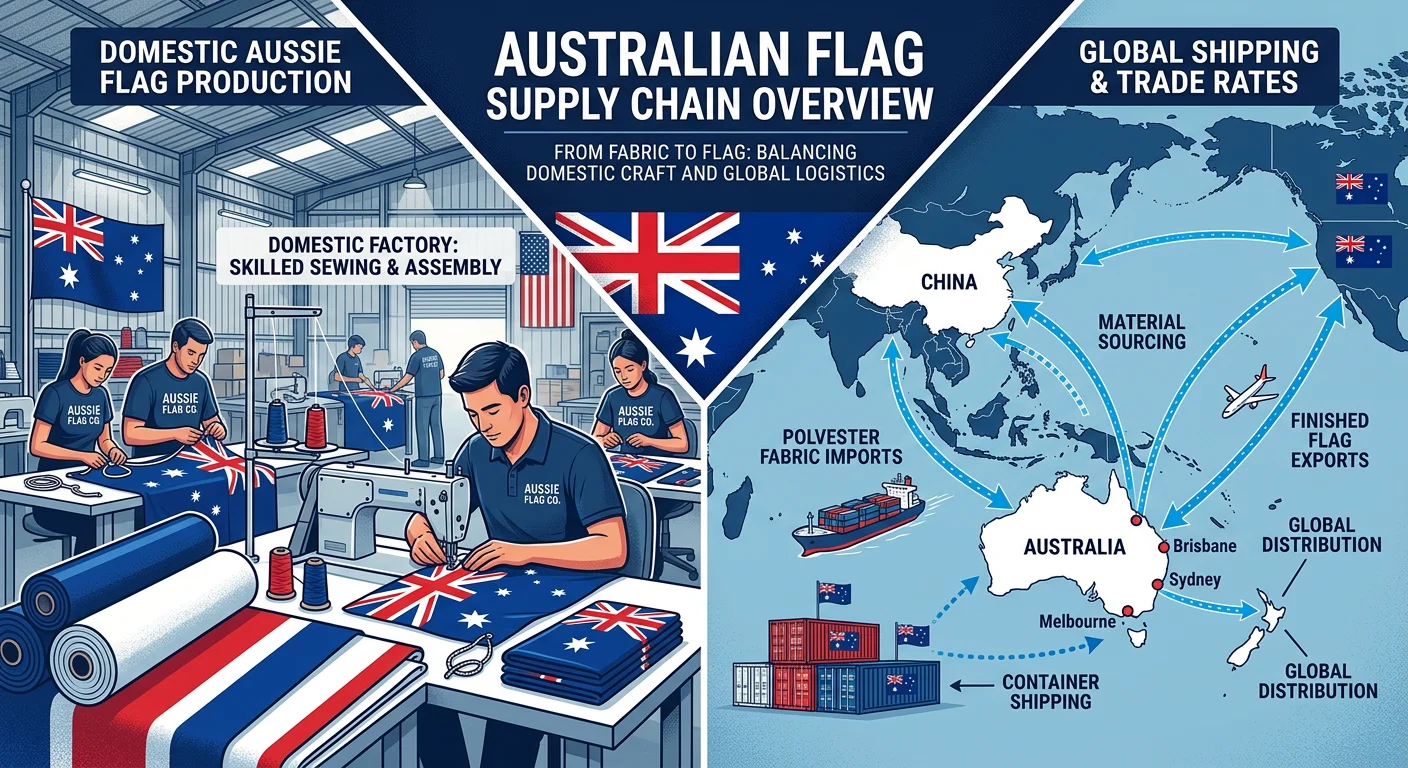
Australia's domestic flag manufacturing industry is smaller than most people expect. What it lacks in scale, it makes up for in craft, history, and specialisation.
A handful of Australian-owned flag manufacturers produce flags here at home. Each has a distinct location, production capability, and niche. Here's who they are, where they operate, and what sets them apart.
The Key Players, State by State
Victoria is home to two significant manufacturers:
Evan Evans (Melbourne) — Founded in 1877, Evan Evans holds a strong claim as the most significant flag maker in Australian history. The company co-designed the Australian flag in 1901. Today, it calls itself "Australia's No. 1 flag manufacturer." Production includes large-format digital printing — they rank among the world's largest digital fabric printers. They were also the first Australian manufacturer to invest in superior flag and digital printing equipment. Recent work includes Collingwood Football Club race banners on a 3-day turnaround , plus installations for the Rising Festival 2025.
Flagworld Pty Ltd / Carroll & Richardson-Flagworld (Mulgrave, Victoria) — Flagworld holds one key distinction: it is the exclusive licensed manufacturer of the Australian Aboriginal Flag on flags, pennants, banners, and buntings. The Commonwealth owns the copyright to the Aboriginal Flag. This licensing arrangement makes Flagworld the sole source authorised by law for reproductions in these formats.
Queensland has its own specialist:
Australian Flag Makers (Geebung, Brisbane) — This Australian-owned and operated business reports around $12 million in revenue . It handles everything from small custom runs to large bulk orders. There are no stated minimum quantity restrictions.
ACT / National Coverage:
Australian Flag Company (Canberra) — This is the most full-service operation on the list. Flags are hand-sewn with reinforced corners, double stitching, and white jet cloth headings. These construction details matter for flags flying outdoors in Australian weather year-round. The product range covers 75+ countries , state flags, desk flags, banners, poles, accessories, and national souvenirs. They run an on-site Australian factory and serve clients across Melbourne and the rest of the country.
Capability Comparison at a Glance
| Manufacturer | Location | Hand-Sewn | Digital Print | Custom Orders | Rental Services |
|---|---|---|---|---|---|
| Evan Evans | Melbourne, VIC | — | ✓ | ✓ | ✓ (poles) |
| Australian Flag Company | Canberra, ACT | ✓ | ✓ | ✓ | ✓ (poles) |
| Australian Flag Makers | Geebung, QLD | — | ✓ | ✓ | — |
| Flagworld | Mulgrave, VIC | — | — | ✓ (licensed) | — |
What "Australian-Made" Means Here
Buying from a domestic Australian flag manufacturer gives you tighter quality control and faster turnaround on custom work. You can also verify that construction meets official Australian flag specifications . For government procurement, schools, or organisations with compliance requirements, that verification matters more than price per unit.
You're also working with people who know Australian weather conditions firsthand. They understand flag etiquette and the real difference between a flag built for indoor ceremonial use and one built to survive a coastal Australian wind.
The domestic industry is real. It's just not large. For high-volume or budget-sensitive orders, it rarely beats offshore pricing. That's the honest trade-off every buyer should weigh before deciding.
Key Production States: Queensland, Victoria, and South Australia
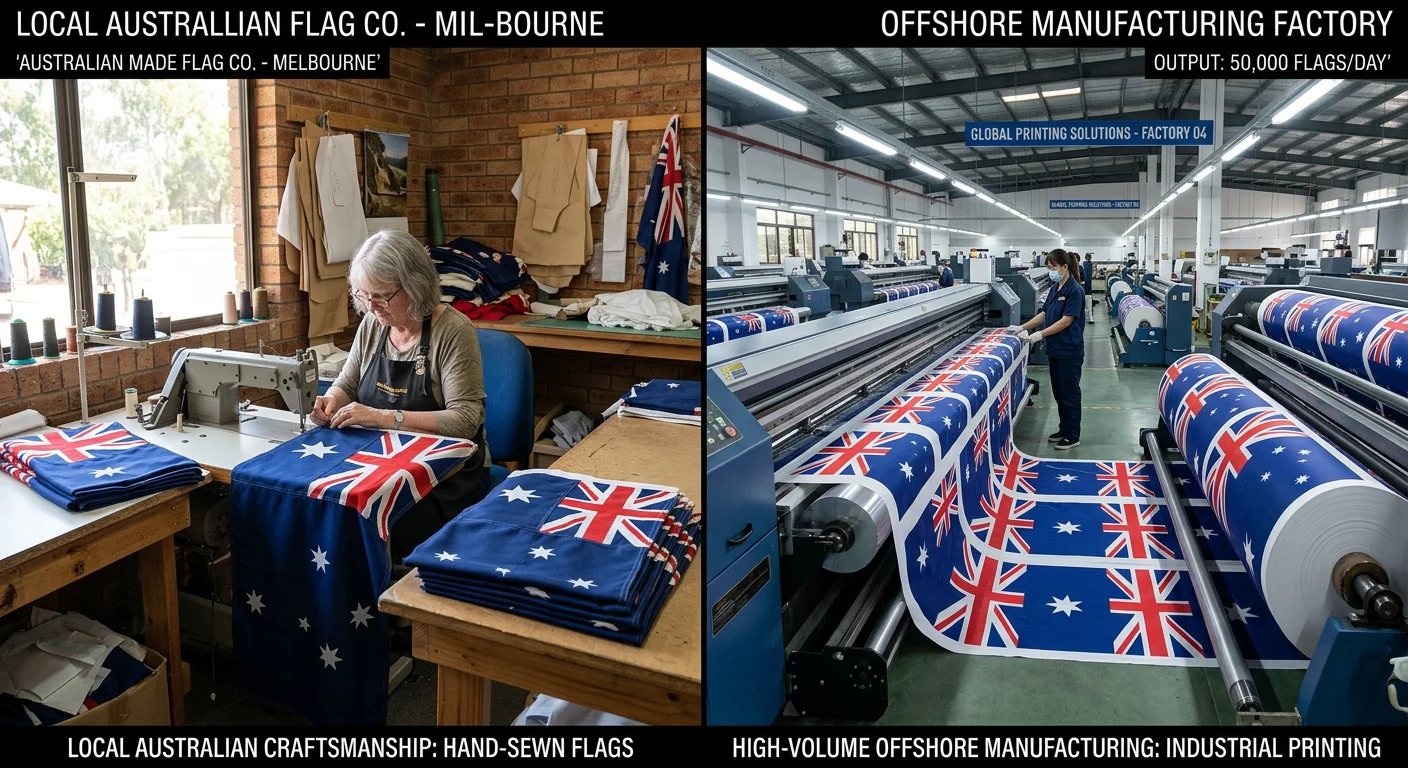
Three states drive Australia's domestic flag manufacturing industry. They don't contribute equally — but together, they produce the bulk of flags made on home soil.
Queensland outperforms what you'd expect from a state not known for precision manufacturing. Australian Flag Makers runs its operation out of Geebung, a northern suburb of Brisbane. It's a 100% Australian-owned business bringing in around $12 million in annual revenue. The revenue figure is impressive, but the real standout is operational flexibility. There's no minimum order requirement. That means they handle everything — a single school ordering ten flags, or a corporate buyer placing an order for thousands. That kind of range is rare in specialist manufacturing.
Victoria holds the deepest history in the industry. Evan Evans has been making flags in Melbourne since 1877 — before the Australian flag even existed. The company helped co-design the flag in 1901. That history isn't just symbolic. Today, Evan Evans runs some of the world's largest-format digital fabric printing equipment. They deliver fast turnarounds on complex, large-scale jobs. Also in Victoria — in Mulgrave — Flagworld operates as the one national flag manufacturer with legal authorisation to produce the Australian Aboriginal Flag on flags, pennants, and banners. The Commonwealth owns that copyright. Flagworld holds the licence. No other supplier can touch it.
South Australia doesn't anchor a major flag manufacturer the way Queensland and Victoria do. Its role sits at the distribution and retail end of the chain — supplying state government procurement, schools, and ceremonial buyers across a large geographic region.
Why Geography Still Matters for Buyers
State location does more than affect logistics costs. It shapes lead times, after-sales support, and — for organisations with Australian flag quality standards requirements — your ability to visit and check production in person. A Queensland buyer working with Australian Flag Makers gets a level of direct access that offshore flag manufacturing can't match. That local proximity carries real weight for custom Australian flag printing service orders. Revisions, colour matching, and tight event deadlines leave no room for error — and being close to your manufacturer makes all the difference.
Domestic production isn't always the cheapest option. But for buyers where accountability matters, knowing which state made your flag is the first step toward a smarter purchase.
Australian Flag Materials and Manufacturing Methods Explained
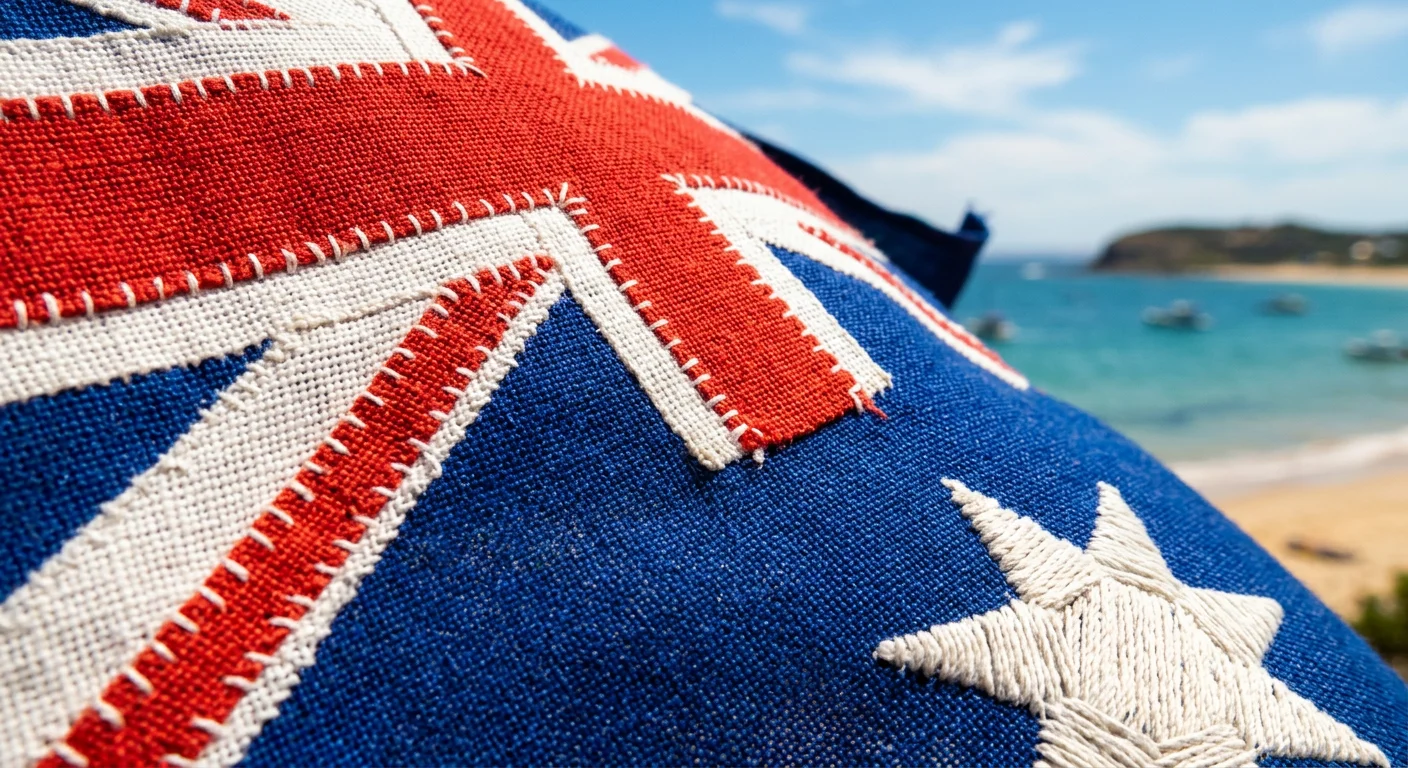
The fabric a flag is made from isn't a minor detail. It decides how long the flag lasts, how it moves in the wind, and whether it holds its colour after a year of coastal sun. If you're making decisions about Australian flag material fabric , knowing your options is where smart purchasing starts.
The Main Fabric Options and What Each One Does
Woven polyester is the workhorse of the industry. The heavy-duty version weighs 350g/m² — dense enough to handle rough outdoor conditions without fraying or fading. It resists wear over months of continuous use. Standard sizing follows the official Australian flag specifications : 1800x900mm, based on the 1:2 hoist-to-fly ratio. You need a polyester Australian flag for flagpole use over months or years? This is your baseline.
Knitted polyester runs a step lighter. It shares the same standard dimensions but comes finished with a header and loops for flagpole rope, plus nylon sister clips. The build suits high-wind environments. A stiffer fabric would put stress on the mounting points — this one doesn't.
Then there's SolarMax nylon — 100% 200-denier fabric, treated against UV and chemical exposure the same way parachute cloth is. It flies in light breezes where heavier fabrics just hang. It dries fast. It also outlasts standard nylon on UV resistance by a clear margin. Pricing reflects the quality: SolarMax flags run from $29.70 to $189.70 depending on size. For long-term outdoor display, the cost-per-day breakdown tends to favour this fabric over cheaper alternatives.
How Flags Are Built
Dye-sublimation printing — also called direct dye printing — is the main method for producing accurate, vibrant colour across nylon fabric. It's how manufacturers hit the precise Australian flag colour standards : Pantone 280 C blue, 185 C red, and clean white.
Construction quality separates a flag that lasts from one that doesn't. High-spec flags use four rows of lock stitching with back-stitch reinforcements, two rows on top and bottom hems, brass grommets, and canvas or rope-threaded headings. These aren't decorative choices. Reinforced corners and double stitching add real life to a flag under continuous outdoor stress. Skimping on any of these points shows up within the first season.
What the Flags Act Requires
Any flag claiming to represent Australia must meet the Flags Act 1953 . The specifications are clear and fixed:
Official Flags Act 1953 Specifications
- Proportion: 1:2 ratio (hoist to fly)
- Union Jack: positioned in the upper canton, adjacent to the staff
- Commonwealth Star: seven points, outer diameter equal to 3/20 of the flag's width, placed in the centre of the lower quarter pointing toward St George's Cross
- Southern Cross: five white stars across the fly half, with four stars at 1/14 of flag width and the smallest Epsilon star at 1/24
- Colour values: Blue (#001B69), Red (#E50027), White (#FFFFFF) in RGB; CMYK equivalents specified for print production
For bulk Australian flags ordered for government use, schools, or formal events, meeting these specs isn't optional — it's the requirement. A supplier who can't point to these standards is one worth questioning before you place an order.
How to Buy Australian Flags in Bulk: Wholesale and Custom Options
Bulk flag buying covers a wide spectrum. A school might order 20 flags for Australia Day. A council might place a 500-unit government procurement. The channel you pick and the supplier you trust should match your volume, timeline, and compliance needs.
Wholesale Channels: Three Paths, Three Trade-offs
Direct Chinese Australian national flag manufacturers (suppliers like FlagFactoryChina or PeaKeen) are built for volume. Expect a 100-piece minimum on custom orders, a 30% deposit upfront, and the 70% balance due before shipment. Production runs 11–15 days. Shipping adds another 3–30 days depending on method. For tight deadlines, expedited freight is available — at a premium. The trade-off is worth it. Competitive unit pricing at scale is something domestic suppliers can't match.
Australian-based flag suppliers like Flagworld offer bulk pricing with no rigid MOQ for standard stock items. That makes them a practical fit for schools, clubs, councils, and event organisers. "Proudly Australian Made" carries real meaning here — faster local delivery, direct accountability, and a production team that already knows the official Australian flag specifications inside and out.
Global platforms like Alibaba work best for high-volume, price-sensitive buyers who know what they want and have done their research. Quality varies. Vetting matters.
Custom Orders: What the Process Looks Like
For custom Australian flag printing service orders, the workflow is clear and predictable once you know the steps:
1
Submit Your Design
Vector format (AI/PDF/CDR preferred), using Pantone colour references
2
Sample Review & Approval
The supplier produces a sample — review and approve it before mass production starts
3
30% Deposit
Pay a 30% deposit to confirm the run
4
Production (11-15 Days)
Production completes in 11-15 days
5
Balance Payment
Pay the remaining 70% balance before shipment
6
Shipping & Tracking
Flags ship via DHL, FedEx, UPS, or TNT — with full tracking
Standard packaging includes free OPP bags. Velvet or leather presentation packaging carries an extra fee.
Pricing Benchmarks to Know
$53
Single Flag
$102
Two-Pack Bulk
100+
Volume Discount
A single high-grade outdoor polyester Australian flag retails around $53 (marked down from $67). A two-pack bulk option runs around $102 , down from $141. For larger volumes, go direct to the manufacturer for a quote. Unit cost drops at scale — cross the 100-piece threshold and the difference becomes clear.
How to Choose the Right Supplier
If you're comparing manufacturers globally, our guide on custom flag manufacturers in China vs Vietnam vs India can help. Before you commit, ask three things: Can they provide a pre-production sample? Do they offer quality remakes for factory faults? Can you verify production via video or on-site inspection for large runs? Solid suppliers — domestic or offshore — say yes to all three, no hesitation.
Made in Australia vs. Imported Flags: Quality and Compliance Comparison
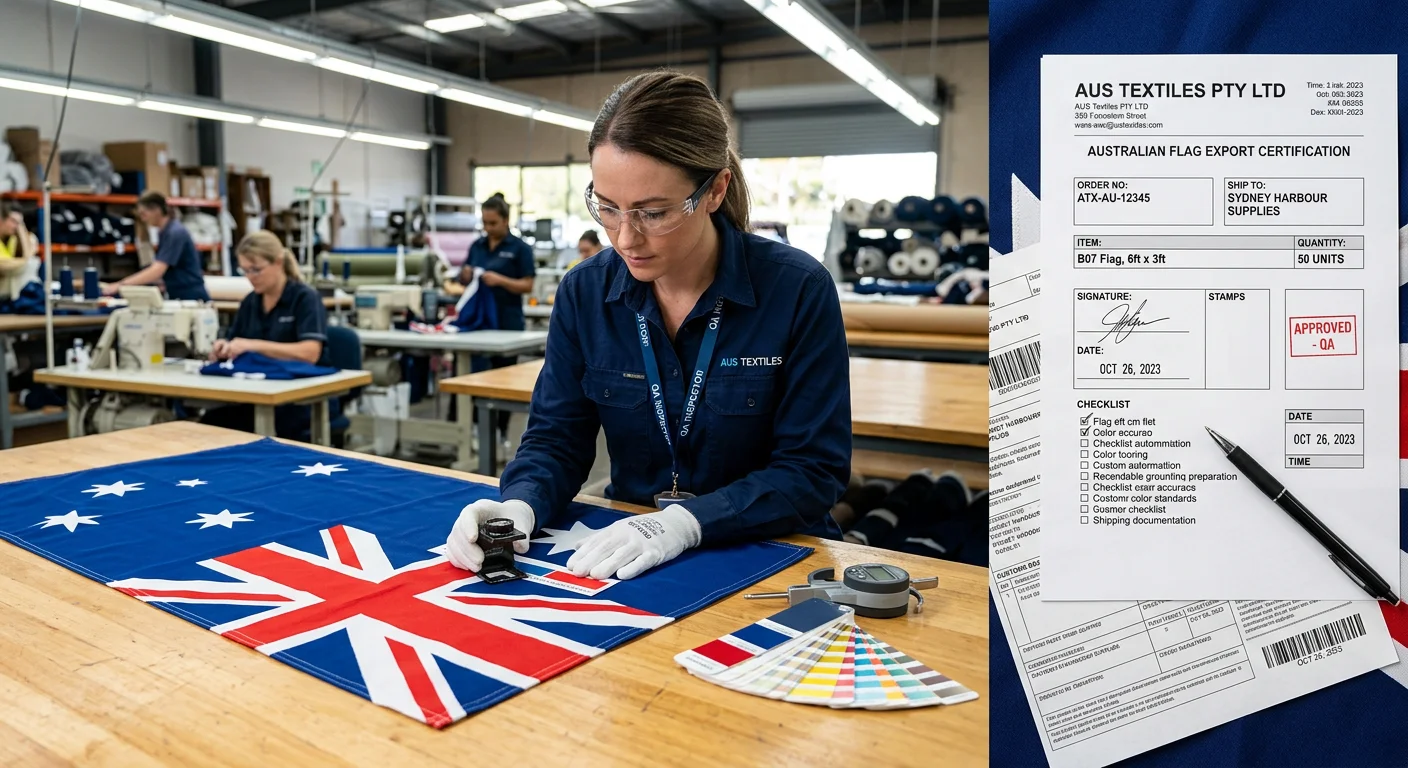
The difference between an Australian-made flag and an imported one goes beyond national pride. It comes down to paperwork, precision, and accountability.
Compliance: The Import Approval Hurdle Most Buyers Miss
Importing flags that carry the Australian National Flag design is not a simple process. You can't just place an order and wait for delivery. Australian Border Force requires pre-approval from the Department of the Prime Minister and Cabinet (PM&C) before clearing the goods. That approval needs a full goods description, quantities, importer details, and a colour image of the design. No separate ABF permit is needed once PM&C signs off — but skip that first step and your shipment won't move.
Flags made in Australia bypass this process. There's no PM&C design approval needed for locally produced flags. That's a real time advantage. Councils, event teams, and procurement officers working to tight deadlines will feel that difference in admin lead time.
State and territory flags follow a similar path. Import approval comes from the relevant Department of Premier and Cabinet or Chief Minister's Department. Same principle, different authority.
Colour Accuracy: A Disagreement Written Into the Industry
You'd expect official colour standards to be clear and consistent. They're not — and that gap matters for anyone sourcing flags against a compliance brief.
Traditional Australian flag manufacturers work to PMS 281 for the dark blue and PMS 185 or 032 for the red. These values align with WA State Flags legislation and reflect how the local industry has operated for decades. The Commonwealth once specified PMS 280 for blue, but manufacturers treated it as an error and kept producing to PMS 281. That spec was left behind without fanfare.
Imported flags don't always match these standards. Colour accuracy is critical for government procurement, ceremonial display, and broadcast-facing use. In those cases, check the Pantone values against the domestic standard before committing to a supplier.
Construction: Where Australian-Made Shows Its Edge
Australian manufacturers sew flags using the straight line method for star appliqué. This technique keeps the Commonwealth Star and the Southern Cross geometrically precise. Government and military orders carry correct seven-point stars, with outer diameter specs aligned to the 1954 Flags Act amendment.
Domestic production goes through quality inspection before anything ships. Stitching, alignment, and colour matching are all checked. That's not a marketing claim — it's a process with real accountability behind it.
Usage Rules That Apply to Both
It doesn't matter if your flag was made in Melbourne or sourced overseas. The same usage rules apply to both.
Here's what's required:
Mandatory Flag Usage Rules
- Reproduce the flag completely and accurately
- No defacing or overprinting
- All symbolic elements — the Union Jack, the Commonwealth Star, the Southern Cross — must stay clearly identifiable
- Dignified use is a requirement, not optional
Flags that fall short of these standards face rejection under the Trade Marks Act s39 . PM&C approval doesn't give a supplier a free pass. Approval on paper doesn't protect anyone who ships a product that doesn't match what was approved.
The Honest Trade-Off
Australian-Made Advantages
- Tighter colour control
- Verified construction quality
- No import approval friction
Imported Flag Advantages
- Competitive pricing at volume
- Reliable production timelines
- Wider supplier network
Australian-made flags offer a clear compliance and quality edge — tighter colour control, verified construction, and no import approval friction. Imported flags, especially from established Chinese national flag manufacturers, offer competitive pricing at volume and reliable production timelines.
For buyers where official Australian flag specifications and regulatory compliance are non-negotiable, local production cuts out the risk that offshore sourcing brings in. For high-volume orders where cost-per-unit is the main driver and quality gets verified through pre-production samples, the import route can work. Just make sure the PM&C approval process is built into your timeline from the start.
Frequently Asked Questions About Australian Flag Manufacturing
Buyers ask the same questions over and over — and they deserve straight answers, not marketing copy. Here are the ones that come up most.
Are most Australian flags made in China?
Many are. But the domestic industry is pushing back hard. An Australian Industry Group survey of 225 industry leaders found that 19% of Australian manufacturers plan to bring production in-house by 2026 — up from just 6% the year before. That's a big jump. Supply chain uncertainty is driving that shift. Confidence in offshore sourcing has dropped, with a net balance reading of -62 among manufacturers surveyed. That number is telling. The appetite for local control is growing fast.
19%
Reshoring Plans
-62
Offshore Confidence
225
Leaders Surveyed
What fabric is used for official Australian flags?
Three main options exist:
Woven Polyester
350g/m² — built for heavy outdoor use
Knitted Polyester
The go-to for high-wind environments
SolarMax Nylon
Best for premium, long-term display
Each serves a different purpose. Pick based on where the flag flies and how long it needs to last. For a deeper comparison, see our guide on best outdoor flag materials. Price per unit is the wrong starting point.
Where can I buy bulk Australian flags?
Three sourcing paths are available:
Domestic Manufacturers
Local lead times, higher compliance certainty
Direct Chinese Suppliers
Lower unit cost, longer shipping windows
Global Platforms (Alibaba)
Wide choice, variable quality control
Each path carries a different minimum order, lead time, and compliance profile. One thing worth flagging: Australian manufacturers report workforce shortages of 44–54% across skill levels right now. Large Australian flag custom runs can take longer than expected. Build that buffer into your timeline before confirming a deadline.
Do Australian flags sold locally meet official standards?
No — not by default. Standards compliance comes down to the supplier, not where they're based. Before ordering, ask for Pantone colour references and full construction specs. This matters most for government, school, or ceremonial use. Don't assume local sourcing means standards-compliant.
Is Australian-made more expensive?
Yes — and the gap is getting wider. Input costs rose at their fastest pace in ten months as of February 2026 (PMI 51.5). Selling prices hit their highest point since September 2025. So the cost difference is real and growing. On the other side, 40% of Australian flag manufacturers are investing in new technology in 2026. That should bring efficiency gains over time. For now, the price premium is real. Whether it's worth paying depends on what the flag is actually for — a one-day event is a different calculation than a permanent government display.
Can I get a custom Australian flag printed to spec?
Yes. Most reputable suppliers — domestic and offshore — offer custom Australian flag printing services . You get pre-production samples, Pantone colour matching, and vector file submissions as standard. For the Australian National Flag design, one extra step applies: imported custom flags need PM&C approval before clearing Australian Border Force. That approval takes time. Factor it in before locking down your deadline.
Conclusion
The Australian flag is more than stars and crosses on fabric. It's about knowing where quality comes from — and making choices you can stand behind.
Here's what we know: most Australian flags are made overseas using high-grade polyester. Local craftsmanship has its place, but so do cost-effective bulk imports. Either way, the right Australian flag supplier makes all the difference .
A few things always hold true:
Key Takeaways
- Official specifications matter
- Material integrity matters
- For government bodies, schools, or event organizers, compliance isn't optional — it's the baseline
So stop guessing. Start sourcing with confidence.
Need custom flag printing that meets Australian flag quality standards? RunCustomFlag.com handles everything — from a single ceremony flag to a full bulk corporate order. You get precision, professionalism, and a process built around your needs.
A flag worth flying deserves a manufacturer worth trusting.