Three vertical stripes of blue, yellow, and red — simple, bold, and familiar in a way that hides its depth. Behind that clean tricolor sits more than two centuries of revolution, resilience, and national identity built through blood and protest.When museums or cultural institutions reconstruct historical exhibits about Eastern European revolutions, they often commission replicas from a custom Romania flag manufacturer for historical displays to accurately reproduce the tricolour that first appeared during the 1848 uprisings.
The Romania flag carries stories most people never hear. In 1848, revolutionaries stitched together a banner for a nation still fighting to exist. Decades later, an angry crowd tore a dictator's emblem from the flag's center with their bare hands. In one historic moment, that hole became both a wound and a declaration.
Tracing the roots of the blue, yellow, and red flag meaning ? Or trying to understand what separates Romania's symbol from its near-identical neighbor Chad? Either way, what follows is the full picture — color by color, decade by decade.
What Does the Romanian Flag Look Like? (Colors, Design & Official Specs)
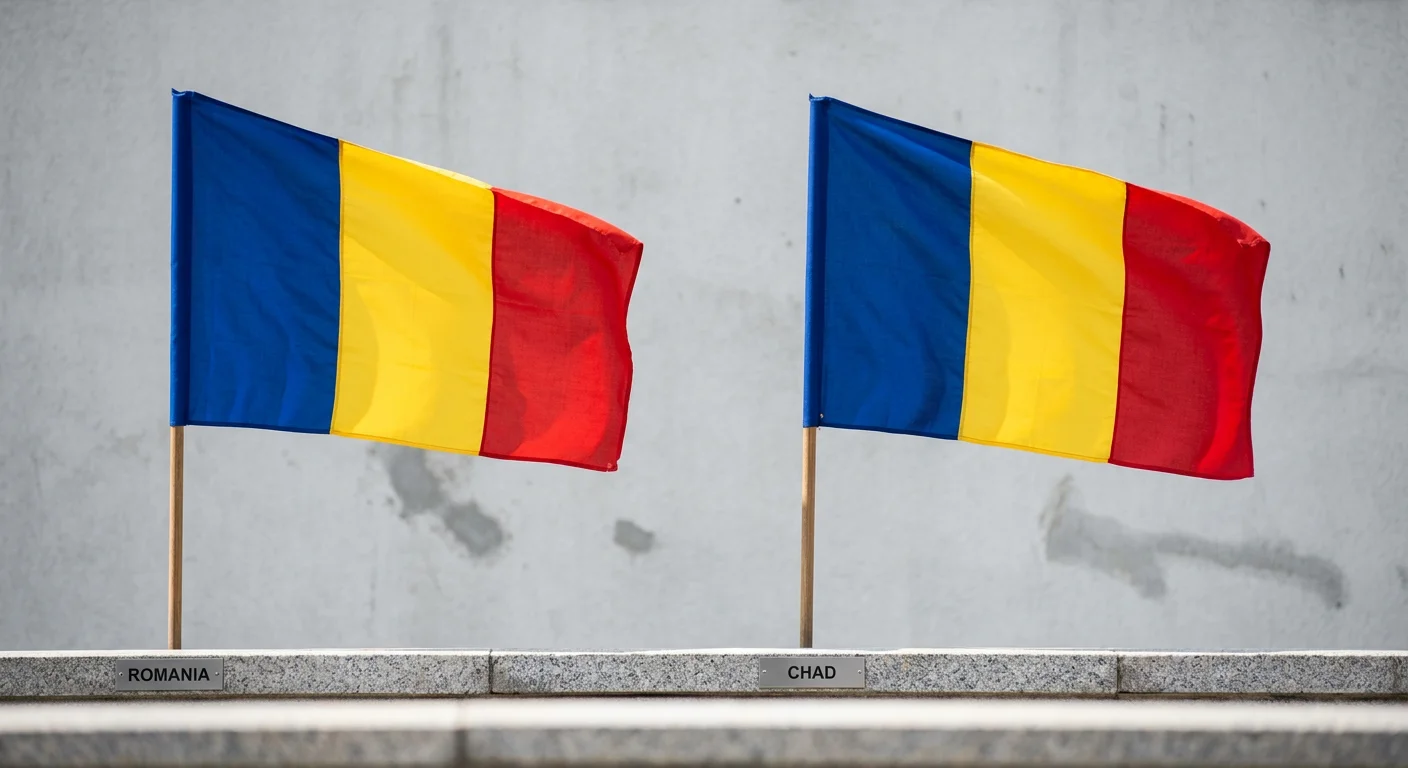
The answer is simple: three equal vertical bands — blue at the hoist, yellow in the middle, red on the fly. No ornament. No emblem. No decoration of any kind on the civilian version.
That plain design is a deliberate choice.
The official proportions are set by law. Romania's Constitution and Law 75/1994 — in force since 1995 — define the flag's exact measurements. The ratio is 2:3 . For every two units of height, the flag runs three units wide. Each band takes up one-third of the total length. Nothing is open to interpretation or artistic license.
The colors have names, not just descriptions:
Blue
Cobalt · Flagpole Side
Yellow
Chrome · Center
Red
Vermilion · Outer Edge
A 2023 update took this further. It locked in exact shade specs for both print and digital use. That level of detail shows how much Romania values its national symbols.
One key detail to know: the stripes run vertically , not horizontally. The everyday civil flag also carries no coat of arms at all. The military version is different. It bears the national emblem centered on the yellow band — 29 × 21.5 cm in size, placed 18 cm above the base.
Geometry as identity. Specification as declaration.
What Do the Colors of the Romania Flag Mean? (Blue, Yellow & Red Symbolism)
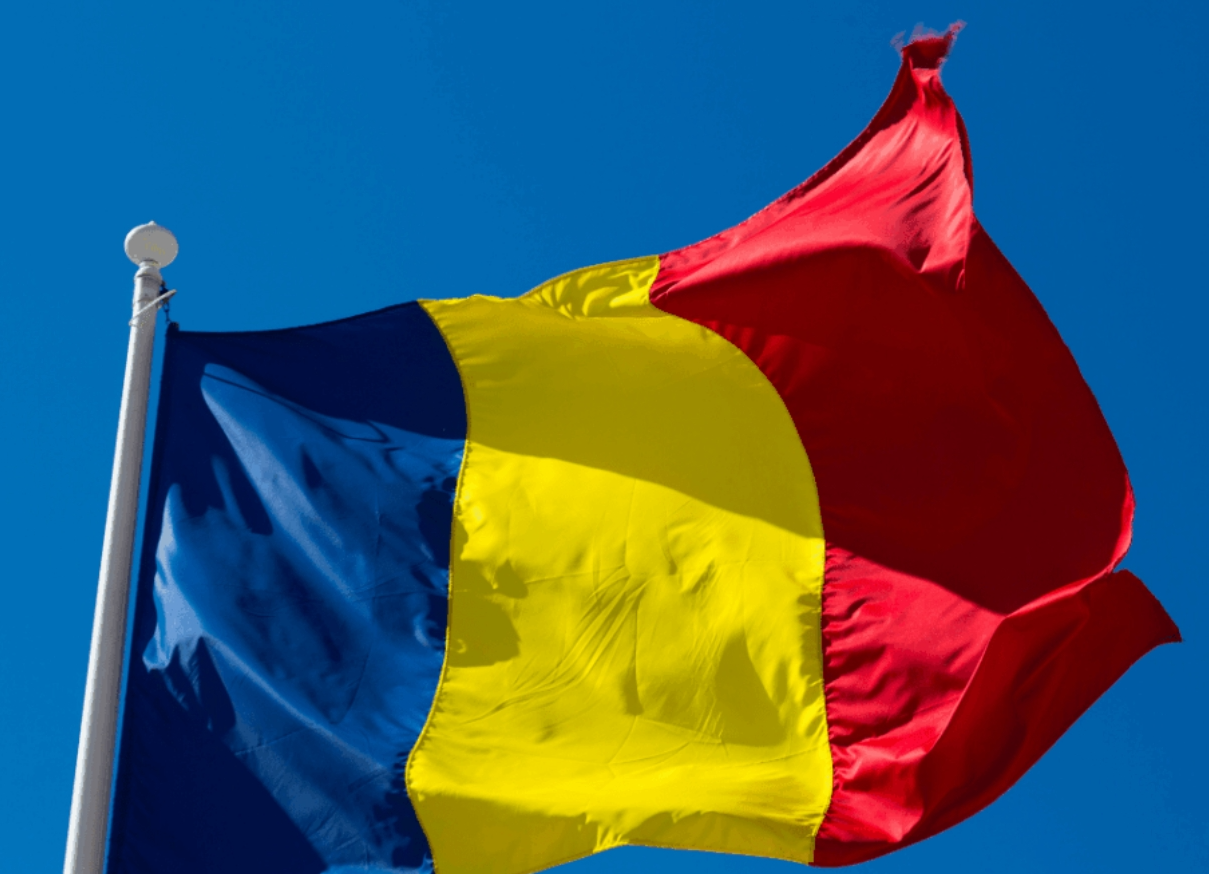
Each stripe on the Romanian flag earned its place. Not through a committee vote or royal decree. Through revolution — through people who decided certain words were worth dying for, and then picked a color to carry each one.
The three colors trace back to a motto that Romanian revolutionaries raised in 1848: Liberty. Justice. Brotherhood. One word per stripe. Left to right across the cloth.
Blue — The Color of Liberty
Blue sits at the hoist side, closest to the pole. Its roots go back to the old principality of Moldavia, where blue appeared on banners and military uniforms long before any unified Romanian state existed.
What it carries: freedom, aspiration, peace. Sky-colored for a reason. The people who stitched it there were looking upward — toward independence they didn't yet have.
Yellow — The Color of Justice
The center stripe is the brightest. That's no accident. Yellow draws on Wallachia's heraldic tradition — the golden fields, the fertile plains, the grain that fed generations. It speaks of the land itself.
What it carries: justice, national wealth, agricultural abundance. A country declaring, through its own flag, that its soil matters. That prosperity is a form of dignity.
Red — The Color of Brotherhood
Red lands on the outer edge, furthest from the pole. In 1848, red meant fraternity — the bond between people choosing the same cause and accepting the same risk.
What it carries: courage, sacrifice, the blood of those who came before. This is not decorative red. It is memorial red.
Three Colors, One Declaration
The three stripes together stand for something bigger than each color alone. They represent the union of Romania's historical provinces — Moldavia, Wallachia, and Transylvania — joined under one national identity after the Great Union of 1918 .
One thing worth knowing: the Romanian Constitution and Law 75/1994 never put these symbolic meanings into legal text. The meaning lives in history, not legislation. It lives in the revolutionary speeches, the protest banners, and the shared memory of a people who had to fight for their own name.
That gap in official definition fits, in its own way. Some things carry more weight because no law had to spell them out.
The Historical Origins of the Romanian Tricolor (Medieval Roots to 1848 Revolution)
Long before anyone voted on it, the colors existed.
Blue, yellow, and red showed up on royal grants, military shields, and battle banners in the late 16th century. Michael the Brave — warrior-prince, unifier, icon — carried a yellow-white damask flag with a black eagle, a green juniper branch, and a cross. His campaigns across Wallachia, Moldavia, and Transylvania planted seeds that took three centuries to grow into something real.
The three medieval principalities each had their own heraldic identity:
Three territories. Three color sets. All quietly echoing each other.
The First Tricolor: 1821
The decisive moment came not from a royal court — it came from a rebellion.
In 1821 , Tudor Vladimirescu led an uprising in Wallachia. He raised what historians now call the first Romanian tricolor — blue, yellow, red. The flag carried the Holy Trinity, Saints George and Tiron, and a Wallachian eagle. Its tassels ran in three colors. Stitched across the cloth were two words that outlasted the man who carried it: "Dreptate și Frăție" — Justice and Brotherhood.
By 1834 , Wallachia had its first documented tricolor. Domnitor Alexandru II Ghica approved it. Sultan Mahmud II also ratified it as a naval and military standard — a notable recognition from an outside power.
1848: Revolution Sets the Final Form
1848 changed everything fast.
On June 26, Romania's revolutionary government adopted vertical blue-yellow-red stripes through Decree Nr. 252. The design drew clear influence from the French tricolor. That year, the spirit of Paris spread across all of Europe.
Protests at Focșani and Râmnicu Sărat turned the flag into a symbol of unity. People carried it across principality borders at the same time. In Sibiu, Transylvanian Romanians adopted their own version with the motto "VIRTUTEA ROMANĂ REÎNVIATĂ" — Roman Virtue Reborn.
The revolution was crushed. The tricolor was banned . But banning a flag does not erase what it means. The colors lived on — underground, in memory, in the anger of the next generation. They waited for the moment someone needed to name what they were fighting for.
How the Romania Flag Evolved Through Key Historical Milestones (1859–Present)
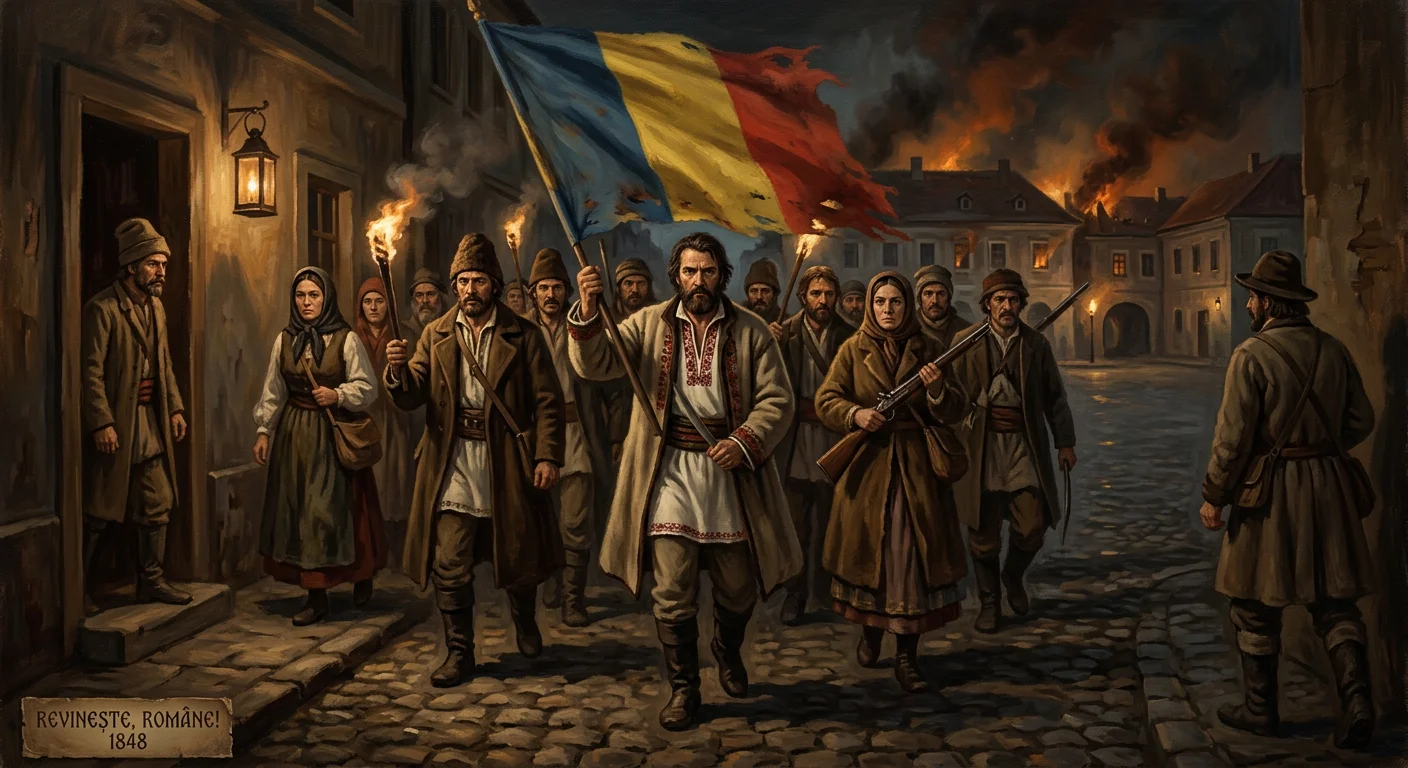
Four decades of revolution, protest, and competing principalities pushed things to a turning point. In 1859, Wallachia and Moldavia merged under a single ruler — Alexandru Ioan Cuza. The new United Principalities needed a flag to match.
What they chose was not quite what we recognize today.
1859–1866: The Horizontal Years
The first national flag of unified Romania ran its stripes horizontally — red on top, yellow through the middle, blue along the bottom. A naval ensign. A state symbol. But not yet the vertical tricolor Romania would one day claim as its own.
That tension between layouts — horizontal versus vertical — ran through the next decade. It was a quiet argument no one could quite settle.
The 1866 Constitution resolved the color question. Article 124 fixed the three shades — blue, yellow, red — into law. No more debate about which colors belonged. But the arrangement stayed open.
1867: The Vertical Form Is Locked In
On 26 March 1867 , the Assembly voted. Nicolae Golescu's proposal carried: vertical stripes, blue at the hoist, yellow at center, red on the fly . Weeks later, on 23 April, a law confirmed it as the official flag of the United Principalities.
The design had first appeared through revolutionary decree in 1848. Now it was constitutional fact.
1877–1922: Coats of Arms and Changing Crowns
Independence brought new additions. Romania declared independence in 1877 . The coat of arms on the state flag changed to reflect the new political reality. By 1882 , military flags moved to a standard square format — 156 cm per side — with tricolored ribbon, tasseled trim, and Hohenzollern arms framed in gold.
The emblem shifted again in 1897 , then once more in 1922 . Each change tracked the kingdom's growing ambitions after the Great Union of 1918 brought Transylvania into the fold.
1947–1989: The Emblem No One Asked For
Communism arrived and placed its mark on the yellow band. A central state emblem in yellow and red sat there, updated in 1948, 1952, and 1965 as the regime shaped its own iconography. The tricolor held underneath. The emblem sat on top like a claim.
Then December 1989 arrived.
Protesters tore the emblem out with their hands. By hand. The holes left behind became the image of the revolution — raw, deliberate, unmistakable. On 27 December , the National Salvation Front restored the plain vertical blue-yellow-red tricolor by law: no emblem, no addition, nothing between the cloth and what it first meant.
The flag had come full circle — stripped back to the form the revolutionaries of 1848 had first imagined.
The 1989 Revolution and the "Holed Flag": Romania's Most Powerful Flag Moment
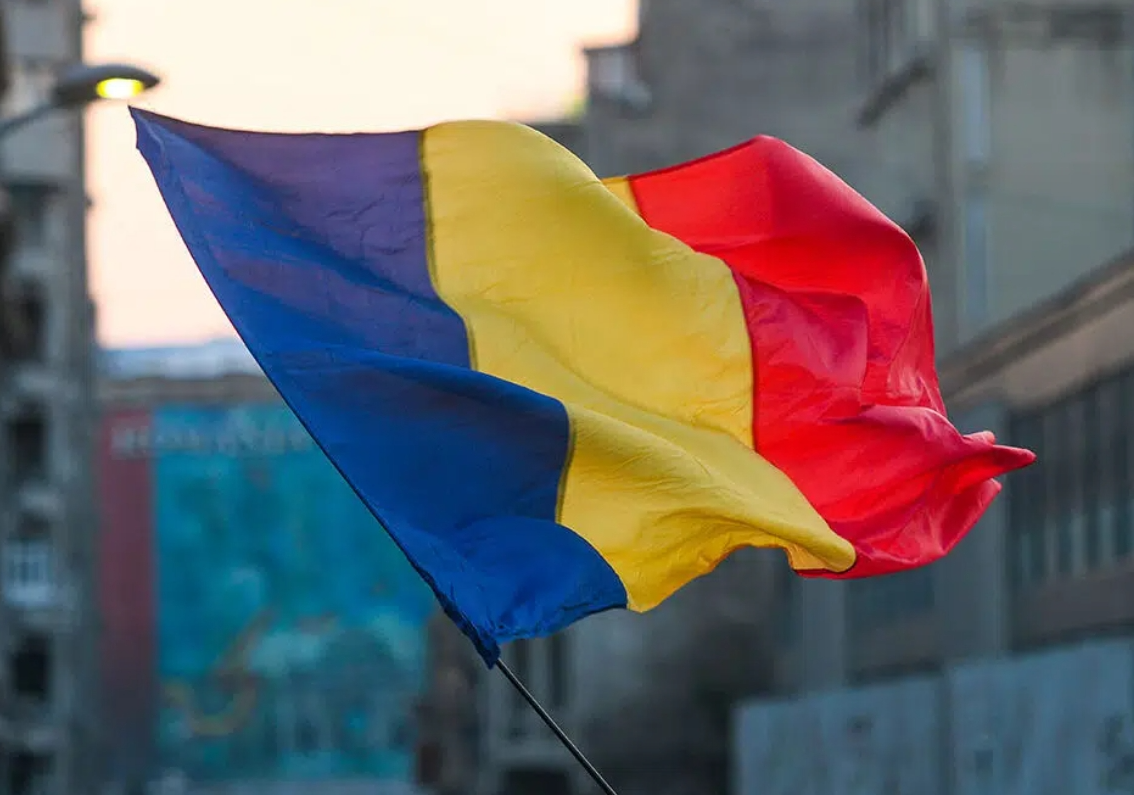
December 17, 1989. Timișoara. Someone picked up a pair of scissors.
No grand gesture. No plan. No rehearsal. Socialist Republic flags hung everywhere. The communist coat of arms was stitched into their yellow centers like a brand burned into cloth. So protesters did the one thing that made sense — they cut it out. Oval holes, for the most part. Ovals are easier than circles when your hands are shaking and the streets are screaming.
That act spread fast. No official decree could have moved quicker. Within days, holed flags showed up in Arad, Brașov, Sibiu, and Bucharest. Thousands of them. People carried them through city streets. Others hung them from windows or raised them above buildings that had flown the regime's emblem for decades.
No pre-printed plain tricolors sat waiting in storage. The revolution outpaced production entirely. People had the old flags. So they cut deliberate, rough holes through the center. No graphic designer could have come up with that.
One flag stands out. Antoniu Octavian Mureșanu pulled it from apartment stairs and carried it to Palace Square on December 21–22. That was the moment Ceaușescu's rally broke apart and turned into the protests that ended his rule. That flag now sits in the National History Museum of Romania. The hole is still there. No one mended it.
On December 22, Ceaușescu fled Bucharest by helicopter. Three days later, on Christmas morning, he faced a firing squad in Târgoviște. The holed flag had already done its job.
The image spread far beyond Romania. A boy from Bucharest — nicknamed the "Gavroche of Bucharest" — appeared wrapped in a holed flag on the cover of Paris Match . Someone brought another to a U.S. president, who thanked the givers for the "beautiful poncho." He had no idea what he held in his hands. That gap in understanding made the symbol sharper, not duller.
Historical Milestone
Decree-Law nr. 2, signed December 27, 1989, established the plain blue-yellow-red tricolor as Romania's official flag. The holed version got no formal status. Once proper flags reached production, the holed ones disappeared.
But the symbol was already set. No law creates that. It belongs to the moment that made it necessary.
Romania Flag vs. Chad Flag: Why Do They Look Almost Identical?
Two nations. One design. Zero coordination.
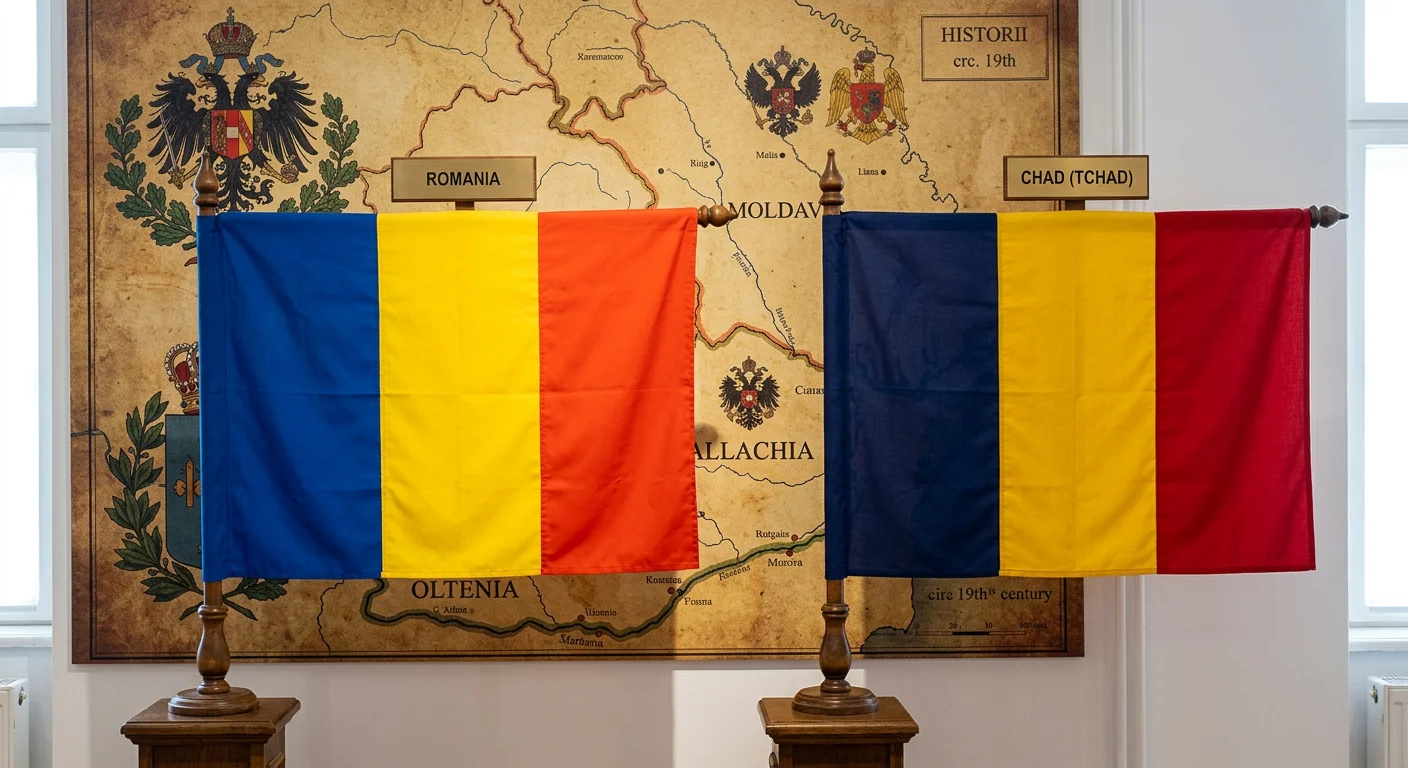
Put the Romanian and Chadian flags side by side. The problem is clear — three vertical stripes, blue at the hoist, yellow through the center, red at the fly. Both run at a 2:3 ratio. To any reasonable eye, they look identical. The confusion is fair, and neither country did it on purpose.
The short explanation: historical coincidence, separated by over a century.
Romania's tricolor was born in revolution in 1848. Chad's was drawn up in 1959 — and Chad's original proposal wasn't even blue. It was green, yellow, and red, following Pan-African convention. Green got dropped to avoid confusion with Senegal and Mali. Nobody thought to check Romania.
Romania's communist government fell in December 1989. The central emblem came off the yellow stripe. For the first time, the two flags became impossible to tell apart. Chad took the matter to the United Nations. Romania didn't concede. Both sides had a point: Romania's design predates Chad's by over a century, but Chad's flag looked distinct at the moment it was adopted.
Key Technical Difference
One technical difference does exist. Chad's blue is Pantone 281 C — darker, deeper. Romania's sits at Pantone 280 C — a lighter cobalt.
On a Romania flag factory floor under controlled lighting, you can see it. On a flagpole in wind and weather, almost nobody can.
The most reliable way to tell them apart isn't color — it's context and period . Any plain tricolor of this design photographed between 1959 and 1989 is Chad's. Romania carried an emblem during those years. Before 1959, it could be Romania's only.
The colors carry different meanings. For Romania, the three stripes represent Wallachia, Oltenia, and Moldavia — a nation built from separate principalities. For Chad, blue carries hope, yellow the desert sun, red the blood of independence. Same cloth. Two separate stories stitched into it.
Looking for authentic national flags? Whether for heritage events, sports, or cultural celebrations, explore our custom national flag collection for precise replicas built to last.
The Romania Flag as a Symbol of National Unity and Cultural Identity
"The tricolor is the flag of the Romanian nation in all lands."
— Mihail Kogălniceanu, 1867
Not this province. Not that principality. All lands. Every Romanian, wherever they stood.
That sentence carries the full weight of what the flag means. It was never just a piece of cloth assigned to a government. It was a claim. Three separate territories — Wallachia, Moldavia, and Transylvania — shared something deeper than geography. A common story. A common struggle. A name worth fighting for.
The colors carry that meaning without fanfare. Blue ties the nation to the Carpathian sky and the old principality of Moldavia. Yellow reaches back into Wallachian soil — the golden fields that fed people through centuries of occupation and hardship. Red holds the dead. Not as a metaphor. It holds the actual dead — the ones from 1821, from 1848, from 1918, from 1989.
That accumulation is the point. Each generation added its own weight to the same three stripes.
Today, Law 75/1994 sets the rules for where and how the flag appears. You'll see it at public institutions, embassies, schools, military parades, and sports events. Every December 1st, Unity Day, it rises above Bucharest, Cluj-Napoca, and Alba Iulia at once. Romanian communities abroad put it up during holidays. The connection holds, even across distance.
The flag asks the same question it always has: who are we, together? For over two centuries, the answer has been the same three colors.
Custom Romania Flags for Events, Heritage & Celebrations
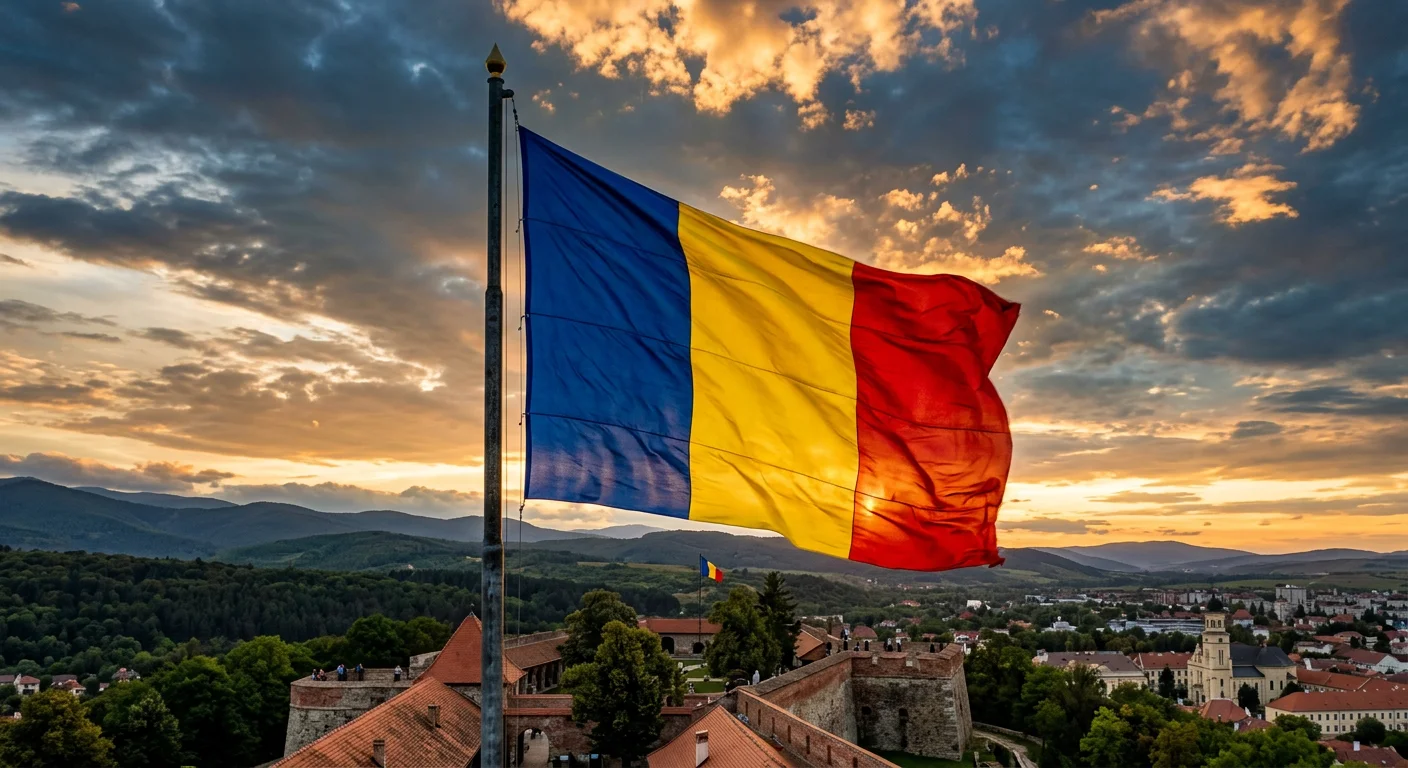
The flag earned its meaning the hard way. Yours should reflect that.
Planning a Romanian National Day gathering on December 1st ? Hosting a diaspora heritage event? Cheering at an international sports fixture? The tricolor deserves to be flown with the right proportions, right colors, and right spirit.
At runcustomflag.com , every custom Romania flag follows the legal 2:3 ratio . You get three equal vertical stripes — cobalt blue, chrome yellow, and vermilion red. Each flag uses durable polyester with proper grommet fittings. Single orders and bulk festival batches both ship within 7–10 days .
⚠ Important Regulation
Romania's 2023 flag regulations ban unauthorized inscriptions or symbols on the national flag. Violations carry fines up to 20,000 lei (~$4,600). Keep personalized elements on companion flags — not on the tricolor itself.
Honor Romania's colors at your next event — design your custom Romania flag here .
Conclusion
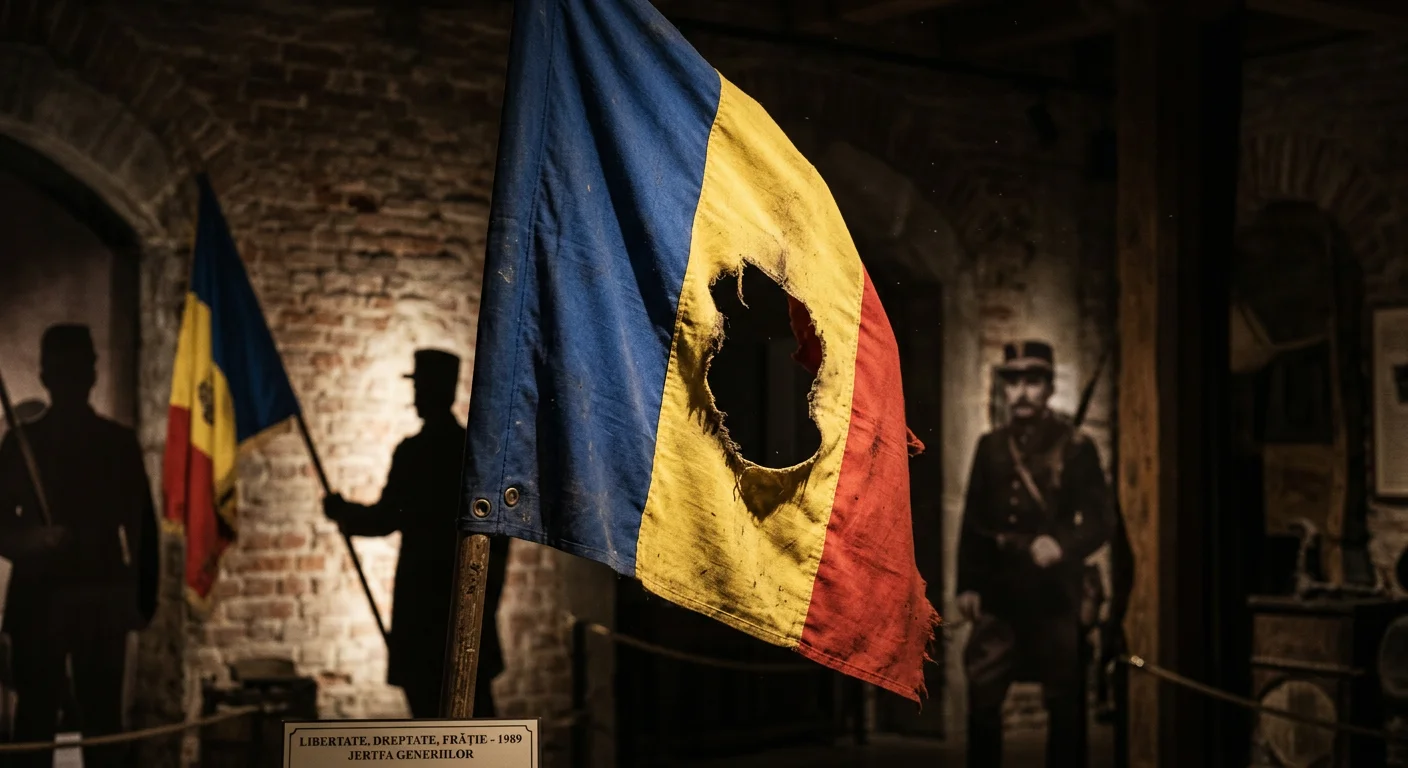
Three vertical stripes of blue, yellow, and red. Simple enough to sketch from memory. Yet each one carries centuries of revolution, sacrifice, and hard-won identity. The Romania flag isn't a piece of colored cloth — it's a living document. Every shade holds the weight of Wallachian and Moldavian heritage. Every stripe echoes the 1848 revolutionaries who stitched this tricolor flag of Romania together as an act of defiance. And that hole cut from the center in 1989? That may be the most honest moment any flag has ever had.
You came here as a student, a traveler, or someone tracing Romanian roots. Either way, you now carry the full story.
Want to honor that story in a real, physical way? RunCustomFlag.com crafts custom Romania flags built to the standard these colors deserve — precise, durable, and built to last.
Some flags are flown. This one was earned .
Video Guide
Related Posts