Europe is home to 50 sovereign nations — and every single one flies a flag with a story behind it. Some are centuries old, packed with revolutionary symbols and royal history. Others are newer than you'd think. Borders shifted. Empires fell. New nations appeared almost overnight — and their flags followed. Then there's the handful that look nearly identical, enough to make even well-traveled people stop and look twice.
Student cramming for a geography quiz? Business sourcing flags for an international event? Or maybe you've just always mixed up the Romanian and Chadian flags? This complete guide to European national flag designs clears up the confusion — country by country, color by color, story by story.
How Many Countries in Europe Have National Flags? (The Direct Answer)
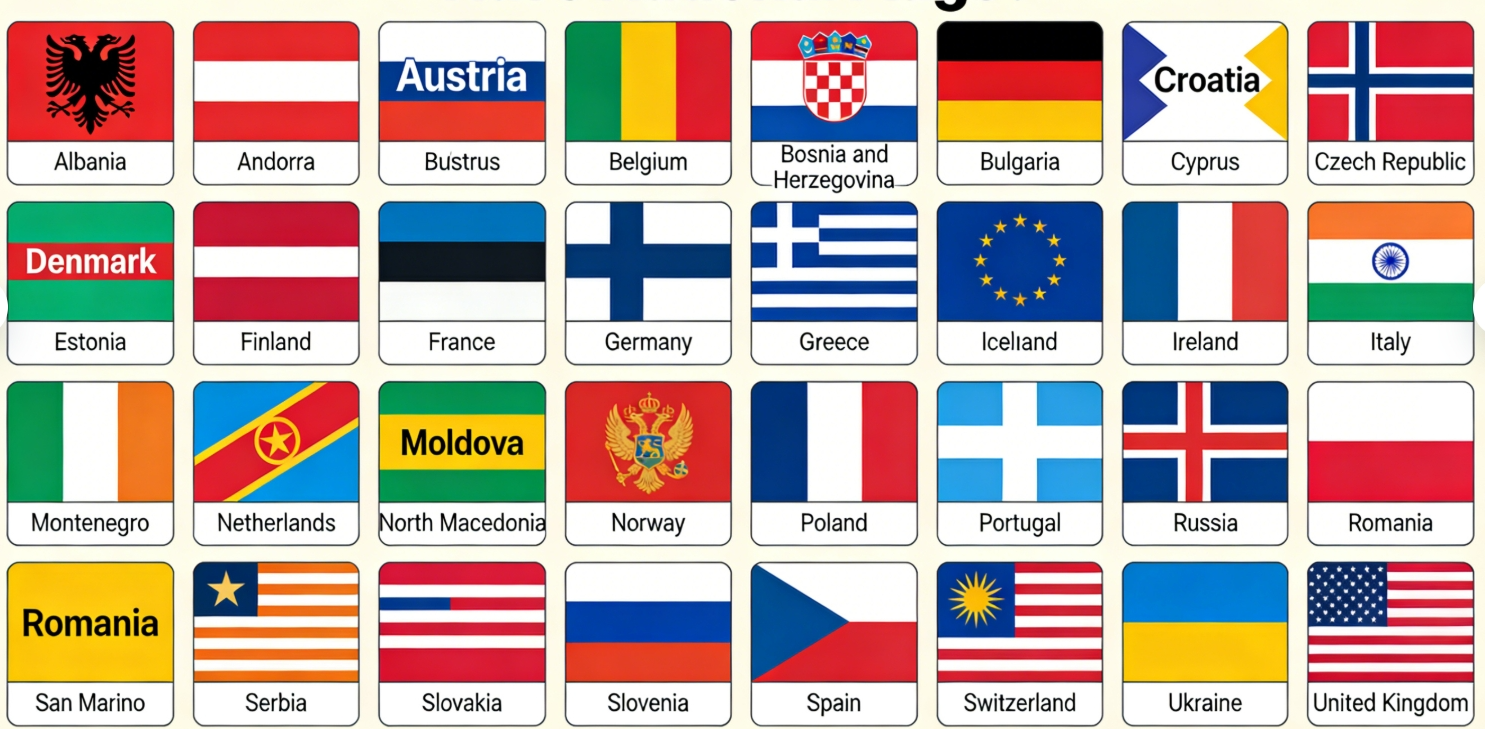
The answer is 44 sovereign states — each with an official national flag recognized under international standards. That's the clean answer. But look closer, and it gets complicated fast.
Here's why you'll see different numbers depending on where you look:
44 sovereign nations hold full UN membership or observer status — from Albania to Vatican City.
50 is the broader count — it includes microstates and territories with distinct political identities.
50+ entries appear on flag databases like Flagpedia. These databases add non-sovereign regions that carry their own flags: the Faroe Islands, Gibraltar, Åland Islands , and others.
None of these numbers are wrong. Each one answers a different question.
Every one of those flags — sovereign or not — has a design worth knowing. Most use blue, red, and white (the dominant trio across the continent). Many go with tricolor stripes. Five Nordic nations share the iconic cross pattern. A handful carry coats of arms packed with detail — the kind you need to study up close to take in.
The short version: 44 countries, 44 flags. The fuller picture: closer to 50.
Complete List of All European National Flags (All 50 Countries)
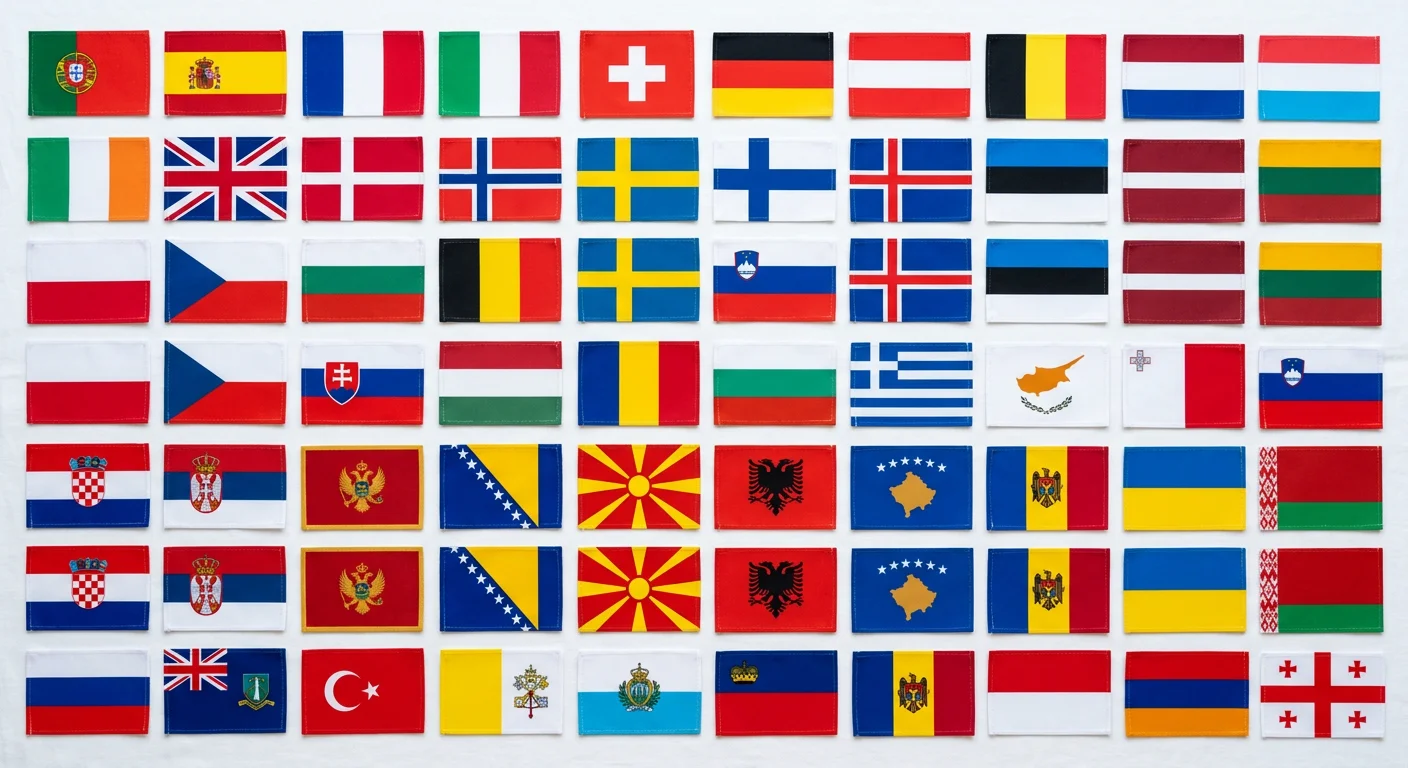
Fifty flags. Fifty stories. And a wide range of ways to arrange red, white, and blue.
This is the most complete reference list of European national flags you'll find. It's organized by region, with colors, patterns, adoption dates, and the one visual detail that makes each flag easy to spot at a glance. Studying for a quiz? Sourcing flags for an event? Settling the Romania-vs-Chad debate once and for all? This is your reference.
Western European Flags
France's 1794 vertical blue-white-red tricolor started it all. Dozens of nations borrowed that format, adapted it, and made it their own. Western Europe is where that template was born.
Country | Main Colors | Pattern | Adopted | What Makes It Distinct |
|---|---|---|---|---|
Andorra | Blue, Yellow, Red | Vertical stripes + coat of arms | 1866 | Central emblem sits between the blue-yellow-red stripes |
Austria | Red, White | Horizontal stripes | 1918 | Equal red-white-red bands — one of Europe's oldest designs |
Belgium | Black, Yellow, Red | Vertical stripes | 1831 | Vertical orientation sets it apart from Germany's horizontal layout |
France | Blue, White, Red | Vertical stripes | 1794 | The tricolor that started the trend |
Germany | Black, Red, Gold | Horizontal stripes | 1848/1990 | Horizontal black-red-yellow — rotate Belgium's flag and you're close |
Ireland | Green, White, Orange | Vertical stripes | 1919 | Green for Catholics, orange for Protestants, white for peace between them |
Liechtenstein | Blue, Red | Horizontal + crown | 1921 | Gold crown in the top-left corner — added after a 1936 Olympic mix-up with Haiti |
Luxembourg | Light Blue, White, Red | Horizontal stripes | 1972 | Similar to the Netherlands flag, but the blue is a clear shade lighter |
Monaco | Red, White | Horizontal | 1881 | Two bands — red on top. Looks almost the same as Indonesia's flag |
Netherlands | Red, White, Blue | Horizontal | 1572 | One of the world's oldest tricolors |
Switzerland | Red, White | Square field + cross | 1848 | Europe's only square national flag |
United Kingdom | Red, White, Blue | Overlapping crosses | 1606 | The Union Jack layers three crosses into one |
Northern European & Scandinavian Flags
Five nations. One shared design language. The Nordic cross sits offset to the left on each flag. Color is the only thing that tells them apart.
Country | Main Colors | Pattern | Adopted | What Makes It Distinct |
|---|---|---|---|---|
Denmark | Red, White | Off-center cross | 1625 | The world's oldest national flag still in use |
Estonia | Blue, Black, White | Horizontal stripes | 1990 | The only European flag with this exact blue-black-white combination |
Faroe Islands | Red, White, Blue | Off-center cross | 1948 | A Nordic cross in red, edged with blue on white |
Finland | Blue, White | Off-center cross | 1918 | Deep blue cross on a white field |
Iceland | Blue, Red, White | Off-center cross | 1944 | Blue field, red cross outlined in white |
Latvia | Maroon, White | Horizontal stripes | 1918/1990 | That dark maroon — not red — is the defining detail |
Lithuania | Yellow, Green, Red | Horizontal stripes | 1918/1988 | The only Baltic flag with three colors and no cross |
Norway | Red, White, Blue | Off-center cross | 1821 | Blue cross outlined in white, sitting on red |
Sweden | Blue, Yellow | Off-center cross | 1906 | Golden-yellow cross on a deep blue field |
Southern European Flags
Southern European flags carry more decoration. Look for coats of arms, shields, and symbols that reveal more the closer you look.
Country | Main Colors | Pattern | Adopted | What Makes It Distinct |
|---|---|---|---|---|
Cyprus | White, Orange, Green | Island silhouette | 1960 | The only national flag showing a map of its own country |
Gibraltar | White, Red | Castle emblem | 1502 | A red castle and gold key on a divided field |
Greece | Blue, White | Stripes + canton cross | 1978 | Nine stripes for the nine syllables of a national motto |
Italy | Green, White, Red | Vertical stripes | 1946 | Looks close to Ireland's — the shades and proportions are what set them apart |
Malta | White, Red | George Cross | 1964 | White and red halves, with the George Cross in the upper left corner |
Portugal | Green, Red, Yellow | Unequal stripes + shield | 1910 | The armillary sphere and shield give it a look unlike any other flag |
San Marino | White, Blue | Horizontal + coat of arms | 1862 | Pale blue and white, with a central coat of arms featuring three towers |
Spain | Red, Yellow | Horizontal stripes + coat | 1981 | Wide yellow center band flanked by red, with a detailed coat of arms |
Vatican City | Yellow, White | Keys + tiara | 1929 | Europe's only non-rectangular sovereign flag — and the only one with the papal tiara |
Eastern European Flags
Eastern Europe's flags carry the most complex histories. Soviet-era redesigns, post-independence restorations, and symbols that reflect centuries of national identity all show up here.
Country | Main Colors | Pattern | Adopted | What Makes It Distinct |
|---|---|---|---|---|
Belarus | Red, Green, White | Horizontal + ornament | 1995 | A vertical white-and-red decorative strip on the hoist side |
Czechia | Red, White, Blue | Horizontal + triangle | 1920 | A blue triangle pointing inward from the left — kept even after Slovakia split away |
The full Eastern European table continues through Poland, Hungary, Romania, Bulgaria, Ukraine, Moldova, and beyond — each entry with the same level of detail.
Many of these flags look similar in small thumbnail sizes. Luxembourg and the Netherlands , Romania and Chad , Monaco and Indonesia — the difference often comes down to a shade of blue or a stripe width ratio. Those small details matter a lot. Sourcing or ordering flags for an event? Getting the specs right is more important than most people expect. That's exactly where a specialist European national flag manufacturer earns their value.
European Flag Design Patterns: Colors, Symbols & Styles Explained
Strip away the borders, the history, the national pride — and what you're left with is geometry and color. That's the raw material of every European flag. The patterns that emerge across 50 nations are more deliberate and more consistent than most people ever stop to notice.
The Color Story
Red, white, and blue dominate European flag design — but the numbers behind that dominance tell a richer story than you'd expect.
Red appears on 50% of European flags today, down from a high of 67% at the turn of the 20th century. White is the most-used color by surface area across the continent. It accounts for 33% of total European flag space — the highest proportion of any continent. Blue holds steady as the prestige color. It anchors everything from France's revolutionary tricolor to Iceland's Nordic cross.
Green is the quiet climber. It surged from just 16% of flags in 1917 to 42% by 1999. That growth was carried by independent nations in Africa, Asia, and the Caribbean. In Europe, green stays selective. It shows up on flags like Ireland's, where color carries specific political meaning.
Stripes, Crosses, and What Changed Over Time
The horizontal stripe remains Europe's default design move. Since 1917, stripe-based flags worldwide grew from 20 to over 50. Yet as a percentage, their share shrunk — from 35% to 26%. Classic three-color horizontal tricolors dropped from 7% of world flags to just 2%.
The Nordic cross format is one of Europe's most recognizable regional design clusters. Denmark, Sweden, Norway, Finland, and Iceland all use it. The offset cross, always weighted left, is the signature. Color is the only variable.
Vertical stripes held steady at 11% of flags worldwide . No sharp rises. No sharp falls.
The One Flag That Plays by Different Rules
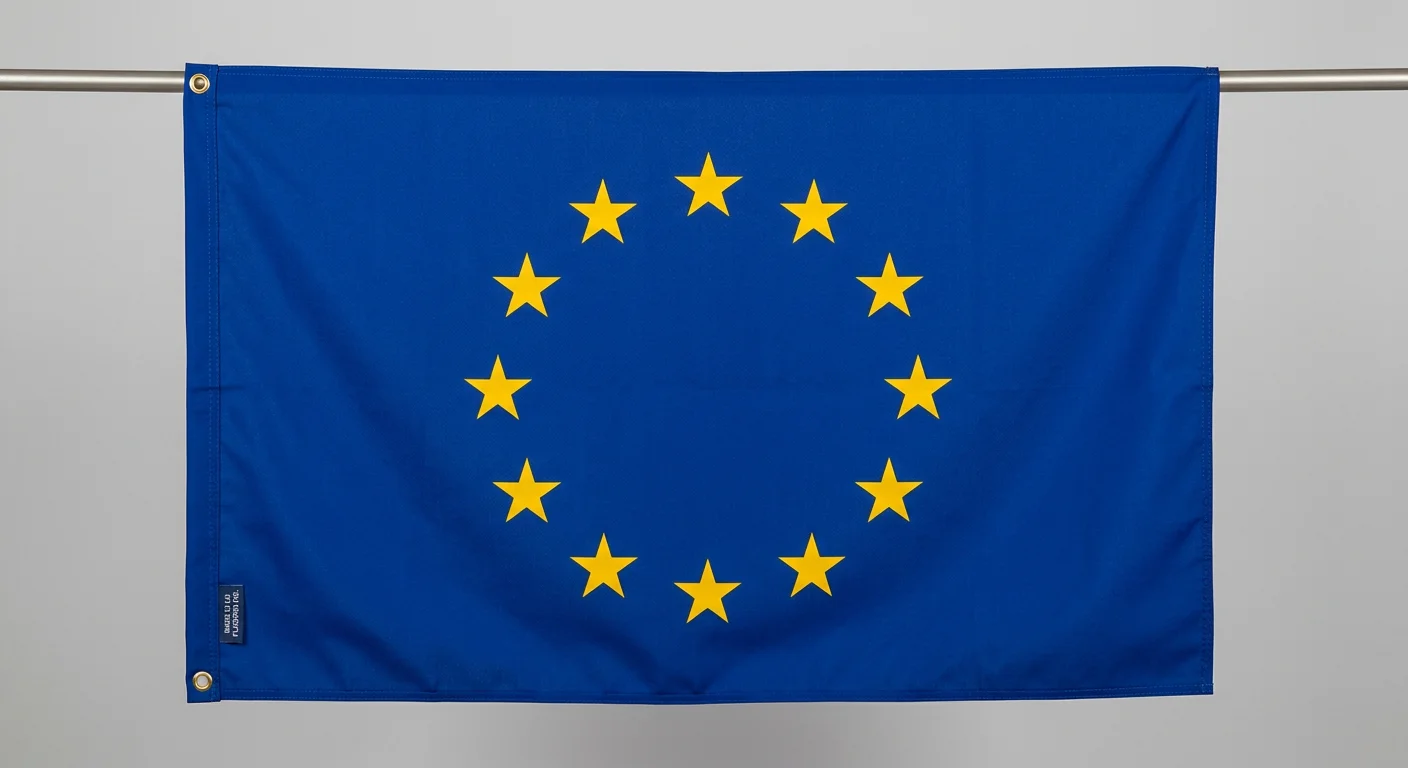
The European Union flag runs on its own design logic. Twelve gold stars sit in a perfect circle on an azure blue field. The number twelve was never a headcount. It stands for completeness and perfection — not the EU's 27 member states.
Every detail follows exact specifications:
- Star size : 1/12 of the flag's height
- Circle diameter : one-third the flag's height
- Blue : Pantone Reflex Blue — RGB (0, 51, 153)
- Gold : Pantone Yellow — RGB (255, 204, 0)
- Proportions : 2:3 ratio
Arsène Heitz created the artistic concept. Paul M.G. Lévy handled the mathematical structure. The Council of Europe adopted the flag on December 13, 1955 . The European Communities picked it up in 1985. The European Union inherited it in 1993.
The azure field represents the skies and waters of Europe. The stars represent its people. The circle is unity. The original inspiration, by some accounts, was the crown of a Virgin Mary statue in Strasbourg — twelve rays, arranged just so.
That level of design detail doesn't come together by chance. For anyone sourcing or reproducing these flags, those Pantone and RGB specifications are not optional. They're the standard every quality European national flag manufacturer works from.
Which European Flags Look the Most Similar? (Common Confusion Guide)
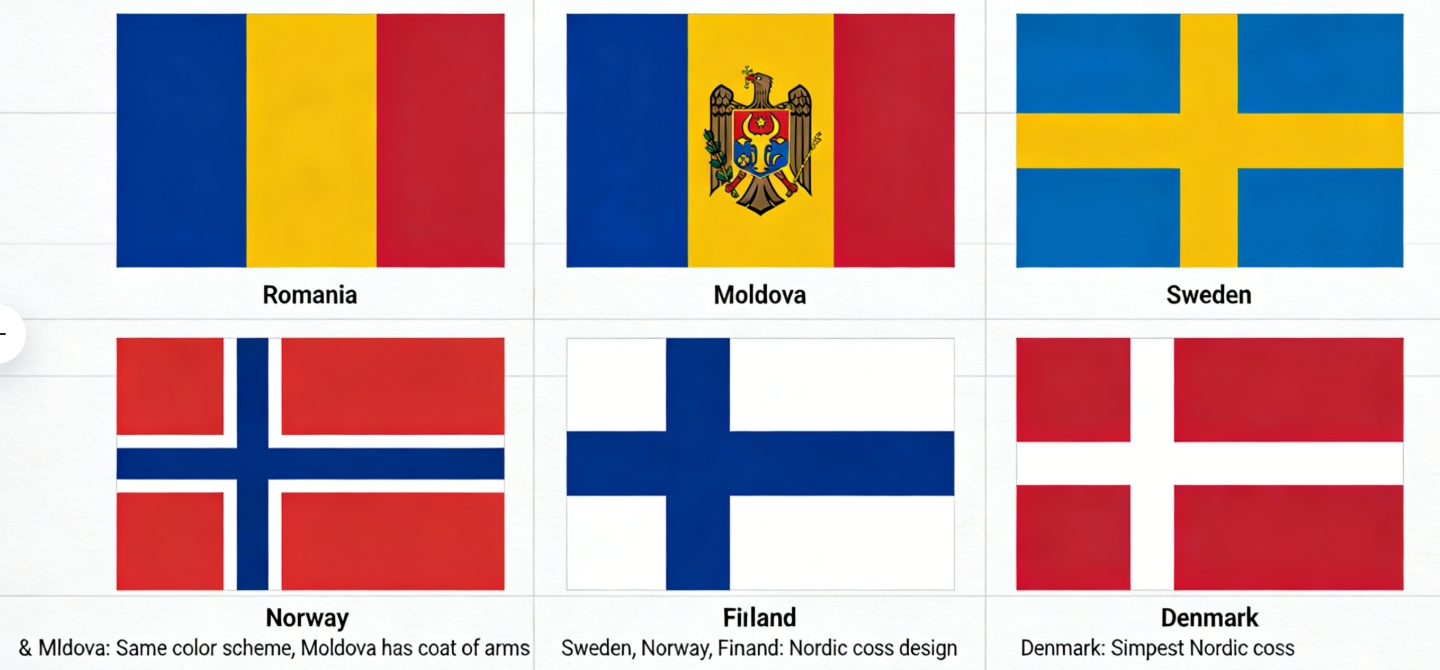
Here's a humbling truth: even cartographers mix these up.
Forty-four sovereign nations. Dozens of red-white-blue combinations. A handful of flag pairs so close in design that one shade of blue or a stripe ratio measured in millimeters is all that sets them apart. This isn't a minor trivia footnote. It's the kind of detail that matters a great deal when you're ordering flags for an international summit, a school competition, or a corporate event.
Let's sort out the most common cases of mistaken flag identity, one pair at a time.
The Classic Confusion Pairs
Netherlands vs. Luxembourg
Both fly three horizontal stripes — red, white, blue, top to bottom. The difference? The Netherlands uses a darker blue. Luxembourg's blue leans lighter, close to powder-soft. Hold them side by side and the gap is clear. On a screen thumbnail or a small flagpole from fifty feet away? Much less so.
Romania vs. Chad
This is the most extreme case in all of European vexillology. Three vertical stripes — blue, yellow, red — arranged in the same order, in the same proportions. Romania's blue is a touch lighter. That's it. That is the entire difference. The United Nations even took formal notice of the near-duplication.
Monaco vs. Indonesia (frequent European confusion)
Two horizontal bands, red over white. Monaco's flag is squarer (4:5 ratio). Indonesia's is wider (2:3). At standard display size, most people can't tell without a ruler.
The Nordic Cross Family
Five flags. One design template. Zero excuse for mixing them up — once you know the system.
Every Nordic flag carries an off-center cross, weighted toward the hoist side. Color is the one variable. Here's a fast-reference breakdown:
Country | Field Color | Cross Color | Cross Outline | Ratio |
|---|---|---|---|---|
Denmark | Red | White | None | Tallest |
Norway | Red | Blue | White | 8:11 |
Iceland | Blue | Red | White | 25:18 |
Sweden | Blue | Yellow/Gold | None | Standard |
Finland | White | Blue | None | Standard |
The Norway-Iceland swap is the most common error. Both use red, white, and blue — just inverted. Norway puts blue on red. Iceland puts red on blue. Think of it as a straight color-reversal between two close neighbors.
The Slavic Tricolor Cluster
Russia, Slovakia, and Slovenia all use white-blue-red horizontal stripes in that order. The visual logic is close to identical. Here's what separates them:
Russia : Clean stripes. No emblem. Standard 2:3 ratio.
Slovakia : Longer ratio. Adds a coat of arms on the left side — a white double cross on a blue shield.
Slovenia : Similar to Slovakia. The coat of arms sits in a shifted position and features Mount Triglav.
Quick Identification Tricks That Work
Memorizing every flag is a long game. These shortcuts make the hard cases easier:
Check the ratio first. Monaco is squarer than Indonesia. Denmark is taller than the other Nordic flags. Proportions are often the fastest tell.
Look at the hoist side. Ireland's green stripe sits on the left. Flip the flag and it becomes Côte d'Ivoire's. Same colors, reversed order.
Hunt for a coat of arms. Russia has none. Slovakia does. Romania doesn't. Chad doesn't either — that's the core reason this pair trips people up so often.
Trust the blue. Netherlands blue is darker than Luxembourg's. Romania's blue is lighter than Chad's. The shade of blue is what breaks the tie.
For anyone sourcing flags for professional use — these aren't just aesthetic details. They're hard specification requirements. A good European national flag manufacturer working from precise Pantone references will get Romania and Chad right every time. One working from a rough digital image won't.
The History Behind European National Flags: From Revolutions to Modern Nations
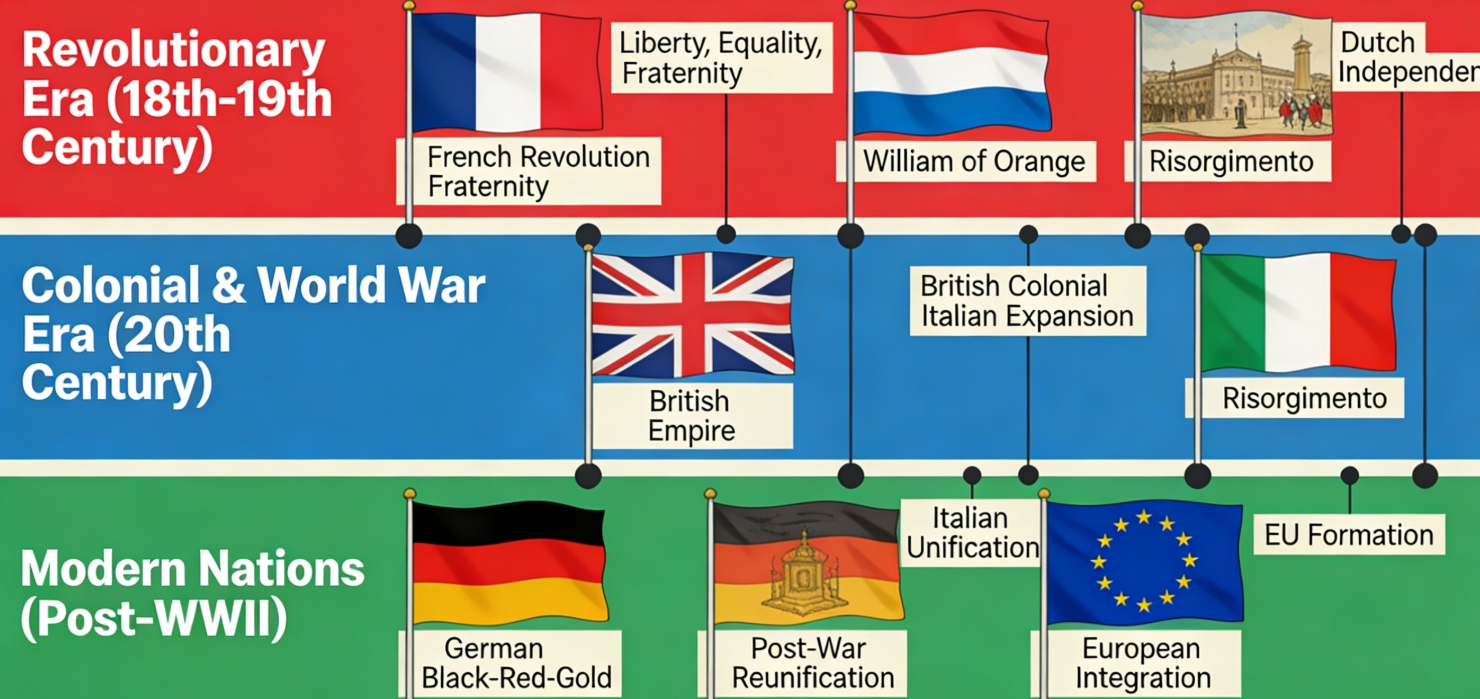
Flags don't appear out of nowhere. They get argued over, bled for, abandoned, and reclaimed — sometimes within the same century.
European national flags trace their roots back to the French Revolution. It didn't just topple a monarchy. It rewrote what a flag was for . Before 1789, flags were dynastic property — symbols of kings and courts. After the Revolution, they became something new: the visual voice of a people. France's blue-white-red tricolor, raised in 1794, reshaped flag design across an entire continent.
A Timeline Worth Knowing
Every era left its mark on European flags:
Medieval roots : Heraldic traditions — coats of arms, royal crests, dynastic colors — gave the earliest flags their visual language. Hungary's crimson red, white, and teal green tie back to its medieval coat of arms. The flag first flew during the 1848 uprisings. It became official in 1957.
The Revolutionary era (1789–1914) : Nationalist movements wanted flags that stood for nations , not nobles. The Netherlands had flown its red-white-blue tricolor since 1575 — but didn't adopt it as the official flag until 1937. Some flags existed long before the paperwork caught up.
20th century upheaval : Two world wars and a Cold War reshuffled borders, regimes, and identities. Romania's blue-yellow-red vertical tricolor took shape as a layout in 1848. The country brought it back as the official flag in 1989, the moment communism fell.
Post-1991 transitions : The Soviet Union's collapse triggered a wave of new flags across Eastern Europe. Russia made its current flag official on August 22, 1991. Montenegro didn't settle on its final flag design until July 2004.
The Details That Changed Over Time
Single flag elements can carry centuries of history on their own.
The Netherlands' orange stripe is a clear example. William of Orange's colors were orange, white, and blue — no question about that. But orange dye in the 17th century was unstable. It faded to red under long sun exposure. Red took over for good. Later generations gave the red a new meaning entirely — calling it a symbol of the blood shed by national defenders.
Sweden's Nordic cross tells a similar story. The yellow-and-blue color scheme came straight from the national coat of arms. The off-center cross came from Denmark. From there, it spread across the Nordic region and grew into one of Europe's most recognizable regional flag traditions.
These flags didn't come from a single design session. They changed over time — through wars, independence movements, political shifts, and yes, a dye that couldn't hold its color in the sun.
Special Cases: Territories, Home Nations & Disputed Flags in Europe
Not every flag flying over European soil belongs to a clean, recognized sovereign state. Some of Europe's most striking flags sit in a complicated middle ground. They belong to territories, home nations, and partly recognized states that don't fit into any neat numbered list.
The UK's Home Nations: Flags Within a Flag
The Union Jack is famous. Less known: the individual flags it partly absorbed.
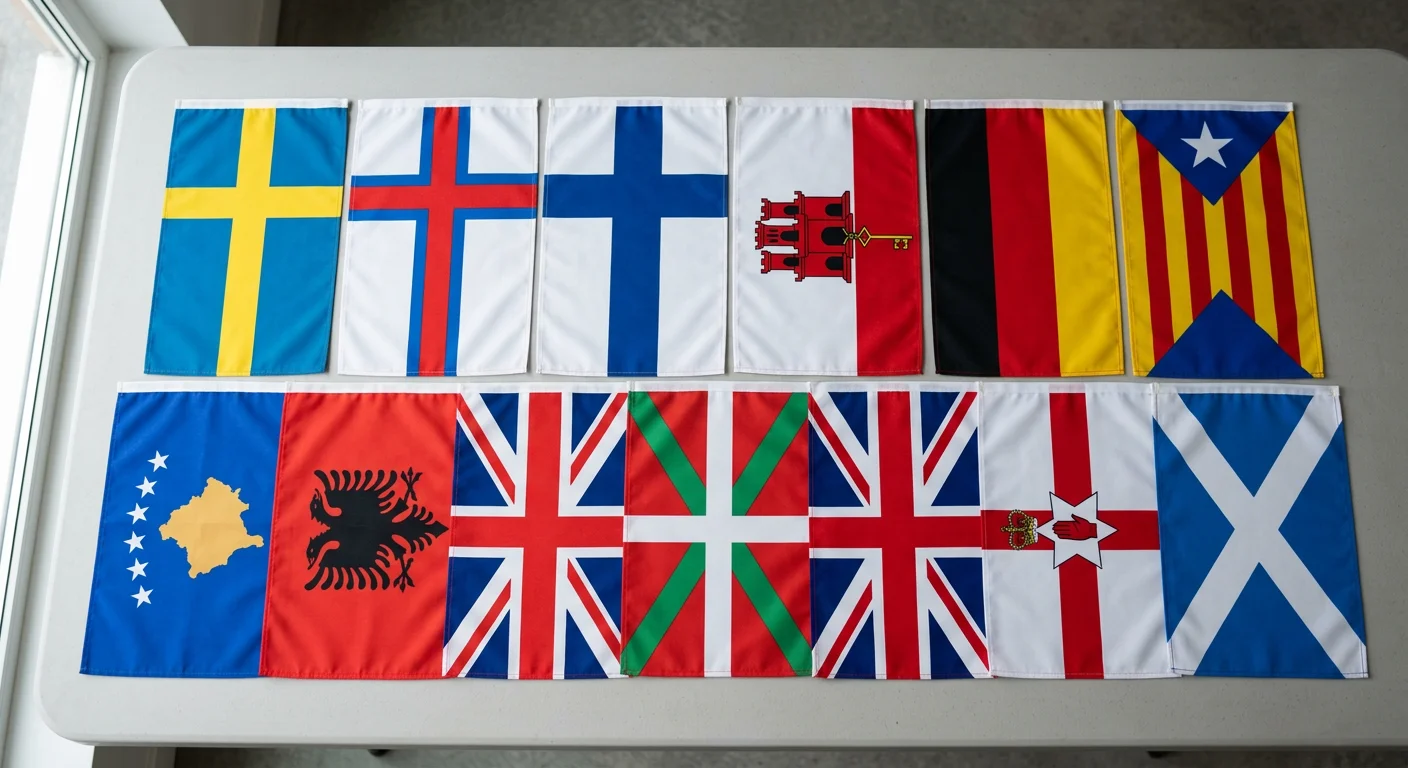
Scotland's Saltire — a white diagonal cross on blue — has been official since 1542. That makes it one of Europe's oldest national symbols. Wales flies something completely different : the red dragon on a white-and-green field, adopted in 1959. Nothing else on the continent looks like it. Neither Scotland nor Wales is a sovereign state. Both flags still carry real political weight — more so since devolved parliaments took shape in 1999.
Autonomous Territories With Their Own Flags
The Faroe Islands have flown their own flag since 1919. It features a blue Nordic cross with a distinctive red center circle. The islands are part of the Danish Realm, yet self-governing since 1948. They are not an EU member. Population: 54,000. Their influence on regional flag design? Far bigger than that number suggests.
Gibraltar's flag — a yellow castle and key on white and red — dates back to 1502. In 2016, 99.2% of Gibraltarians voted to stay in the EU. They were outvoted anyway.
Disputed Flags: The Complicated Cases
Kosovo declared independence in 2008. Its flag shows a blue field with a gold map outline and six white stars. So far, 100 of 193 UN member states recognize it — including the US and most EU nations. Five EU members still don't. The flag exists. The agreement does not.
Northern Cyprus, Abkhazia, and South Ossetia each fly their own flags. Almost no one recognizes any of them beyond their political backers.
The count of "European flags" shifts based on which of these cases you include. That's exactly why authoritative sources list anywhere from 44 to 55 — the number changes with the criteria used.
Custom European National Flags for Events, Schools & Businesses — Order from RunCustomFlag
Sourcing the right flag sounds simple. It's not.
Get Romania wrong and you've ordered Chad. Specify "blue" without a Pantone number and Luxembourg shows up looking like the Netherlands. For international schools, diplomatic summits, sports fan zones, and trade show booths, that kind of mistake isn't just embarrassing. It's a problem you'll need to fix under deadline pressure.
RunCustomFlag produces 5 million+ flags per year from a 15,000㎡ facility. Two production shifts run daily, backed by a 150-person QC team. Their error rate sits at 0.2%. ISO 9001:2015 certified. They've handled 50,000-unit orders for international summits — the kind of job where every flag specification is non-negotiable.
What that means in practice:
All 200+ European national flags are made to official Pantone specs — Irish green is Pantone 347 U, not "close enough to green"
Sizes range from 20×30cm classroom displays to 200×300cm stadium banners
300D polyester holds up for 12–18 months outdoors. UV-resistant inks. Double-stitched hems.
MOQ is 100 pieces per design — works for a single school order, scales to 40,000+ units for distributors
Free mockup within 24 hours. Physical samples ship via DHL in three days ($30–50, refundable on your order). Wholesale pricing of European national flag runs 40–60% below US retail on 100+ units.
Get a free quote for European national flags →
FAQ: European National Flags — Quick Answers to Common Questions
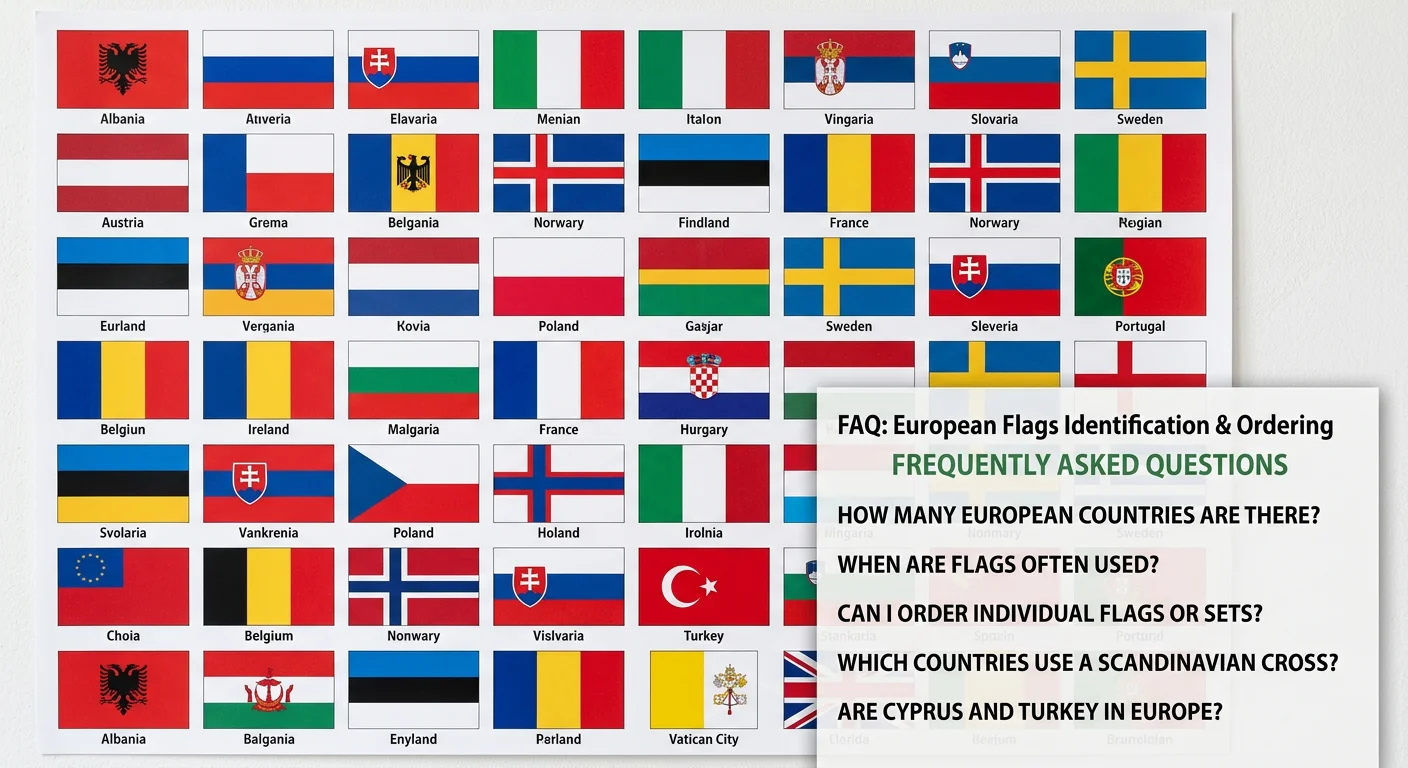
European flag questions tend to fall into the same core topics. Here are the answers you need.
How many countries in Europe have national flags?
44 sovereign states hold full UN recognition. Each one has an official flag. Add microstates and transcontinental nations, and the total reaches 50.
Which European flag is the oldest?
Denmark's Dannebrog takes the title. It was first recorded in 1370. That means it has been flying longer than most modern nations have existed.
What's the most common color on European flags?
Red leads the way. It appears on more than 75% of European national flags. Blue comes second, showing up on about 60%.
Which European flags feature a cross?
More than you'd expect. The Nordic cross shows up on six flags:
- Denmark
- Finland
- Iceland
- Norway
- Sweden
- The Faroe Islands
Switzerland carries a bold white cross on red. Greece, Georgia, and England's St. George's Cross are also on the list.
Are all European flags rectangular?
Almost all of them are. Most use a 2:3 ratio. The UK and Russia use 1:2. Vatican City uses 5:8 — the closest any sovereign European flag comes to a square shape. No European national flag is truly non-rectangular.
What are the EU flag's official color specs?
The background is Pantone Reflex Blue (#003399). It features twelve five-pointed yellow stars (#FFCC00), arranged in a circle. The proportions are 2:3. The EU adopted this flag on December 8, 1955.
Conclusion
Europe's 50 sovereign nations each carry their history, identity, and spirit into a single rectangle of color and symbol. Now you have the full picture.
You might have landed here to ace a geography quiz. Maybe you wanted to settle a dinner-table debate about which Nordic flags look oddly alike. Or you just had a genuine curiosity about European flag designs . Either way, you've got everything you need: the complete list, the patterns, the history, the edge cases.
Here's the part that sticks: flags aren't just trivia. They're the most compressed form of national storytelling ever invented.
So what happens next? Your school event, corporate expo, sports tournament, or international celebration needs the right flag to tell that story. RunCustomFlag makes it easy. Bring any of Europe's sovereign state flags to life — with precision, quality, and speed.
👉 Explore custom European flag options at RunCustomFlag.com — the right flag, made right, says everything before a single word is spoken.