Ordering custom national flags without knowing your printing options is a gamble. One government agency received 500 ceremonial flags with colors so washed out they were unusable. An event company paid premium prices for outdoor rally flags that faded within three weeks. These aren't rare horror stories. They're predictable results of mismatched printing decisions.
Comparing dye sublimation flag printing against screen printing for a bulk stadium order? That's a real decision with real consequences. The same goes for weighing embroidery against digital methods for a diplomatic ceremony. The right choice depends on factors most national flag suppliers never take the time to explain.
This guide breaks down every major flag printing method . You'll get the real differences, the hidden trade-offs, and the exact scenarios where each method wins — so your next order turns out the way you planned.
Dye Sublimation Flag Printing: Best for Full-Color & Outdoor National Flags
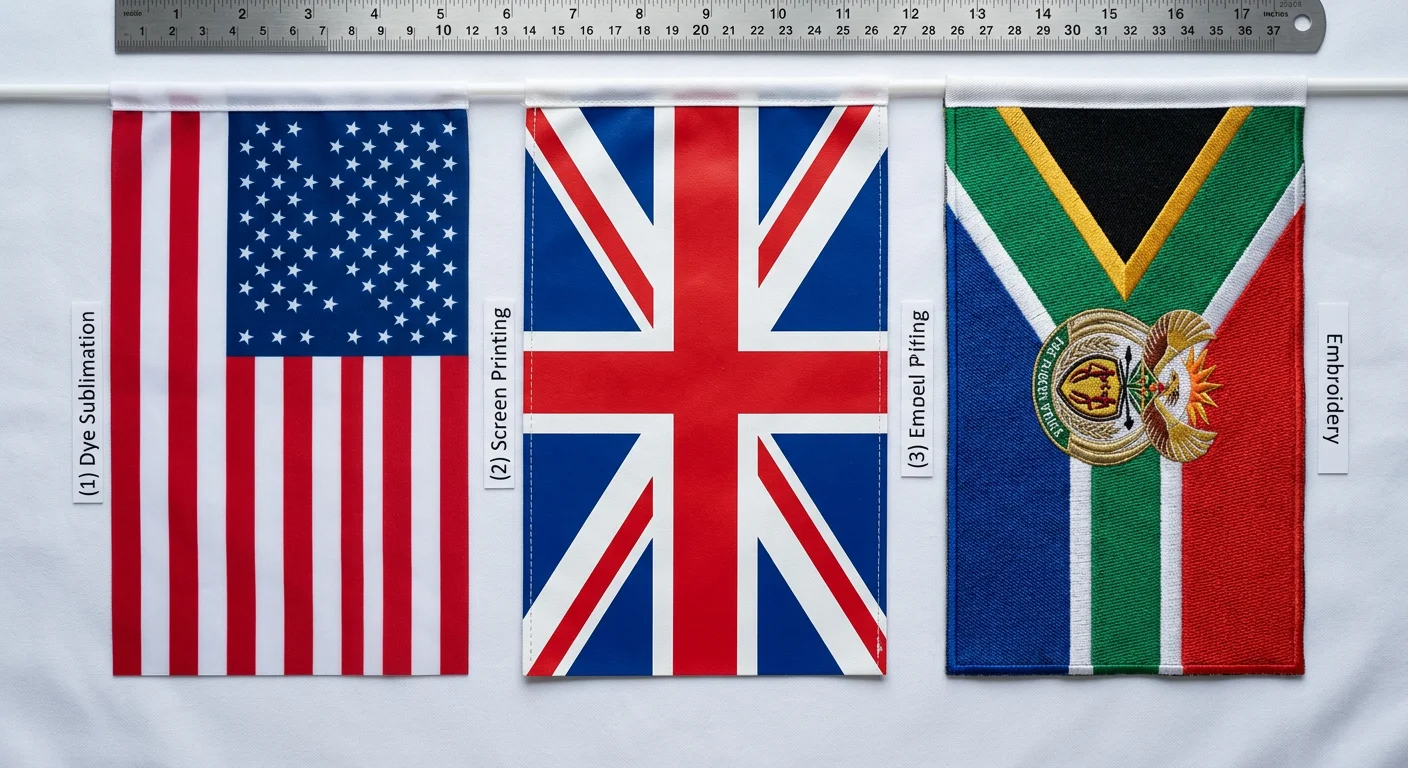
Dye sublimation is the closest thing to magic in flag printing — and the data backs that up.
Heat and pressure work together at 375–400°F (190–204°C) . They turn dye inks into gases that bond inside polyester fibers. Not on top of them. Inside. That's the key difference. The color won't crack, peel, or wash out — because it's part of the fabric itself, not just a surface coating.
No other flag printing method can match what you get here: photographic-quality detail with rich, saturated color . Gradients, complex artwork, multi-color national emblems — dye sublimation handles them all without losing sharpness.
What You Need to Know Before You Order
Three hard limits are worth knowing upfront:
Polyester only. Dye sublimation doesn't work on cotton or dark-colored materials. Your flag fabric needs to be white or light-colored polyester. Any other material won't work with this method.
Single-sided output. The reverse side shows about 15% lighter color than the front. Full double-sided visibility needs a different approach.
Fading over time. Colors start out vivid. Over time, though, dye sublimation fades faster than direct-to-fabric printing. The dye doesn't go as deep into the fiber structure, so it breaks down sooner under UV exposure.
Where Dye Sublimation Wins
Color vibrancy is where this method shines. For custom garden flags , event displays , barrier branding , and any project where bold color matters more than long-term durability, dye sublimation is the strongest option out there.
Lead times can run as fast as 8 days . There's also no minimum order quantity — so it's a solid fit for small-batch or one-off custom national flag projects where flexibility matters.
Your goal is a flag that turns heads, not one that survives five years of harsh weather. This method delivers exactly that.
Digital Printing for Custom Flags: Ideal for Small Batch & High-Detail Orders
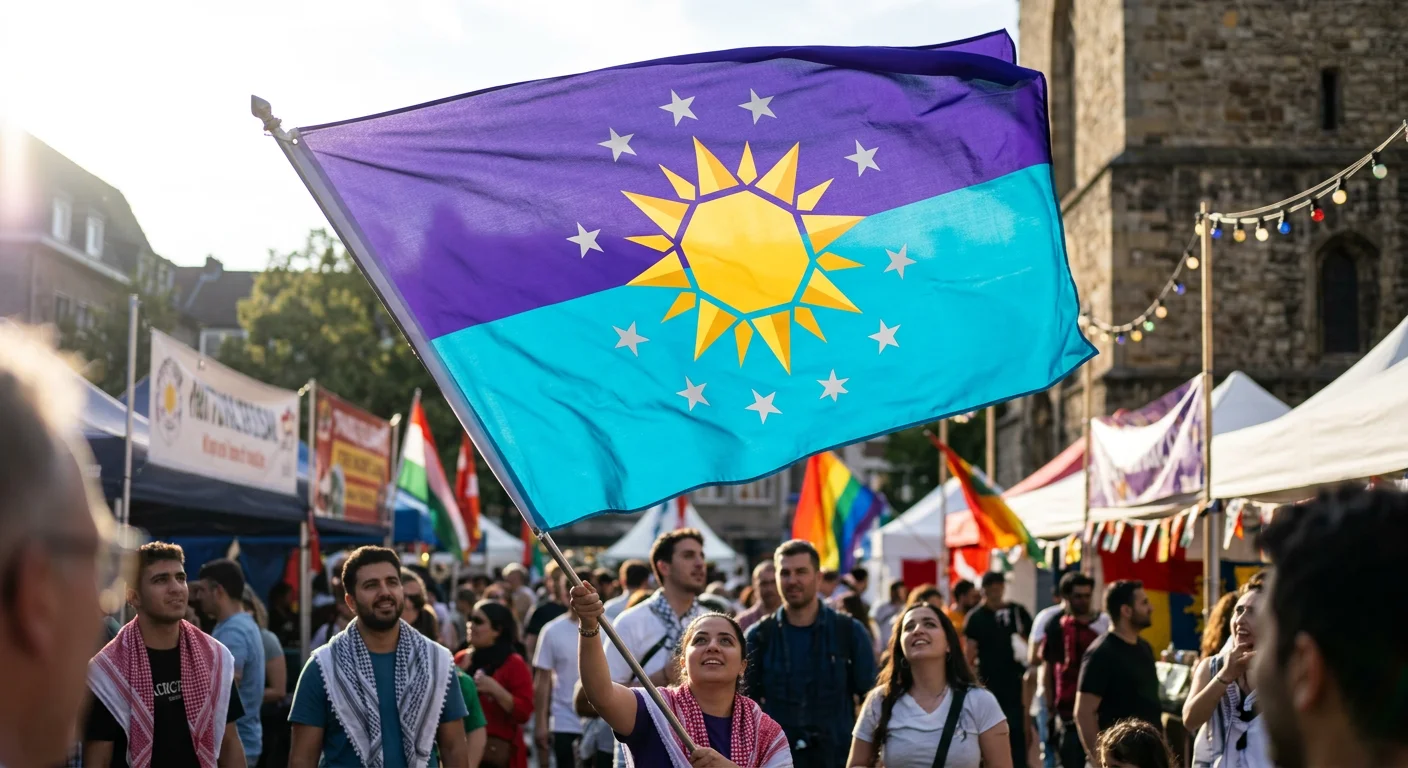
Digital printing removes the biggest friction point in custom flag orders: commitment.
No setup fees. No plate costs. No pressure to order 500 units just to make the economics work. You can print a single flag — at full color, full detail — and move on. No other method offers that at this price point.
Precision Color Without the Compromise
Digital UV Eco Dye printing reproduces sharp, high-detail graphics across the full CMYK spectrum. Fine linework stays crisp. Complex national emblems don't blur. Gradient shading holds.
Key Tip: Color File Format
One thing to get right before submitting files: always submit in CMYK, not RGB. An unverified RGB file risks a 10-20% color shift in the final print. That's the difference between a flag that matches your brand and one that doesn't. Need exact color accuracy? Pantone matching is available for those projects.
Small Batches, Fast Turnaround
Orders under 25 flags ship in 4 business days . There's no minimum — one unit qualifies. Volume discounts kick in at 100 units. Wholesale pricing starts as low as $1.57 per piece at minimum two-unit orders.
So digital printing is the clear choice for:
Event planners
Government sample runs
Trade show displays
Parade flags
Corporate picnics
Anywhere the timeline is tight and the quantity is low, this method delivers.
Double-Sided Visibility Is Built In
Dye sublimation can't do this — digital printing supports a true double-sided (DS) configuration. A blackout liner sits between the layers and blocks bleed-through. Both sides display full color at equal intensity. For flags on poles or in open spaces, that's a real functional upgrade.
Finishing options include reinforced edges, grommets, rope headers, and pole sleeves. Size ranges run from 4"×6" hand flags all the way up to 12'×18' oversized formats . You get full production flexibility across every application.
Screen Printing for National Flags: The Cost-Efficient Choice for Bulk Orders
Here's a number that matters: at 500 units, screen printing brings your per-flag cost down to $2–4 . Digital printing at the same volume? Still $6–9 . That gap is why government procurement offices and large-scale event wholesalers keep coming back to screen printing.
The economics work in your favor past a certain threshold. Below 50 units, digital and screen printing are neck and neck on price. Cross 100 units , and screen printing pulls ahead — and stays there.
How the Pricing Breaks Down
| Quantity | Screen Print (3x5 ft) | Digital Print (3x5 ft) |
|---|---|---|
| 1-5 | $12-18 | $10-15 |
| 10-50 | $8-12 | $9-13 |
| 100+ | $3-6 | $7-10 |
| 500+ | $2-4 | $6-9 |
There is a trade-off, though. Each color needs its own screen. Every extra color adds 20–50% to setup costs and 1–3 days to lead time . Designs with more than 8 colors are a problem. Color accuracy drops 15–20% beyond 6 colors . Photorealistic emblems or detailed multi-color artwork are not a good fit here.
Screen printing is built for simple, bold national flag patterns . That's the design type where it delivers its best results.
Durability That Outperforms in Direct Sunlight
Screen printing uses a thicker ink layer — 0.1–0.2mm penetration — and that gives it a real advantage outdoors. UV-resistant inks extend fade resistance to 18–24 months . Compare that to dye sublimation's 12–18 month average under the same harsh sun exposure. Add 100% polyester fabric , double-stitched edges, and brass grommets, and you get flags that hold up through two full outdoor seasons without issue.
Bulk buyers get strong value here. For 1,000+ unit government orders or resale stock, screen printing keeps quality consistent at scale — up to 100,000 units per run. Lead times run as fast as 2–6 business days on orders of 100+, so you're not waiting long to fulfill large contracts.
Embroidery & Applique: Ceremonial Quality for National Flags
Some flags aren't meant to be printed. They're meant to be built.
Embroidery and appliqué sit in a different category from every other method in this guide. This isn't about speed, volume, or cost-per-unit. It's about creating a flag that carries real institutional weight — the kind you'd present at a diplomatic ceremony, display in a military headquarters, or hand to a dignitary.
The Technical Standard Behind Ceremonial Quality
Precision here is non-negotiable. Take the US flag as a benchmark. A professional embroidered version requires:
56,962 stitches across a field measuring 15.78cm × 22.8cm
Thread matched to Pantone 193C (Old Glory Red) and Pantone 282C (Old Glory Blue) — verified against physical Pantone samples, not your monitor
Stars arranged across 9 alternating rows , each five-pointed with one tip facing upward, spaced with zero tolerance for inconsistency
That last point matters more than most buyers realize. Monitor calibration distorts color perception. Your national flag supplier matches threads by screen? You're already starting with a color drift built into the product. Always verify against physical samples.
Appliqué + Embroidery: The Hybrid That Wins on Complex Emblems
National flags with detailed coats of arms or multi-element emblems are tough. Neither method alone gets the job done. The right approach combines both:
Appliqué lays precision-cut fabric pieces as structural base layers — delivering durability that holds up in high-wind outdoor conditions
Embroidery detailing adds fine linework, lettering, and dimensional texture on top
The result is what the industry calls an heirloom-quality finish — tactile, durable, and authoritative in ways no printed flag can match.
What to Verify Before Production Starts
Two quality checks prevent expensive mistakes:
Thread color verification — confirm Madeira Classic 40 thread codes (Blue 1243, Red 1281, White 1001) against physical Pantone swatches before a single stitch runs
Proportion accuracy — the union (blue star field) must span 7/13 of the flag width , covering the top seven stripes
Skip these steps and you risk a ceremonial flag that fails inspection. Or worse — one that gets used without anyone catching the error.
Matching Printing Method to Flag Material: Polyester, Nylon & Cotton Guide
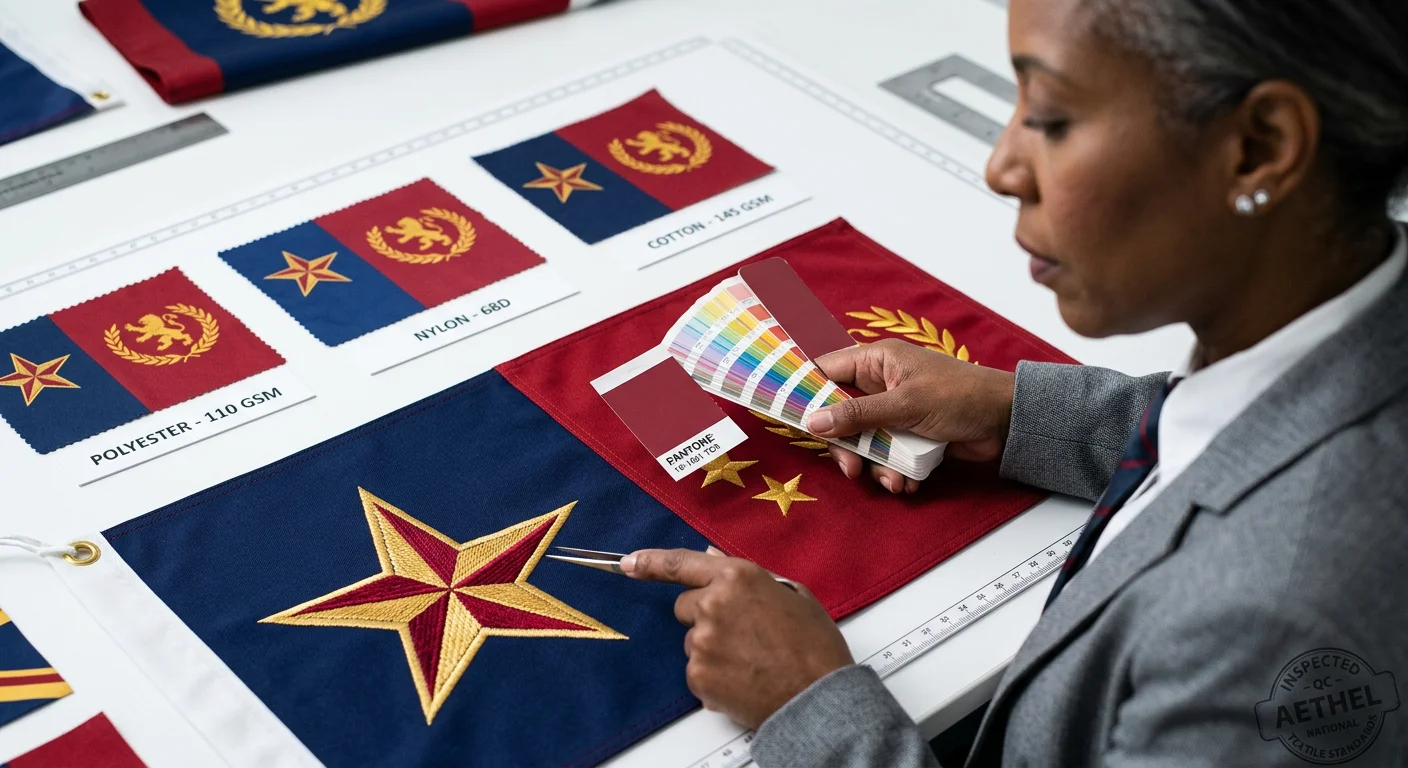
The fabric you choose locks in your printing options before you submit a single file.
Most buyers focus on design and ignore material — then wonder why their flags look nothing like the proof. Here's the reality: printing method and fabric are a system. Get the pairing wrong, and even the best print technology fails you.
Polyester: The High-Performance Default
Polyester is the dominant flag material for one reason. Dye sublimation was built for it. Polyester fibers open under heat, absorb dye deep into the material, then lock it in for good. You get vivid, UV-bonded color that beats every other fabric-method combination for outdoor use.
For serious outdoor flag applications, 200-denier (200D+) yarn density is non-negotiable. Go lighter and you lose abrasion resistance and wind durability. That means flags that fall apart before a full season ends. Two-ply construction — Poly-Max, Tough Tex, or Hercules — adds structural reinforcement. Open-weave cuts wind resistance and reduces water retention. Reinforced fly stitching stops fraying at the leading edge.
Get it right, and a 2-ply polyester flag holds up for 1+ year in high winds . Nothing else comes close.
Nylon: Light Winds, Moderate Conditions
Nylon works well in one specific scenario: locations with light, variable breezes and frequent rain. Its 200-denier bunting weight catches minimal wind and dries fast. That cuts mildew buildup and reduces stress on grommets over time.
The printing trade-off is real, though. Nylon requires acid dyeing. Direct vibrant printing won't work without UV treatment. Even with treatment, expect a 6–12 month outdoor lifespan under normal conditions. That's about half of what polyester gives you.
Cotton: Keep It Indoors
Cotton pairs best with embroidery and appliqué. It holds rich color depth and has a classic drape that synthetic materials can't match — perfect for ceremonial and indoor display use.
Take it outdoors? The lifespan drops to weeks. Synthetic flags last 2–4× longer in any outdoor condition. Keep heavyweight 2-ply cotton for short-duration display indoors.
| Material | Best Printing Method | Outdoor Lifespan | Ideal Use Case |
|---|---|---|---|
| Polyester (2-ply) | Dye sublimation | 1+ year | Outdoor flagpoles, high wind |
| Nylon (200D) | Acid dye / screen | 6-12 months | Light breeze, rainy climates |
| Cotton (2-ply) | Embroidery / applique | Weeks-months | Indoor ceremony, display |
Scene-Based Decision Framework: Which Printing Method Fits Your Use Case
The right printing method for a stadium flag will blow your budget on a diplomatic ceremony order — and the reverse is just as true. Context drives everything.
Here's a straight map from use case to method. Stop guessing. Start ordering with confidence.
Outdoor National Flags (Flagpoles, Government Buildings, High-Wind Locations)
Choose dye sublimation on 2-ply polyester. You get UV-bonded color, solid structural durability, and a 1+ year lifespan under real outdoor stress. Designs with more than 8 colors or complex national emblems? This is your go-to high-volume method — nothing else competes at scale.
For simple, bold patterns at 500+ units, screen printing with UV-resistant inks is worth a hard look. Cost runs $2–4 per flag versus $6–9 for digital at the same volume. That gap adds up fast.
Indoor Exhibitions, Trade Shows & Corporate Events
Digital printing is the clear winner here. No minimums. Turnaround hits 4 business days for orders under 25 units. You also get full double-sided color with a blackout liner included.
Display quality matters more than weatherproofing in these settings. Digital gives you sharp precision without locking you into a bulk run commitment.
Sports Events, Rallies & Hand Flags
Small-to-mid batches? Go dye sublimation. Orders over 100 units? Switch to screen printing.
Color vibrancy drives visual impact in crowd settings. Both methods deliver strong results. The real tipping point is quantity — let that decide for you.
Diplomatic Ceremonies & Military Presentations
Embroidery and appliqué. No exceptions.
No printed flag carries the authority of hand-stitched construction. This is the non-negotiable choice for flags representing a government, a branch of service, or an official state occasion. Institutional weight demands it.
| Use Case | Recommended Method | Key Priority |
|---|---|---|
| Outdoor flagpole | Dye sublimation / Screen print | Durability + UV resistance |
| Indoor exhibition | Digital printing | Detail + flexibility |
| Event / rally flag | Dye sublimation | Color vibrancy |
| Diplomatic / ceremonial | Embroidery + applique | Authority + precision |
| Bulk wholesale (500+) | Screen printing | Cost efficiency |
Pro Tip: For bulk orders over 100 pieces, contact our team for special pricing and dedicated project support.
Quick-Decision Checklist: 5 Questions to Find Your Ideal Flag Printing Method
Five questions. That's it. Answer each one and you'll land on the right printing method fast.
Work through them in order. Each answer cuts options down and points you in the right direction.
Q1: Does your design have more than 4 colors or complex detail?
- Yes → Digital, UV, or dye sublimation. These methods handle full-color artwork, gradients, and detailed emblems. No sharpness lost.
- No → Screen printing. Bold, simple patterns are where screen printing wins on cost. It's hard to beat at this level.
Q2: Are you ordering more than 100 units?
- Yes → Screen printing or offset. Unit costs fall fast at scale.
- No → Digital or heat transfer. No plates, no screens, no minimum order required.
Q3: Will this flag live outdoors?
- Yes → Digital UV or dye sublimation on 70g/m² polyester. UV-cure inks hold color. Tear-resistant fabric stands up to wind. The build handles rain and sun.
- No → Almost any method works here. Focus on detail quality and budget instead.
Q4: Is budget the primary constraint?
- Yes → Single-reverse digital. One viewable side, low setup cost, clean color output.
- No → Double-sided with a blackout liner. Full color on both faces, plus added structural durability.
Q5: Do you need delivery within one week?
- Yes → Digital, UV, or heat transfer. No drying delays. Production moves fast.
- No → Screen printing is back on the table — and worth it for bulk runs.
| Your Scenario | Best Method |
|---|---|
| Full-color + small batch + outdoor + fast | Digital / UV |
| Simple design + 500+ units + standard lead time | Screen printing |
| Intricate logo + high-wind outdoor | Applique + digital |
| Double-sided visibility + tight budget | Block-out digital (single-reverse if one angle only) |
Run through these five questions before your next order. The right method will be clear.
FAQ: Most Searched Questions About Custom National Flag Printing Methods
Buyers get burned because they order first and research second. These are the questions you should ask before signing any invoice.
Which printing method produces the most vibrant colors?
Dye sublimation wins. The dye fuses inside polyester fibers — not on top. You get deep, saturated color that won't crack or peel. Screen printing uses spot colors. It can't match that same richness on detailed, full-color national emblems.
What's the most durable method for outdoor flags?
Double-sided digital printing on spun polyester. UV and wind resistance hold strong in high-exposure locations. Need widths beyond 160cm? Panels stitch together and the flag stays structurally solid.
What's the real difference between dye sublimation and digital printing?
Dye sublimation goes deeper into thicker polyester. That makes it the better choice for large-format pieces like backdrops and tent structures. Digital printing works across more fabric types. It suits smaller runs where full-color accuracy is the priority.
What's the minimum order for custom national flags?
One unit. Both digital and dye sublimation handle single-unit orders with no problem. Screen printing starts making financial sense at 100+ units — below that, the cost per piece runs high.
How long does production take?
Digital printing ships in 3–7 business days for small-to-mid quantities. Large screen print runs need 10–14 days to complete.
Is double-sided printing worth the extra cost?
Expect to pay 40–60% more than single-sided. What you get in return: equal color visibility from both faces, with a blockout liner built in. Single-sided flags are lighter and catch the wind better. Go that route where one viewing angle covers everything you need.
Which fabric handles high winds best?
2-ply spun polyester, available from 2.5×4 ft up to 30×60 ft. It outperforms nylon in windy and coastal conditions. It also works well with both digital printing and appliqué construction.
Why Choose RunCustomFlag.com for Your Custom National Flag Order
The U.S. Department of Defense trusts RunCustomFlag.com. So do government buildings across Florida, Ohio, and Texas. These clients don't take chances with unknown national flag suppliers — they come to us because the work gets done right.
Here's what that means in real orders: 600 oversized 20-ft flags for the 2026 U.S. 250th Anniversary, delivered in 5 business days. 1,200 flags shipped to multiple cities in one 2024 contract cycle. Embassy clients called it "exceptional quality and fast turnaround on a complex order."
The numbers back that up:
96%
Customer Satisfaction
4.75/5
Average Rating
500+
Hours UV Tested
70mph
Wind Resistance
5,000+
Grommet Load Cycles
Every order goes through color proofing within hours of file submission — no matter the size. No screen fees. No color limits. No minimums. Submit your file in AI, EPS, SVG, or PDF format. Our team reviews it, matches Pantone colors, and confirms everything before production starts.
Ready to order? Request a free sample, get an instant quote online, or reach out to an advisor for complex or ceremonial flag projects.
Conclusion
Picking the right custom national flag printing method is not guesswork. It's a real decision that shapes how your flag performs, how long it holds up, and how well it represents what matters most.
Here's the short version:
Dye sublimation flag printing is the top choice for outdoor durability and full-color accuracy
Screen printing fits high-volume orders on a tight budget
Embroidery brings a ceremonial quality that no other method can match
Match your method to your material, your use case, and your timeline. Do that, and you won't waste money on a flag that falls short.
You now have a clear framework. The next step is putting it into action.
Ready to get it right the first time? The team at RunCustomFlag.com can help you pick the best printing method, lock in your specs, and get a finished flag that delivers on every level.
Get your free quote today — your flag should fly and look great doing it.
Video Guide
Related Articles