So you're flying halfway around the world to visit a flag factory. Maybe it's your first time, maybe your third. Either way, you're about to spend real money — on flights, on hotels, on meals with factory owners who will smile a lot and show you their best side. The question isn't whether you'll see a clean production floor. They'll make sure of that. The question is whether you'll know what to look for behind the performance they've rehearsed for you. This guide is the difference between a factory tour that tells you something useful and one that's just expensive tourism.
Before You Walk In: Pre-Visit Preparation Checklist
Most buyers show up to factory visits underprepared and don't realize it until they're standing on the production floor with nothing to compare against. The single biggest mistake? Walking in without your own spec sheet and assuming the factory's samples represent their normal output.
Pull their certifications before you go — ISO 9001, OEKO-TEX, BSCI if you care about compliance. But here's what separates a useful visit from a wasted trip: verify those certs independently. A surprising number of factories display expired certificates or ones issued to a parent company they're barely connected to. One call to the certification body settles it.
Send your visit agenda seven to ten days ahead. Not because it's polite — because their reaction tells you something. A factory that pushes back on specific inspection requests or tries to steer you toward a "general tour" is managing your perception. A factory that asks clarifying questions about your specs is probably used to working with serious buyers.
What to Bring
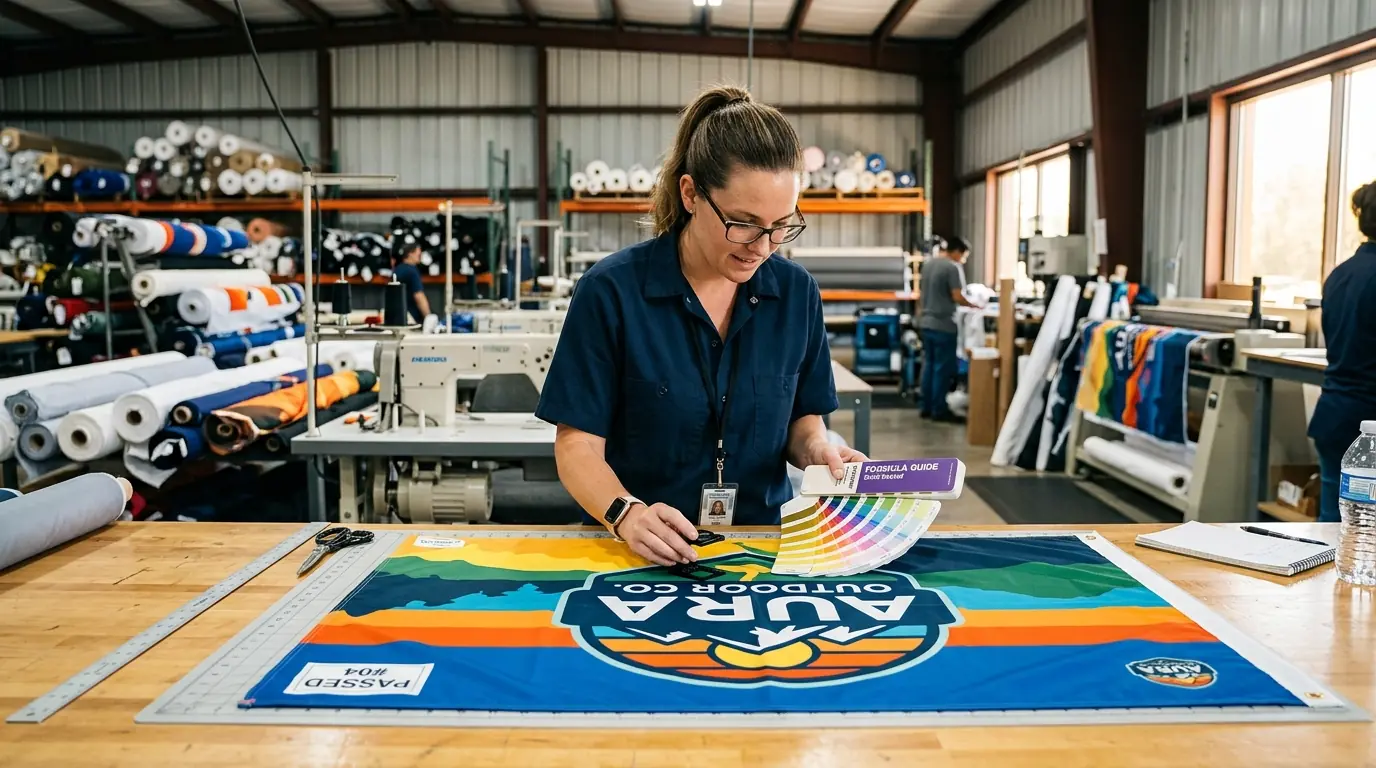
Bring your own Pantone cards, a printed spec sheet with tolerances marked, and if possible a prototype or approved sample from a previous supplier. Tuesday through Thursday visits during normal production hours give you the most honest picture. Monday mornings and Friday afternoons tend to be either startup chaos or wind-down mode — neither shows you steady-state operations.
Critical Prep Step
Your AQL sampling plan should be decided before you arrive, not negotiated on the floor. If the factory doesn't know what AQL means, that tells you everything about their quality infrastructure.
Production Floor Layout: What a Real Flag Factory Looks Like
A well-run flag factory has a logic to its floor plan that you can read in about thirty seconds.
Raw Materials
→
Cutting
→
Printing
→
Sewing
→
Finishing
→
QC & Ship
Raw material storage flows into cutting, cutting feeds printing, printing feeds sewing, sewing feeds finishing, and finishing feeds QC before shipping. If you're walking back and forth across the floor to follow a flag from start to finish, the layout is either poorly planned or you're being routed around something.
The thing most buyers miss is machine utilization. A floor full of beautiful sublimation printers means nothing if a quarter of them are sitting idle on a Tuesday afternoon. Idle machine ratios above fifteen to twenty percent during peak hours usually signal either overcapacity they bought to impress visitors or workflow bottlenecks they haven't solved. Both are problems, just different ones.
Capacity claims are where factories get creative. When someone says "we do two thousand pieces per day," ask them to walk you through the math. How many sewing lines? How many operators per line? What's the average cycle time per flag? A real production manager can answer this without hesitation. Someone reciting a sales pitch will give you a round number and change the subject.
Pay attention to the climate on the floor, especially near the printing stations. Sublimation printing is sensitive to temperature and humidity — the sweet spot is roughly eighteen to twenty-four degrees Celsius with moderate humidity. If the printing area feels like a sauna or has no climate control at all, color consistency across large runs becomes a gamble. Not every factory needs a laboratory-grade environment, but zero environmental controls is a yellow flag for anyone promising Pantone-accurate color matching.
Printing and Color Accuracy: The Questions to Ask On-Site
Color is where most custom flag disputes start and where most factory tours fail to dig deep enough. The factory will show you their best prints. Your job is to figure out whether those prints are repeatable across a thousand-unit run or just what they can achieve when they're trying to impress you.
Ask to see their spectrophotometer. Not whether they have one — whether it's calibrated and when the last calibration happened. A spectrophotometer measures color in CIE Lab values, and the number you care about is Delta E.
< 2.0
Imperceptible
2.0-5.0
Noticeable
> 5.0
Customer Complaints
Below 2.0 on average, the human eye can barely detect the difference. Above 5.0, your customer will notice, and above that, you'll be fielding complaints. If the factory can't tell you their typical Delta E range, they're not measuring it consistently.
The non-obvious test: bring the same Pantone swatch and ask them to match it under different lighting. Metamerism — where two colors look identical under one light source but different under another — kills flag orders that look perfect in the factory showroom and wrong on a customer's outdoor flagpole. D65 daylight simulation is the standard, but ask them to show you the match under fluorescent and incandescent too. If they look confused by this request, their color management isn't where it needs to be.
Colorfastness matters more for flags than most printed products because flags live outdoors in UV exposure, making outdoor flag material selection critical. ISO 105 testing should be standard. Ask for their test reports, not just their claims. If they're producing US government flags, they should know DDD-F-416F specs without being prompted — that's a quick credibility check.
Sewing and Construction Inspection: What to Check on the Line
Forget the showroom samples. Walk to the actual sewing line and pull a flag that's mid-production — one that nobody prepped for your visit.
Stitch count is your first diagnostic.
Eight to twelve stitches per inch is the industry standard for flags. Below eight, seams will fail under wind stress faster than anyone wants to admit. Above twelve, you're paying for unnecessary thread consumption and the fabric puckers. Count it yourself on a random unit. If the factory's own operators don't know the target SPI, the specification isn't being enforced at the machine level.
Grommets are where cheap construction shows up fastest. A single grommet should hold at least twenty pounds of pull-out force. Double-reinforced grommets on larger flags should handle fifty or more. Ask to see their pull test equipment. If they don't have any, they're relying on feel — which is another way of saying they're guessing.
Commercial-Grade Standard
- Double-fold hems (2-4 inch range)
- Bar-tack reinforcement at corners
- Reinforced grommet attachment points
Unfit for Purpose
- Single-fold hems
- No corner reinforcement
- Will shred in moderate wind within weeks
The hem and stress-point construction tells you about the factory's understanding of how flags actually get used. Double-fold hems in the two-to-four inch range with bar-tack reinforcement at corners and grommet attachment points — that's the baseline for commercial-grade flags. If you see single-fold hems with no reinforcement, these flags will shred in moderate wind within weeks. That's not a quality standard conversation; it's a product that isn't fit for purpose.
One thing that separates factories with real quality discipline from those running on autopilot: needle registers. A factory following ISO 9001 should track every needle in and out. Broken needle accountability prevents needles from ending up in finished products. It sounds paranoid until you're the one whose customer found a needle fragment.
Quality Control System: Separating Real QC from Theater
This is the section that matters most, and it's the one where factories are most practiced at putting on a show.
Three tiers of QC exist, and the tier a factory uses tells you almost everything.
Inline QC — where inspectors check at multiple points during production, not just at the end — is the gold standard. End-of-line inspection catches defects but doesn't prevent them. Final inspection before shipping is a safety net, not a quality system. Most factories that actually care run a hybrid: inline checks at critical stages plus a final audit.
The fastest way to separate real QC from theater: look at the QC station itself. Are there measuring tools — calipers, color charts, rulers, tension gauges? Or is it just a table where someone gives a visual once-over? A QC station without instruments is a checkpoint without standards.
Ask to see batch records. A real quality system traces raw materials through production to finished goods. If they can only show you final inspection reports but can't trace which fabric lot went into which production run, they're doing quality assurance as documentation exercise, not as process control. This matters because when something goes wrong on your order, traceability is how you figure out whether it's a batch problem or a systemic one.
The red flag within the red flag: ask how long they've been keeping these records. If every document looks pristine and recent, the system may have been set up for your visit rather than being part of their daily operations. Worn binders and digital logs with entries going back months are more convincing than a brand-new quality manual.
Third-party inspection alongside in-house QC is the setup that protects you most, but it only works if the factory cooperates with outside inspectors without friction. Gauge their reaction when you mention bringing in a third-party QC firm. Enthusiasm is good. Defensiveness is data.
Need a Reliable Flag Supplier? Skip the guesswork — see our transparent production process and request samples before committing to a factory visit.
Red Flags: Signs This Factory Will Cause You Problems
Some warning signs are obvious — a factory that refuses to let you take photos on the production floor is hiding something, full stop. But the subtler signs are the ones that save you from expensive mistakes.
The Spotless Factory Problem
A production floor that looks like it was cleaned five minutes before you arrived probably was. Real manufacturing floors have wear patterns, material scraps near cutting stations, and thread waste near sewing lines. A factory floor that's immaculate during operating hours is a showroom, not a workplace. This doesn't mean filthy is acceptable — it means lived-in is honest.
The Suspiciously Low Quote
Pricing that's twenty to forty percent below what other qualified factories are quoting isn't competitive; it's a warning. Either they're cutting corners you can't see yet (thinner fabric, fewer stitches, cheaper dye), or they're buying your order with a loss-leader price and will make it up on change orders and quality shortcuts later. The cheap quote is almost never the cheap outcome.
Subcontracting is the ghost in the machine for flag buyers sourcing from multiple countries. Ask directly: "Will any part of this order be produced at a different facility?" Then verify. If the factory gets evasive, or if their raw material records don't match their claimed production volume, they're likely farming out overflow work to facilities you'll never inspect. Google Earth is genuinely useful here — compare the factory's claimed facility size against satellite imagery.
Trading companies posing as manufacturers are more common than most buyers expect. The tell: ask a specific technical question about their equipment — printer resolution, maximum print width, sublimation temperature profiles. A manufacturer answers from memory. A trading company checks with someone else.
If every machine on the floor looks new and identical, ask when they purchased the equipment. An established factory has a mix of older workhorse machines and newer additions. All-new equipment either means a recent startup with no track record or a staged facility.
The 10-Minute Walk-Through Questions Every Buyer Should Ask
You won't always have a full day for a factory audit. Sometimes you're squeezing a visit between other supplier meetings, and you've got maybe ten or fifteen minutes on the floor. These are the questions that give you the most signal in the least time.
"What's your on-time delivery rate for the last twelve months?"
Anything below ninety percent is a capacity or management problem. But the more telling response is how they answer. A specific number with context ("ninety-two percent, we had a delay cluster in August due to a dye supplier issue") is credible. "Almost always on time" is not a number.
"What happens when a color doesn't pass your QC check?"
This reveals whether they have a rejection and rework process or whether they ship marginal product and hope the buyer doesn't notice. A factory that can walk you through their color rejection workflow — who makes the call, what the threshold is, whether the customer gets notified — has a real system.
"Can I talk to your QC manager directly?"
Reluctance here is diagnostic. If the QC manager isn't available or "is in a meeting" during your scheduled factory tour, either they don't want you talking to the person who knows the real defect rates, or the QC manager doesn't actually exist as a dedicated role.
Skip the vanity metrics. Machine utilization rates and defect percentages are easy to recite and hard to verify in a quick visit. Instead, look at the floor while you're asking questions. Are operators following consistent processes? Is work-in-progress organized or chaotic? Are there visual management boards tracking daily output? The floor tells you more than the answers.
Your Next Move
If you've read this far and you're still planning to visit a factory without a printed spec sheet, your own Pantone cards, and a clear AQL plan — go back and re-read the first section. The prep is more than half the value of the trip.
For first-time factory visitors: pick your two or three highest-priority concerns from this guide and focus there. Trying to inspect everything on your first visit means you'll inspect nothing well. Color accuracy and QC system integrity are usually the two areas where the gap between factory claims and factory reality is widest.
For repeat buyers evaluating a new supplier: the QC and red flags sections should be your primary focus. You already know what a production floor looks like. What you need to know is whether this particular factory's quality system will hold up when they're under deadline pressure and your order isn't their biggest one.
Your first order with any factory should be sized as a test, not a commitment. Build the relationship with a run that's large enough to stress their production system but small enough that you can absorb the loss if they disappoint you. If you need help evaluating OEM flag service providers, start with a clear spec sheet and realistic expectations.
Related Articles