You're watching the World Cup. Three different teams walk out under flags that look almost identical — bold horizontal stripes of yellow, blue, and red. You squint. You check your phone. You're still confused. For global distributors, this confusion isn't just visual — it's commercial. Many buyers rely on experienced Colombia Flags suppliers and wholesale national flags partners to ensure the right flag reaches the right market without costly mix-ups.
That's not a coincidence. It's not a copy-paste design mistake either. The similarity between Colombia, Ecuador, and Venezuela's flags tells a 200-year-old story. It involves a revolutionary dreamer named Francisco de Miranda. It connects to a continent-shaking independence movement led by Simón Bolívar. And it traces back to a short-lived superstate called Gran Colombia — one most people have never heard of, yet whose mark still hangs on three flagpoles today.
Read on. Once you understand why these flags look the same, you'll know how to tell them apart in about five seconds flat.
Side-by-Side Flag Comparison: Colombia vs. Ecuador vs. Venezuela
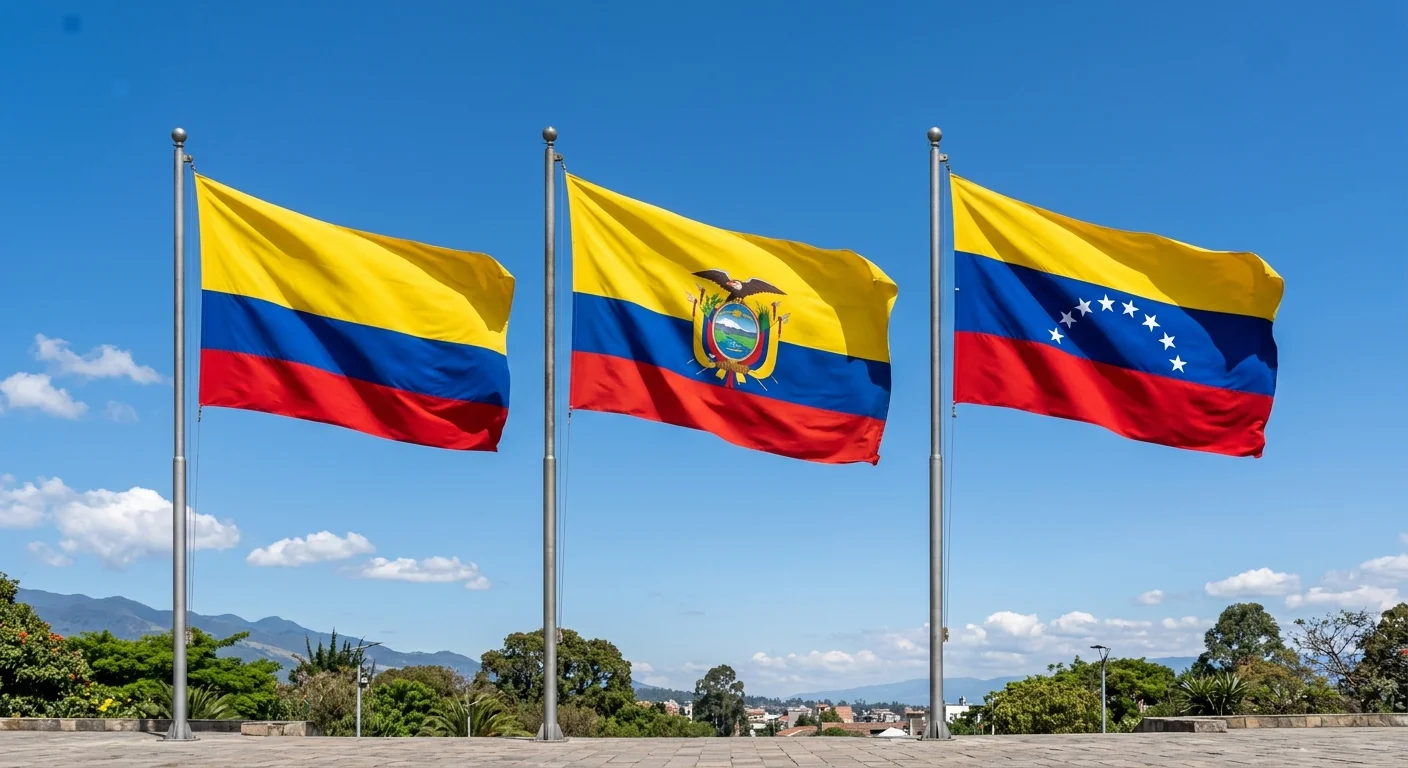
Three flags. Same three colors. Arranged in the same horizontal order. Mixed them up before? You're not alone — and you're about to fix that for good.
Here's everything laid out clearly:
| Feature | Colombia | Ecuador | Venezuela |
|---|---|---|---|
| Stripe Ratio | 2:1:1 (yellow = top half) | 2:1:1 (yellow = top half) | 1:1:1 (equal thirds) |
| Central Emblem | None | Coat of arms | 8 stars in an arch |
| Blue Shade | Standard | Lighter blue | Dark blue |
The One-Sentence ID Guide for Each Flag
Colombia is the minimalist. No stars, no emblems, no frills — just clean geometry. A wide yellow stripe on top, a medium blue stripe in the middle, a medium red stripe at the bottom. That's it. Plain, simple tricolor.
Ecuador is the complicated one. Same stripe proportions as Colombia, but add a full coat of arms dead center and you've got Ecuador. That emblem carries a lot — it features Mount Chimborazo, a river steamboat, and an Andean condor perched on top like it owns the place. Ecuador locked in this coat of arms in 1900 to stop being confused with Colombia. It helped. Sort of.
Venezuela broke away from the formula. The stripes are equal width — no double-yellow. Eight stars sit in an arch across the blue band, each one representing an independent province. Venezuela also shifted to a darker shade of blue after Gran Colombia dissolved in 1831.
The Five-Second Cheat Sheet
Stars
Venezuela
Coat of Arms
Ecuador
Plain
Colombia
The colors — yellow for natural wealth, blue for ocean and sky, red for the blood of patriots — are the same across all three flags. That shared palette is no accident. All three countries inherited it from the same revolutionary roots.
This is also why professional Ecuador Flags manufacturers pay close attention to emblem detailing, while Venezuela Flags wholesalers prioritize correct star alignment and stripe ratios to meet official specifications.
How to Tell Them Apart in 5 Seconds: A Quick Identification Guide
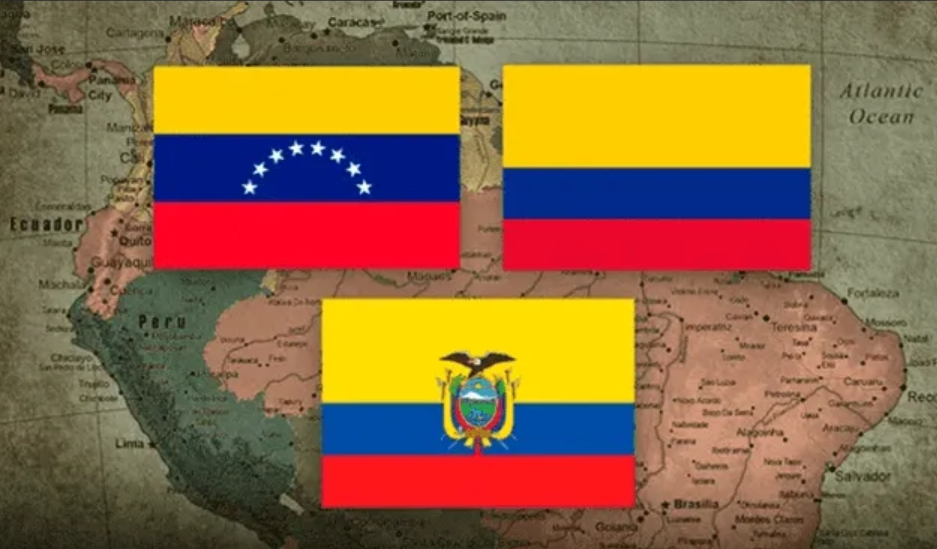
Good news: your brain already has everything it needs. Pick one anchor point per flag — one visual hook that sticks — and the confusion disappears.
Think of it like learning to tell identical twins apart. Once you spot that one has a scar above their eyebrow, you never mix them up again. These flags work the same way.
Find Your One Anchor Per Flag
1
Look for stars
A curved arch of eight stars sitting in the blue stripe means you're looking at Venezuela. Full stop. No other flag in this trio has stars. Done.
2
Look for a busy center
The flag is covered with a colorful, detailed emblem right in the middle? That's Ecuador. That's Ecuador's coat of arms — a condor with wings spread wide, like it's delivering a speech about Andean sovereignty.
3
Nothing on the flag — it's Colombia
Colombia never needed decoration. Just three clean stripes. Pure simplicity.
The Mental Shortcut That Works
Stars → Venezuela. Stuff → Ecuador. Nothing → Colombia.
For event organizers and resellers, sourcing from reliable wholesale national flags channels ensures these visual distinctions are accurately reproduced — especially when multiple similar flags are displayed side by side.
Drill that three-word pattern once. That's all it takes. Three similar flags show up on screen — at the Olympics, at a summit, in a geography quiz — your eyes will know where to land. No hesitation.
The Evolution of Each Flag After Gran Colombia's Dissolution
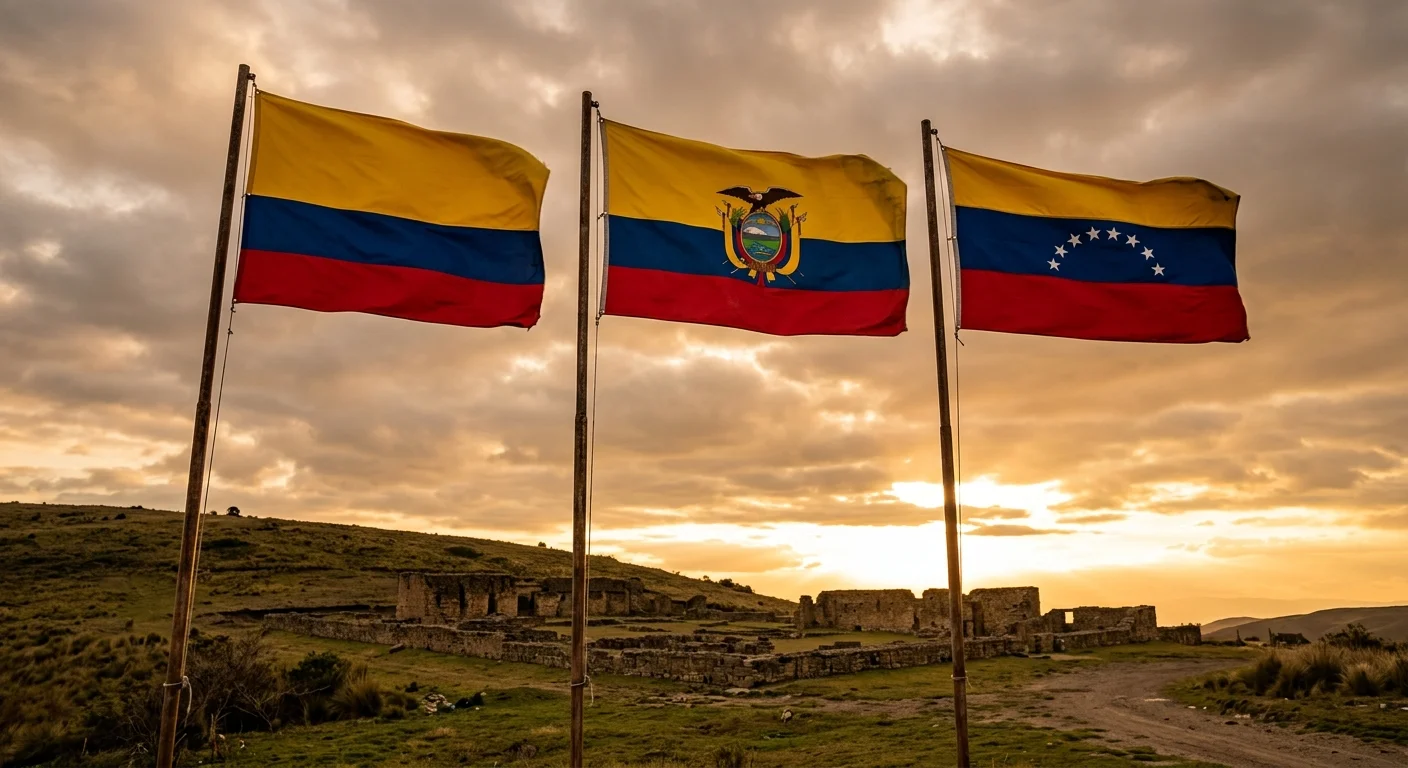
Gran Colombia lasted about as long as a college friendship group. By 1831, the whole thing had collapsed. Three separate nations stood in the rubble — each one clutching the same yellow-blue-red color palette like inherited furniture nobody knew what to do with.
What happened next is genuinely fascinating. Each country took the same raw material and pulled it in a different direction. Not a radical departure. Just enough to say we're us, not them — which is, at its core, the entire project of nation-building.
Venezuela: Stars, Equal Stripes, and One Presidential Power Move
Venezuela came out of 1831 with a horizontal yellow-blue-red tricolor and a coat of arms in the center. Standard enough. But over the next century and a half, things shifted.
The stripes got equalized. Gran Colombia's original 1819–1820 design used a 2:1:1 ratio — a wide yellow top stripe dominating the composition. Venezuela dropped that and went with equal thirds instead. Each stripe the same width. A clean, democratic geometry that Colombia never adopted.
Then came the stars. Seven of them, arranged in an arc across the blue stripe, representing Venezuela's original independent provinces. That arc became the flag's defining visual signature.
In 2006, Hugo Chávez added one more star. Seven became eight. The official justification was historical — recognizing the province of Guayana. Critics called it a political move. Either way, Venezuela's flag today carries eight stars in that blue stripe arch. That detail sets it apart from every other flag in this group at a glance.
Colombia: The Late Horizontal Turn
Here's a counterintuitive fact: Colombia's most recognizable flag design wasn't finalized until 1861 — thirty years after Gran Colombia dissolved.
Right after 1831, the Republic of New Granada (Colombia's direct predecessor) kept the familiar colors but arranged them vertically — a red-blue-yellow vertical tricolor. It looked nothing like what you'd recognize today.
The horizontal flip happened on November 26, 1861, under President Tomás Cipriano de Mosquera. The layout was standardized into horizontal stripes: yellow on top taking up 50% of the flag's total height, with blue and red each claiming 25% below it. Aspect ratio locked at 2:3.
Colombia made one deliberate choice — and kept it. The civil flag carries no emblem at all. No coat of arms. No stars. Nothing in the middle. Just three stripes doing their job in silence. A coat of arms exists for formal state occasions, but the everyday Colombian flag is pure geometry. That restraint turned out to be the flag's most recognizable quality.
Ecuador: The Slow Addition of Identity
Ecuador's path was the most gradual. Coming out of 1831, its flag was a clean horizontal tricolor — yellow, blue, red — no emblems, no frills. Hard to tell apart from what Colombia would later standardize.
For decades, that was fine. Then the two countries grew into distinct nations with distinct stories. The confusion started to matter.
Ecuador's answer arrived in 1900: a formal coat of arms, centered on the flag. That emblem packed in Mount Chimborazo, an Andean condor with wings spread wide, laurel branches, and palm fronds. It wasn't decoration — it was a declaration of specific identity. A visual argument that Ecuador was not, in fact, Colombia.
Ecuador also uses lighter shades of yellow and blue compared to Colombia. The difference is subtle enough to miss unless the flags hang side by side.
The stripe proportions — yellow at 50%, blue and red at 25% each — match Colombia's exactly. But the coat of arms makes confusion close to impossible once you know to look for it.
Three countries. One dissolved federation. Three different decisions about what to keep, what to change, and what to add. Today, many brands and institutions rely on custom flags services to recreate these historical variations — from precise stripe ratios to emblem placement — without compromising authenticity.The flags today are the result of those choices — built across decades, sometimes by presidents, sometimes by legislatures, and at least once by a controversial head of state determined to leave his mark on national symbolism.
Other Countries Inspired by the Gran Colombia Tricolor Legacy
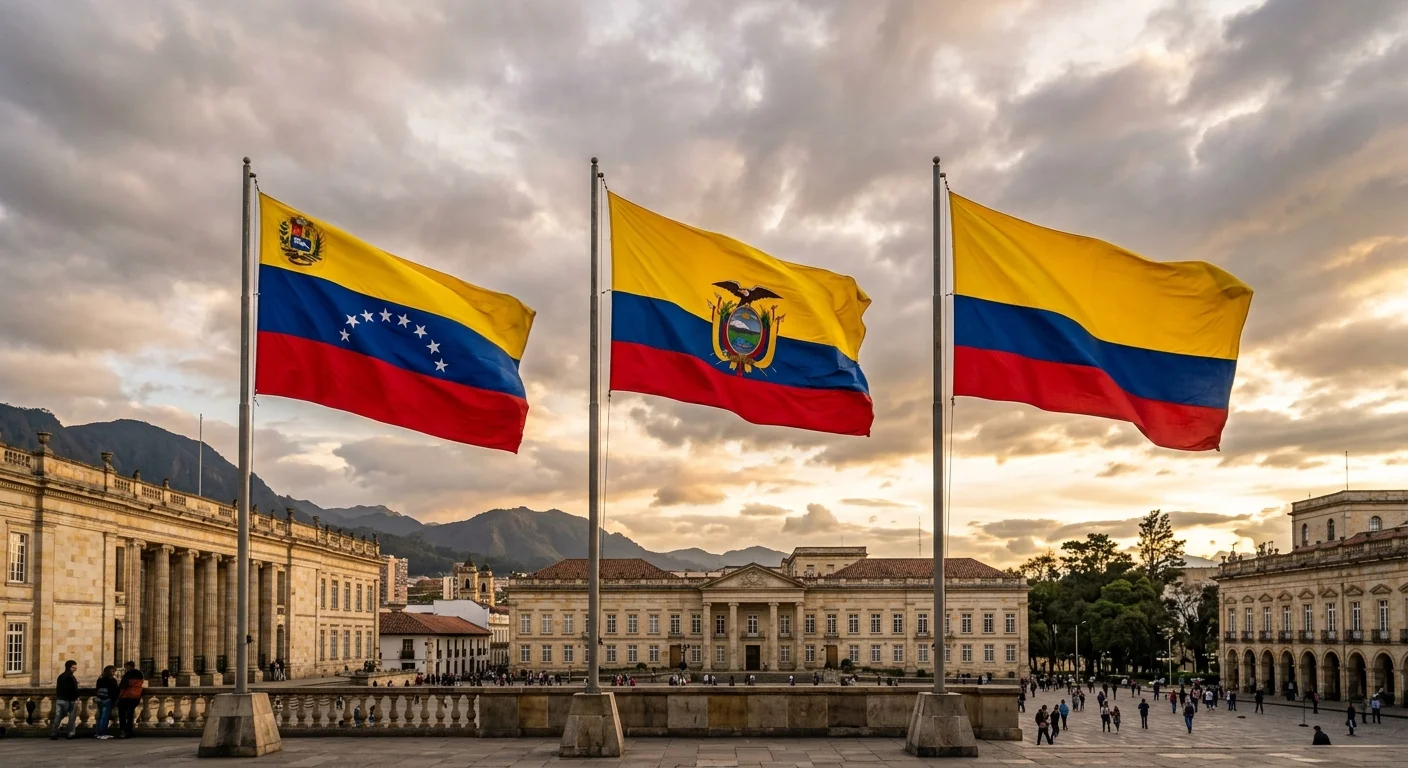
Gran Colombia lasted just twelve years. But the flag it left behind? That thing has legs.
The federation collapsed in 1831. It didn't split into three countries — it split into three countries that each kept the same color palette, the same horizontal layout, and a near-identical stripe logic. Then a fourth country joined the club seventy years later. Panama broke away from Colombia in 1903. Early Panamanian flag versions carried tricolor echoes before the country went its own separate direction.
So the final count of nations with a direct bloodline to Francisco de Miranda's 1801 design: four. Colombia, Ecuador, Venezuela, and Panama — all successors to a republic that no longer exists. All carry design DNA from a flag adopted by a congress on December 17, 1819.
That's not nothing. Out of 20-plus nations in Latin America, four trace their flag's core palette back to one revolutionary's color theory. That's a lasting footprint for a country that dissolved before most people alive today were born.
The Central American Federation (1823–1841) left a similar ghost imprint. Guatemala, Honduras, El Salvador, and Nicaragua all inherited its blue-white-blue horizontal striping. Same story, different region. Federal unions fall apart. The flags stick around.
History's weird that way.
Pro Tip: Ordering flags for international events? Browse our national flags collection for bulk pricing on country-specific designs with guaranteed accuracy.
What Flag Colors & Design Tell Us About National Identity
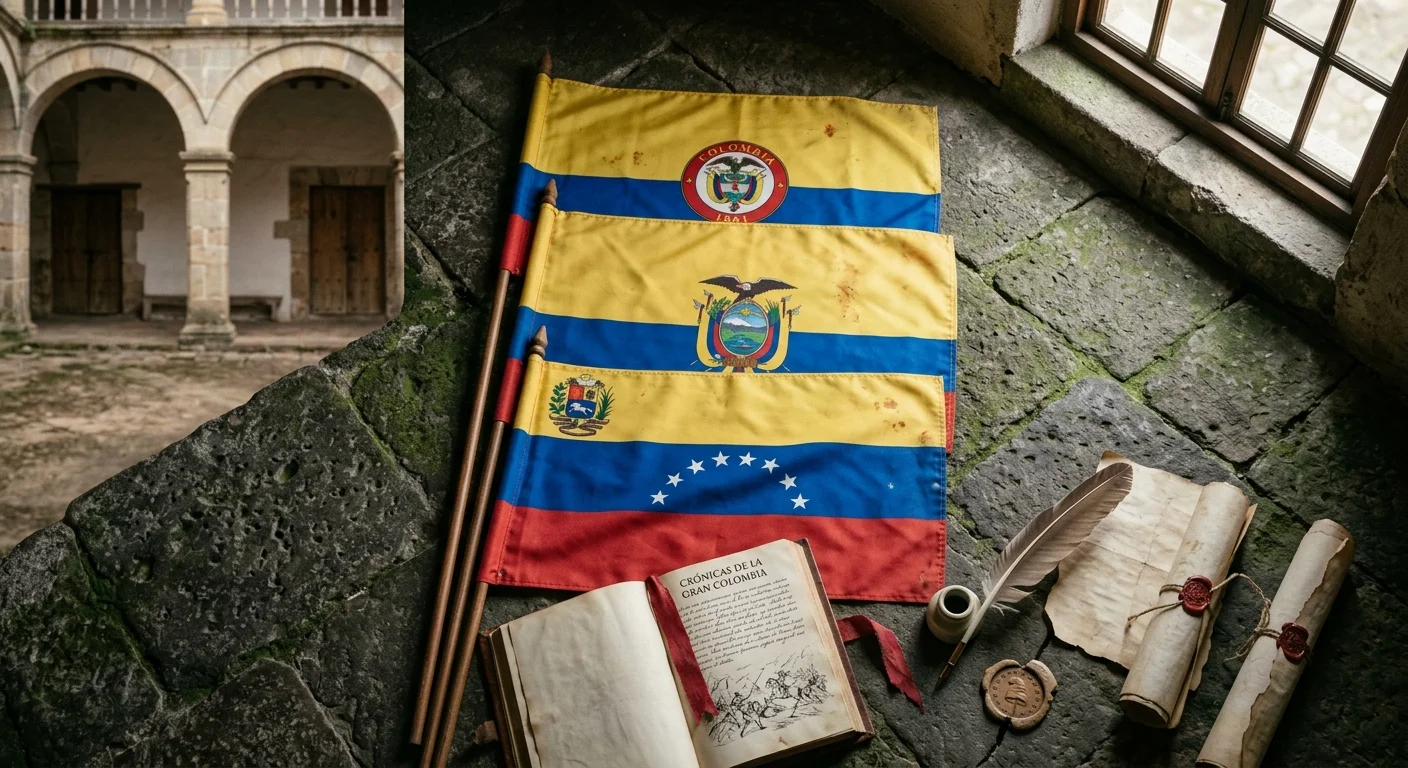
Flags are not decoration. They're compressed history — centuries of war, revolution, and national argument packed into three colors and a rectangle.
Every color on every flag means something specific. Vexillologists — people who study flags for a living, which is a real job — have mapped this out in detail. Red signals strength and courage across most cultures. Blue carries justice and perseverance. Yellow or gold represents wealth and natural resources. Green signals land, fertility, and independence. These aren't random associations. Committees, generals, and revolutionaries chose these colors. They knew that symbols do psychological work that words can't.
The yellow-blue-red triad shared by Colombia, Ecuador, and Venezuela fits this pattern well. Miranda named those meanings when he designed the flag in 1801:
Yellow
The vast natural wealth of the continent
Blue
The two oceans and the sky above a people claiming freedom
Red
The blood of every person who died making that freedom real
That's not poetic retrofitting after the fact.
Here's what's striking about shared flag colors: they do something real to the people who see them.
Research on flag psychology finds that exposure to national flags increases in-group trust by 10–15%. Subliminal flag priming in one Israeli study narrowed the political gap between opposing groups by 20%. In India, flag-color priming caused Hindu participants to donate 12% more to Muslim minorities. Flags activate a sense of shared identity that cuts through other divisions — even without people noticing.
10-15%
In-Group Trust Increase
20%
Political Gap Narrowed
12%
Cross-Group Donation Rise
For Colombia, Ecuador, and Venezuela, that shared palette isn't just a historical footnote. It's an active psychological signal. Three separate nations. One collective memory of colonial resistance, stitched into the same three colors.
The North American Vexillological Association lays out five design principles:
Rule 1
Keep it simple
Rule 2
Use meaningful symbolism
Rule 3
Limit to 2-3 colors
Rule 4
Avoid lettering
Rule 5
Be distinctive
These five rules explain why these flags each hold up on their own — even though they look nearly identical at first glance. Each flag satisfies all five. The similarities come from shared heritage. The differences — a condor, eight stars, or plain empty stripes — are where each country's identity quietly steps forward.
That's the whole game. The colors say we came from the same place. The emblems say but we are not the same country.
That same principle drives modern flag production, where a trusted national flags factory must balance shared heritage designs with country-specific details that define identity.
FAQ: Common Questions About Colombia, Ecuador & Venezuela Flags
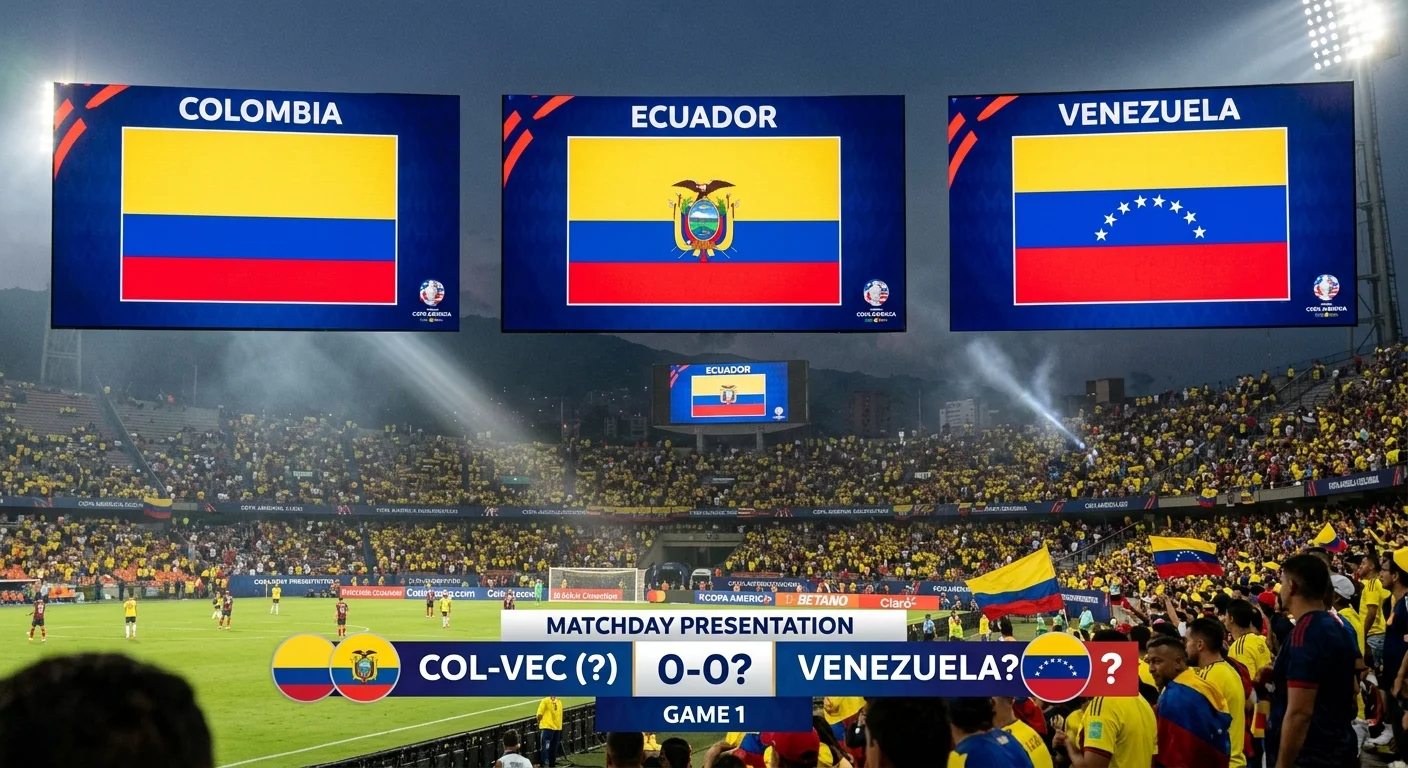
Flag confusion is not a niche problem. At the 2022 Copa América, ESPN broadcast a match featuring Colombia — and put Venezuela's eight-star flag on screen instead. Twitter lost its mind. Someone in the comments wrote "Gran Colombia lives" and got 4,000 likes. This stuff matters to people.
Here are the questions that come up every time.
Why do Colombia, Ecuador, and Venezuela have such similar flags?
Because they used to be the same country. Francisco de Miranda designed the original yellow-blue-red tricolor in 1801. Gran Colombia adopted it in 1819. The federation broke apart in 1831. Three nations walked out carrying the same color palette. Nobody gave it back.
The one-sentence version: Shared flag = shared origin. Gran Colombia split up. The colors didn't.
Which flag has a coat of arms — Colombia or Ecuador?
Ecuador. Always Ecuador.
Ecuador's official flag puts a full coat of arms right in the center — a condor, Mount Chimborazo, a river steamboat, laurel branches. The works. Colombia's everyday flag has nothing. Clean stripes, no emblem. A Colombian coat of arms exists, but it shows up only in formal government settings. On the street, on the pitch, in the crowd — Colombia's flag is pure geometry.
Both flags use the same 2:1:1 stripe ratio (yellow takes up half the flag). That's the trap. Same proportions, but the visual weight is totally different.
Memory shortcut: Ecuador has a condor on it. Colombia has nothing on it. One word per flag.
What do the eight stars on Venezuela's flag represent?
Seven original provinces signed the 1811 Declaration of Independence — Caracas, Cumaná, Barinas, Margarita, Barcelona, Mérida, and Trujillo. That gave you seven stars. Then in 2006, Hugo Chávez added an eighth star for the province of Guayana, which joined in 1817. Historians pointed to the historical basis. Critics pointed to the timing. Either way, eight stars is now the official count.
Venezuela also uses equal-width stripes — 1:1:1 — not the 2:1:1 ratio Colombia and Ecuador share. So: same three colors, different proportions, stars on the blue band. That's Venezuela's whole visual identity, in short.
Memory shortcut: 8 stars, equal stripes. Both things are Venezuela.
Do these flags get mixed up at sporting events?
All the time. During the 2014 World Cup, media outlets used Ecuador's emblem-bearing flag to represent Colombia. FIFA had to issue a clarification about stripe proportions and the missing coat of arms. The 2022 Copa América ESPN incident wasn't a one-off. It's a repeat problem any time these three nations compete in the same tournament bracket.
The irony is that the confusion keeps proving the historical point. Three flags look alike because three countries share one origin. Every mix-up is an accidental history lesson.
Conclusion
Three countries. One revolutionary dream. A flag that refused to fade.
The yellow, blue, and red stripes connecting Colombia, Ecuador, and Venezuela are no design accident. They are a 200-year-old mark left by Francisco de Miranda and Simon Bolivar's bold vision of a united South America. Gran Colombia fell apart, but its tricolor lived on. Each nation kept it woven into their identity — like a shared heirloom no one was willing to return.
Now you can spot the coat of arms differences in five seconds flat. That makes you a reliable identifier of Latin American flags — a more useful skill than it sounds.
Here's the thing: flags carry weight . Every stripe, every symbol, every proportion is a deliberate choice. It tells you who a people are and where they came from.
Feeling inspired? At RunCustomFlag.com, you can bring that same intention into your own custom national flag. Your story deserves its own colors.
Video Guide
Related Articles