The Fundamental Difference: How Each Printing Method Works
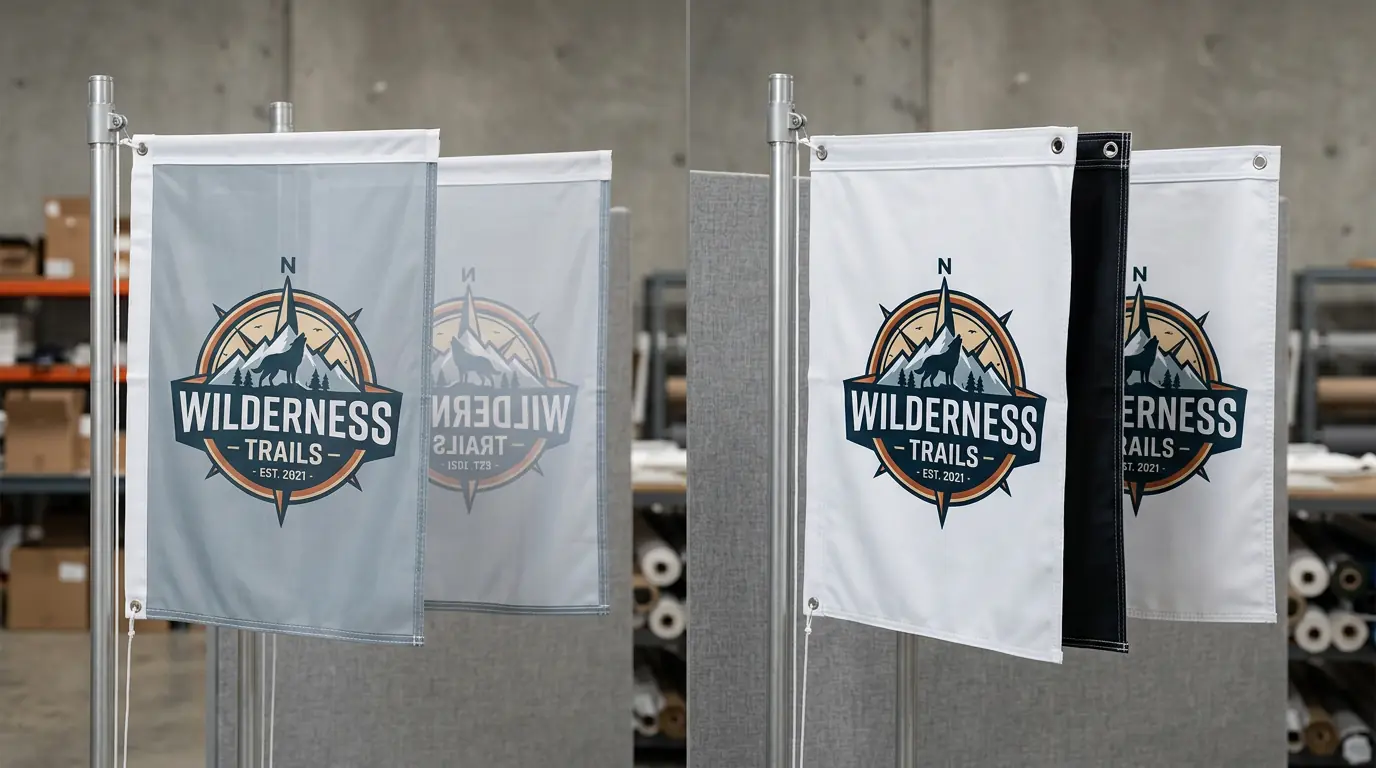
The question of single-sided versus double-sided flag printing comes up constantly in wholesale sourcing, and the confusion is usually because buyers are comparing two things that look similar on a spec sheet but perform completely differently in use. Understanding the physical construction difference first makes everything else — pricing, durability, application decisions — much clearer.
Single-sided flags print on one layer of fabric. The image is vibrant and sharp on the face side; on the reverse, it shows through as a mirror image at reduced color saturation. How much show-through you get depends on the fabric weight — lighter fabrics (90gsm) show more bleed-through, heavier fabrics (110gsm) show less, but even at the heavier end, some reverse visibility is always present. For most applications where the flag hangs against a wall or pole with one primary viewing direction, this is functionally irrelevant. For applications where the flag is viewed from multiple directions, it is not.
Double-sided flags use two layers of fabric with a blockout liner sewn between them. Each side shows the correct image independently — no mirror reverse, no color bleed-through. The blockout liner is the key cost driver: it adds material cost, adds manufacturing steps, and increases the total fabric weight to typically 290gsm or higher. That weight increase has implications for how the flag behaves in wind, how it ships, and how long it lasts under different conditions.
The practical takeaway: roughly 65% of flags sold are single-sided, and that proportion reflects real market demand rather than buyers settling for less. Single-sided is not a budget compromise — it is the correct specification for a large majority of applications. The question is whether your specific use case is in that majority or not.
Cost Comparison: Single vs Double-Sided
Double-sided flags cost roughly twice as much as single-sided equivalents in the same size and fabric. That ratio holds reasonably well across manufacturers and sizes, though at higher quantities the gap can narrow. The cost components driving that difference are real: two layers of printed fabric instead of one, a blockout liner material in between, more complex assembly and sewing labor, and higher finished weight which increases shipping cost.
At small quantities — under 25 units — the per-unit cost difference is most visible. The price premium for double-sided construction at low volumes can run 80-100% above single-sided. At larger quantities — 50-100 units and above — bulk discounts of 20-50% apply to both types, but double-sided pricing at bulk still typically exceeds single-sided retail pricing for the same flag. Volume does not close the gap; it just makes both options cheaper proportionally.
For buyers evaluating the cost difference, the question to ask is not "can I afford double-sided?" but rather "does my application require it?" If the answer is no, buying double-sided because it feels more premium is not a business decision. If the answer is yes, the premium is justified and should be built into your pricing from the start. To get specific pricing for your volume and specifications, you can request a free custom flag quote with the details of your order.
Visibility And Quality: The Real Trade-Offs
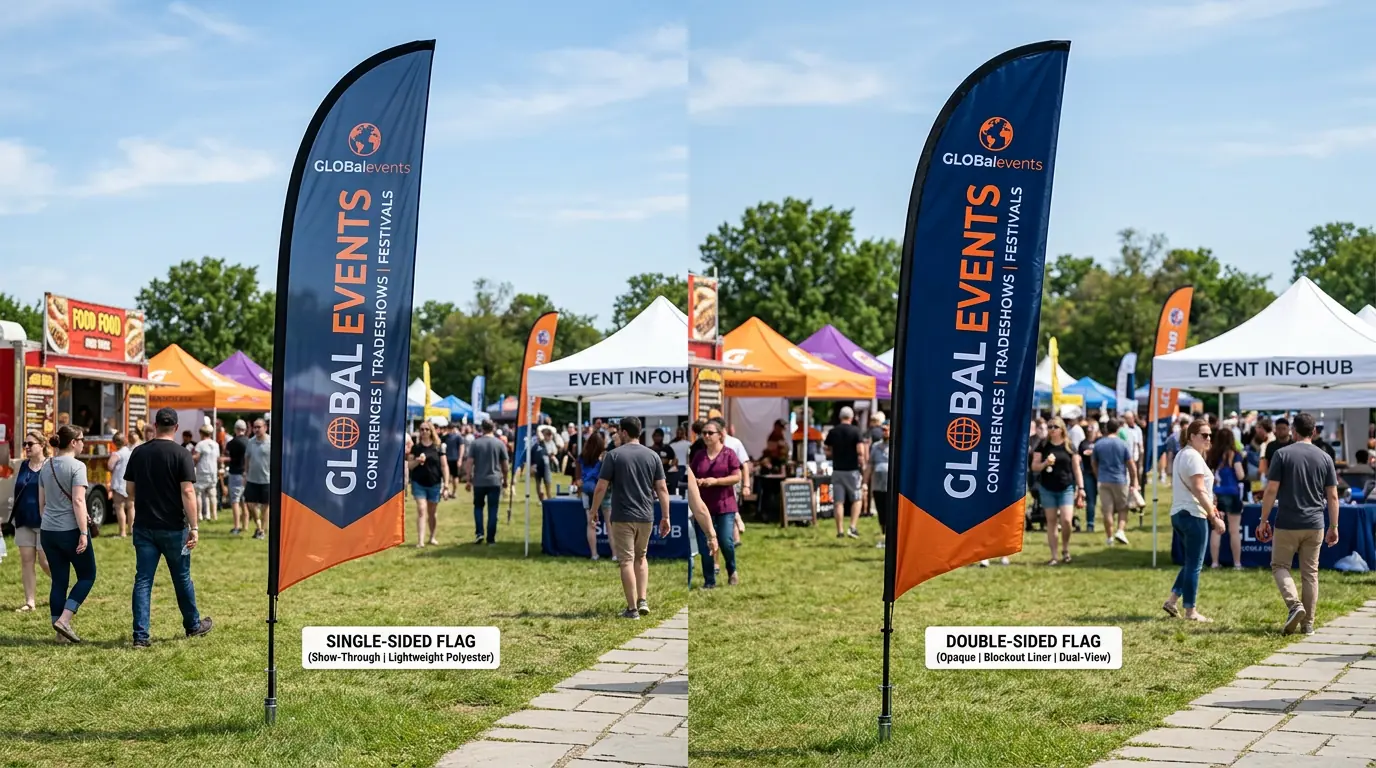
Single-sided dye-sublimation printing at 1440 DPI produces excellent color saturation and detail on the front face. The reverse side shows the mirror image at reduced intensity — how much reduced depends on fabric opacity and lighting conditions. In bright backlit conditions (direct sun behind the flag), the show-through is most visible. In overcast conditions, indoors, or with a solid background behind the flag, the difference between front and back is much less noticeable in practice.
Double-sided flags show the correct image on both sides with full color intensity. For flags with text, logos with non-symmetric elements, or directional graphic elements, this is a binary requirement, not a preference. A national flag that must read correctly from both sides of a street pole needs double-sided construction. A company logo flag with asymmetric text would be unreadable from the reverse on a single-sided flag.
There is one durability trade-off that often surprises buyers: double-sided flags, despite their higher material cost, do not necessarily last longer outdoors. The additional weight (290gsm+ versus 90-110gsm) means more stress on the fabric in wind, and the additional seam complexity creates more potential failure points. In high-wind locations, single-sided flags often outlast double-sided equivalents because they fly more freely and flex with the wind. The heavier double-sided construction performs better in low-wind, stationary display applications. To understand what flag materials and printing capabilities are available for either construction type, reviewing your options before specifying is worthwhile.
When Single-Sided Is The Right Choice
The majority of flag applications are correctly served by single-sided construction. The clearest cases: flags mounted against a wall or fence where the reverse is never visible, event applications where viewers approach from one direction, trade show booth setups with a back panel behind the flag, and roadside signage where traffic approaches from one direction. In all of these, the show-through issue is practically irrelevant and paying the double-sided premium provides no measurable benefit to the client.
Wind behavior is another factor that often tips the decision. Lighter single-sided flags (90-110gsm) create better flutter and movement in moderate breezes, which increases visual attention. If your application is designed to attract attention through flag movement — retail storefronts, car dealerships, outdoor advertising — a single-sided flag in a lighter fabric may actually perform better than a double-sided flag that sits more heavily in the same wind conditions. Feather flags and teardrop banners are almost exclusively single-sided for exactly this reason. For buyers sourcing wholesale feather flags for outdoor advertising, single-sided is the standard construction that makes those formats work as attention devices.
Temporary events lasting one to three days, test orders for clients who have not yet committed to a permanent setup, and budget-constrained projects where cost matters — all of these are appropriate single-sided applications. For the full range of wholesale advertising flags for business campaigns, single-sided construction is the production standard and works well for the vast majority of promotional contexts.
When Double-Sided Is Worth The Extra Cost

The clearest double-sided requirements: street pole banners where pedestrians and vehicle traffic pass on both sides, building facade flags visible from the street in both directions, and flags at entry points where the approach direction varies. In any of these contexts, a single-sided flag is not a cost-efficient alternative — it is the wrong product for the application.
Corporate events and trade shows where brand professionalism is being assessed directly are another strong case. Not because single-sided looks bad — it does not — but because the visible construction quality of a properly made double-sided flag with a clean blockout finish signals an investment level that clients notice. For a corporate client spending significantly on an event presence, the flag construction is part of the brand signal. A branded company flag supplier specializing in corporate applications will typically recommend double-sided for any client-facing permanent installation.
For permanent outdoor installations designed to last multiple seasons in a protected, low-wind location, double-sided construction can deliver better value over 18 months than a replacement cycle of single-sided flags. The key qualifier is "low-wind" — in exposed locations, that longevity assumption does not hold. For wholesale country flags from a certified factory, diplomatic and government contexts almost always specify double-sided construction as a standard requirement regardless of wind exposure.
Making The Decision: A Practical Buying Framework
Before specifying single-sided or double-sided, answer three questions: Will this flag be viewed from both sides by the intended audience? Is this a permanent or long-term installation in a low-wind location? Is the brand quality signal of the flag itself being evaluated by the client or their customers?
If the answer to all three is no, single-sided is the correct specification. If the answer to any one is yes, evaluate double-sided on that dimension specifically — not as a blanket upgrade. A trade show booth flag with a back panel behind it does not need double-sided regardless of how expensive the event is. A street pole banner in a downtown retail district needs it regardless of budget constraints.
For national flags specifically: diplomatic and government protocols almost always require double-sided construction. Promotional and event use accepts single-sided. The sensible approach for buyers sourcing both contexts simultaneously is a hybrid order: double-sided for permanent or protocol-sensitive installations, single-sided for events and temporary applications. That split manages the cost profile without over-specifying across the board. To understand the ordering process when mixing specifications, the OEM flag ordering process from design to delivery covers what to document before production. For custom flag manufacturing that accommodates mixed specifications across a single order, working with a manufacturer experienced in both construction types is the most efficient approach.