That flag on your front porch has been up for a while now. Maybe the red stripes look more salmon than crimson. Maybe the fly end is starting to look like it lost a fight with a weed whacker. You want to display it proudly, but at some point, a worn flag stops being a sign of patriotism and starts being a sign of neglect. The U.S. Flag Code does not give you a specific expiration date — it simply says a flag should not be displayed when it is "no longer a fitting emblem for display." That leaves the judgment call to you, and most people wait too long to make it.
Knowing when to replace a flag matters because continuing to fly a tattered, faded, or stained flag does the opposite of what you intend. And once you do retire it, there is a right way to do that too. Here are the five clearest signs it is time, and what to do next.
5 Signs At a Glance
Faded colors beyond recognition, fraying past the fly end, visible daylight through fabric, permanent mold or stains, and failing grommets or header — if any one of these applies, your flag needs to come down.
Sign 1: The Colors Have Faded Beyond Recognition
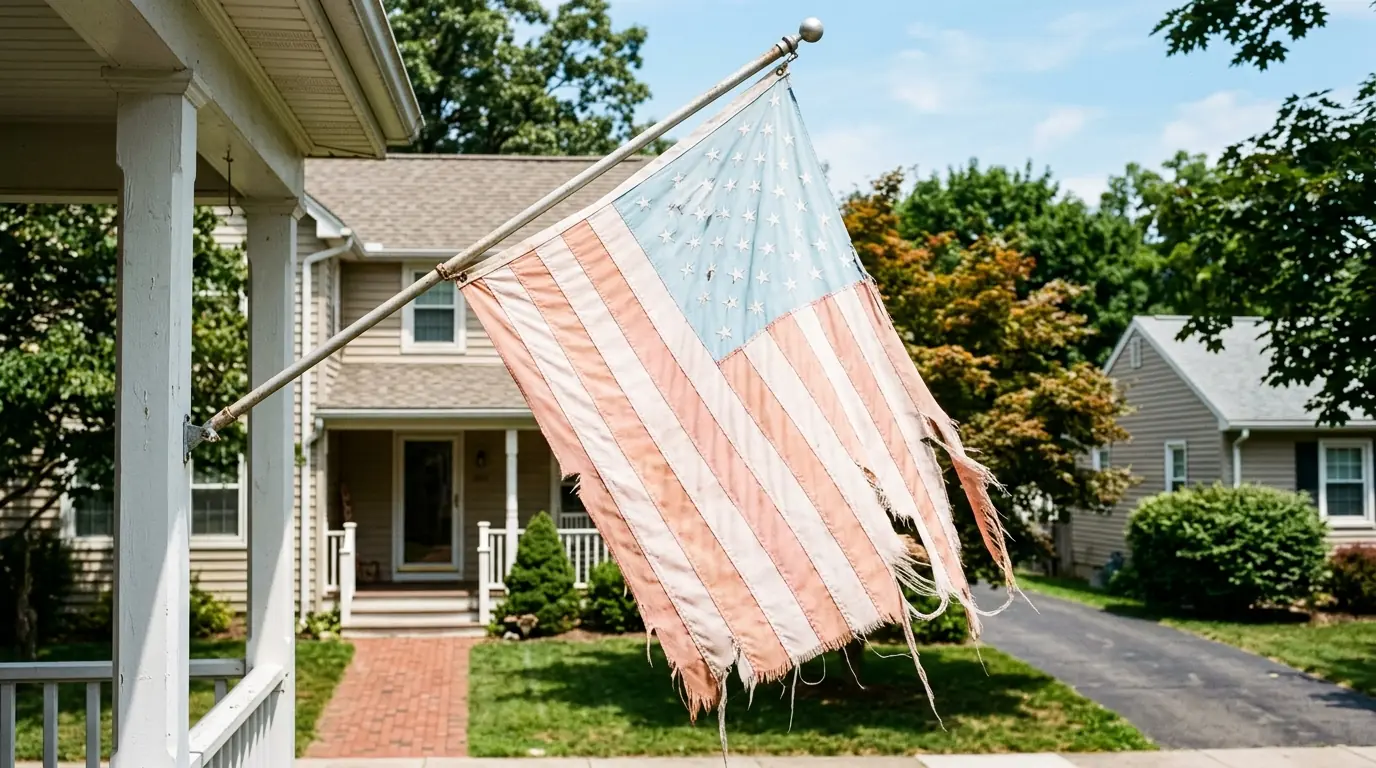
Fading is the most gradual change, which is exactly why it sneaks past people. You see your flag every day, so the shift from deep red to washed-out pink happens in such small increments that your eye adjusts. The real test is simple: hold a new flag next to yours. If the contrast is jarring, your flag has been telling you something for weeks.
UV damage is the primary driver here, and it does not treat all materials equally. Nylon fades faster than polyester because polyester contains UV inhibitors that slow the breakdown of dye molecules. A nylon flag facing south in direct sun can start losing color integrity within three months. Polyester buys you more time, but no fabric holds its color indefinitely under sustained UV exposure.
Some flags are marketed as "UV-resistant," and they do last longer — but that label means delayed fading, not permanent color. If your flag has been up for six months or more without rotation, pull it down and compare it against an official color reference. When the blue canton looks gray and the red stripes have gone pink or orange, you are past the threshold. No amount of washing brings faded dye back.
Sign 2: Fraying and Tearing Have Eaten Past the Fly End
The fly end — the free edge opposite where the flag attaches to the pole — takes the worst beating. Wind does not just wave a flag; it snaps it. That repeated whipping motion concentrates stress on the trailing edge, and over time, the fibers start to separate. A little fraying at the fly end is normal and almost inevitable with outdoor display. The question is how far it has gone.
Minor fraying can be trimmed and re-hemmed. A pair of sharp scissors and a sewing machine can buy you another month or two. Some manufacturers even recommend adding four rows of zigzag stitching along the fly end as a preventive measure when the flag is new — it acts as a backstop that slows the unraveling process. But once tears extend past roughly a quarter of the flag's width, or once ripping has created holes rather than just ragged edges, sewing patches will not hold. Wind will find the weak spot every time.
One thing worth checking that people overlook: your flagpole hardware. A rusted metal pole or splintered wooden pole acts like sandpaper on the fabric at the header. If you are burning through flags faster than expected, the pole itself might be the problem, not just the weather. Clean and inspect your hardware when you swap in a new flag.
Sign 3: You Can See Daylight Through the Fabric
This one requires no expertise to diagnose. Take your flag down, hold it up to the light, and look. If you can see through it — not at the seams, but through the fabric itself — the fibers have degraded to the point where the next strong wind gust could tear it apart without warning.
Fabric thinning happens when UV radiation and moisture break down the polymer chains in synthetic materials, or rot the cellulose in cotton. The flag loses weight, loses density, and loses strength. A nylon flag that has been flying continuously for six months or more will often show see-through spots, especially in the center panels where wind stress and UV exposure overlap. Cotton flags degrade even faster because they absorb moisture, which accelerates fiber breakdown.
No repair fixes this. You can stitch a torn seam, but you cannot restore tensile strength to degraded fabric. If the light test shows thinning, the flag is done — replace it before it shreds in a storm and ends up tangled in your neighbor's tree.
Sign 4: Mold, Mildew, or Stains That Will Not Come Out
Not every stain means retirement. A flag that caught some mud in a rainstorm can usually be hand-washed with mild detergent and cold water, air-dried, and put back up. The flags that need to come down permanently are the ones with damage that has penetrated the fibers themselves.
Black or green mold spots that survive a thorough cleaning mean the mold has colonized the interior of the fabric, not just the surface. A musty smell that persists after the flag is fully dry confirms it. Mold thrives in warm, damp, poorly ventilated conditions — and a flag that gets rained on and then sits folded in a box without drying completely is a perfect incubator. Rust stains that have migrated from corroded grommets into the surrounding fabric are another sign. The stain itself is cosmetic, but the corrosion that caused it usually means the grommets are failing too.
Important Warning
Do not use bleach. It seems logical for mold removal, but bleach damages both the dye and the fabric structure of most flag materials. If a gentle wash with mild soap does not remove the stain, the flag is telling you it is time. Wear gloves when handling a moldy flag — mold spores are not something you want on your skin or in your lungs.
Sign 5: The Grommets or Header Cannot Hold the Flag Securely
A flag with perfect colors and intact fabric is still unfit for display if it cannot stay on the pole. Grommets — the metal rings that attach the flag to the halyard or clips — fail in a few ways: they bend, they corrode, they crack, or they rip right out of the fabric because the surrounding material has worn thin.
Brass grommets resist corrosion far longer than steel ones, so if your grommets are rusting, they were probably steel and you should upgrade to brass on your replacement flag. DIY grommet replacement kits run about ten to fifteen dollars and can work well if you catch the problem early and the header fabric is still strong. But here is the judgment call most people get wrong: a torn header is not just a grommet problem. If the reinforced strip along the pole-side edge is ripping, the entire flag has been under enough stress that the rest of the fabric is likely compromised too. Replacing grommets on a flag with a torn header is like putting new tires on a car with a cracked axle.
A flag that keeps coming loose is also a safety concern. In high wind, a detached flag can tangle in power lines, wrap around poles, or become a projectile. If your flag is regularly pulling free despite properly installed hardware, the attachment points have failed and the flag needs to go.
Pro Tip: Upgrade to brass grommets and heavy-duty polyester for flags that last 2-3x longer. Contact us for custom flag options with reinforced headers.
How to Retire a Flag With Proper Dignity

Taking down a worn flag is the right call. Throwing it in the trash is not.
The U.S. Flag Code — specifically 4 USC Section 8(k) — states that a flag that is no longer fit for display should be "destroyed in a dignified way, preferably by burning."
That language is straightforward, but the practical execution has some nuances worth knowing.
The easiest option for most people is a drop-off. American Legion posts have been holding formal flag retirement ceremonies since 1937, and most posts maintain collection boxes where you can leave a worn flag year-round without needing to attend a ceremony. VFW posts offer the same service. Boy Scout and Girl Scout troops frequently participate in retirement ceremonies as community service projects, especially around Flag Day on June 14th. Some fire stations, post offices, and town halls also maintain collection bins, often in partnership with local veterans' organizations.
If you want to retire a flag yourself, a small private burning ceremony is appropriate — but only for cotton flags. Burning nylon or polyester releases toxic fumes that you do not want to breathe. For synthetic flags, cutting the flag into strips so that it no longer resembles a flag, then disposing of the strips, is an acceptable alternative. Some organizations will disassemble synthetic flags rather than burn them for exactly this reason.
Cotton Flags
Safe to burn in a private ceremony. The natural fibers produce no toxic fumes.
Nylon / Polyester Flags
Do NOT burn. Cut into strips until unrecognizable, then dispose of the strips separately.
Whatever method you choose, the point is intentionality. A flag that served its purpose deserves a deliberate send-off, not a trip to the landfill stuffed in a garbage bag.
How Long Each Flag Material Actually Lasts
Knowing the typical lifespan of your flag material helps you plan replacements before the flag reaches the embarrassing stage. The general benchmarks for continuous outdoor display break down like this.
3-6
Months - Nylon
6-12
Months - Polyester
Years
Indoor - Cotton
Nylon is the most popular residential flag material because it is lightweight and flies well in light breezes. The trade-off is durability: expect three to six months of continuous outdoor display before replacement signs appear. The U.S. government, which flies flags daily on public buildings, reports an average working life of about 90 days — roughly three months. That is with daily exposure to all weather conditions.
Polyester is heavier, which means it needs more wind to fly properly, but it holds up significantly better in harsh conditions. In moderate climates with occasional rather than daily display, a polyester flag can last six to twelve months. In high-wind or coastal environments, four to eight months is more realistic. The higher upfront cost is offset by needing replacement roughly half as often as nylon.
Cotton looks beautiful and has a traditional hand feel, but it is not built for sustained outdoor use. Moisture absorption accelerates every form of degradation — fading, mold, fiber breakdown. Keep cotton flags for indoor display or ceremonial use where they can last years.
Money-Saving Tip
Buy two flags and rotate them. Alternating display gives each flag recovery time and roughly doubles the functional lifespan of both. If you are flying a flag daily and do not want to think about it constantly, polyester with a rotation system is the most cost-effective setup over a two-year window.
Conclusion
The decision to replace a flag comes down to a honest look at five things: color fidelity, structural integrity at the fly end, fabric density, cleanliness, and hardware function. If any one of those has crossed the line, the flag should come down. If two or more have, you have probably waited longer than you should have.
If you are looking at your flag right now and genuinely cannot tell whether it is still acceptable, do the side-by-side test with a new one. The answer will be immediately obvious. And when you do take the old flag down, give it a proper retirement — an American Legion or VFW drop-off takes less than five minutes and closes the loop the right way.
Your next step is simple: inspect what is on your pole today. If it passes all five checks, make a note of when you put it up so you know when to check again. If it does not pass, order a replacement — polyester if you want longevity, nylon if you want it to fly in every breeze — and retire the old one before the weekend is over.
Video Guide
Related Articles