If you've been comparing quotes from flag suppliers and the pricing feels all over the place — $2 here, $18 there, $0.90 from some factory you found on Alibaba — you're not confused. The flags wholesale market is genuinely fragmented, and the price you pay depends less on the flag itself than on which supply channel you're buying from. A 3×5 ft polyester flag can cost anywhere from $1.50 to $39 per unit at wholesale, and both ends of that range are legitimate. The difference comes down to where it's made, what it's made of, and how many you're ordering. This article breaks down the actual supplier landscape, pricing mechanics, and the decisions that matter most — so you can stop comparing apples to freight containers and start building a sourcing strategy that fits your business.
[aiwriter engine="anthropic/claude-sonnet-4.6" id="225" name="自动写内容段落要求"]How the Flags Wholesale Market Actually Works
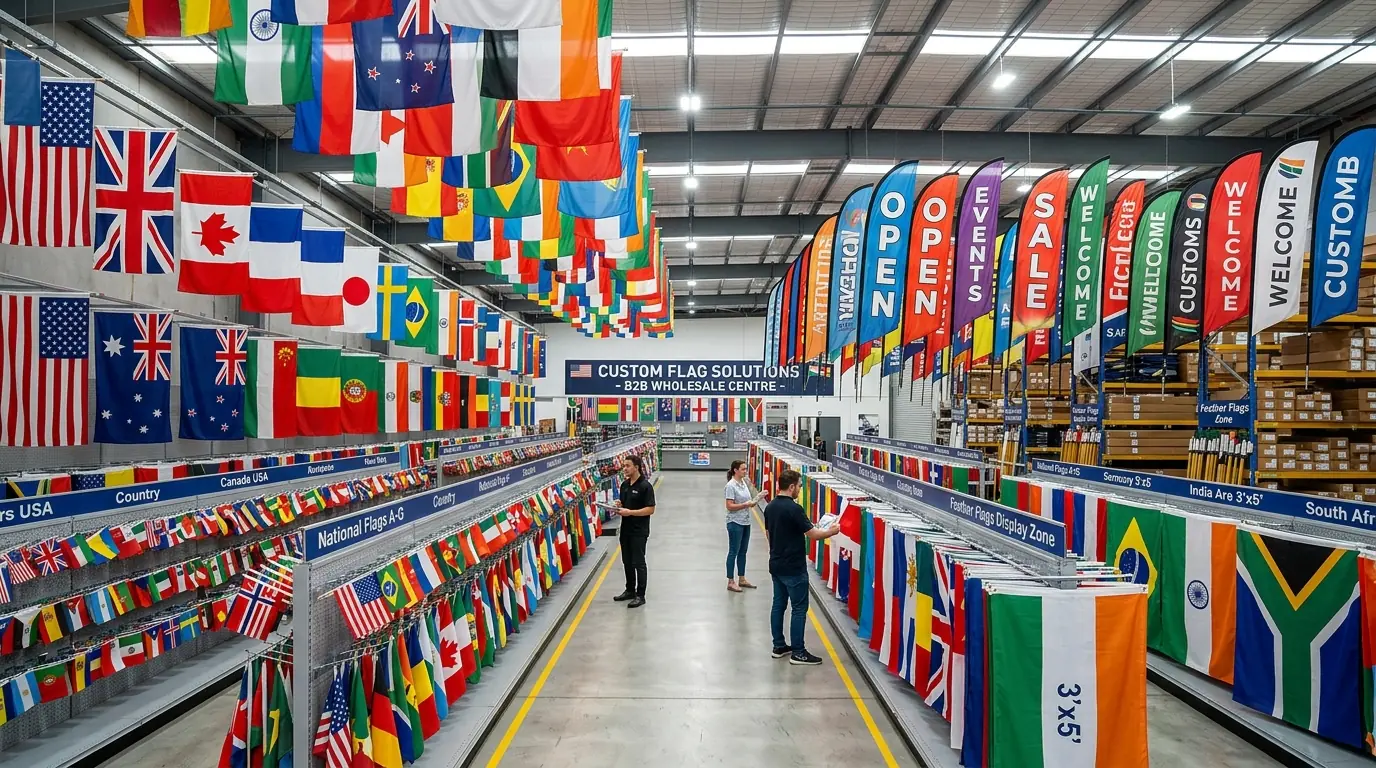
There are three supply channels worth understanding, and they don't compete on the same terms.
Domestic manufacturers — companies like Annin Flagmakers, Valley Forge Flag, and USA Flag Co — make flags in the US (or occasionally source from allied countries). Their strength is compliance: Berry Amendment eligibility, government spec adherence, American-made nylon with embroidered stars and sewn stripes. Pricing starts higher, typically $8–39 per unit for a standard 3×5 ft flag, but you're paying for a product that can go on a government building or into a retail channel where "Made in USA" matters. Lead times are usually two to three weeks for stock items, longer for custom.
Global importers and distributors — companies that warehouse China-made or India-made flags in US or European fulfillment centers — sit in the middle. They offer lower minimums (sometimes no MOQ at all for stocked items), faster domestic shipping, and prices in the $3–12 range. The tradeoff is less customization flexibility and thinner margins if you're reselling. United States Flag Store, for example, requires a $200 opening order and $1,000 in annual purchases to maintain wholesale pricing, plus a tax ID. That's a low bar, but it's designed to filter out one-time buyers.
Then there's direct-from-China factories — which is where we operate at RunCustomFlag. This channel makes the most sense when you're ordering custom flags in volume. Per-unit pricing for promotional or event flags at quantities above 100 can drop to $0.80–2.00, and for standard polyester flags, the $2–5 range is realistic. The catch is lead time (typically 10–20 days production plus shipping) and the need to manage quality expectations clearly upfront. If you're ordering 50 garden flags for a weekend market, this channel is overkill. If you're supplying a chain of 30 retail locations or running a large-scale event, the math changes fast.
The non-obvious thing here: wholesale pricing isn't just about per-unit cost. It's about whether your order profile matches the supplier's operating model. A domestic manufacturer optimized for government contracts won't give you competitive pricing on 500 promotional flags. A China factory optimized for bulk dye-sub printing won't make sense for 20 hand-sewn nylon flags. Mismatching your order to the wrong channel is the most common reason buyers feel like they're "overpaying."
[aiwriter engine="anthropic/claude-sonnet-4.6" id="225" name="自动写内容段落要求"]The Suppliers Worth Knowing — And What Each One Is Actually Good At
Annin Flagmakers gets mentioned in every wholesale flag article, and for good reason — they're the oldest and largest US flag manufacturer, and their products are the default for institutional buyers. If you're supplying to schools, municipal buildings, or military-adjacent retail, Annin is the safe choice. Their pricing isn't the lowest, but their consistency is hard to beat for sewn nylon American flags.
Valley Forge Flag occupies a similar tier but leans even harder into government compliance. They require an active customer number before you can even register for wholesale, which tells you something about who they're built to serve. If you don't already have a relationship with a Valley Forge distributor, the onboarding process can feel slow. Worth it for government contract fulfillment; not worth the friction if you're sourcing custom promotional flags.
Flag Guys is interesting for a different reason. At roughly $8.30 per flag when you buy a case of 60, they hit a sweet spot for small retailers and flagpole installation companies who need reliable American-made flags without committing to large volumes. That's not the cheapest per-unit price in the market, but the low case quantity makes it accessible.
For custom and promotional flags at scale — event banners, custom promotional flag manufacturer runs, branded custom feather flag manufacturer orders, corporate displays — the pricing equation shifts heavily toward China-based production. At RunCustomFlag, we handle orders ranging from a few hundred promotional flags to container-load quantities for distributors, and the per-unit pricing at those volumes is genuinely difficult for any domestic supplier to match, especially on dye sublimation and screen printing services for flags.
Bannerfi uses a tiered discount model that's transparent enough to be useful as a benchmark: 30% off at 10–49 units, 50% off at 200–499, and 70% off above 1,000. Those tiers roughly mirror what you'd see across the industry, though the base price they're discounting from matters more than the percentage itself.
[aiwriter engine="anthropic/claude-sonnet-4.6" id="225" name="自动写内容段落要求"]Where the Real Price Breaks Happen

Most buyers assume pricing scales linearly — order more, pay less per unit, simple. That's broadly true, but the savings curve isn't smooth. It has specific inflection points, and understanding where they fall can save you from ordering 500 units when 250 would have gotten you nearly the same per-unit price.
For standard 3×5 ft polyester flags, the biggest per-unit drop usually happens between 50 and 250 units. Below 50, you're absorbing setup costs (screen preparation, print file setup, color matching) that get amortized across too few pieces. Above 250, the savings per additional unit flatten out — you're still saving, but the incremental improvement shrinks. The jump from 50 to 200 units might cut your per-unit cost by 35–40%. The jump from 200 to 1,000 might only cut another 15–20%.
Nylon flags follow different math. Sewn nylon with UV treatment is labor-intensive, so the setup cost is a smaller proportion of total cost. NorthStar's published pricing illustrates this: 100 units at around $18.97 each, 1,000 units at about $11.38. That's a meaningful drop, but you need ten times the volume to get there. For most buyers, the 100–250 unit range is where nylon pricing becomes workable without tying up excessive capital in inventory.
The least intuitive pricing tier is promotional and event flags sourced from China. At quantities above 100, pricing can hit $0.80–2.00 per unit for single-sided polyester flags with digital printing. But here's what catches people: shipping costs at those volumes can represent 20–40% of the product cost itself. A $1.20 flag that costs $0.45 to ship is really a $1.65 flag. Always evaluate landed cost, not just the factory quote.
[aiwriter engine="anthropic/claude-sonnet-4.6" id="225" name="自动写内容段落要求"]Material Tiers — And Why the Cheapest Option Might Cost You More
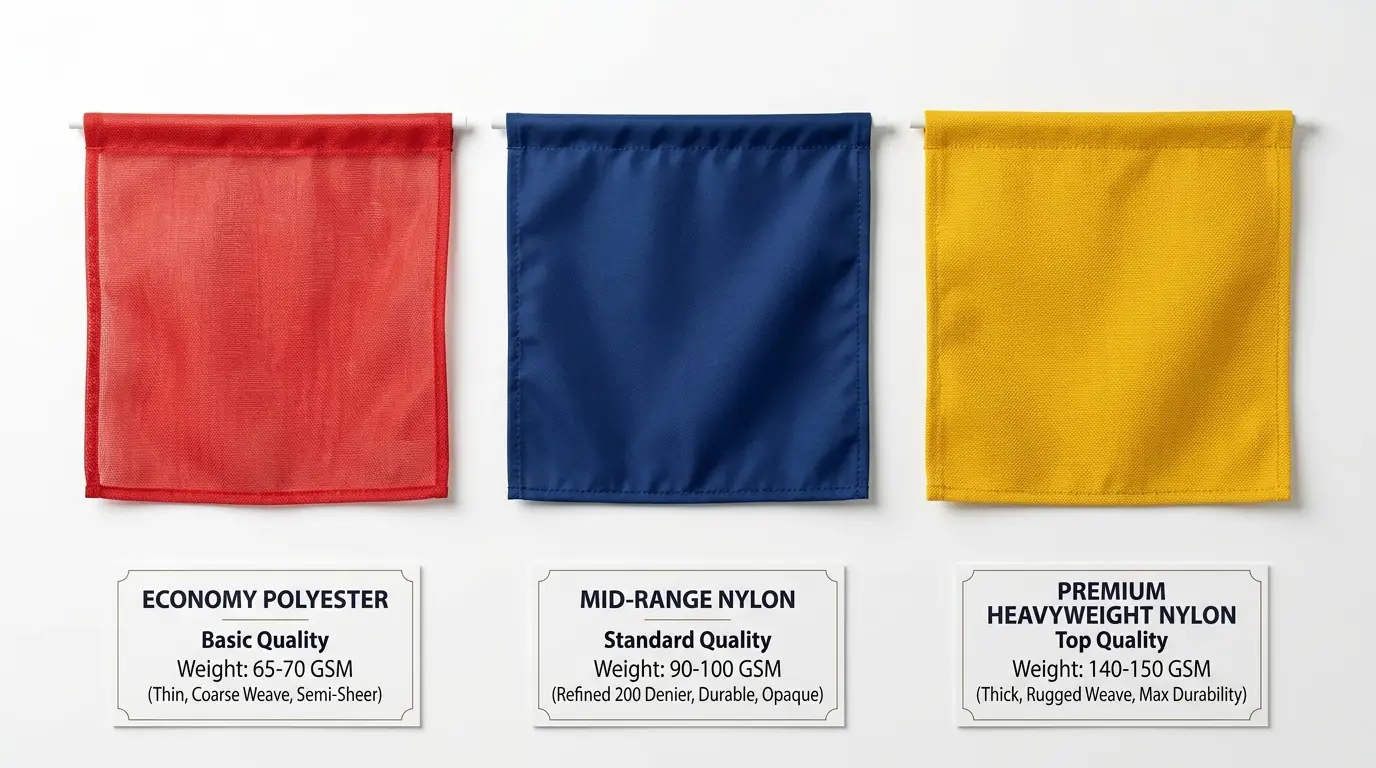
If you're buying flags wholesale and you think "polyester is polyester," you're about to learn an expensive lesson. The gap between economy-grade polyester and mid-range polyester is not subtle — it's the difference between a flag that looks acceptable for three months and one that holds up for years.
Economy polyester (90–110 GSM) is what most sub-$2.00 wholesale flags are made from. It prints well with dye sublimation, it's lightweight, and it catches wind easily. For a one-day event, a trade show, or a giveaway, it's perfectly fine. Expecting it to survive a full outdoor season is where problems start. UV degradation hits fast — you'll see noticeable fading within 8–12 weeks of continuous outdoor exposure. If your client is a car dealership flying flags daily, this tier will need replacing two or three times a year.
Mid-range options (150 GSM polyester or 200-denier nylon) are where most wholesale buyers should default for anything that stays outside longer than a few weeks. Nylon in particular has a natural UV resistance advantage and dries faster after rain, which matters more than people think — a wet flag is a heavy flag, and heavy flags stress grommets, seams, and poles. As a leading custom flag supplier, we typically recommend this tier for custom corporate flag manufacturer orders where the flags will be displayed at storefronts or office buildings for extended periods.
Premium heavyweight nylon with UV treatment and fully sewn construction is the tier that national flag manufacturer for government and institutions orders demand. These flags are built for permanent installation — think government buildings, embassies, memorial sites. Pricing runs $20–50 per unit at wholesale, and the lifespan can reach 10–15 years in moderate climates. Virtually no one needs this tier for promotional use, but if you're bidding on a government contract, offering anything less is a non-starter.
The mistake I see most often: buyers choosing economy-tier for outdoor retail displays to hit a price point, then dealing with complaints and replacements that end up costing more than mid-range would have from the start. If flags are going outdoors for more than 30 days, spend the extra dollar per unit.
[aiwriter engine="anthropic/claude-sonnet-4.6" id="225" name="自动写内容段落要求"]Setting Up a Wholesale Account — What Actually Matters
The paperwork for wholesale flag accounts is straightforward, but the requirements vary enough between suppliers that it's worth understanding what you're walking into before you apply.
Most US-based wholesalers require a Tax ID or EIN, a reseller certificate (so they can sell to you tax-exempt), and some form of business license. The application typically takes 3–5 business days to process. United States Flag Store requires a $200 opening order and $1,000 in annual purchases. Other distributors set annual minimums higher — $500–5,000 to maintain active pricing tiers.
What trips up first-time wholesale buyers: these accounts are designed for ongoing business relationships, not one-time purchases. If you need 200 flags for a single event and have no plans to reorder, you might get better value from a distributor who sells at near-wholesale pricing without the account setup. The wholesale account structure rewards repeat buyers — the first order often barely breaks even compared to retail pricing after you factor in the application time and minimum commitments.
Valley Forge's requirement for an existing customer number before registration is the extreme version of this. They're essentially saying: if you don't already buy from one of our distributors, we're not the right fit for you. That kind of gatekeeping frustrates new buyers, but it also means their wholesale channel isn't diluted by low-volume one-offs.
For direct-from-factory purchasing — whether through us at RunCustomFlag or any China-based supplier — the account setup is different. There's usually no formal wholesale account or tax ID requirement. Instead, the "qualification" happens through your order specifications. You'll go through a OEM flag ordering process from design to delivery that starts with design files, material selection, and sample approval. The MOQ itself functions as the entry barrier rather than a membership application.
[aiwriter engine="anthropic/claude-sonnet-4.6" id="225" name="自动写内容段落要求"]Building a Sourcing Strategy That Actually Works
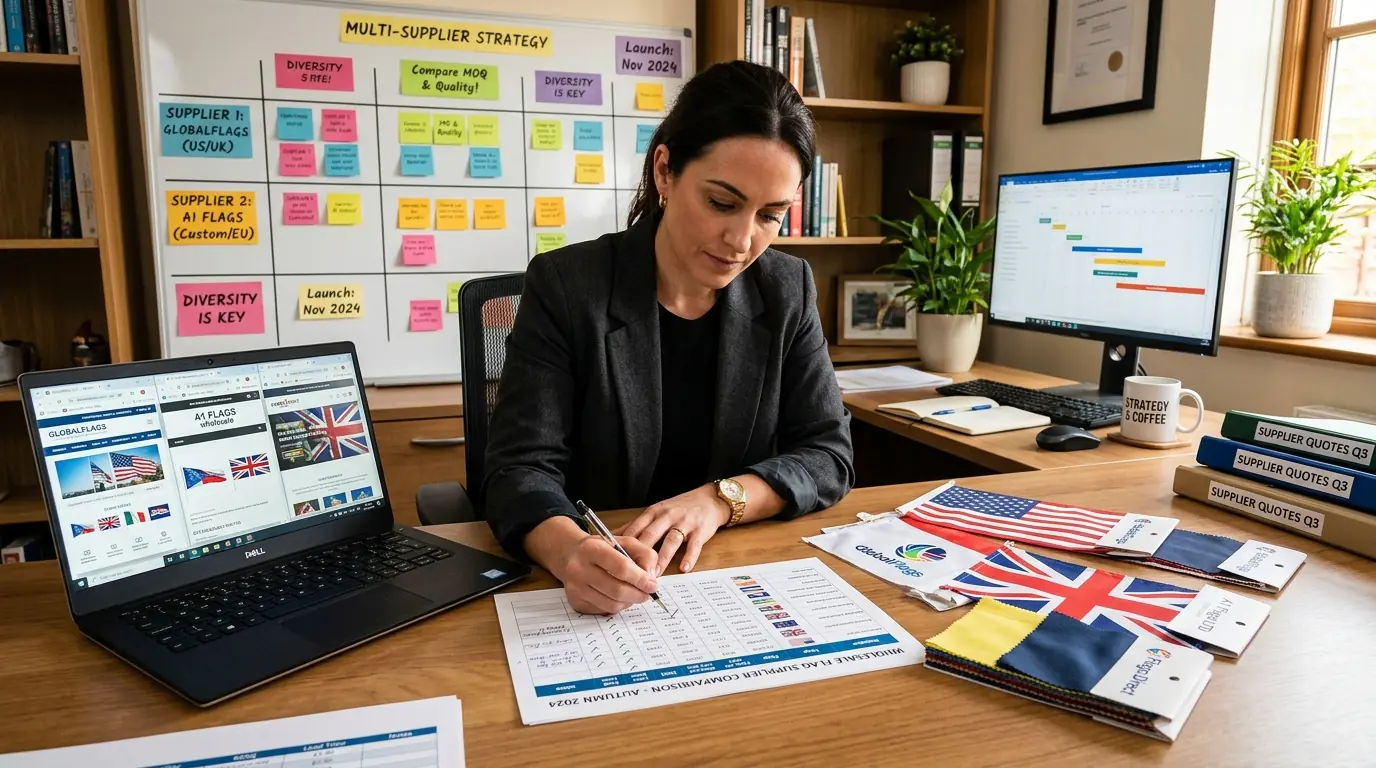
Relying on a single wholesale supplier for all your flag needs is like using one tool for every job — it works until it doesn't. The smarter approach is a tiered sourcing model, and the tiers map to your order types, not your preferences.
For quality-sensitive orders — government flags, diplomatic gifts, permanent installations, or retail where "Made in USA" drives purchasing decisions — domestic manufacturers are worth the premium. Annin, Valley Forge, and similar companies exist precisely for this lane. Trying to substitute with a China-sourced alternative for these orders usually creates compliance headaches or brand perception issues that cost more than the savings.
For volume-driven, price-sensitive orders — event flags, promotional giveaways, custom teardrop flag manufacturer runs for trade shows, seasonal retail inventory — direct-from-China production is where the economics work. The key decision point: at roughly 200 units, China-sourced flags typically beat domestic pricing even after shipping and duties. Below that threshold, the shipping cost per unit erodes the manufacturing savings. This is where working with a factory like RunCustomFlag makes the most difference — you can request a free custom flag quote with your exact specs and quantity to see where the break-even falls for your specific product.
For emergency and small-batch orders — 20 flags needed by Friday, a rush replacement for damaged inventory, a test run before committing to a large order — US-stocked importers with no MOQ are the right call. You'll pay more per unit, but the speed and low commitment offset the premium. Trying to rush a China order for 30 flags is almost always a bad trade: expedited shipping can double or triple the per-unit cost, eliminating any manufacturing savings.
The decision framework is simpler than it looks. Ask two questions: How many units? And how soon? Above 200 units with 3+ weeks of lead time, go factory-direct. Below 50 units or under a week's deadline, go US-stocked. Everything in between depends on whether you value price or speed more for that specific order. You can also pair flag display system manufacturer products and wholesale flagpole supplier with bulk pricing orders with your flag orders from the same factory to consolidate shipping costs — that's a tactic that experienced distributors use to push their effective per-unit cost even lower.
[aiwriter engine="anthropic/claude-sonnet-4.6" id="225" name="自动写内容段落要求"]What Most Wholesale Buyers Get Wrong
The most common mistake isn't picking the wrong supplier. It's comparing quotes that aren't actually comparable.
A $2.00 per-unit quote from a China factory and an $8.00 per-unit quote from a US distributor might look like a $6.00 difference. But if the China quote is for 110 GSM single-sided polyester and the US quote is for 200-denier nylon with reinforced stitching, you're comparing two fundamentally different products. Before you evaluate any wholesale pricing, lock your specifications first: material weight, print method (dye sublimation vs. screen print), single or double-sided, finishing details (grommets, pole pockets, reinforced fly hem), and packaging. Only then are quotes comparable.
The second mistake is over-ordering on the first run to chase a lower per-unit price. If you've never sold a particular flag design before, ordering 1,000 units to get the best price tier is a gamble. The per-unit savings between 200 and 1,000 units might be 15–20%, but sitting on 800 unsold flags wipes out that saving and then some. Better to order 200–300, validate demand, and scale on the reorder. Most factories — including ours — offer better pricing on reorders anyway because the setup work is already done.
Third: ignoring landed cost. Factory price is not your cost. Add shipping (sea freight for large orders, air for rush), customs duties (flags typically fall under HTS code 6307.90, with rates varying by material and origin), inland freight to your warehouse, and any inspection or broker fees. A responsible factory will help you estimate landed cost before you commit, but ultimately it's your job to calculate it. If a supplier quotes you a price and acts confused when you ask about shipping terms, that's a red flag worth paying attention to.
[aiwriter engine="anthropic/claude-sonnet-4.6" id="225" name="自动写内容段落要求"]Conclusion: Your Next Move in Flags Wholesale
The flags wholesale market rewards buyers who match their sourcing channel to their order profile — not buyers who chase the lowest quote regardless of context. If you're supplying government or institutional clients, the domestic premium manufacturers are non-negotiable. If you're running promotional campaigns, stocking retail inventory, or supplying event companies with branded flags at volume, factory-direct sourcing from China is where the margin lives.
If you're placing your first wholesale flag order, start with a mid-size run — 100 to 300 units — from a single supplier. Get the specs locked before you compare quotes. Calculate landed cost, not just unit price. And don't overcommit inventory on an unproven design.
If you already know your quantities and specs, the fastest way to benchmark your current pricing is to request a free custom flag quote from our team at RunCustomFlag. We'll give you a landed-cost estimate based on your exact requirements — material, size, print method, quantity, and delivery location — so you can compare against your existing suppliers with real numbers, not guesswork. That comparison alone usually tells buyers whether their current sourcing strategy is costing them more than it should.